
(Art direction and design;
illustration created with
AI: Jean-Dominique Lavoix-Carli)
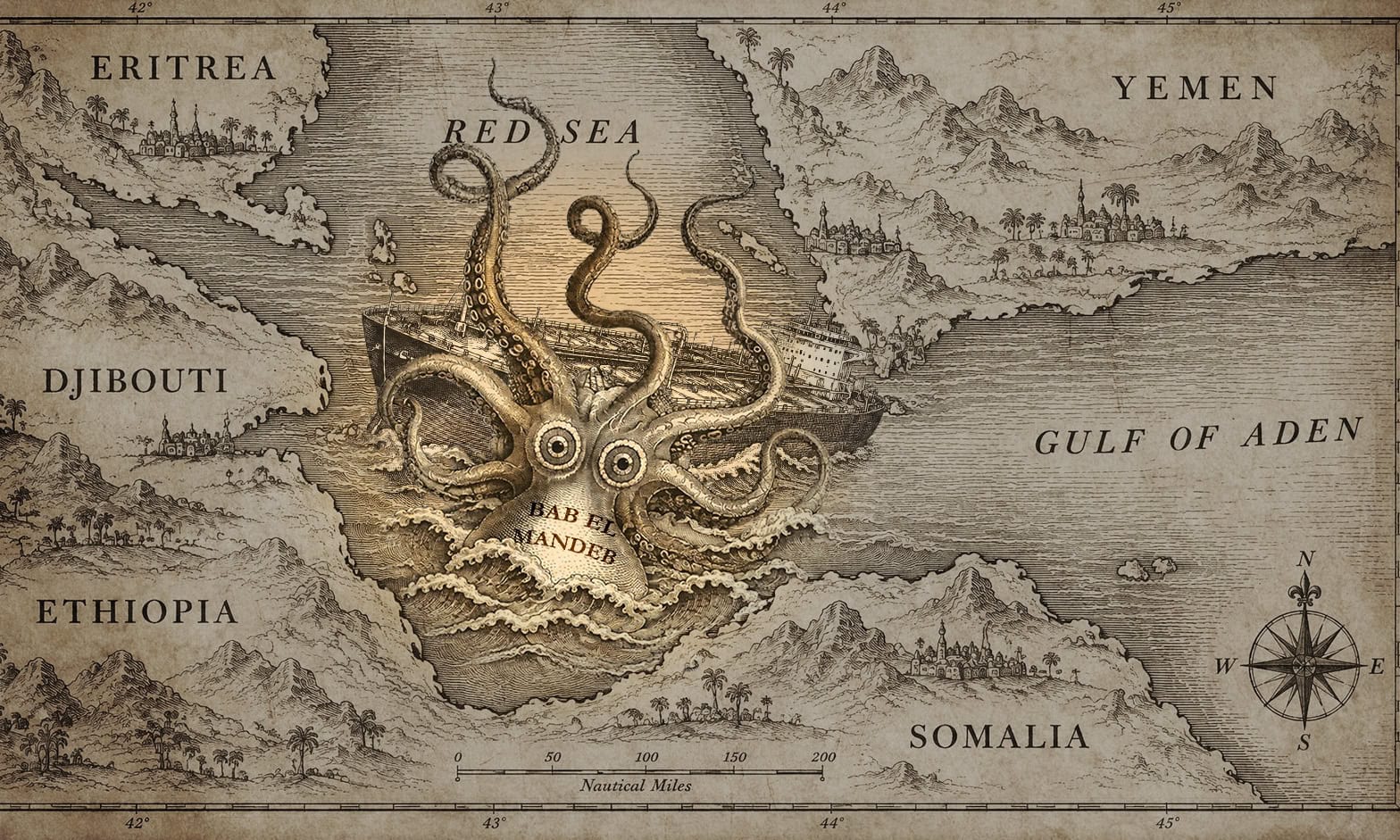
Fighting rages in Yemen, as the strategic battle for control over Bab el-Mandeb, the West Coast, and its mountainous defense line intensifies. Whatever the immediate tactical outcome of these ongoing hostilities, a profound shift occurred in September 2026. On 10 September, the Houthis seized the port city of Mocha, strategically located on the Red Sea. Then, the next day, they captured the Greater and Lesser Hanish islands, Dhubab, and Perim (or Mayyun) Island, sitting directly in the middle of the Bab el-Mandeb Strait. As a result, they gained physical territorial control over the strait, combining thus long-range threat projection with now direct presence astride the Strait, one of global trade’s primary chokepoints, the lock to the Red Sea and the Suez Canal.
This dramatic escalation contrasts sharply with the earlier phase. During the first months of the US-Israel-Iran war, the Ansar Allah (“Partisans of God”), also known as the Houthis – the principal armed group fighting Yemen’s internationally recognised government since 2014 – had remained rather remote from the conflict.
Houthi restraint ended on 13 July 2026, when their Sanaa airport was bombed to prevent an Iranian aircraft carrying Islamic Revolutionary Guard Corps (IRGC) advisors from landing.1For this paragraph, among other sources, Yousef Mawry, “Leading Houthi threatens ‘siege’ on Saudi Arabia after Yemen airport attack“, Al Jazeera, 14 July 26. While Yemen’s internationally recognised government claimed responsibility for the attack, the Houthis blamed Saudi Arabia, retaliating the same day with drone and missile strikes on Saudi Abha airport.
Since then, hostilities have escalated, raising fears of a broader Middle East conflagration.
Maritime traffic and thus supply chains are already greatly upset by the chaotic situation in the Strait of Hormuz. Transit through Bab-el Mandeb was already disrupted, but had been slowly moving towards normalisation. Against this backdrop, what are the potential impacts of the latest Houthi actions: are we about to witness another severe degradation of maritime navigation and seaborne trade, along with its inevitable cascading negative effects?
In the first part of this article we briefly present maritime trade and outline the key role of the Strait of Bab el-Mandeb within it. Then we turn to the Houthi maritime attacks since 7 October 2023, identifying five phases – the last one having started on 5 October 2026 – and look at the consequences for maritime transport. This allows us to outline a pattern. Finally, we look at the impacts of the changes in maritime transport ushered by the Houthi attacks. We focus on one such effect, the distance sailed, and its multiple consequences.
The key role of the Bab el-Mandeb Strait in world trade
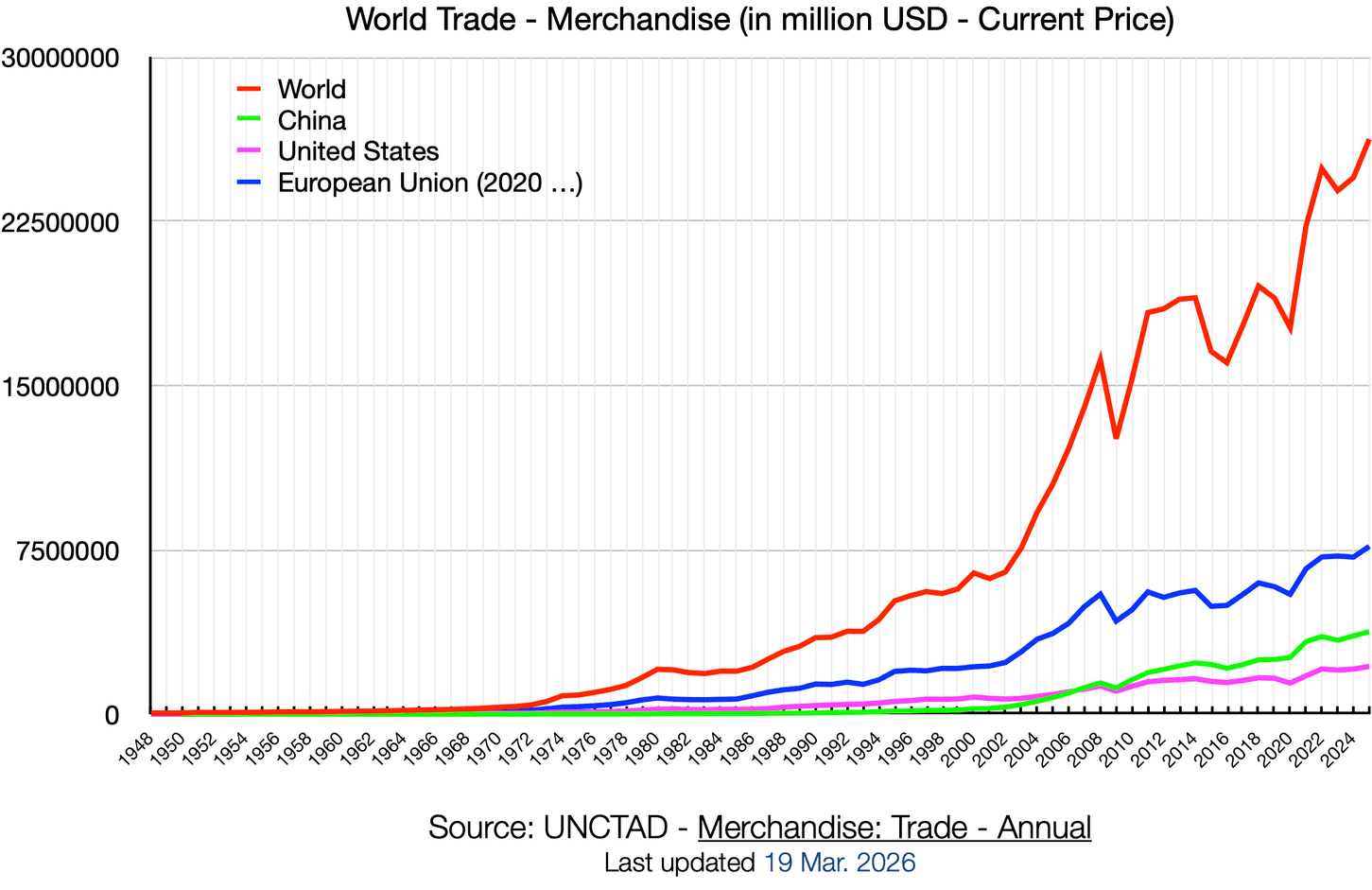
Since World War II, global merchandise trade has skyrocketed to reach USD 26.26 trillion in 2025, measured through exports, at current prices.2UNCTAD datahub – Merchandise: Trade – Annual - Last updated 19 Mar. 2026. In value, China represented 17.5% of global exports, the EU (extra-European trade) 13.8% of global merchandise exports and 12.9% of imports, and the U.S. 8.32% of exports and 15.9% of imports.3UNCTAD, Ibid.; WTO, Spotlight: Global trade developments and outlook – Annual Report 2026.
Maritime transport is vital for merchandise trade.4We often find the following estimates: Maritime transport represents over 80% of total global merchandise trade volume, e.g. UNCTAD, Launch of the Review of Maritime Transport 2025, and around 70% of total global merchandise trade in value. This seems to originate in the following statement: “With over 80 per cent of global trade by volume and more than 70 per cent of its value being carried on board ships and handled by seaports worldwide, the importance of maritime transport for trade and development cannot be overemphasized.”UNCTAD, Review of Maritime Transport 2017, p.x, 16. However, how these figures are reached is not detailed: trade flows are given in USD and maritime flows in tonnes, ton-miles and TEU. Indeed a maritime expert, Pablo Rodas-Martini asked the same question and pondered on the absence of real answer, “One question, many answers: How much of the world’s trade is carried by sea?“, 2019.
As a result, the reality is that we know neither the share of maritime transport in global merchandise trade in volume nor in value. And, relatedly, we cannot trace its evolution nor performance. In 2024, maritime transport volumes reached 12720 million tons.5UNCTAD, Review of Maritime Transport 2025, 24 Sep 2025, using private firm database research Clarksons Research 2025. For 2026–2030, UNCTAD expects total seaborne trade to increase at an annual average of 2 per cent.6Ibid., p.8. The UN body singles out geopolitical risks, including in the Red Sea, as heightening uncertainty and risks for the future of trade in general and maritime transport in particular. Those should not, however, stop growth, but could dampen it.7Ibid., p. 7-8.
Maritime trade can be schematically summarized in the diagram below:
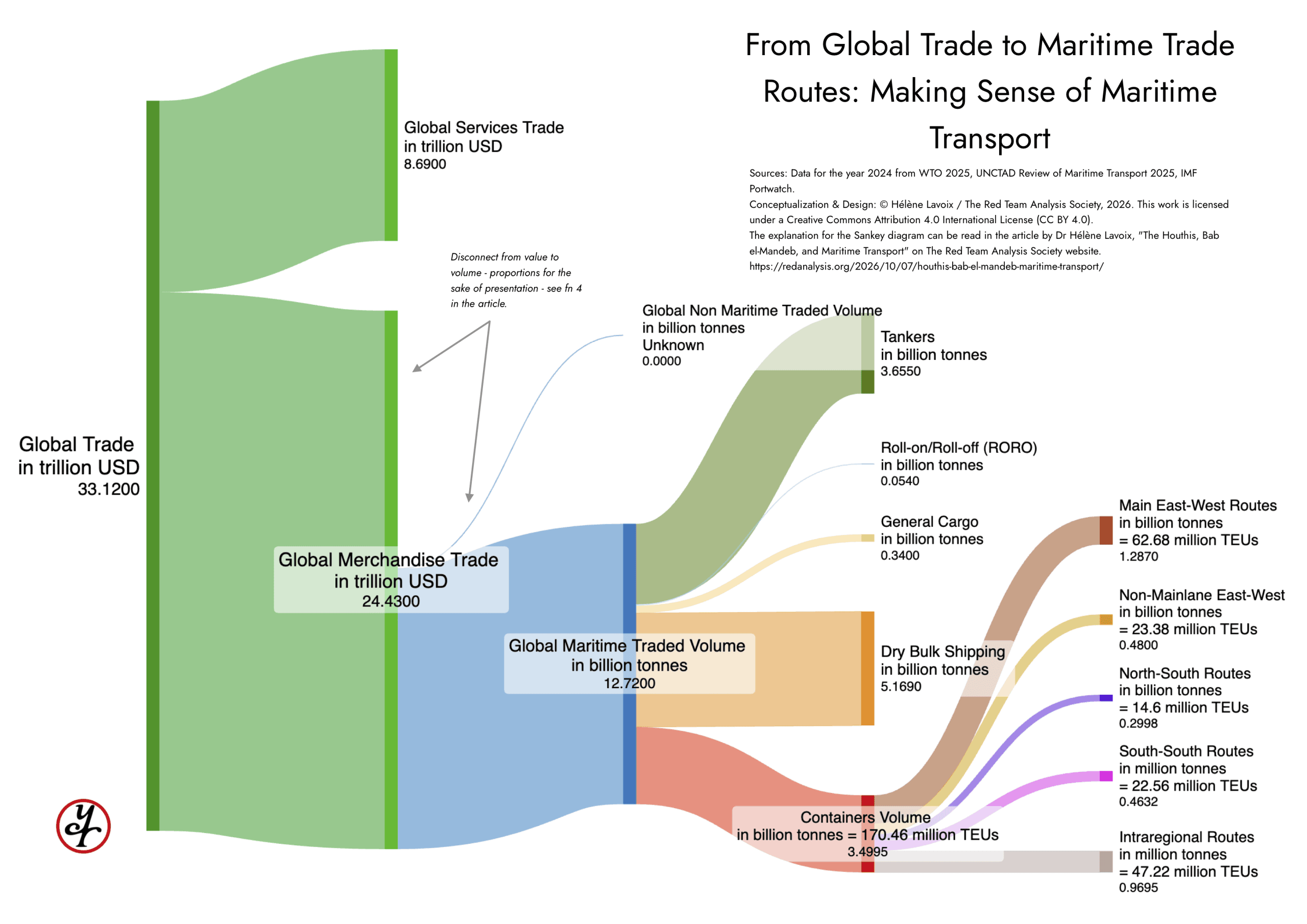
First, seaborne trade is usually measured in volume, most often metric tonnes and TEUs (Twenty-foot Equivalent Units), as well as ton-miles and TEU-miles, which also consider the distance the volume of cargo travels.8TEU = Twenty-foot Equivalent Unit: Standard unit for counting containers of various capacities and for describing the capacities of container ships or terminals. One 20 Foot ISO container (see heading 17 below) equals 1 TEU.” United Nations, Glossary for Transport Statistics 3rd Edition (EN), p. 68.
Ton-miles or TEU-miles: One ton of cargo or one TEU shipped over a distance of one mile. For example, If a ship carries 10,000 tons of cargo across 2,000 miles, it generates 20,000,000 ton-miles of shipping demand.
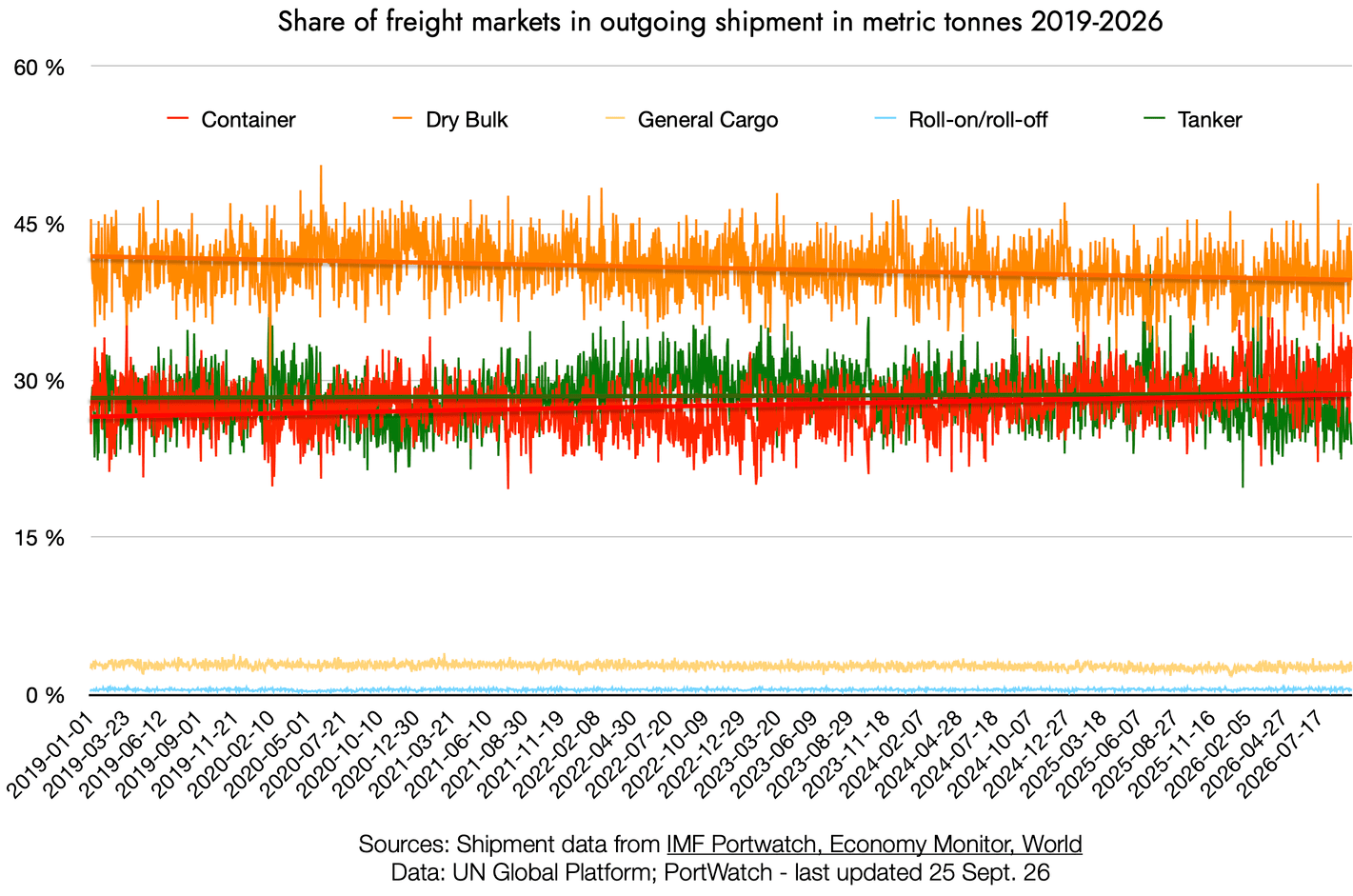
Then, seaborne trade is categorised according to segments of the maritime freight market and thus types of vessels.9The shares of each market below are calculated according to shipment data fro 2026 from IMF Portwatch, Economy Monitor, World – Data: UN Global Platform; PortWatch – last updated 25 Sept. 26.
Dry bulk shipping is the largest segment in volume. It is used for massive loose substances, for example, for ores, coal, grains, and fertilizers. In 2026, in volume, it represented on average 39.38% of all outgoing shipments.
Next come containers, used to transport goods packed in standardised containers, either 20-foot or 40-foot. In 2026, this market represented 30.10% of outgoing shipments.
Tankers follow. They are used for liquids or gas, such as oil and liquefied natural gas (LNG), but also water. In 2026, they represented 27.49% of outgoing shipments.
Finally we have two smaller market segments: general cargo – for packaged goods and substances not fit for containers – and Roll-on/Roll-off (RORO) – where cargo is driven on and off a ship using ramps, instead of being lifted by cranes, which includes car-carrying ships. They represent, respectively, 2.56% and 0.47% of outgoing shipments.
In this article, we shall not dwell on tankers and energy transportation, which deserve specific analysis considering notably the chaotic situation around Hormuz.
Finally, trade for each type of market segment must consider the shipping route taken, i.e. the specific maritime path or network of lanes used by commercial vessels to transport cargo between ports. They are categorised according to the transiting volume. The three main routes are the East-West routes, subdivided as:
- Asia-Europe – Connecting Asia to Europe;
- Transpacific – Connecting Asia to North America, which includes three routes: Asia to US West Coast, Asia to US East Coast via the Panama Canal and Asia to US East Coast via the Suez Canal;
- Transatlantic – Connecting North America to Europe.
We then have the non-mainlane routes, as detailed on the diagram, and the inter-regional routes, which are increasingly important in terms of transiting volumes, considering notably inter-regional traffic within eastern Asia.
It is along these shipping routes that chokepoints come into play. Chokepoints are critical, narrow maritime passageways, often straits, that dictate ship sizes and whose operational status – whether open or closed – directly determines the commercial viability of global trade routes. Portwatch references 28 chokepoints throughout the world.10IMF Portwatch, Port Monitor: Chokepoints.
Whether a chokepoint is open or closed ripples upward and downward throughout the entire maritime sector then through trade to impact the entire economic and political system upon which our current world civilisation is built. Impacts cascade in all directions, having far-reaching indirect effects, including because those interact with other conditions and events, as we shall see in the third part.
Here we focus on one strategic chokepoint, the Bab el-Mandeb Strait, key to the Red Sea and the Suez Canal, hence the impacts on the Asia-Europe route and the Asia-North America route via the Suez Canal.
When there is no disruption, around 15% of all maritime trade volume passes through the Strait of Bab el-Mandeb,11Parisa Kamali, et al. for the IMF and Serkan Arslanalp et al. for Portwatch, “Red Sea Attacks Disrupt Global Trade“, IMF, 7 March 2024. which gives an indication of the magnitude of the effect if Bab el-Mandeb is under threat, as has been the case since 7 October 2023, as we shall now see.
The Houthi attacks and maritime traffic via Bab el-Mandeb
The Houthis enter the Israel-Hamas conflict: Near closure of Bab el-Mandeb
Following the 7 October 2023 Hamas terrorist attack on Israel and retaliatory Israeli war on and “complete siege” of Gaza, on 19 October, the Houthis started striking Israel.12Israeli-Palestinian Conflict“, Global Conflict Tracker, Council on Foreign Relations, Updated August 3, 2026; Michael Knights, “Assessing the Houthi War Effort Since October 2023“, CTC Sentinel, April 2024, Volume 17, Issue 4. This initial assault escalated into eight subsequent waves through December 2023, collectively involving “46 known MRBMs, cruise missiles or drones”.13Knights, “Assessing the Houthi War Effort…”, ibid. None of those projectiles reached Israel, thanks to U.S., European, Arab, and Israeli air defences, but those attacks and their range nonetheless demonstrated Houthi firepower, hitherto unacknowledged.14Knights, “Assessing the Houthi War Effort…”, Ibid. This heightened awareness impacts the perception of threats stemming from potential Houthi attacks, notably where maritime transport is concerned.
In November 2023, the Houthis started their anti-shipping campaign on the Red Sea, targeting initially Israeli-linked ships with naval commandos and helicopter operations.15For the entire paragraph, Knights, “Assessing the Houthi War Effort…”, Ibid. On 19 November they seized the Israeli car-carrier Galaxy Leader. Despite many attempts, they did not succeed again in capturing other vessels. In December, the Houthis switched tactics towards sinking vessels, while now targeting all ships visiting Israeli ports. The complexity of precise targeting led to many vessels suffering from Houthi attacks, even if they were not part of the initial targeted scope. For example, Chinese and Iranian ships, or even vessels carrying food deliveries for Houthi ports were also struck.
As a result, on 18 December, the U.S. and nine coalition partners launched the naval “Operation Prosperity Guardian” demanding that the Houthis stop all attacks on shipping.16U.S. Department of War, Immediate Release, Statement from Secretary of Defense Lloyd J. Austin III on Ensuring Freedom of Navigation in the Red Sea, 18 December 2023
Nonetheless, by 19 December, major shipping companies – Hapag Lloyd, MSC and Maersk, oil major BP and oil tanker group Frontline stated they had decided to avoid the Bab el-Mandeb Strait and to re-route via the Cape of Good Hope.17Ahmad Ghaddar, “Houthi attacks in the Bab al-Mandab Strait hit global trade“, Reuters, 19 December 2023. On 5 February 2024, CMA CGM, the last major container company to do so, finally abandoned the Red Sea route via Bab el-Mandeb.18SeaNews Editor, “CMA CGM confirms halt to Red Sea routing“, Kuehne-Nagel, 5 February 2024.
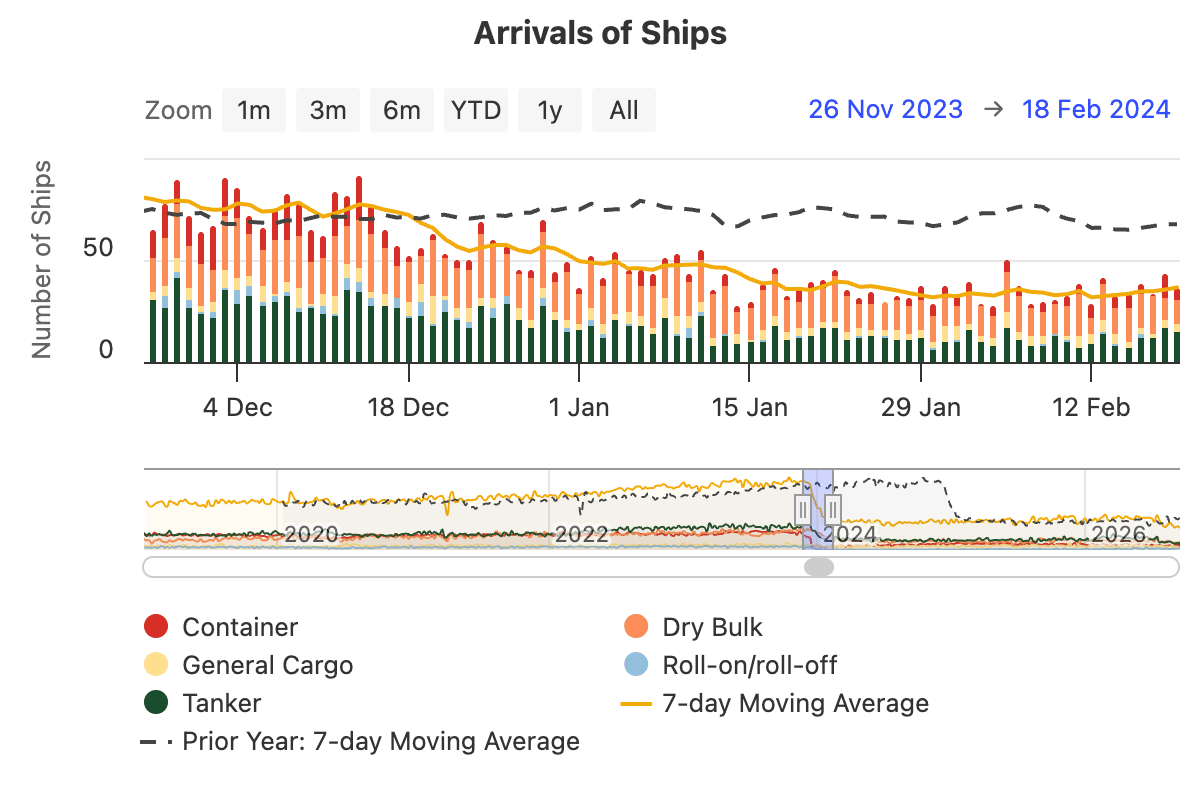
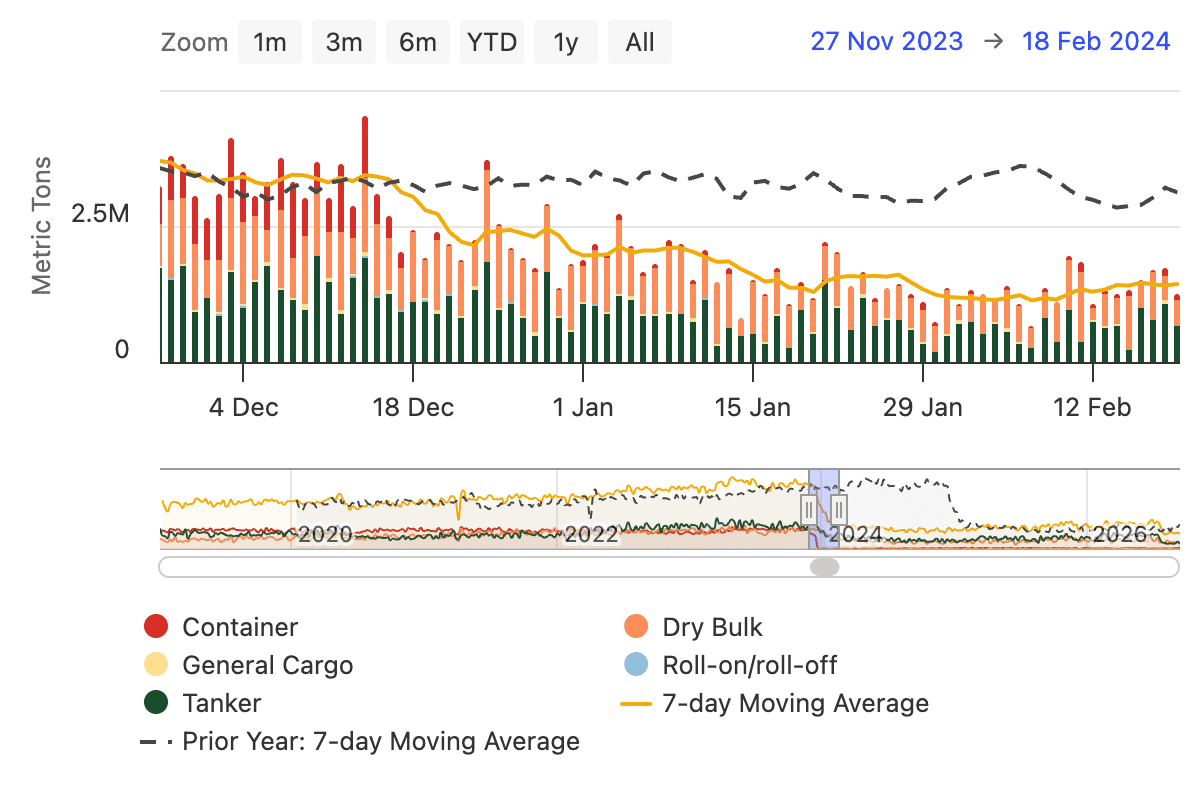
Thus, one month of sustained attacks led major carriers to change route, the re-routing being completed in one and a half months. The ships would now sail via the Cape of Good Hope. The fall in transit calls and trade volume through Bab el-Mandeb can best be appraised in the two charts below. It was most particularly marked for containers, which almost disappeared, tankers and RORO.
Hostilities persist – Bab el-Mandeb remains quasi-closed
As hostilities continued throughout 2024 and the first part of 2025, including a new U.S. operation against Houthi forces in Yemen, started mid-March 2025,19Christopher M. Blanchard, “Yemen: Conflict, Red Sea Security, and U.S. Policy“, IF12581, Congressional Research Service (CRS), Updated July 21, 2026., passage through the Strait of Bab el-Mandeb remained at a fraction of what it had been, as shown in the chart below.
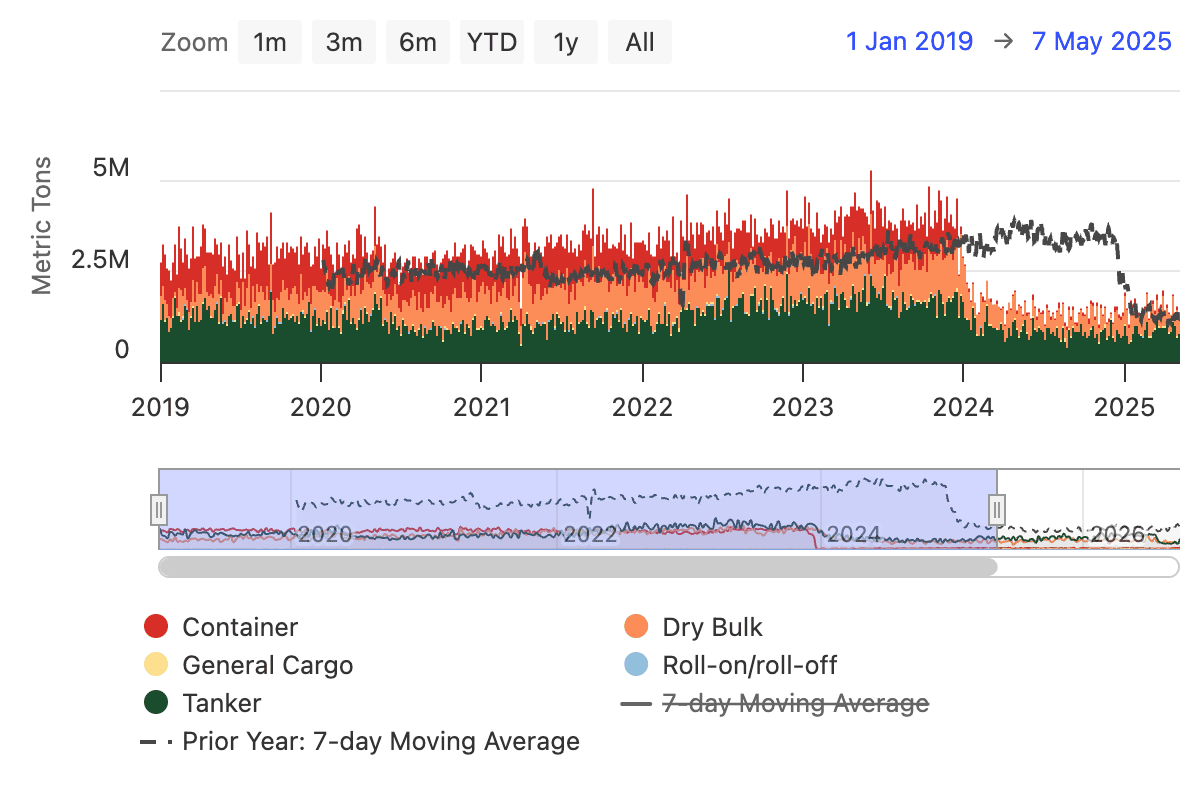
Sources: UN Global Platform; PortWatch – Chart exported from IMF Portwatch
Stabilisation in the Red Sea
Then, on 6 May 2025, the Oman Foreign Ministry announced in an official statement that Oman mediated discussions had resulted in a ceasefire agreement between the Houthis and the U.S., according to which:
“In the future, neither side will target the other, including American vessels, in the Red Sea and Bab al-Mandab Strait, ensuring freedom of navigation and the smooth flow of international commercial shipping.“
Oman announces ceasefire agreement between Washington and Sanaa, Foreign Ministry of the Sultanate of Oman, 6 May 2025.
The impact of the ceasefire on transit through Bab el-Mandeb could not be immediately seen, considering navigation and maritime routing complexities as well as actors’ caution.
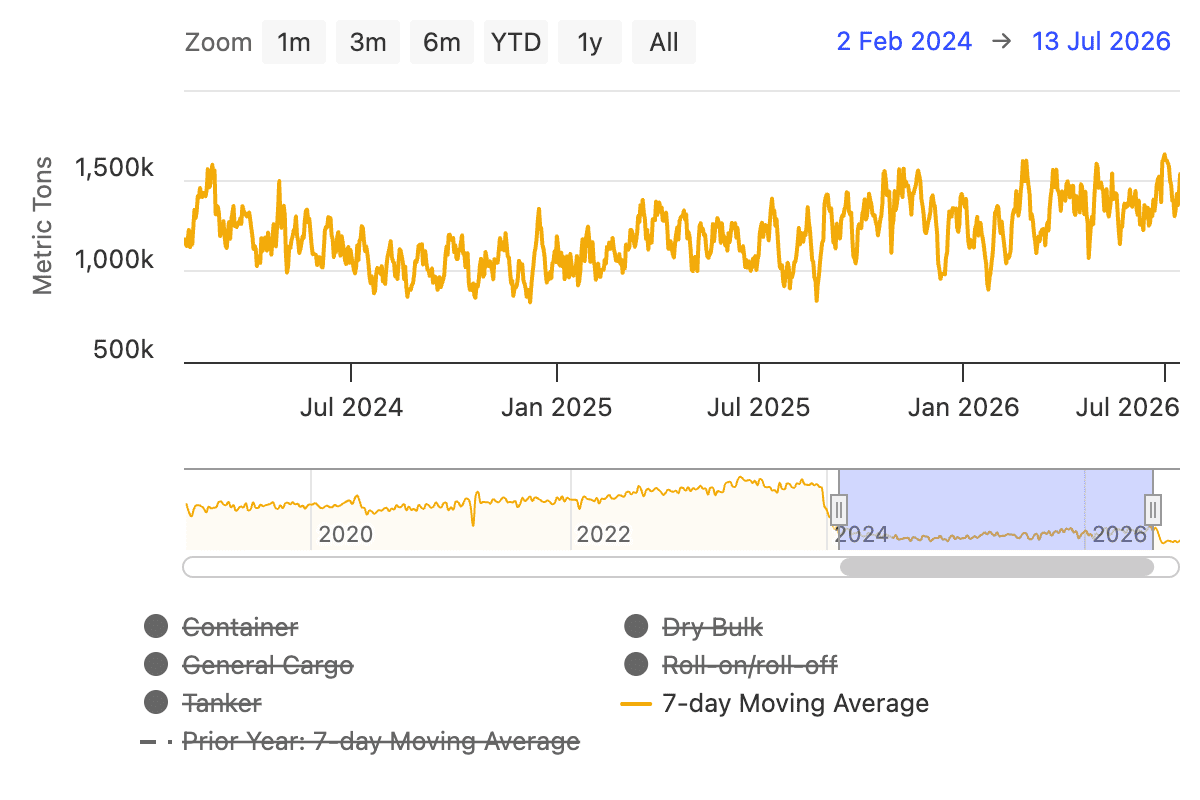
It is only in July 2025 that a slight improvement started showing. Since then, and lasting through the first half of 2026, despite the U.S.-Israel-Iran war, passage through the Strait of Bab el-Mandeb began to timidly recover: the seven-day average for transit calls slowly moved towards the high thirties, whereas it was in the low thirties during 2024 – and in the high seventies before 7 October 2023.
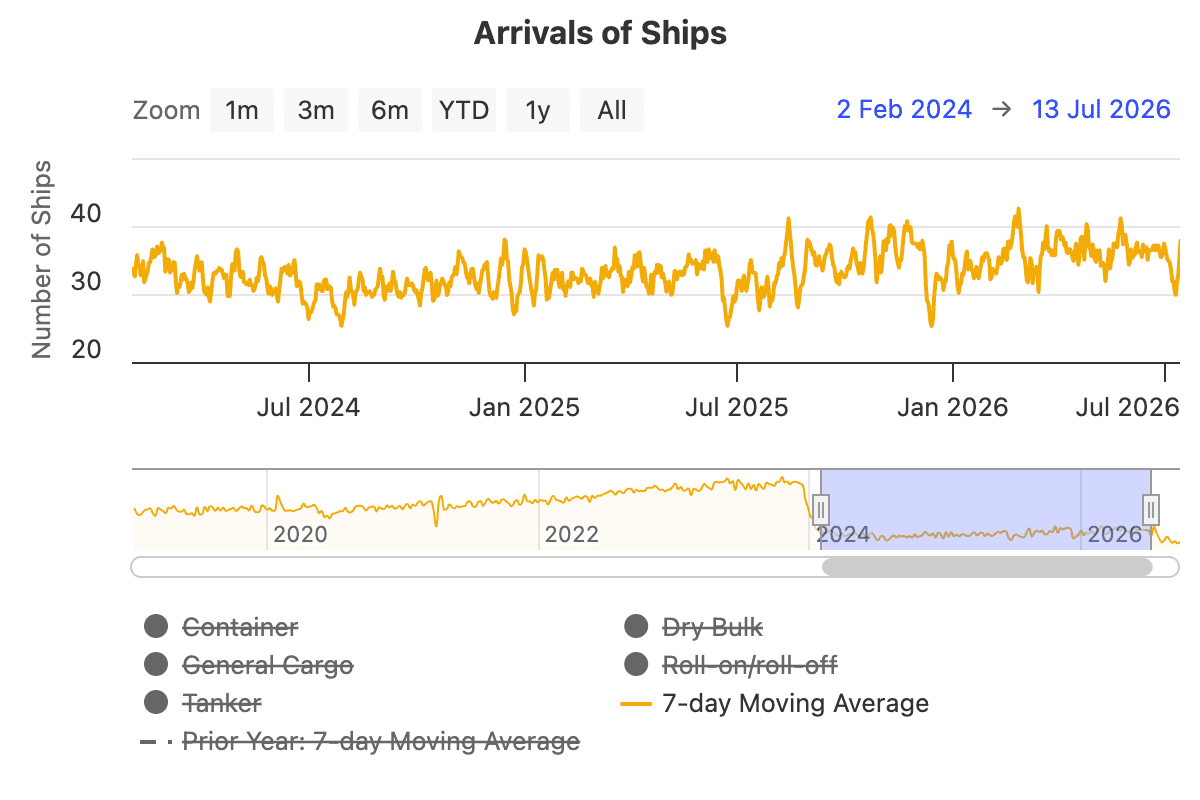
As a result of the second half of 2025 improvement, starting in January 2026, major container carriers began considering sailing again through Bab el-Mandeb. For example, on 15 January 2026, Danish Maersk announced it would gradually resume trans-Suez shipping, thus through Bab el-Mandeb.20Press release, “Maersk’s MECL service returns to trans-Suez route“, 15 January 2026. As a first step in this direction, Maersk re-routed via Suez its MECL service, connecting the Middle East and India with the U.S. East Coast.21Ibid. Similarly French CMA-CGM started re-routing its India-US INDAMEX service via Bab el-Mandeb and Suez in January.22Reuters, "What are Shipping Companies’ Plans for Return to Suez Canal?“, Asharq Al Awsat, 19 December 25.
The Houthis’ Summer 2026 offensive
However, on 13 July 2026, the bombing of Houthi-controlled Sanaa airport reignited the Houthi forces’ offensive.23Yousef Mawry, “Leading Houthi threatens ‘siege’ on Saudi Arabia…,” Ibid. After having retaliated against Saudi Arabia, perceived as the real attacker, by striking, the same day, Saudi Abha airport, on 20 July, the Houthis declared a general mobilisation and call to arms as well as “a maritime embargo against the criminal Saudi enemy”.24https://t.me/army21ye/3581 On 22 July, they claimed to have fired missiles and drones at the Saudi-flagged ships Encelia et Layla.25https://t.me/army21ye/3586 Saudi Arabia confirmed the attack on the Encelia, resulting in a fire at the bow of the vessel.26https://www.spa.gov.sa/en/N2639825
Throughout July and August 2026, the Africa Center for Strategic Studies, part of the U.S. Department of War, counted 12 Houthi attacks in the southern Red Sea on commercial vessels.27Africa Center for Strategic Studies, “Houthi Leverage over the Red Sea Escalates Threats for Africa“, 22 September 2026. Those were mainly Saudi ships, but the Egyptian cargo ship Tihamah was also hit and six crew members were killed.28Africa Center for Strategic Studies, “Houthi Leverage over the Red Sea Escalates Threats for Africa“, 22 September 26; Adam Hancock, AFP, Reuters and The Associated Press, “Six killed in Houthi attack on Bab al-Mandeb ship, Yemen’s government says“, Al Jazeera, 12 August 2026. The Yemeni coastguard rescuing the ship also came under fire.29Ibid.
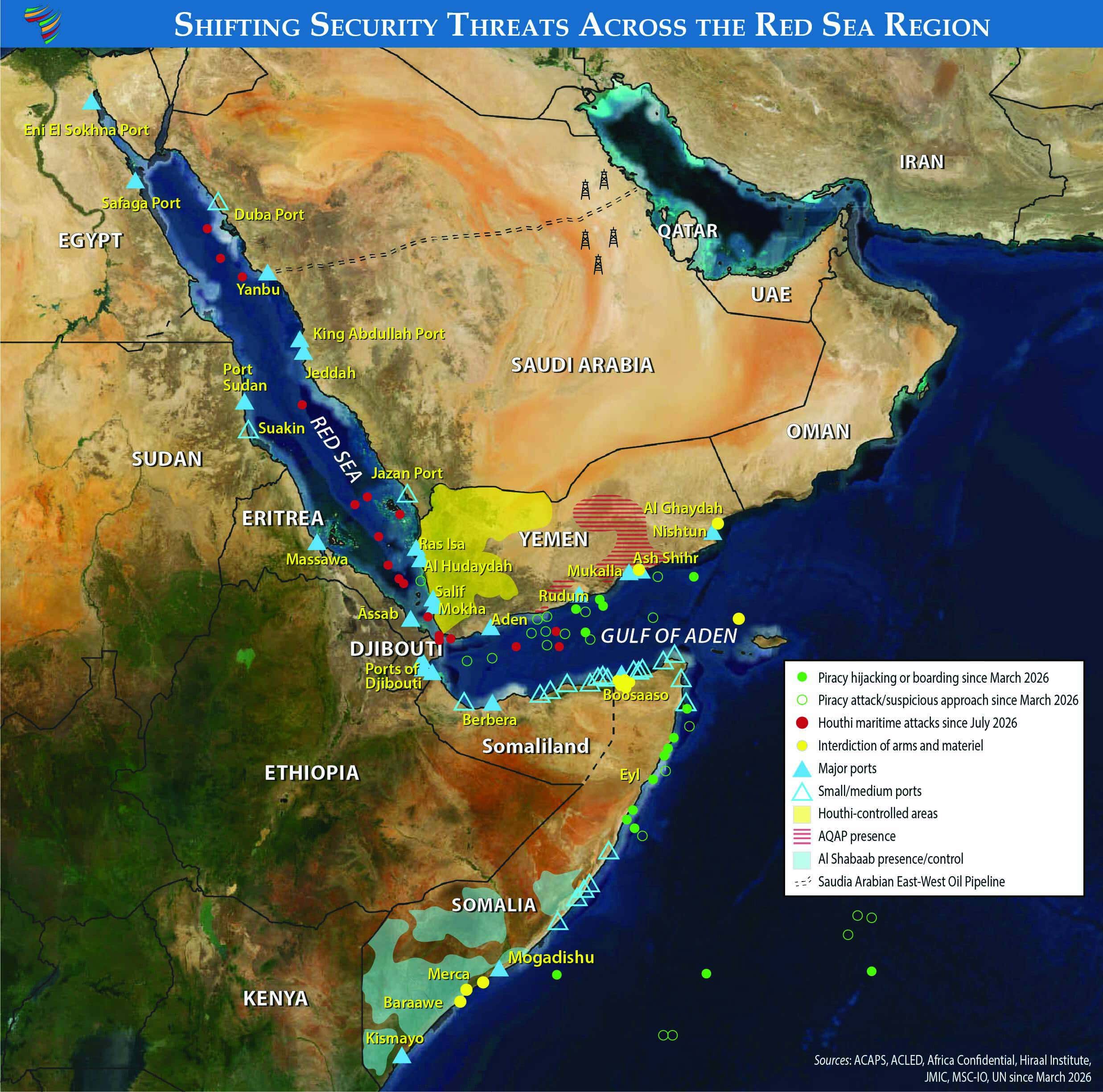
Meanwhile, piracy increased in the area, with at least 23 attacks in the nearby Gulf of Aden from April to September 2026.30Africa Center for Strategic Studies, “Houthi Leverage over the Red Sea Escalates…”, Ibid. Indeed, first, the repositioning of multilateral naval forces considering the Hormuz Strait challenges, led to increased piracy in the Gulf of Aden. Then, the UN has documented links between the Houthis and Al-Shabaab in Somalia, which leads us to consider that the new Houthi offensive could also have fostered Al-Shabaab piracy.31United Nations Security Council, S/2025/71/Rev.1, “Thirty-fifth report of the Analytical Support and Sanctions Monitoring Team submitted pursuant to resolution 2734 (2024) concerning ISIL (Da’esh), Al-Qaida and associated individuals and entities”, 6 February 2025; Jay Bahadur, “Somali piracy surges due to Chinese ransom payments and Strait of Hormuz crisis“, Global Initiative against Transnational Crime, 30 June 2026; Africa Center for Strategic Studies, “Houthi Leverage over the Red Sea Escalates…”, Ibid.
Al-Shabaab, an Al Qaeda affiliate, is the major threat to the Somali government.32Africa Center for Strategic Studies, “Expanding Al Shabaab–Houthi Ties Escalate Security Threats to Red Sea Region“, 28 May 2025. The Houthis would exchange material and training with Al-Shabaab in return for arms smuggling and piracy.33United Nations Security Council, S/2025/71/Rev.1Ibid.
Then, on 10 September, the Houthis seized the port city of Mocha, strategically located on the Red Sea. The next day, they captured the Greater and Lesser Hanish islands, Dhubab, another port city on the West coast, and Perim (or Mayyun) Island, sitting directly in the middle of the Bab el-Mandeb Strait.34Institute for the Sudy of War, Iran Updates: September 10, 2026; September 11, 2026; Mohammed Al-Qadhi, Prof. Dr. Elham Manea, Dr. Abdulaziz Alghashian, and Maged Al-Madhaji, “The Houthis Seize Yemen’s West Coast: Reactions from Experts“, Sana’a Center, 15 September 26.
As a result, the Bab el-Mandeb Strait was de facto under control of the Houthis.
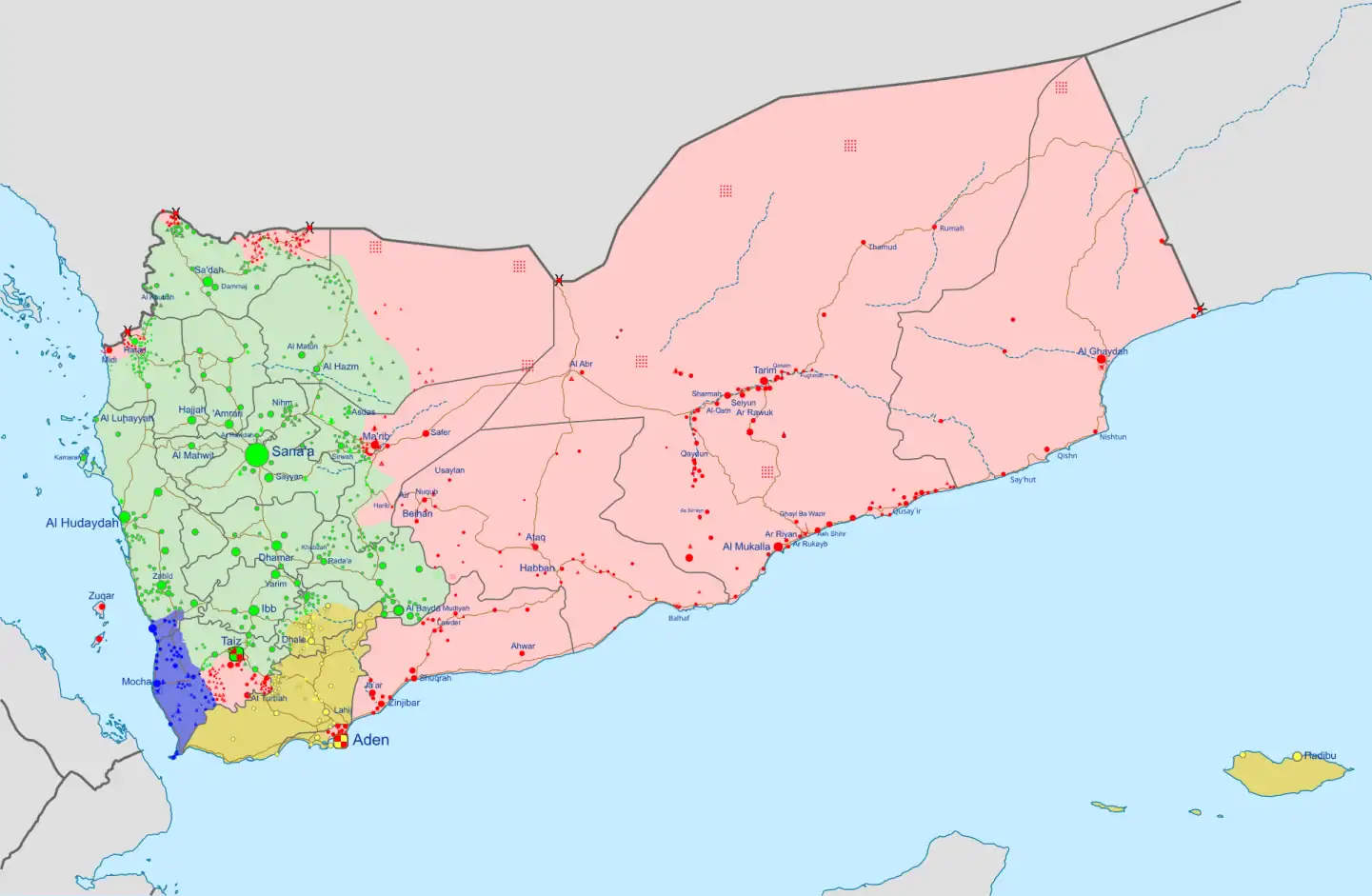
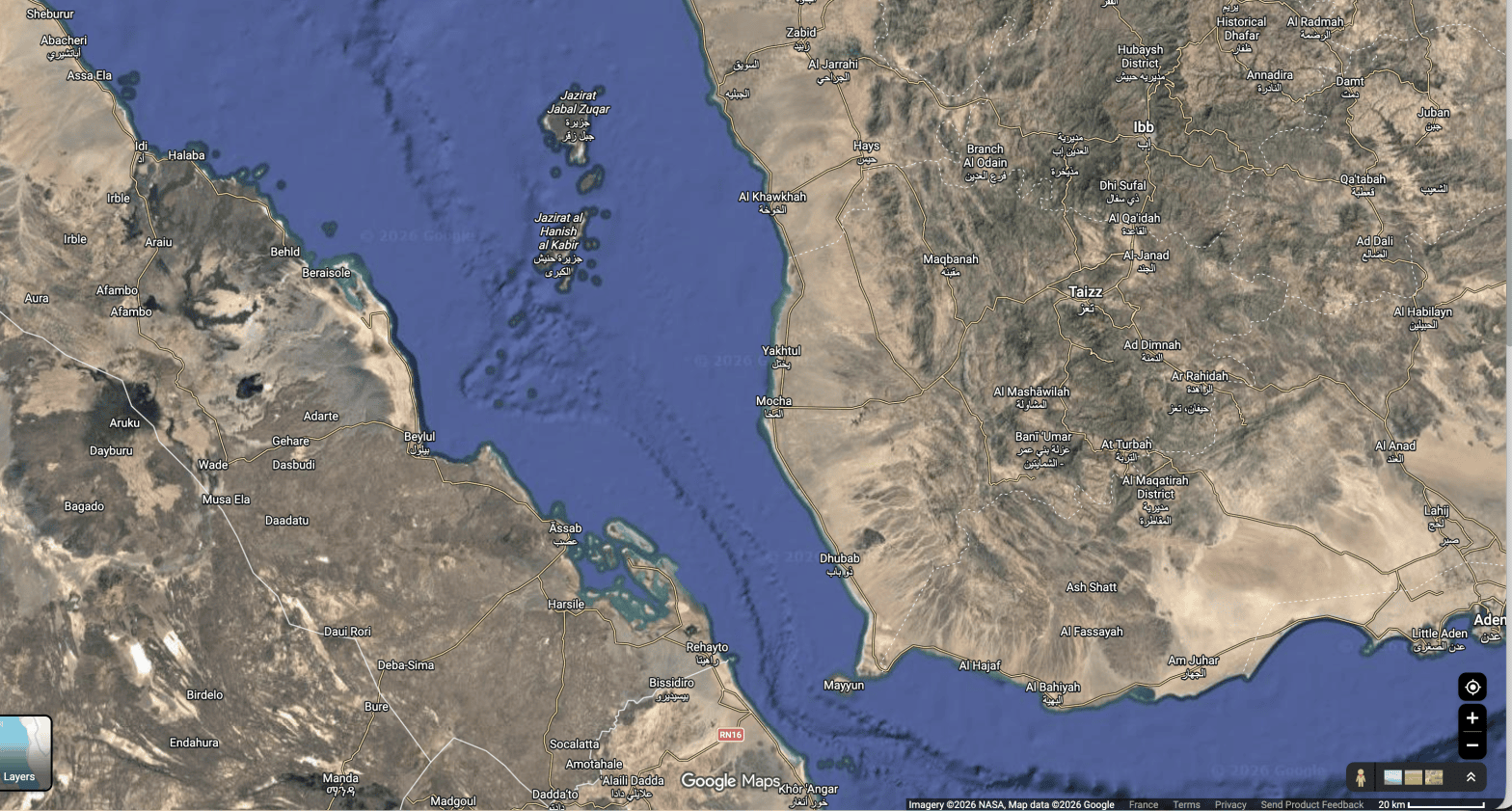
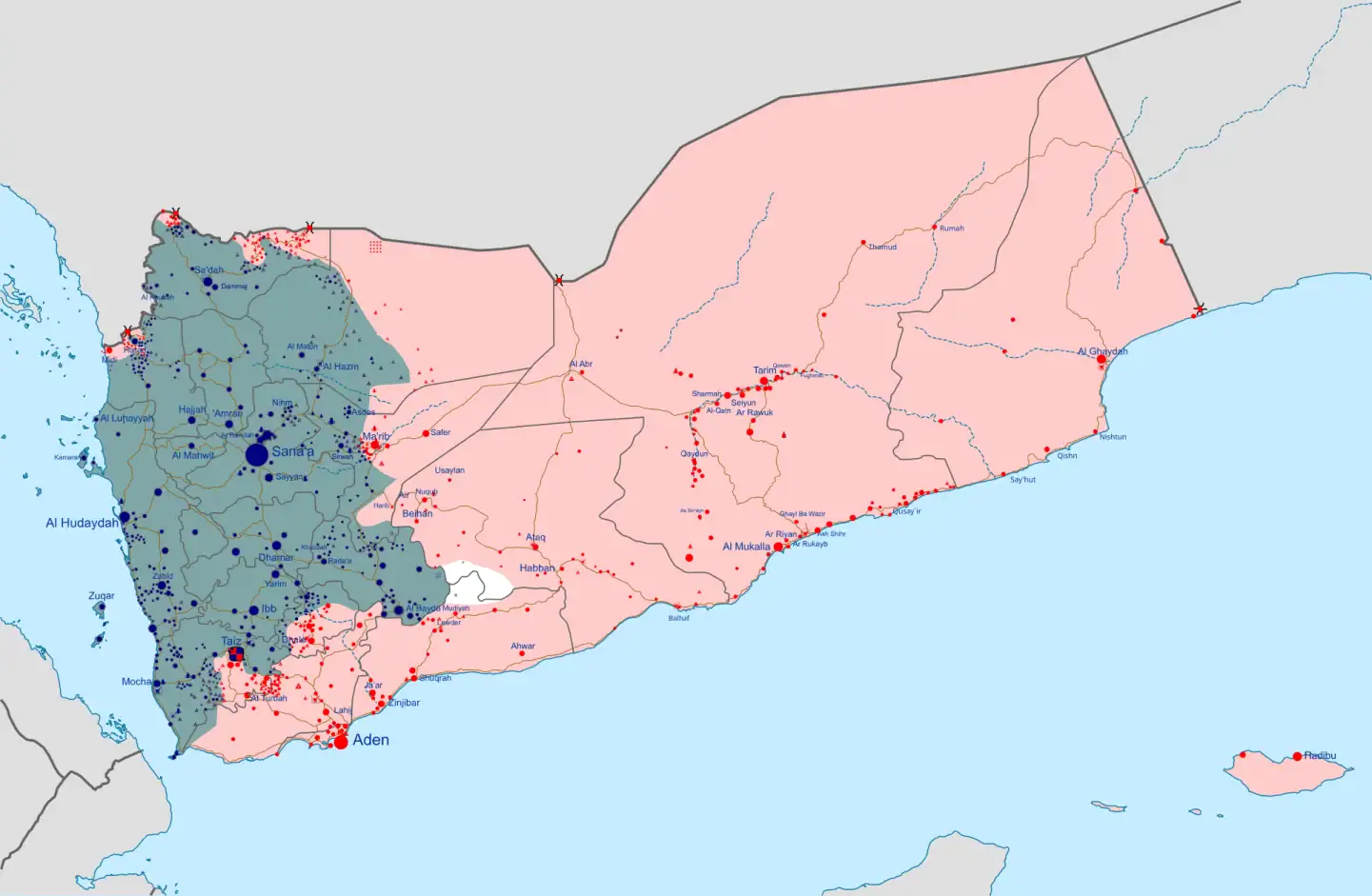
Pink: Controlled by Presidential Leadership Council-led government – Blue: Controlled by the Houthis
As a result, traffic further dipped in the Bab el-Mandeb Strait, as shown in the charts below.
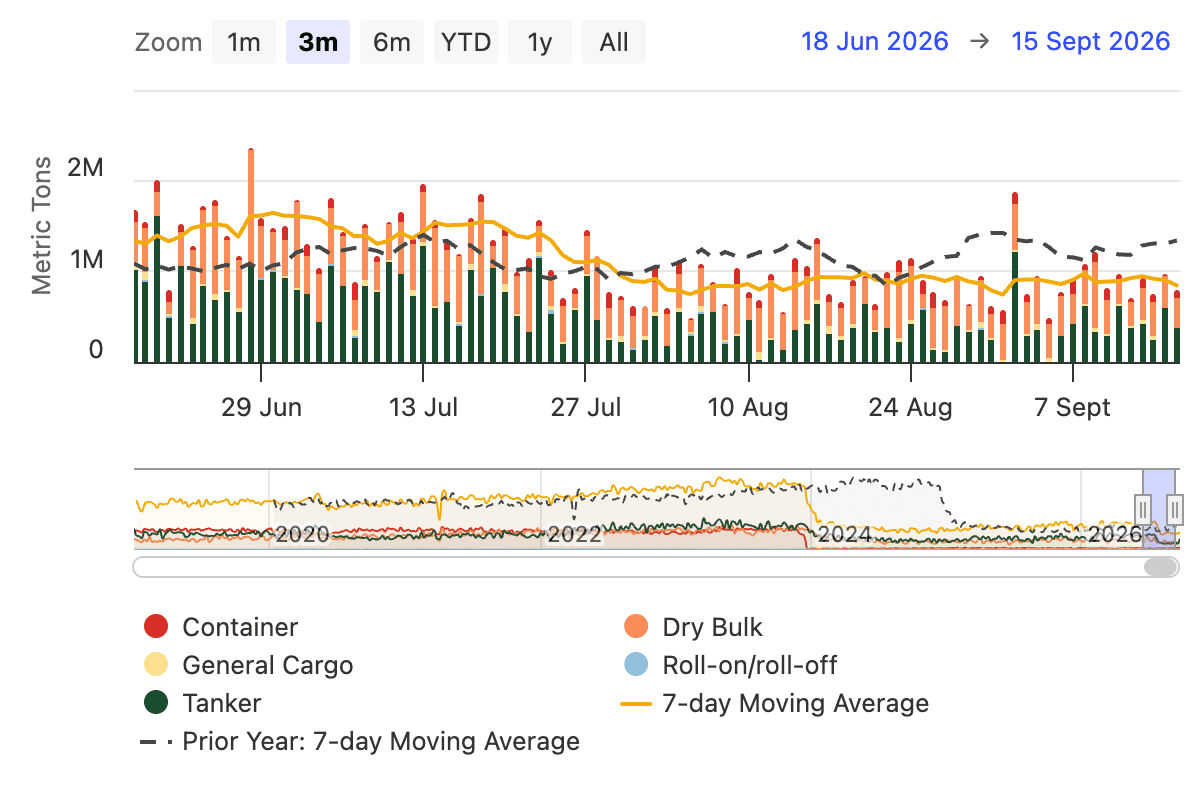
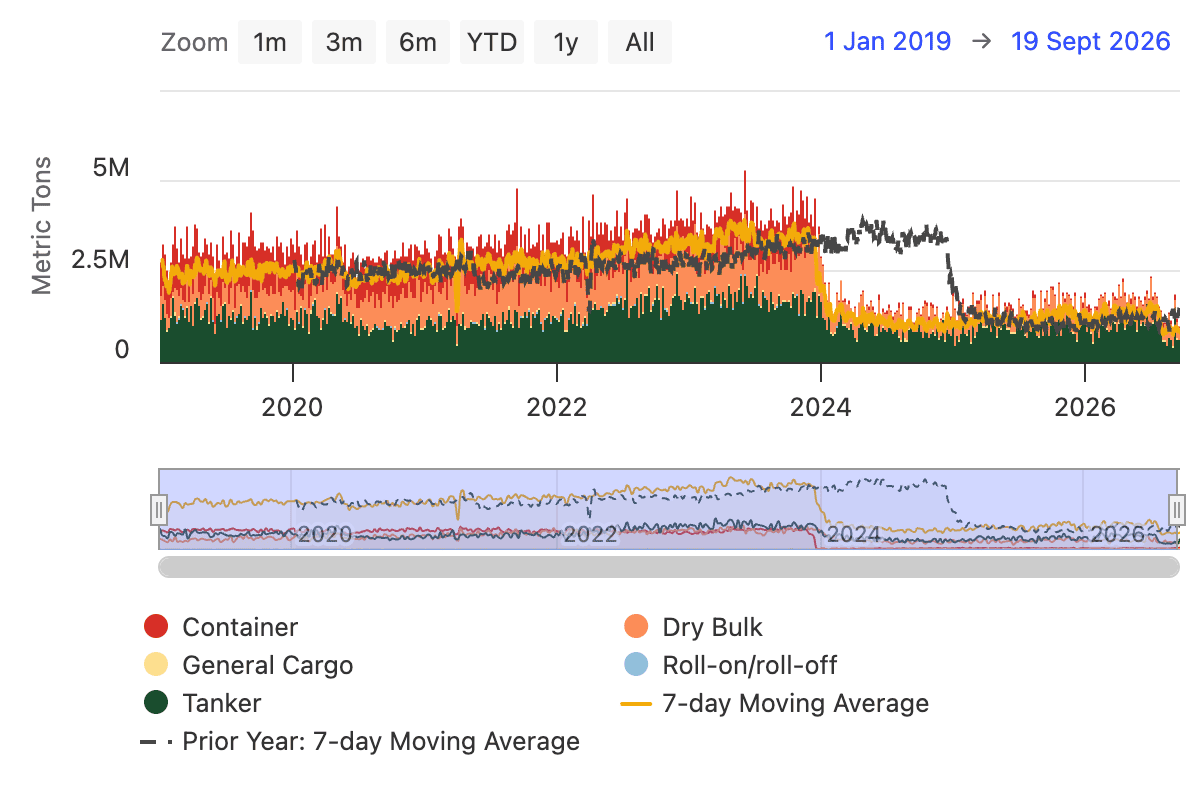
The fall in volume concerns, however, mainly tankers, most probably Saudi ones. Major container carriers, for their part, did not abandon their earlier plans to resume using the route via Bab el-Mandeb and Suez.35Manal Barakat, “Ocean carriers accelerate their return to the Suez Canal as transits gather momentum“, Kuehne and Nagel, 4 Sept 26.
The Houthis indeed emphasised that they would continue to ensure safe shipping in the Strait, except for Saudis vessels, and that they would not ask for transiting fees.36Al-Araby al-Jadeed, “A Houthi leader told Al-Araby Al-Jadeed: ‘We do not intend to impose transit fees in Bab al-Mandab.’“, 11 September 26. The Houthis’ promise is reinforced and legitimised by the results of the meeting of U.S. officials with Houthi leaders in Oman on 12-13 September.37Patrick Wintour, “US opts not to back Saudi Arabia in Yemen after meeting Houthi leaders“, The Guardian, 16 September 26. Then, the Houthis reportedly reassured the U.S. that they would abide by the May 2025 agreement in exchange for the absence of involvement of the U.S. in support of Saudi Arabia against Houthi forces.38Ibid.
On the contrary, Saudi officials and Yemen internationally recognised government emphasise the Houthi threat on maritime traffic.39UN Meeting of the Security Council, 10222nd Meeting (PM), “Houthi Advance towards Key Red Sea Chokepoint Raises Risk of Wider Conflict, Assistant Secretary-General Warns“, 15 September 26.
Yet, during September 2026, no attack on vessels were reported in the area, while piracy in the Gulf of Aden seems to have been receding.40Africa Center for Strategic Studies, “Houthi Leverage over the Red Sea Escalates…”, Ibid; Lloyd’s List Intelligence, Red Sea Brief – 1 October 2026.
As a result, again, a timid recovery of transit in the strait was taking place, with 1.1 million metric tonnes transiting through Bab el-Mandeb, as moving average on 27 September, against 3.2 million on the same day in 2023. The following week the 7-day moving average slightly declined but remained nonetheless larger than the figure for the start of September.
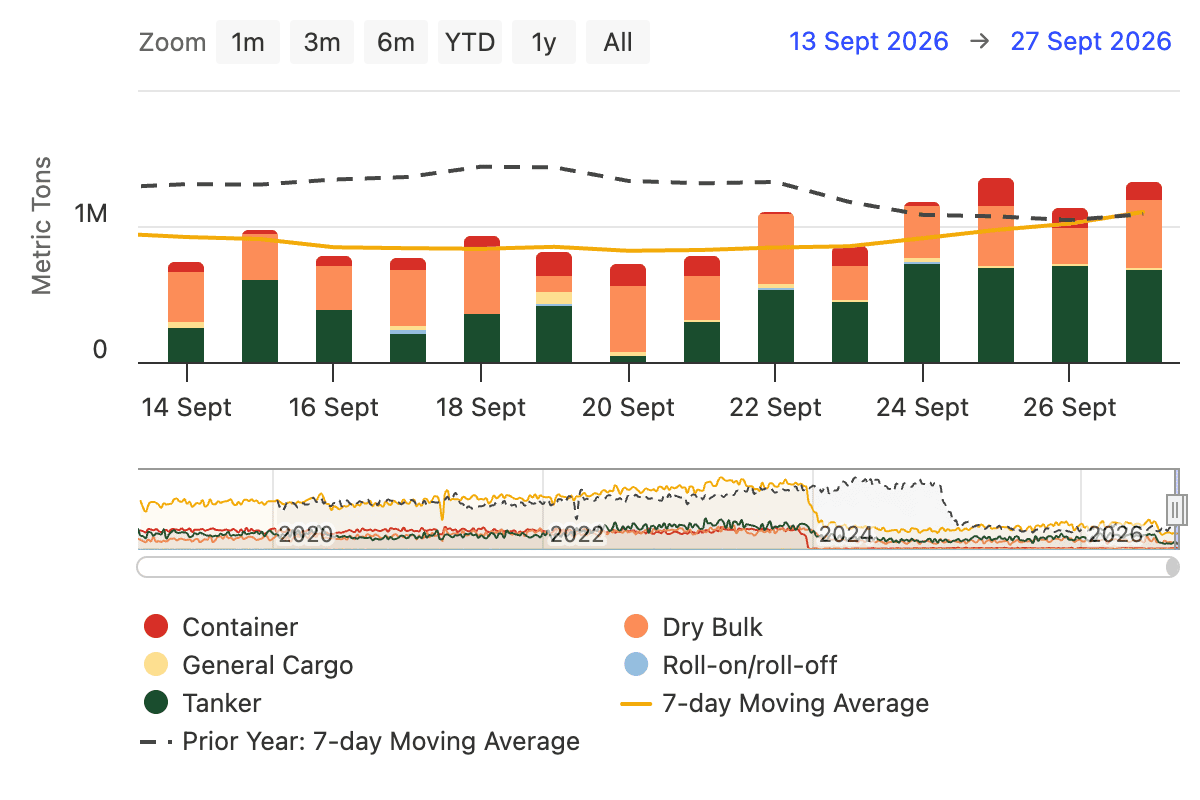
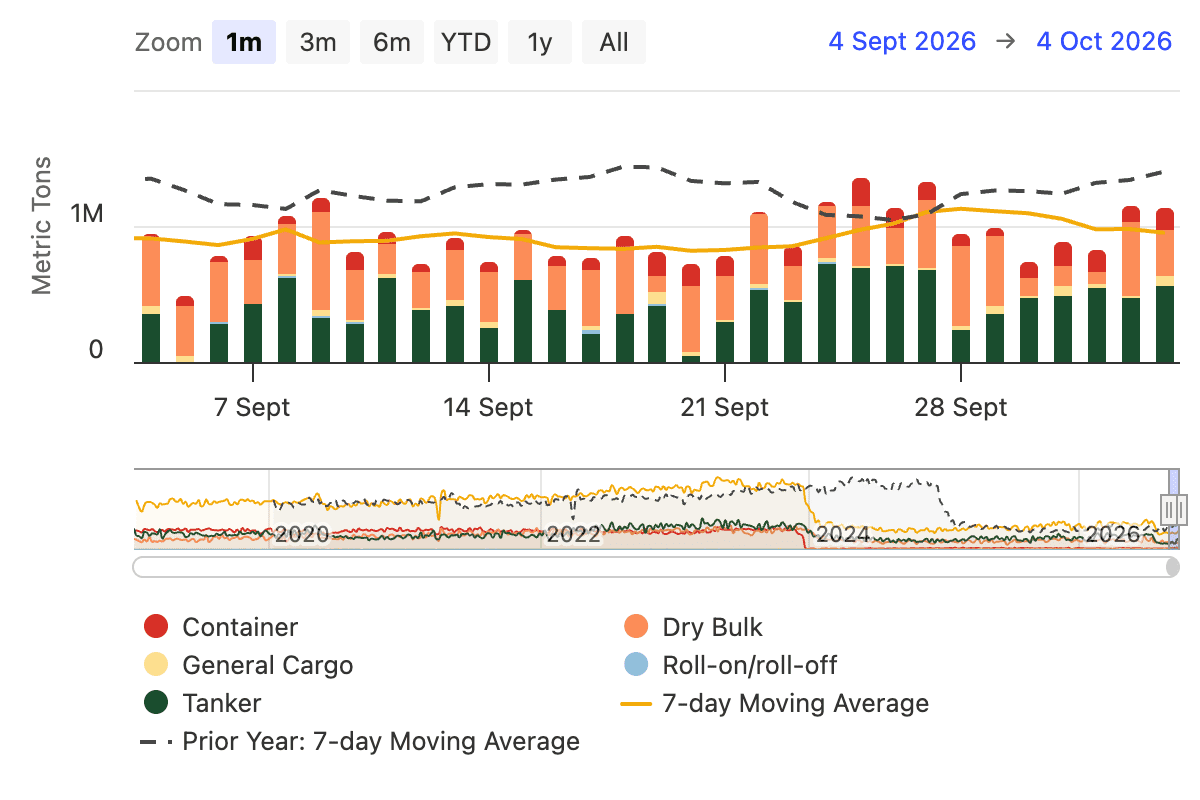
Meanwhile, container shipping companies continue to carry out their plan for a gradual return to the Red Sea, now for October 2026.41Ahram Online, “Maersk, Hapag-Lloyd to resume Suez Canal routing for AE12 service from 27 October“, 29 September 26. Nevertheless, they state that they are maintaining a high level of monitoring for each passage.
We thus see here the result of opposite forces interacting, as far as container shipping is concerned. On the one hand, the willingness to free up vessel space and clear congestion in Asia pushes container shipping companies to use the route via Bab el-Mandeb,42Barakat, “Ocean carriers accelerate…”, Ibid. itself made safer by the U.S. agreement with the Houthis. On the other hand, the rising Gulf instability, from fighting in Yemen to the war in Iran, compounded by the inability of the U.S. to end swiftly and victoriously a war it has launched, a potential symptom of its weakening as super power, still deters transit via Bab el-Mandeb, which remains, as a whole, at a third of what it had been before 7 October 2023 attacks. Indeed, the Global Shippers Forum reportedly wondered if the return to the Red Sea was not too early considering political instability and thus a “reckless gamble”.43Metro, “Suez returns as Middle East shipping risks intensify“, 16 September 26.
Operation “Dawn of Yemen”
A new phase is starting.
Fighting continued, notably around Taiz. This led Yemen internationally recognised government to announce, on 4 October 2026, “the launch of military operations to restore the remaining territory of the Republic and extend state authority and its institutions across the country.”44President Dr. Rashad Al-Alimi website, President Al-Alimi Announces Launch of Military Operations to Restore State Authority Nationwide; 4 Oct 26; Al Jazeera, “Why is fighting intensifying in Yemen’s Taiz governorate?“, 4 October 26. Then, on 5 October, Operation “Dawn of Yemen” was launched, aiming “to restore state institutions, liberate the capital, Sana’a, and end the coup by the terrorist Houthi militias.”45President Dr. Rashad Al-Alimi website, PLC President Announces Launch of “Dawn of Yemen” Operation to Restore State Institutions and Liberate Capital Sana’a, 5 Oct 26. On 5 October, government forces claimed to have retaken Dhubab district in front of Perim Island, which the Houthis deny.46Al Jazeera, “Yemen war: What’s the latest, as government forces claim advances?“, 5 October 26. At the time of writing, according to the Institute of for the Study of War, the Houthis had stopped Yemen governmental forces north of Dhubab.47ISW, “Iran Update, October 6, 2026“.
The pattern we see emerging is, first, unsurprisingly, that Houthi attacks lead to less transit through Bab el-Mandeb and a re-routing via the Cape of Good Hope. The change is rather rapid. On the contrary, an absence of attacks over months leads to a very slow recovery of transit. American guarantees, when they involve an agreement with the potential attacker, create a kind of security floor that leads shipping companies to plan for the reopening of routes via Bab el-Mandeb, even though new short sporadic offensive take place. This concerns mainly container carriers and should be further researched for other market segments. However, the U.S.-Houthis agreement, considering the unsettled geopolitics of the region in general and of Yemen in particular, is insufficient to lead rapidlu to a return to the pre-7 October situation.
Let us turn now to the potential impacts that must be accounted for when considering disturbance to maritime traffic through the Strait of Bab el-Mandeb.
Potential future impacts
While all consequences of a phenomenon always take place in reality, in terms of analysis and strategic foresight we need to consider only those relevant to the actor for which the analysis is done.48Please note that chains of impacts must also be taken into account. Direct impacts may be perceived as irrelevant but longer term consequences may be pertinent. For example, in our case, a state located in the Gulf may be concerned about the level of army readiness in operational terms that the Houthi offensive demands. A shipping company will not have this concern but will still need to monitor various levels of army readiness to gauge the potential for regional conflagration. The level of detail and understanding needed for this specific impact will vary according to the monitoring organisation. As another example, a Gulf state may not be interested in the delays and difficulties met in a port such as Rotterdam, Shanghai or Singapore, as a result of changes in the level of threat in the Bab el-Mandeb Strait. However, a company that has ordered components needed for the production of goods will be concerned by such challenges.
As a result, here, we only focus on one of the most important direct impacts of the situation in the Bab el-Mandeb Strait, namely the change in distance sailed. It can then serve as basis for the construction of specific chains of impacts for particular actors. The other major impacts that should also be considered are the disruptions in ports resulting notably from variability, with consequences for port management, congestion and delays, then on supply chains and stock management, the rise of multimodality, and, finally, the political and geopolitical consequences in terms of revenues, as well as political instability, including, in the context of rising food insecurity linked to climate change, food riots.
Changes in the distance sailed
Re-routing when a strait is closed or reopened changes the distance sailed. If, as in 2024, the new route goes through the Cape of Good Hope from the Red Sea, then the distance increases. On the other hand, if the re-routing means moving back to the original route, away from the Cape of Good Hope, then the distance decreases. For example, the distance from Shanghai to Rotterdam via Bab el-Mandeb and Suez reaches 10600 nautical miles, and via the Cape of Good Hope 13800 nautical miles.49CarraGlobe, “Suez vs Cape of Good Hope: Days, Miles and Cost per Container“, 26 September 26.
An increased distance means that the number of days necessary for the journey will grow. However, the number of days added varies according to the specific route and the number of calls, and not only to the quantity of miles traveled.50CarraGlobe, “Suez vs Cape of Good Hope…,” Ibid. Logically, a shorter distance means the number of days necessary for the journey will also decrease, again with variability.
Impact on the number of vessels and carrying capacity needed
The number of days for the journey and the distance travelled have an impact on the number of vessels and the carrying capacity needed.51CarraGlobe, “Suez vs Cape of Good Hope…,” Ibid; UNCTAD rapid assessment, Ibid.
Longer distances mean an increased ton-mile or TEU-mile demand. UNCTAD estimated that a 100% diversion from the Suez Canal to the Cape of Good Hope meant a 10% increase in TEU-mile demand, which translated into more ships and carrying capacity needed.52UNCTAD rapid assessment, Ibid. What we observed is approximately a 66% diversion, which must have translated into a 6.6% increase in the TEU-mile demand.
The change in ton-miles will vary according to market segments and, within each, to the type of goods.53UNCTAD rapid assessment, Ibid.
Now, as the distance decreases when a chokepoint reopens, then fewer ships and less carrying capacity will become necessary. If UNCTAD estimates are correct, we could expect a decline in TEU-mile demand equivalent to around 6.6% once transit through Bab el-Mandeb fully recovers.
Flexibility in fleet management
As the distance and thus ton-miles change with re-routing, whatever the direction of the route, fleets will need to reorganise and shipping companies will need to develop the managerial and organisational flexibility needed to adequately handle the volatility of geopolitics. This, in general, will demand increased skills, while affecting costs and prices adversely.
Potential emergence of overcapacity
As distance decreases, overcapacity could emerge.
In 2024, the increase in ton-miles demand, across all types of carriers, following the re-routing from Bab el-Mandeb to the Cape of Good Hope, notably helped absorb a developing overcapacity in terms of shipping capacity, as highlighted by UNCTAD.54Review of Maritime Transport 2025, 24 Sep 2025. Indeed, the UN body stresses that between 2010 and 2024, maritime trade demand in metric tons “increased by 37.5%, while global fleet capacity in dead weight tons jumped by 85%. Over the same period, distance-adjusted demand rose by 53.2%”.55UNCTAD, Review of Maritime Transport 2025, 24 Sep 202556. Thus, if the change of route implies shorter distances, overcapacity will surface.
Recent forecasts by the Baltic and International Maritime Council (BIMCO), the world’s largest international shipping association, for the container segment for 2026 and 2027 confirm the possible rise of overcapacity as re-routing through the Red Sea takes hold.57The Maritime Executive, “Overcapacity Looms Over Container Shipping as Supply Pressure Mounts“, 23 Sept. 2026.
Convergence with other factors and cascading impacts – The case of El Niño and the Panama Canal
The past has shown that environmental constraints and other geopolitical factors also impact the global maritime distance covered by specific goods in certain market segments.
For example, the drought in Panama that severely impacted ship transit in 2023 and 2024 was exacerbated by the strong 2023 El Niño.58Ayesha Tandon, “Drought behind Panama Canal’s 2023 shipping disruption ‘unlikely’ without El Niño“, CarbonBrief, 1 May 2024. The Panama Canal, another chokepoint, can act in tandem with the Strait of Bab el Mandeb on Asia-North America routes. Indeed, part of the seaborne traffic from Asia to North America East Coast travels via Bab el-Mandeb and Suez, while a larger part uses the route via the Pacific and then via the Panama Canal. Constraints on both Bab el-Mandeb and Panama mean that the original route via Suez/Bab el Mandeb has to go through the Cape of Good Hope, without the option to use the alternative route via the Pacific and the Panama Canal, itself under tension. As maritime traffic becomes congested between the West and East Coasts, rail traffic is increasingly used, which also becomes congested. As a result cost and delays in delivery rise.
Now, according to the World Meteorological Organisation (WMO), in 2026, El Niño is expected to be particularly strong and to persist through February 2027.59WMO press release, “El Niño set to become very strong, raising risks of extreme weather into 2027“, 3 Sept 26. Thus, a hindering drought may take place again in 2026 and 2027. Indeed, in August 2026, Panama started restraining maritime traffic.60Mark Saunokonoko with Agence France-Presse, “Panama canal traffic facing further cuts as drought from El Niño worsens“, The Guardian, 15 September 26. Rainfalls then eased the restraint.61Ships and Ports, “Panama Canal Eases Draft and Transit Restrictions“, 29 September 26. However, El Niño is not over.
In this case, re-routing via Bab el-Mandeb could, for example, ease the load on West Coast ports, while increasing the role of East coast ports. With the intensification of the effects of climate change, such environmental tensions could become the norm with consequences for both fleet management and supply chains organisation.
It could also call into question the function and role of the Panama canal, especially as the size of ships increases beyond what the Panama canal can handle. Interestingly, this could have, in turn, economic, political and geopolitical impacts as the American BlackRock Inc. has taken over Panama ports from Chinese companies, in the wake of President Trump reassertion of his willingness to see the U.S. leading the Western Hemisphere.62Didi Tang and Alex Veiga, “BlackRock strikes deal to bring ports on both sides of Panama Canal under American control“, Associated Press, 4 March 2025; among other texts, America 250: “Presidential Message on the Anniversary of the Monroe Doctrine“, WhiteHouse.gov, 2 December 25.
Accelerating structural changes with unknown consequences: the rise of the MegaMax
In container shipping, the forced use of longer routes following the near closure of the Bab el-Mandeb Strait allowed for the testing of gigantic vessels such as the MegaMax, as well as the capacity of ports on new routes to accommodate those ships.63Lloyd’s List, Sea news, “MSC’s megamax fleet expansion is reshaping global container shipping“, Kuehne-Nagel, 9 July 26. This could have contributed to a structural change in fleets, as triggered by Mediterranean Shipping Co’s (MSC) strategy, with, for example, consequences for port infrastructure.64Ibid.
In case of re-routing via Bab el-Manded, together, overcapacity plus rising orders and increased use of gigantic vessels could mean a harshening of competition in container shipping, with impact on prices such as a price war, for example, and a rising sensitivity to geopolitical and economic upheavals.
Impacts on the costs of shipping
A longer distance means increased costs in terms of fuel, charter costs – average manning costs and other operating costs, such as maintenance, stores, spares, management and administration, insurance, which will increase if the change of route means higher risks of piracy – potentially “lost value of time sensitive freight” and greenhouse gas (GHG) emissions.65CarraGlobe, “Suez vs Cape of Good Hope…,” Ibid; UNCTAD rapid assessment, Ibid; OECD-International Transport Forum, The Red Sea Crisis: Impacts on global shipping and the case for international co-operation, 2024.
Furthermore, a longer distance tends to imply an increase in speed, which in turns also means more GHG emissions, despite international efforts to reduce them.66UNCTAD,Review of Maritime Transport 2025, 24 Sep 2025. As a result, the need for speed will make the task of reducing those emissions from ships more difficult without endangering maritime traffic and supply chains.67Ibid.
To summarise, with a longer distance re-routing, GHG emissions tend to increase because of three factors: distance, speed, and the difficulty in strictly applying rules without unintended consequences for trade and supply chains.
Meanwhile, supplementary GHG emissions also potentially raise shipping costs under the EU emissions trading system.68Alex Mills, “Maritime trade routes are under threat—and markets still underprice the risks“, Atlantic Council, 25 August 26.
However, considering the war against Iran, the rising price of fuel also tends to push vessels to reduce speed, whatever the distance, as happened in 2026 and is expected to continue during 2027.69The Maritime Executive, “Overcapacity Looms Over Container Shipping as Supply Pressure Mounts“, 23 Sept. 2026. In that case, GHG emissions will decrease, which, in turn, will also lower cost. A secondary impact on delays will however have to be taken into account.70Ibid.
Fuel is also particularly important as its price will vary according to the tightness of the closure of Hormuz, and of the Strait of Bab el-Mandeb (for example the Houthis’ embargo on Saudi ships), to escalation between the Houthis and Saudi Arabia, and to other geopolitical factors such as sanctions against Russia. Worse still, potential disruption in the supply of fuel and shortage must also be considered, depending on the shipping company, country, and route.
To sum up, in 2024, the OECD calculated the supplementary costs, for a median sized container ship, generated by insecurity in the Red Sea with two cases, one for a route through Bab el-Mandeb and Suez, despite insecurity, and one for a route via the Cape of Good Hope.71OECD-International Transport Forum, The Red Sea Crisis: Impacts on global shipping and the case for international co-operation, 2024. Those additional costs are summarised in the table below:
| Cost item | Via Suez Canal (USD) | Via Cape of Good Hope (USD) |
| Total additional costs per ship | Up to 1 million | 1.7 million |
| Additional costs per 40-foot container | Up to 160 | 272 |
Meanwhile freight rates as applied to customers skyrocketed, and sat far above the supplementary cost incurred by container shipping companies. As highlighted by the OECD:
... Container transport pricing has become increasingly opaque and hard to predict for shippers and logistics services
OECD-International Transport Forum, The Red Sea Crisis: Impacts on global shipping and the case for international co-operation, 2024, pp. 18 & 19.
providers (Baker, 2024c).
There is also a significant divergence between development of cost for shipping companies and freight rates. As indicated above, the cost increases of rerouting a median size container ship around the Cape of Good Hope amount to around USD 300 per 40ft import container, whereas the container freight rates on the Asia-Europe and Asia-North America routes have increased by around USD 1 800-4 200 per container.
Thus, it would seem that the Houthi attacks on Bab el-Mandeb, finally, were very profitable, at least during the first year, for container shipping companies.
As price increases are passed on to the next purchaser, each time potentially with a supplementary margin, inflation may grow, contributing to a rising dissatisfaction among final consumers, with potential consequences in terms of political instability, according to countries and cases. Then inflation and political instability may in turn constrain demand, with a delay, leading to depressed demand, depressed trade and thus increased maritime overcapacity.
Now, if re-routing takes place through Bab el-Mandeb, costs will decrease, apart from those created by the growing complexity to manage fleets, as seen previously. As a result, justification for higher freight rates will also disappear. If the market also faces overcapacity as highlighted above, then a race towards lower prices may start to take place with major consequences for the container shipping industry.
Prices in other market segments such as dry bulks seemed to have been less impacted, but detailed research would be needed.72OECD-International Transport Forum, The Red Sea Crisis: Impacts on global shipping and the case for international co-operation, 2024.
According to concerned actors, detailed scenarios taking into account geopolitical complexities, competing factors, chains of impacts and feedbacks would be needed to cover the full range of possible futures, and thus to create resilient strategies.
Houthi forces counted an estimated 350000 fighters in September 2024.73United Nations, Final report of the Panel of Experts on Yemen established pursuant to Security Council resolution 2140 (2014) – S/2024/731 – September 2024, p.10. They succeeded in de facto controlling the Strait of Bab el-Mandeb. As a result, they could bring the U.S., the most powerful state in the international system, to the negotiation table and agreement followed. They impact the maritime shipping industry and more particularly container shipping companies, thus maritime trade, and, ultimately, global trade and all industries dependent upon it, thus the lives of millions.
We have here a perfect demonstration of what power and geopolitics truly mean.
Notes
- 1For this paragraph, among other sources, Yousef Mawry, “Leading Houthi threatens ‘siege’ on Saudi Arabia after Yemen airport attack“, Al Jazeera, 14 July 26. ↩︎
- 2
- 3UNCTAD, Ibid.; WTO, Spotlight: Global trade developments and outlook – Annual Report 2026. ↩︎
- 4We often find the following estimates: Maritime transport represents over 80% of total global merchandise trade volume, e.g. UNCTAD, Launch of the Review of Maritime Transport 2025, and around 70% of total global merchandise trade in value. This seems to originate in the following statement: “With over 80 per cent of global trade by volume and more than 70 per cent of its value being carried on board ships and handled by seaports worldwide, the importance of maritime transport for trade and development cannot be overemphasized.”UNCTAD, Review of Maritime Transport 2017, p.x, 16. However, how these figures are reached is not detailed: trade flows are given in USD and maritime flows in tonnes, ton-miles and TEU. Indeed a maritime expert, Pablo Rodas-Martini asked the same question and pondered on the absence of real answer, “One question, many answers: How much of the world’s trade is carried by sea?“, 2019.
As a result, the reality is that we know neither the share of maritime transport in global merchandise trade in volume nor in value. And, relatedly, we cannot trace its evolution nor performance. ↩︎ - 5UNCTAD, Review of Maritime Transport 2025, 24 Sep 2025, using private firm database research Clarksons Research 2025. ↩︎
- 6Ibid., p.8. ↩︎
- 7Ibid., p. 7-8. ↩︎
- 8TEU = Twenty-foot Equivalent Unit: Standard unit for counting containers of various capacities and for describing the capacities of container ships or terminals. One 20 Foot ISO container (see heading 17 below) equals 1 TEU.” United Nations, Glossary for Transport Statistics 3rd Edition (EN), p. 68.
Ton-miles or TEU-miles: One ton of cargo or one TEU shipped over a distance of one mile. For example, If a ship carries 10,000 tons of cargo across 2,000 miles, it generates 20,000,000 ton-miles of shipping demand. ↩︎ - 9The shares of each market below are calculated according to shipment data fro 2026 from IMF Portwatch, Economy Monitor, World – Data: UN Global Platform; PortWatch – last updated 25 Sept. 26. ↩︎
- 10IMF Portwatch, Port Monitor: Chokepoints. ↩︎
- 11Parisa Kamali, et al. for the IMF and Serkan Arslanalp et al. for Portwatch, “Red Sea Attacks Disrupt Global Trade“, IMF, 7 March 2024. ↩︎
- 12Israeli-Palestinian Conflict“, Global Conflict Tracker, Council on Foreign Relations, Updated August 3, 2026; Michael Knights, “Assessing the Houthi War Effort Since October 2023“, CTC Sentinel, April 2024, Volume 17, Issue 4. ↩︎
- 13Knights, “Assessing the Houthi War Effort…”, ibid. ↩︎
- 14Knights, “Assessing the Houthi War Effort…”, Ibid. ↩︎
- 15For the entire paragraph, Knights, “Assessing the Houthi War Effort…”, Ibid. ↩︎
- 16U.S. Department of War, Immediate Release, Statement from Secretary of Defense Lloyd J. Austin III on Ensuring Freedom of Navigation in the Red Sea, 18 December 2023 ↩︎
- 17Ahmad Ghaddar, “Houthi attacks in the Bab al-Mandab Strait hit global trade“, Reuters, 19 December 2023. ↩︎
- 18SeaNews Editor, “CMA CGM confirms halt to Red Sea routing“, Kuehne-Nagel, 5 February 2024. ↩︎
- 19Christopher M. Blanchard, “Yemen: Conflict, Red Sea Security, and U.S. Policy“, IF12581, Congressional Research Service (CRS), Updated July 21, 2026. ↩︎
- 20Press release, “Maersk’s MECL service returns to trans-Suez route“, 15 January 2026. ↩︎
- 21Ibid. ↩︎
- 22Reuters, "What are Shipping Companies’ Plans for Return to Suez Canal?“, Asharq Al Awsat, 19 December 25. ↩︎
- 23Yousef Mawry, “Leading Houthi threatens ‘siege’ on Saudi Arabia…,” Ibid. ↩︎
- 24https://t.me/army21ye/3581 ↩︎
- 25https://t.me/army21ye/3586 ↩︎
- 26https://www.spa.gov.sa/en/N2639825 ↩︎
- 27Africa Center for Strategic Studies, “Houthi Leverage over the Red Sea Escalates Threats for Africa“, 22 September 2026. ↩︎
- 28Africa Center for Strategic Studies, “Houthi Leverage over the Red Sea Escalates Threats for Africa“, 22 September 26; Adam Hancock, AFP, Reuters and The Associated Press, “Six killed in Houthi attack on Bab al-Mandeb ship, Yemen’s government says“, Al Jazeera, 12 August 2026. ↩︎
- 29Ibid. ↩︎
- 30Africa Center for Strategic Studies, “Houthi Leverage over the Red Sea Escalates…”, Ibid. ↩︎
- 31United Nations Security Council, S/2025/71/Rev.1, “Thirty-fifth report of the Analytical Support and Sanctions Monitoring Team submitted pursuant to resolution 2734 (2024) concerning ISIL (Da’esh), Al-Qaida and associated individuals and entities”, 6 February 2025; Jay Bahadur, “Somali piracy surges due to Chinese ransom payments and Strait of Hormuz crisis“, Global Initiative against Transnational Crime, 30 June 2026; Africa Center for Strategic Studies, “Houthi Leverage over the Red Sea Escalates…”, Ibid. ↩︎
- 32Africa Center for Strategic Studies, “Expanding Al Shabaab–Houthi Ties Escalate Security Threats to Red Sea Region“, 28 May 2025. ↩︎
- 33United Nations Security Council, S/2025/71/Rev.1Ibid. ↩︎
- 34Institute for the Sudy of War, Iran Updates: September 10, 2026; September 11, 2026; Mohammed Al-Qadhi, Prof. Dr. Elham Manea, Dr. Abdulaziz Alghashian, and Maged Al-Madhaji, “The Houthis Seize Yemen’s West Coast: Reactions from Experts“, Sana’a Center, 15 September 26. ↩︎
- 35Manal Barakat, “Ocean carriers accelerate their return to the Suez Canal as transits gather momentum“, Kuehne and Nagel, 4 Sept 26. ↩︎
- 36Al-Araby al-Jadeed, “A Houthi leader told Al-Araby Al-Jadeed: ‘We do not intend to impose transit fees in Bab al-Mandab.’“, 11 September 26. ↩︎
- 37Patrick Wintour, “US opts not to back Saudi Arabia in Yemen after meeting Houthi leaders“, The Guardian, 16 September 26. ↩︎
- 38Ibid. ↩︎
- 39UN Meeting of the Security Council, 10222nd Meeting (PM), “Houthi Advance towards Key Red Sea Chokepoint Raises Risk of Wider Conflict, Assistant Secretary-General Warns“, 15 September 26. ↩︎
- 40Africa Center for Strategic Studies, “Houthi Leverage over the Red Sea Escalates…”, Ibid; Lloyd’s List Intelligence, Red Sea Brief – 1 October 2026. ↩︎
- 41Ahram Online, “Maersk, Hapag-Lloyd to resume Suez Canal routing for AE12 service from 27 October“, 29 September 26. ↩︎
- 42Barakat, “Ocean carriers accelerate…”, Ibid. ↩︎
- 43Metro, “Suez returns as Middle East shipping risks intensify“, 16 September 26. ↩︎
- 44President Dr. Rashad Al-Alimi website, President Al-Alimi Announces Launch of Military Operations to Restore State Authority Nationwide; 4 Oct 26; Al Jazeera, “Why is fighting intensifying in Yemen’s Taiz governorate?“, 4 October 26. ↩︎
- 45President Dr. Rashad Al-Alimi website, PLC President Announces Launch of “Dawn of Yemen” Operation to Restore State Institutions and Liberate Capital Sana’a, 5 Oct 26. ↩︎
- 46Al Jazeera, “Yemen war: What’s the latest, as government forces claim advances?“, 5 October 26. ↩︎
- 47ISW, “Iran Update, October 6, 2026“. ↩︎
- 48Please note that chains of impacts must also be taken into account. Direct impacts may be perceived as irrelevant but longer term consequences may be pertinent. ↩︎
- 49CarraGlobe, “Suez vs Cape of Good Hope: Days, Miles and Cost per Container“, 26 September 26. ↩︎
- 50CarraGlobe, “Suez vs Cape of Good Hope…,” Ibid. ↩︎
- 51CarraGlobe, “Suez vs Cape of Good Hope…,” Ibid; UNCTAD rapid assessment, Ibid. ↩︎
- 52UNCTAD rapid assessment, Ibid. ↩︎
- 53UNCTAD rapid assessment, Ibid. ↩︎
- 54Review of Maritime Transport 2025, 24 Sep 2025 ↩︎
- 55
- 56
- 57The Maritime Executive, “Overcapacity Looms Over Container Shipping as Supply Pressure Mounts“, 23 Sept. 2026. ↩︎
- 58Ayesha Tandon, “Drought behind Panama Canal’s 2023 shipping disruption ‘unlikely’ without El Niño“, CarbonBrief, 1 May 2024. ↩︎
- 59WMO press release, “El Niño set to become very strong, raising risks of extreme weather into 2027“, 3 Sept 26. ↩︎
- 60Mark Saunokonoko with Agence France-Presse, “Panama canal traffic facing further cuts as drought from El Niño worsens“, The Guardian, 15 September 26. ↩︎
- 61Ships and Ports, “Panama Canal Eases Draft and Transit Restrictions“, 29 September 26. ↩︎
- 62Didi Tang and Alex Veiga, “BlackRock strikes deal to bring ports on both sides of Panama Canal under American control“, Associated Press, 4 March 2025; among other texts, America 250: “Presidential Message on the Anniversary of the Monroe Doctrine“, WhiteHouse.gov, 2 December 25. ↩︎
- 63Lloyd’s List, Sea news, “MSC’s megamax fleet expansion is reshaping global container shipping“, Kuehne-Nagel, 9 July 26. ↩︎
- 64Ibid. ↩︎
- 65CarraGlobe, “Suez vs Cape of Good Hope…,” Ibid; UNCTAD rapid assessment, Ibid; OECD-International Transport Forum, The Red Sea Crisis: Impacts on global shipping and the case for international co-operation, 2024. ↩︎
- 66UNCTAD,Review of Maritime Transport 2025, 24 Sep 2025. ↩︎
- 67Ibid. ↩︎
- 68Alex Mills, “Maritime trade routes are under threat—and markets still underprice the risks“, Atlantic Council, 25 August 26. ↩︎
- 69The Maritime Executive, “Overcapacity Looms Over Container Shipping as Supply Pressure Mounts“, 23 Sept. 2026. ↩︎
- 70Ibid. ↩︎
- 71OECD-International Transport Forum, The Red Sea Crisis: Impacts on global shipping and the case for international co-operation, 2024. ↩︎
- 72OECD-International Transport Forum, The Red Sea Crisis: Impacts on global shipping and the case for international co-operation, 2024. ↩︎
- 73United Nations, Final report of the Panel of Experts on Yemen established pursuant to Security Council resolution 2140 (2014) – S/2024/731 – September 2024, p.10. ↩︎