

A Strategic Foresight Report based on a 161-Variable Causal Graph Model revealing the levers shaping the future of supply chains.
The global competition for critical minerals is often reduced to a simple duel between the U.S. and China. But the real system is far more complex – and far more unstable.
Based on a rigorous structural model (Causal Knowledge Graph), this report moves beyond conventional analysis to map the true architecture of the competition. It reveals where power lies, which levers decision-makers can actually pull, and how the system can structurally evolve.
Key Findings
This report distills the 161 variables and 701 causal relationships of the model into actionable strategic insights:
- The most powerful levers are not exactly what you expect. U.S. power matters, but not in the way you think. The decisions and actions of individual countries matter. They are not pawns in a big-power game.
- Perception is constitutive of structure. For example, “Diplomatic skepticism” towards the U.S. is as directly influential as China’s entire market dominance. Trust is a causal force, not a soft factor.
- The system’s structure can shift. The formation of mid-power mineral alliances excluding the U.S. is the single most important structural pivot.
- Spillover effects: The competition’s primary outcomes are not supply chains, but China’s threat perception and US global influence—which then reshape other domains. As a result, the critical minerals competition becomes a driver of broader geopolitical dynamics.
The quest for the security of critical minerals supply chain also depends on geopolitical tensions elsewhere.- Four types of futures are embedded in the present. The report identifies the structural oscillations between U.S.-led, China-excluding, and multipolar supply chain worlds.1This report does not include a detailed set of scenarios with narratives, but identifies four types of major future scenarios and explains why.
Visualising the 161 variables of the global critical minerals competition: the most directly influential factors.
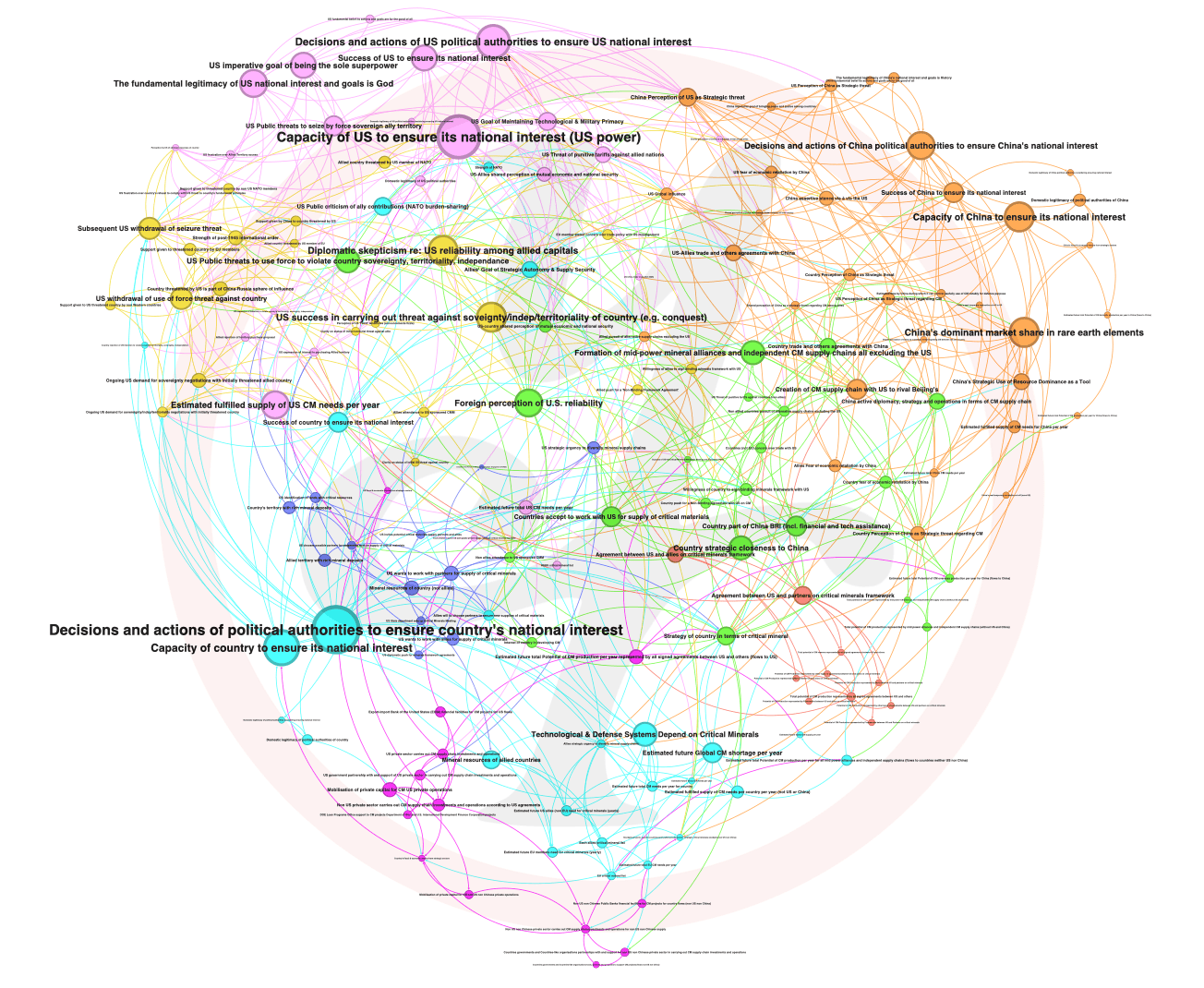
Node size indicates outdegree centrality (watermarked for web display only).
Who Should Read this Report?
- Corporate Strategists: Map your supply chain risks against the structural drivers of the market.
- Government Officials: Identify leverage points for national security and diplomatic action.
- Investors: Anticipate shifts and geopolitical shocks in the mining and processing sectors.
Methodology
This report is neither a classical international politics analysis, nor a collection of opinions. It is the result of a Causal Network Analysis using the strategic foresight and warning methodology of the Red Team Analysis Society, grounded in revisited structural analysis.2Structural analysis in strategic foresight was notably used and developed by Michel Godet and Philippe Durance, also building on Jay Forrester’s work.
- 161 Variables analyzed.
- 701 Directed Edges mapped.
- Centrality measures calculated to identify influence and vulnerability.
What You Will Receive
- Format: a 37-page in-depth PDF Report with
- Causal network visualizations (graphs with nodes – variables – sized for each centrality measure).
- Tables of the major variables selected and analysed, with measures and ranks.
- Strategic implications for the US, China, other countries, and companies.
- A framework you can use for monitoring and scenario development
- Includes also 12 charts to visualise the critical mineral demand-supply gap and geographical imbalances for major minerals and a table of the countries engaged in U.S. Critical Minerals Diplomacy (up until end of February 2026).
- License: Single User License or Enterprise License
- Delivery: Immediate digital download upon purchase.
Pricing
Single User License: €4,900 excl. taxes (VAT may apply depending on location).
Enterprise License: Need to share this report with your team or department? Contact us for Enterprise Licensing (allowing internal distribution).
To discuss how this analysis can be tailored to your specific needs—including country-specific instantiations, scenario workshops, or custom monitoring—please contact us.
Licensing Terms
- Single User License: This license is strictly for one individual. The PDF may not be shared, uploaded to shared drives, or distributed to colleagues.
- Enterprise License: Designed for teams and organizations. This license grants permission to distribute the report within your organization (e.g., via intranet, email, or shared drive) and ensures compliance with copyright regulations.
Please respect our intellectual property. If you have a team, contact us for a tailored quote.
Notes
- 1This report does not include a detailed set of scenarios with narratives, but identifies four types of major future scenarios and explains why. ↩︎
- 2Structural analysis in strategic foresight was notably used and developed by Michel Godet and Philippe Durance, also building on Jay Forrester’s work. ↩︎