
(Art direction and AI design: Jean-Dominique Lavoix-Carli)
Watch Out briefs flag geopolitical and security developments that may carry significant second-order and longer-term implications. They are designed to support early awareness and strategic monitoring. For in-depth analysis, structured risk mapping, strategic foresight and early warning, please contact us.
What
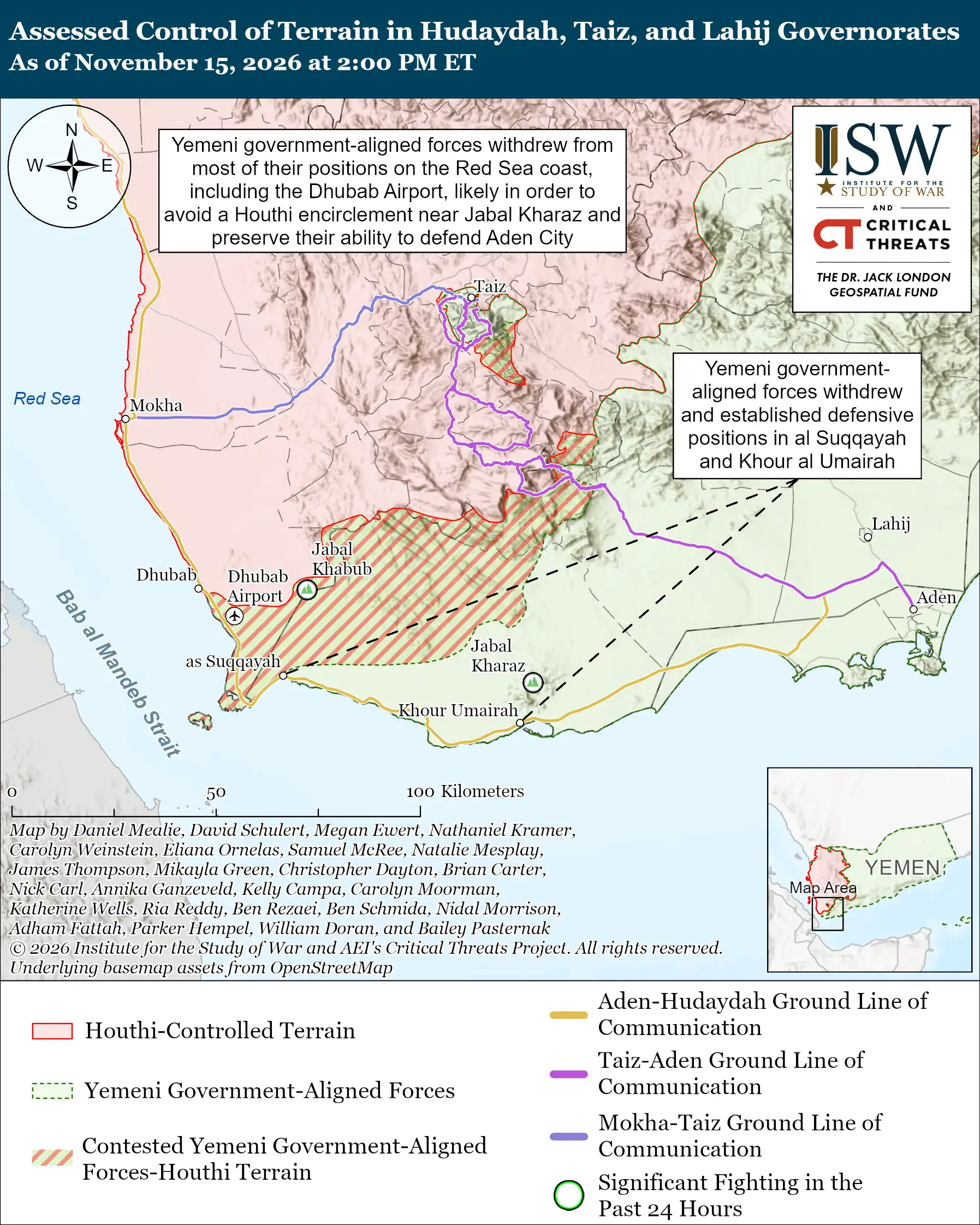
On 15 November 2026, the Houthis (Ansar Allah) took over the remaining part of the southern Red Sea Coast from Dhubab Airport to Bab el-Mandeb – territory they had lost from 6 to 10 October – as well as Jabal Kahbub. They effectively forced the forces of the internationally recognised government to withdraw to protect Aden, as Houthi advances northwest of the city increasingly threatened it.
It is key to monitor the war in Yemen closely. Houthi territorial gains have national, regional and international consequences, ranging from geopolitics to trade. Furthermore, a Houthi victory – however uncertain and complex – could create a strategic shock, generate multiple deep impacts and reshuffle the region’s strategic outlook.
Content
Facts and Context
The broader global context to consider is one of rising instability and increasing geopolitical tensions.
Regionally, the U.S. is attempting to become less involved in the Middle East as defined in its National Security Strategy – (November 2025) with “Shift Burdens, Build Peace“. However, on 28 February 2026, it also initiated a war alongside Israel a war with Israel against Iran with far-reaching consequences, for example, on oil prices, oil-derived products and inputs across supply chain, and regional stability.
More specifically regarding Yemen, a ceasefire agreement between the Houthis and the U.S. was reached on 6 May 2025 and reasserted on 12-13 September 2026.1Hélène Lavoix, “The Houthis, Bab el-Mandeb, and Maritime Transport“, 8 October 2026. As a result, so far, the U.S. has so far remained uninvolved in the conflict in Yemen, neiher intervening directly nor supporting Saudi Arabia in its complex dealings with Yemeni actors.
The Houthis are aligned with Iran; however they are not subservient to it, and their actions stem from their own aims and from internal Yemeni dynamics.2E.g. Helene Lackner, “Yemen’s Ansar Allah“, MERIP, 29 January 2025. They also actively oppose the Israeli actions against Palestinians. 3See for more details, Lavoix, “The Houthis…“, Ibid.
War has been raging again in Yemen since the 13 July 2026 Houthi offensive, followed by the launch of the 5 October counter-offensive, Operation “Dawn of Yemen” by the internationally recognised Yemeni government in Aden.4For a timeline from 7 October 2023 to mid-September 2026, Lavoix, “The Houthis…“, Ibid.
Between 6 and 10 October 2026, the Houthis had lost part of the coastal territory conquered in September, extending south of Dhubab.5Ibid.
Over the course of the last month, the Houthis succeeded in surrounding Taiz and moving south towards Aden.6Institute for the Study of War, “Iran Update“, daily, 10 October to 15 November 15 2026. On 11 November they launched an offensive in southwestern Lahij Governorate from Al-Turbah (southern Taiz Governorate) through Al-Majza towards Al -Shatt, Al-Sarih, and potentially, Jabal Kharaz, which would open the road to Aden.7ISW, Iran Update, 12 Nov 2026.
Meanwhile, Saudi Arabia – which the Houthis consider as their main opponent – provides air support to the forces of the internationally recognised Yemeni government, attacking Houthi forces, logistical lines, as well as capabilities deep inside Houthi territory.8Statements by the Official Spokesperson for the Yemeni Armed Forces, Brigadier General Yahya Saree Qasim Saree; ISW “Iran Updates”. For their part, the Houthis strike Saudi territory as far and as often as possible, targeting notably oil, business and transport infrastructure.9Ibid.
As the threat to Aden grew, southern forces withdrew from their positions on the Red Sea coast to defe,nd the city.10ISW, Iran Update, 15 Nov 2026.
The Houthis seized the opportunity to recapture the abandoned terrain, as shown on the ISW-CTP map for 15 November 2026:11Ibid
According to Houthi Al Masirah television, Houthi forces:
“…have expanded their battlefield gains from the outskirts of Dhubab and Bab al-Mandeb, through Ras al-Arah al-Mudaribah and Khawr Umairah, to the Kharaz mountains in Lahj governorate, placing Saudi-backed mobilizations before a new military reality after their retreat from strategic positions and loss of rear supply lines…”
Yemeni Forces Advance Near Bab al-Mandab, Putting Saudi-Backed Forces on Back Foot: Analyst, Al Masirah TV, 16 November 2026.
The fighting now lies approximately 60 km west of Aden. However, fighting is still ongoing and the front lines remain fluid and rapidly shifting.
Why it matters and impacts
- Maritime chokepoint vulnerabilities: The Bab el Mandeb Strait is vital for shipping and thus for trade. As a maritime chokepoint, it is highly sensitive to military escalations, tensions and geopolitical shocks. Read our in-depth article “The Houthis, Bab el-Mandeb, and Maritime Transport” for more on this issue.
- Erosion of Saudi Deterrence and Leverage: The strategic regional influence of Saudi Arabia could be severely impacted by a Houthi victory. Saudi Arabia could see its negotiating hand weakened while its ability to secure its southern border could be tested.
- Reshuffling of the Regional Balance of Power: If war ended in Yemen, and even more if the Houthi were victorious, the regional geopolitical outlook would be fundamentally reshuffled.
- Compounding risks and Gulf countries future: Changes in Yemen, combined with continuous tension around the Strait of Hormuz could alter the economic prospects and geopolitical status of multiple countries in the region. Building scenarios for the future of the Gulf countries in this context would yield critical constructive insights.
→ For commissioned in-depth analysis, structured risk mapping and strategic foresight and early warning: contact us.
Notes
- 1Hélène Lavoix, “The Houthis, Bab el-Mandeb, and Maritime Transport“, 8 October 2026. ↩︎
- 2E.g. Helene Lackner, “Yemen’s Ansar Allah“, MERIP, 29 January 2025. ↩︎
- 3See for more details, Lavoix, “The Houthis…“, Ibid. ↩︎
- 4For a timeline from 7 October 2023 to mid-September 2026, Lavoix, “The Houthis…“, Ibid. ↩︎
- 5Ibid. ↩︎
- 6Institute for the Study of War, “Iran Update“, daily, 10 October to 15 November 15 2026. ↩︎
- 7ISW, Iran Update, 12 Nov 2026. ↩︎
- 8Statements by the Official Spokesperson for the Yemeni Armed Forces, Brigadier General Yahya Saree Qasim Saree; ISW “Iran Updates” ↩︎
- 9Ibid. ↩︎
- 10ISW, Iran Update, 15 Nov 2026. ↩︎
- 11Ibid ↩︎