
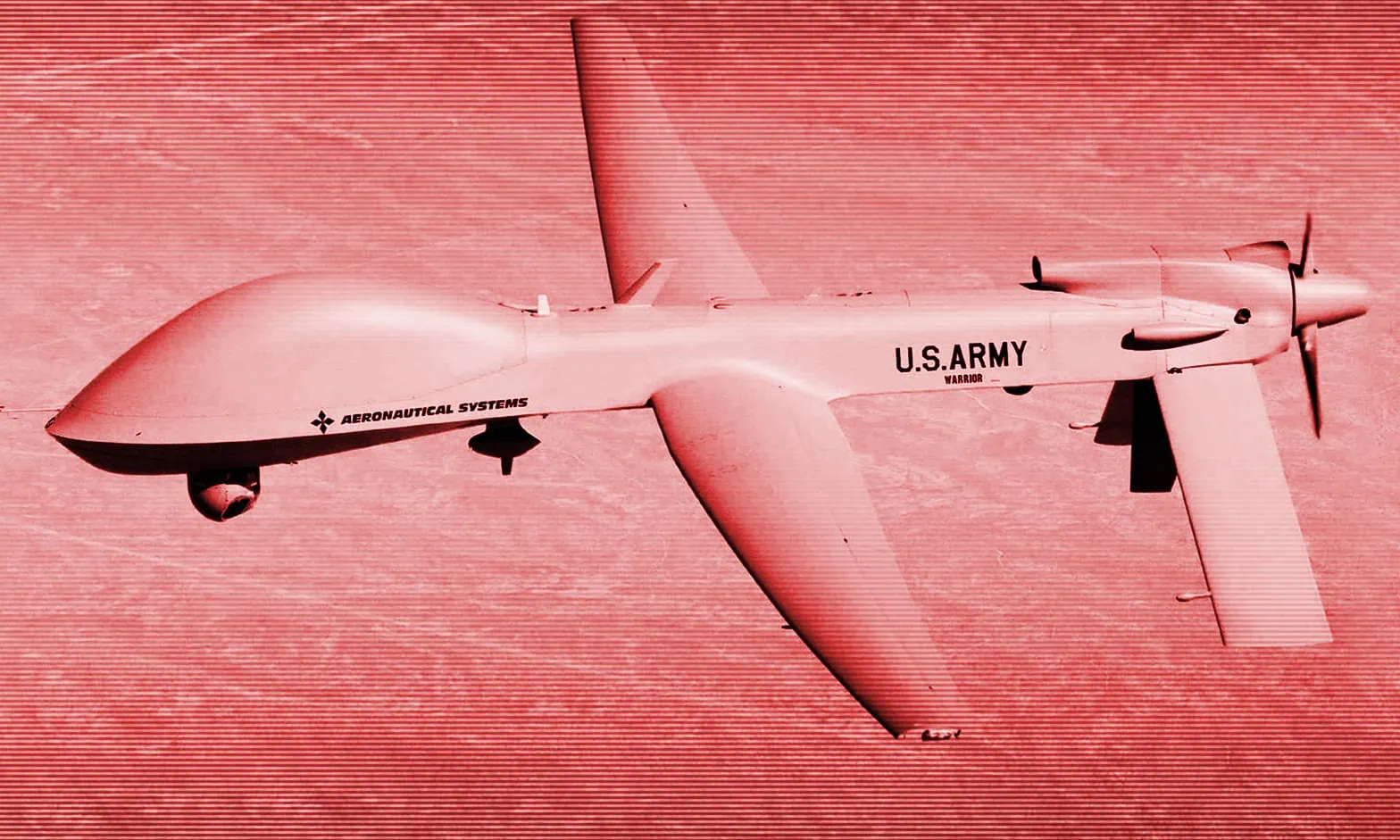
(U.S. Army’s MQ-1C Warrior UAV
Photo Courtesy of U.S. Army –
Public Domain)
In December 2024, the Chinese government ordered one million kamikaze drones for the People’s liberation Army (Dylan Malyasov, “China places massive order for kamikaze drones”, The Defence Blog, 22 December 2024).
During the same period, OpenAI, the U.S. giant of generative AI signed a partnership with Anduril, the rising combat drones company (Mike Stone and Aishawara Stain, “Defense firm Anduril partners with OpenAI to use AI for national security mission”, Reuters, December 4, 2024).
This partnership is the latest in a series of contracts signed between Anduril and the armed services, such as a 100 million USD contract with the Space Force to expand its edge data services integration capabilities (Patrick Tucker, “Can OpenAI power military drones defense? New partnership with Anduril offers clues”, DefenseOne, December 4, 2024).
In order to develop the production capabilities required by its contracts, Anduril is building Arsenal-1 in Columbus, Ohio. This industrial complex is designed to “hyperscale” the production of drones and weapons system (Stavroula Pabst, “The AI weapon army goes to Ohio”, Responsible Statecraft, February 20, 2025).
Drones, be they aerial, terrestrial, marine or submarines, are becoming a prominent segment of contemporary arsenals, integrating AI. Their autonomy is growing at a very fast pace. They are used by national militaries, such as those of the U.S., the Chinese or the Russian armies. They are used as well by militias, such as the Houthi or the Hezbollah. They have become a prominent feature of the Ukraine war, or of the Lebanon war (See Jean-Michel Valantin in The Red Team Analysis, “AI at War (1) – Ukraine”, 8 March 2024 and “AI at War (2), Preparing for the U.S-China War ?“, 17 September 2024).
- RTAS Expertise Highlighted on Italian Television Channel LA7

- The Houthis, Bab el-Mandeb, and Maritime Transport

- The Strange Mystery of Bolivia’s Lithium Reserves

- Beyond Geopolitics: Understanding the Critical Pressures Reshaping Our World.

- WATCH OUT – The Iran War, Saudi Arabia, and the Houthis

- Chronicles of the Hyperwar – AI: AI, the New Energy Frontier (1)

- SIGNAL – The Golden Dome, a New Technological Frontier

Meanwhile, rapid progress are made in the field of humanoid/android robots, especially in China and in the U.S. Like drones and other technologies, androids are rapidly being militarized. (Dan Grazier, “What if the robot army is defeated?”, Responsible Statecraft, 10 March 2025).
However, this new dimension of the arms race raises the question of whether these weapons systems are “only” of tactical importance, or whether their importance in warfare is becoming such that their use is of strategic importance?
In other terms, in the age of the militarization of AI, is “drone power” a pivotal new technology ? Is it necessary to acquire general dominance on a theatre of operation? And how are these capabilities going to be projected on theatres of operations ? And for which conflict?
The Age of the Great Swarm
Replicator
On 30 August 2023, Kathleen Hicks, Deputy Secretary of Defense, gave a speech to a military and media crowd about the need for the U.S. to mass produce drones in order to outsize the Chinese People’s Liberation Army (Deputy Secretary Kathleen Hicks Keynote Adress: “The Urgency to innovate”, US Department of Defense, 28 August, 2023).
To achieve this objective, the assistant-secretary announced the “Replicator” initiative. This military-industrial initiative will mobilize the U.S. production capabilities to produce a “mass” of military drones. The objective, for this “mass”, is to be superior to the whole of the Chinese military mass of troops and machines.
It is important to note that the assistant-secretary was talking on the Island of Guam, which is a major U.S. Navy base in the Pacific. So, the geography of the declaration of assistant-secretary of defense takes place in very important U.S Navy base. This base would be, or will be, on the front line of naval operations against, for example, China.
Since then, « Replicator » has become the framework for the Pentagon-led race for drones (“Pentagon ramps up development for Replicator program”, Gov CIO, 01/29/2025). This military and industrial policy has to follow two intertwined tracks. The first one is the development of the industrial capabilities at the proper scale.
The other track is particularly driven by the Defense Innovation Unit (DIU). Its goal is to implement « the initiative’s Autonomous Collaborative Teaming, or ACT, effort. The goal of the ACT is the production of the “automated coordination of swarms of hundreds or thousands of uncrewed assets across multiple domains” (Patrick Tucker, “DIU orders software to drive massive drone swarms”, Defense One, November 20, 2024).
From Replicator to Anduril
In this context, the rapid development of Anduril takes a strategic meaning. Indeed, Anduril multiplies partnerships with the U.S. military. The attractiveness of Anduril for the U.S military is notably motivated by the company’s software platform “Lattice” (Patrick Tucker, “DIU orders software to drive massive drone swarms”, Defense One, 20 November, 2024). “Lattice” works by absorbing data from different resources. Then, an integrative layer treats the data through machine learning process, prioritizes and distributes it to tasks different systems. Among those, drones or swarms of drones are of major military interest (Jon Harper, “Anduril wins $100M deal with CDAO to scale “edge data mesh” capabilities”, DefenseScoop, 3 December 2024).
Meanwhile, Anduril, among other tech companies, has developed a strong partnership with OpenAI. This partnership aims at reinforcing the cybersecurity and the cyber-capabilities of the drones.
According to Anduril as well as to OpenAI, this partnership will be particularly focused on the development of counter unmanned vehicles (drones) and cybersecurity capabilities, in order to protect military personnel (Stavroula Pabst, ibid and James O’Donnell, “We saw a demo of the AI system powering Anduril’s vision for war”, MIT Technology Review, December 10, 2024).).
Towards the AI military-industrial complex
In the same dynamic, in December 2024, Anduril and Palantir, the commercial and defense data analytics company, launched a consortium.
Meanwhile, in order to reinforce their access to Pentagon’s call for tenders, those companies aim to achieve a better integration of AI to national security as defense contractors (Michael Klare, “A new military-industrial complex arises”, TomDispatch, 9 February, 2025).
For this, they aim to access the vast amounts of data that the U.S defense and security apparatus produces. Thus, they would be able to train their AIs through Anduril’s Lattice and Palantir’s Menace software. This access and training would allow these companies to produce the next level defense AI (“Anduril and Palantir to accelerate AI capabilities for National Security”, Anduril, 12/6/2024).
Meanwhile, Anduril and Palantir integrate other AI companies to their consortium. They are in talks with companies such as, for example, Space X, Archer aviation, Scale AI, Saronic, among others. The consortium appears as being both a vehicle and a pressure group. It dedicates itself to a better penetration of the world of defence contractors by the tech & AI sector. Its purpose is to reinforce their capabilities to answer the Pentagon’s call for tenders (Klare, ibid).
The meaning of geography
It is worth noting that Anduril’s Lattice has been tested during an exercise of the U.S Pacific Fleet. Then, it was used to connect a dozen uncrewed systems as well astheir data feeds.
According to Anduril, it was also tested during a Central Command (CENTCOM) exercise (Patrick Tucker, “Can OpenAI power military drones defense? New partnership with Anduril offers clues”, DefenseOne, December 4, 2024). Then, the technology was used to “manage an integrated team of multiple uncrewed aircraft to locate, identify, and destroy a surface-to-air missile site…” (Tucker, ibid and “Anduril Lattice showcased in U.S CentCom Desert Guardian 1.0”, 11/12/2024).
De facto, these exercises have allowed to test the degree of autonomy of drone swarms. They are coherent with the guidelines of the DIU to implement the Replicator policy.
As it happens, situations when and where US drones and military personnels would need to be protected from attacking UAVs seem largely akin to warfare situations. That is why the geography of the Anduril’s tests with the Pacific Fleet and the Central Command is particularly significant because it is deployed in the region where tensions rise between the U.S and China.
In the latter case, the area of responsibility of the CentCom is immense. It covers the region extending from Middle East and the Persian Gulf to Central Asia. So, the CentCom is in charge of the U.S strategic and military stance towards Iran. In the former case, the Pacific Fleet covers the Asia-Pacific area and the Indian Ocean. One must observes that these “areas of responsibility” are also vast geopolitical region where the US and China spheres of influence are also intermingling.
Arsenal 1, what is it good for ?
In this context, the fact that “Arsenal-1”, the new industrial complex of Anduril will be dedicated to “hyperscaling” appears as being a response to the needs generated by the “Replicator” policy. However, the strategic objective is not to create a mass of drones, but a smart mass of smart swarm (Stavroula Pabst, “The AI weapon army goes to Ohio”, Responsible Statecraft, February 20, 2025).
This new field of weapons systems and strategy opens industrial perspectives that seem interesting enough to motivate the opening of talks between Anduril and the Founders Fund, the capital venture company presided by Peter Thiel, co-founder of Palantir. His fund considers an investment to hike Anduril’s valuation at 28 billion USD (Krystal Hu, Anna Hu and Kenrick Hai, “Founders Fund in talks to back defense firm Anduril at $28 billion valuation”, Reuters, February 8, 2025).
In other terms, the Anduril case and its partnerships with AI and tech companies such as Open AI and Palantir are quite revealing of the rapidly evolving new warfare age that the militarization of AI is generating.
The other driver of this technological and strategic trend is a strategic context of rising geopolitical tensions. This new reality begs the question of the kind of adversary the “new swarm military” is designed to fight.
Towards the great droids armies?
The Chinese People’s Liberation Army is also “intelligentizing” itself on a massive scale (Jean-Michel Valantin, “AI at War (2) – Preparing for the U.S-China War ?“, The Red Team Analysis, September 17, 2024). As in the U.S., the different armed branches of the PLA integrate AI power. This process runs through the entire organization of the PLA (Nigel Inkster, The Great decoupling: China, America and the struggle for technological supremacy, Hurst, 2021 and Hélène Lavoix, “Exploring cascading impacts with AI”, The Red Team Analysis Society, May 17, 2023 and “Portal to AI-Understanding AI and Foreseeing the AI powered world”, “Portal to Quantum Information Science and Technology- Towards a Quantum AI World ?” The Red Team Analysis Society).
Enter the droids
One of the manifestations of this dynamic is the Chinese production and sales of drones, especially of the CASC “Rainbow” and Wing Loong series. They are bought and used all over the Middle East and the Persian Gulf, for example in Iraq, Yemen, the United Arab Emirates, Saudi Arabia, Egypt, Nigeria, and elsewhere such as in Serbia (Dale Aruf, “China’s tech outreach in the Middle East and North Africa”, The Diplomat, November 17, 2022 and Kris Osborn, « China Adds AI to its Wing Loong Fleet of Attack Drones », Warrior Maven – Center for Military Modernization, 13 Décembre 2023).
So, when those drones are used in combat situation, their performances inform the Chinese political and military authorities about their tactical and strategic usefulness. (Jean-Michel Valantin, “China, Serbia, AI and the Pincer movement on Europe”, The Red Team Analysis Society, April 2, 2023).
The civil-military fusion is not for the faint of heart
As it happens, a main driver of this constant Chinese military technological evolution is the policy of “civil-military fusion”. This process is managed through a very close military-civil relationship established between the People’s Liberation Army (PLA) and civil research-development laboratories and industrial companies (Elsa B. Kania in “The PLA’s trajectory from informatized to “intelligentized” warfare”, The Bridge, June 8, 2017).
In this regard, one has to analyze the strategic dimension of the presentation byby UBTech, a major Chinese robot company. The company’s breakthrough took place in the production of humanoid robots functioning autonomously, and as interactive units of a common swarm. This robotic swarm functions through its own internet-of-humanoids and a common software platform. This android swarm supports the development of electric cars in Shenzhen. UBTech is already exporting its model (Jijo Malayil, “Watch: UBTech achieves first multi-humanoid robot coordination feat”, Interesting Engineering, March 3, 2025).
During the same period, in February 2025, the Chinese Unitree company presented its new product, an android able to learn how to replicate tasks, such as dancing or practicing kung-fu (Jijo Malayil, “China’s humanoid robot turns into kung-fu master after dazzling dance debut”, Interesting Engineering, 27 February, 2025).
So, one may hypothesise that these new AI technologies are de facto going to be integrated by the civil-military fusion loop. Consequently, one may also hypothesize that android swarms are going to be militarized. Those new technologies will certainly support the production of a new class of terrestrial combat robots.
The Great Robotic Wall
The People’s Liberation Army is currently developing its own AI architecture, which should integrate all its different armed services. This architecture is called the “ Multi-domain precision warfare (“MDPW”). (Kris Osborne, “China’s new multi domain precision warfare” operational concept”, RealClear Defense, 26 October, 2023).
Hence, it is possible to foresee the emergence and development of an “AI drones and robot ecology” through the connection of drones and other robotic forces within the MDPW architecture. Thus, the (near) future battlefield will see the implementation of drones and android swarms, coordinated through a common AI platform.
Go West, young robot!
In the U.S., the development of autonomous robots is boosted by major investments by AI giants. For example, in March 2025, Nvidia has presented its android “Isaac GROOT N1”. This new humanoid robot is equipped of a double cognitive system, based on a visual language system, which allows the robot to understand its environment. The first system is dedicated to quick decisions. The second one is dedicated to analytical thinking (Kyle Wiggers, “Nvidia debut GROOTS N1, a foundational model for humanoid robotics”, TechCrunch, 18 March 2025).
The key strength of this model is that the system is able to extrapolate general laws from its experience and the environment. Thus, it is able to apply this thinking to other situations. Thus, this robot is able to self-teach to adapt to its tasks. Other major actors of the robotic industry, such as U.S Agility Robotics, Boston Dynamics (that has been bought by the Korean Hyundai Motor Group), Israeli Mentee Robotics and the German NEURA Robotics have started using this system (Ashutosh Sing, “Nvidia launches GROOT N1, an open source foundational AI model for humanoid robotics”, TechPortal, March 19, 2025).
As some of these companies, for example Boston Dynamics, are already working with the U.S military, and especially the U.S Army, one may infer that these robotic advances will be quickly militarized and weaponized. Even if a large number of these companies are not American ones, there are numerous partnerships between the Pentagon, US and non U.S companies developing weapons systems for the U.S military. It is the case, for example of the US-Israeli cooperation necessary to develop the “Iron dome” AI-powered ground to air multi-layered missile defense system (Iron Dome, Wikipedia).
This rapid evolution of the Chinese and U.S. AI combat power begs the question of its projection. This question is especially important for China. Indeed, if the PRC develops its military, and especially its marine capabilities, it does not have the 170 years of experience in force projection accumulated by the U.S military.
The hybridation of sea power and drone power
In November 2024, a new Chinese carrier was detected in the Chinese harbour of Guangzhou. Some of its singular features led analysts to think that this ship may as well be a plane carrier as a drone carrier. In other words, the integration of the different forms of AI (military) power is now streamlined in the forceful industrial modernization of the Chinese military (Alex Luck, “Chinese experimental aviation platform and combat USV emerge in detailed imagery”, Naval News, 07/11/2024)
Drones on the Sea
It is also significant to note that drones are now becoming a part of the Chinese sea power. They add new capabilities in terms of autonomous firepower and intelligence, surveillance and reconnaissance. This happens while the Chinese maritime strategy extends the Chinese influence from the littoral to Taiwan and the South China sea as well as to the Pacific, the Indian ocean and international waters (Commander Aaron Merchant, U.S Navy, “China’s global maritime ambition 10,000 miles beyond Taiwan”, U.S Naval Institute, December 2024).
This technological development is particularly important in regard of the state of the U.S. Navy. Indeed, the Chinese fleet is literally in the making. Thus, its new ships, submarines, command and control systems are being “intelligentized” while they are designed and produced (Jean-Michel Valantin, “Militarizing Artificial Intelligence – China (2)”, The Red Team Analysis Society, May 22, 2018 and Christopher Mc Fadden, « China uses cheap AI chip to control hypersonic weapons, boosting range », Interesting Engineering, 17 April, 2024).
When I’m old, will you still care for me?
On the other side of the Pacific Ocean, the U.S Navy is comparatively old. The U.S Navy and the U.S Air Force are major technological attractors and integrators. However, their massive combat platforms and fleets have all been designed and built during the 20th century or before the new “AI age” (David Edgerton, The Shock of the Old, Technology and global history since 1900, Oxford University Press, 2011 and Jean-Michel Valantin, “The U.S Navy vs the climate and ocean change insecurity”, The Red Team Analysis Society, June 11, 2018). Thus, AI appears as a new layer of technology, that is quite complex to integrate. It also has to imbue and cross strong institutional cultures and boundaries.
This technological competition combines with the lessons learned from the maritime dimension. of the Ukraine war. During the first two years of the war, four Russian ships were sunk in the Black Sea, either by drone swarms or by smart missiles manned by Ukrainian crews (Jean-Michel Valantin, “AI at War (1) – Ukraine”, The Red Team Analysis, 8 March 2024).
In other terms, drones have demonstrated their efficiency as a new dimension of sea power. Reciprocally, one can observe that, facing the Ukrainian drone threat, the Russian forces have strongly reinforced and modernized their electronic warfare capabilities.
Thus, the rise of geopolitical tensions is becoming a strong driver of the militarization of AI, while preparing new forms of war. Those emerge while the “human mass” is “mixed” and hybridized with the “robotic mass” and other forms of AI power.
This means that, if and when a direct conflict erupts between the two intelligentized great powers militaries, the conflict will oppose human soldiers versus robotic power, as well as robotic and AI forces.
Knowing that AI power is a “force multiplier”, we now have to anticipate the level of violence and attrition that such a conflict would entail. We also have to anticipate what would be its strategic and political consequences.


Thank you to Dr. Jean-Michel Valantin for the article, an intriguing exploration of the evolution of smart warfare and the competition between major powers in drones and robots.