
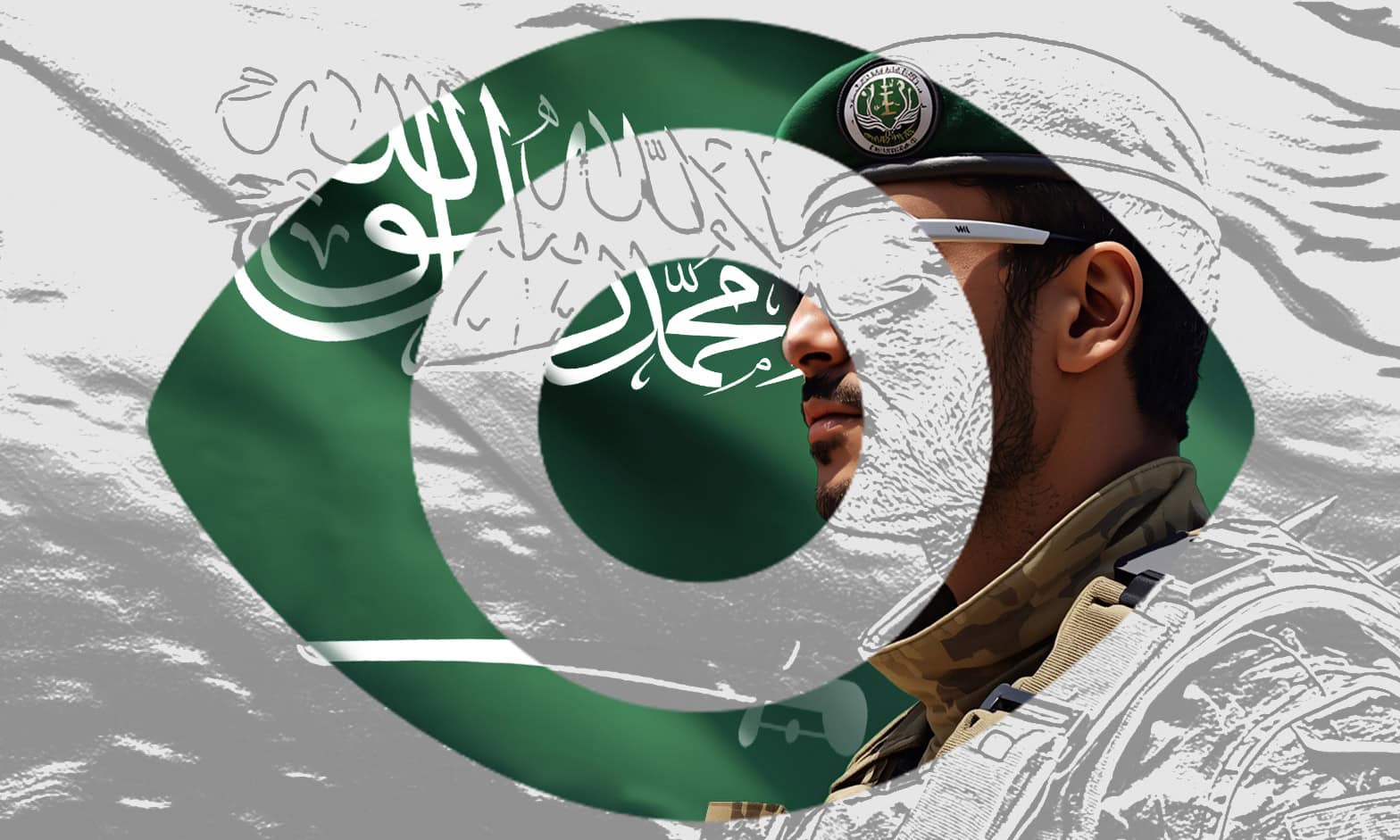
(Art direction and AI design: Jean-Dominique Lavoix-Carli)
Watch Out briefs flag geopolitical and security developments that may carry significant second-order and longer-term implications. They are designed to support early awareness and strategic monitoring. For in-depth analysis, structured risk mapping, strategic foresight and early warning, please contact us.
What
Saudi Arabia is a key actor in the US-Israel vs Iran war thanks to its strategy and geographical location. As a result of the conflict, Saudi Arabia could see its place as major regional actor enhanced. On the short term, much hinges on future Houthis’ actions.
Content
- What
- Facts and Context
- Hearsay regarding the Kingdom of Saudi Arabia support for the war against Iran
- Iranian attacks cause relatively less direct damage to Saudi Arabia than to its neighbours
- Saudi Arabia benefits from ports on the Red Sea
- Saudi Arabia can still export part of its oil and gas
- Saudi Arabia and the Houthis: Reaping the benefits of strategy?
- Why it matters and impacts
Facts and Context
Hearsay regarding the Kingdom of Saudi Arabia support for the war against Iran
- In contradiction with Saudi official statements, reputable American newspapers reportedly state support by the Kingdom of Saudi Arabia (KSA) for the U.S.-Israel war against Iran:
- According to The Washington Post, the Kingdom of Saudi Arabia reportedly supported President Trump in starting the war against Iran.1Michael Birnbaum, John Hudson, Karen DeYoung, Natalie Allison and Souad Mekhennet, “Push from Saudis, Israel helped move Trump to attack Iran“, The Washington Post, 28 February 2026.
- Similarly, according to The New York Times, at the end of March 2026, Saudi Crown Prince Mohammed bin Salman reportedly favoured and supported, in unofficial communication with the American Presidency, the continuation of the war to bring the Iranian government and regime down.2Julian E. Barnes,Tyler Pager and Eric Schmitt, “Saudi Leader Is Said to Push Trump to Continue Iran War in Recent Calls“, The New York Times, 24 March 2026. The Saudi leader is meant to have stressed the “’historic opportunity’ to remake the Middle East”.3Ibid.
- Publicly, however, KSA calls for a “peaceful resolution to this conflict”.4Ibid.
- President Trump appeared to confirm the support of the Saudi leader by highlighting, in a press conference, that “Saudi Crown Prince Mohammed bin Salman is ‘a warrior'”, claiming that “Saudi Arabia is ‘fighting with us’”.5The Times of India video, “‘MBS Is Fighting With Us’: Trump Puts Stamp On Saudi Arabia’s Role In Raging Iran War“, 25 March 2026.
- The problem with using hearsay as source is that it is impossible for anyone to check the validity of the source and the quality of information.6Hélène Lavoix, “How to Read a Large Amount of Information and Fight against Fake News“, The Red Team Analysis Society, 3 April 2019. This absolutely goes against any proper analysis, making it far more difficult if not impossible.
The U.S. system is familiar with this process of publishing hearsay as “hidden insiders information”, any unhappy political opponent using newspapers to leak possibly true information to try obtaining something.
The only thing we can seriously infer from such leaks are that there is disagreement within the American system. However, it is impossible to assess the truth and the relevance of the leaked information, as we have no verbatim and as it is impossible to know who said what, why, when and how: words can be repeated out of context, the person sharing the leak may not understand the full picture, etc.
There are a host of reasons for which such information should be taken with caution. On the other hand, it cannot either be neglected. - As a result, here, besides other negative consequences which are out of scope of this brief, we consider that these hearsay and leaks highlight the fear of the U.S. Presidency to see their war against Iran backfiring. Meanwhile, singling out Saudi Arabia and the Crown Prince stresses the important role played by the Kingdom in the American Middle East history and strategy, while stressing the Kingdom’s critical role in the region..
The two newspapers article have nonetheless potentially domestic impacts, as explained in an interesting Saudi analysis,7Mohammed Omar, “Trump Humiliates MBS on a Saudi Stage and Exposes the Alliance“, House of Saud, 28 March 2026. as well as international ones. - Now, on 27 March, at the FII Priority summit backed by the Saudi Public Investment, the American President also insulted the Saudi Crown Prince, with certain dire consequences for any relationship between the U.S. and Saudi Arabia,8Mohammed Omar, “Trump Humiliates MBS on a Saudi Stage and Exposes the Alliance“, House of Saud, 28 March 2026. without forgetting American standing on the world stage.
- As a result, it is highly likely that the Kingdom of Saudi Arabia will reinforce its objective of sovereign independence.9Ibid. Hence, the strength of Saudi Arabia’s regional power, including vis a vis the U.S., becomes even more important for the kingdom.
- Last but not least, President Trump also most probably made a mortal enemy of Crown Prince Mohammed bin Salman.
- RTAS Contribution to AMRAE’s 50th Landmark Edition of Atout Risk Manager

- RTAS Expertise Highlighted on Italian Television Channel LA7
- The Houthis, Bab el-Mandeb, and Maritime Transport
- The Strange Mystery of Bolivia’s Lithium Reserves

- Beyond Geopolitics: Understanding the Critical Pressures Reshaping Our World.

- WATCH OUT – The Iran War, Saudi Arabia, and the Houthis

- WATCH OUT – Yemen and Saudi Arabia
Iranian attacks cause relatively less direct damage to Saudi Arabia than to its neighbours
- Even though KSA is also victim of Iranian attacks,10Mark F. Cancian and Chris H. Park, “Assessing the Air Campaign After Three Weeks: Iran War By the Numbers“, CSIS, 25 March 2026. considering Saudi’s territory compared with the size of its neighbours, the strikes may appear as less intense.
- Against the backdrop of tensions with the United Arab Emirates (UAE), particularly in the economic sphere,11Mohammed Ayoob, “Saudi Arabia vs. the UAE: The Other Gulf Crisis“, The National Interest, 14 February 2026. Saudi Arabia could seize the opportunity presented by these Iranian attacks, as they diminish the appeal of the United Arab Emirates – and Dubai in particular – to foreign businesses and expatriates.
Saudi Arabia benefits from ports on the Red Sea
- KSA is not locked in the Persian/Arabian Gulf. On the contrary from its neighbours, five out of nine of its ports are on the Red Sea.12Ministry of Media – Saudi Arabia, “Saudi Ports Authority“, Saudipedia, 10 October 2025.
- The five Saudi ports on the Red Sea are:13Ministry of Media – Saudi Arabia, “Saudi Ports Authority“, Saudipedia, 10 October 2025.
- King Fahad Industrial Port in Yanbu (the largest Saudi ports in terms of capacity, and in terms of loading crude oil, refined products and petrochemicals on the coast of the Red Sea, with thirty-four docks and ten terminals);
- Yanbu Commercial Port (one of the oldest ports, capacity of 13.5 million t, twelve docks and two terminals);
- Jeddah Islamic Port (the second-largest Saudi port, “handles more than 75 percent of the cargo coming through Saudi ports”);
- Jazan Port (the smallest Saudi port, includes twelve docks and one terminal);
- Duba Port (the second smallest Saudi port in terms of capacity, includes six docks and three terminals).
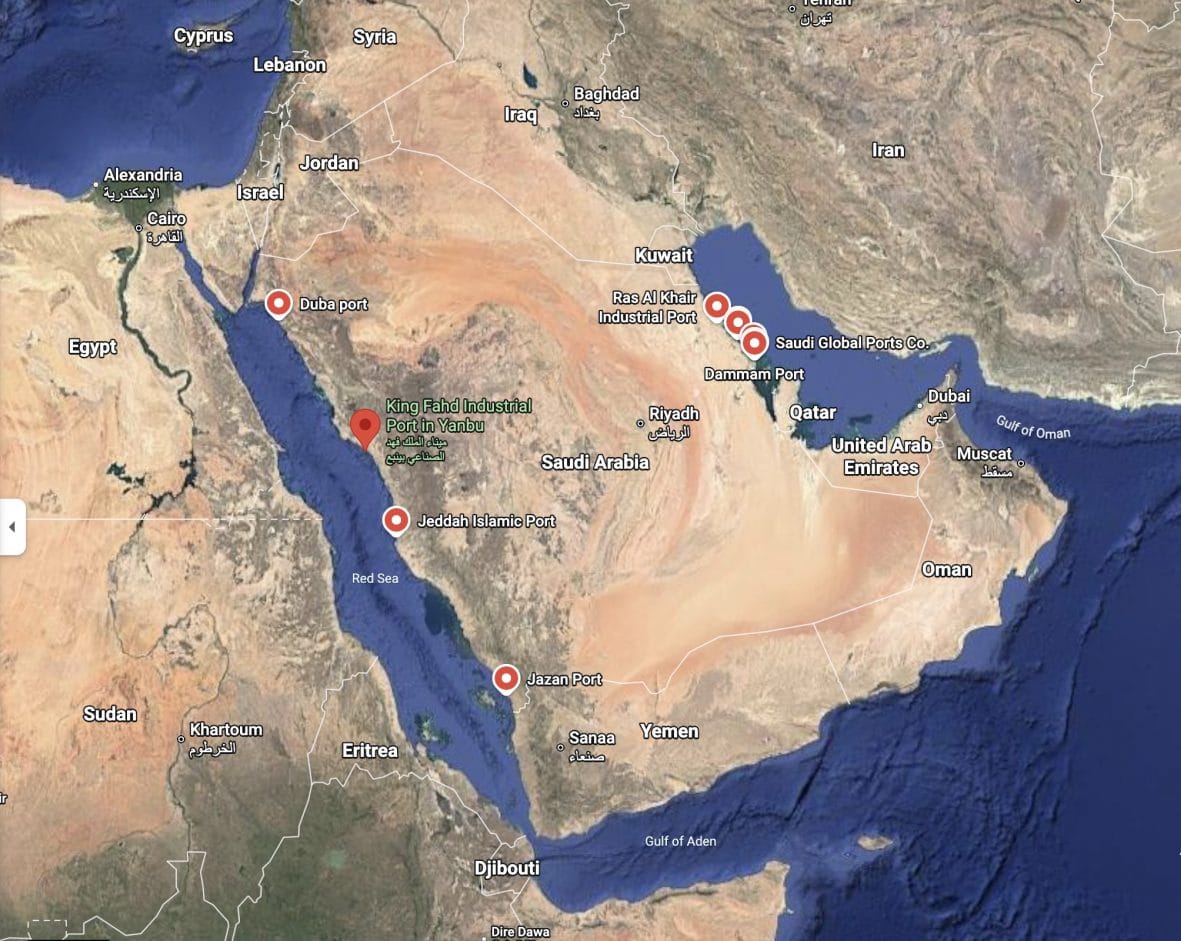
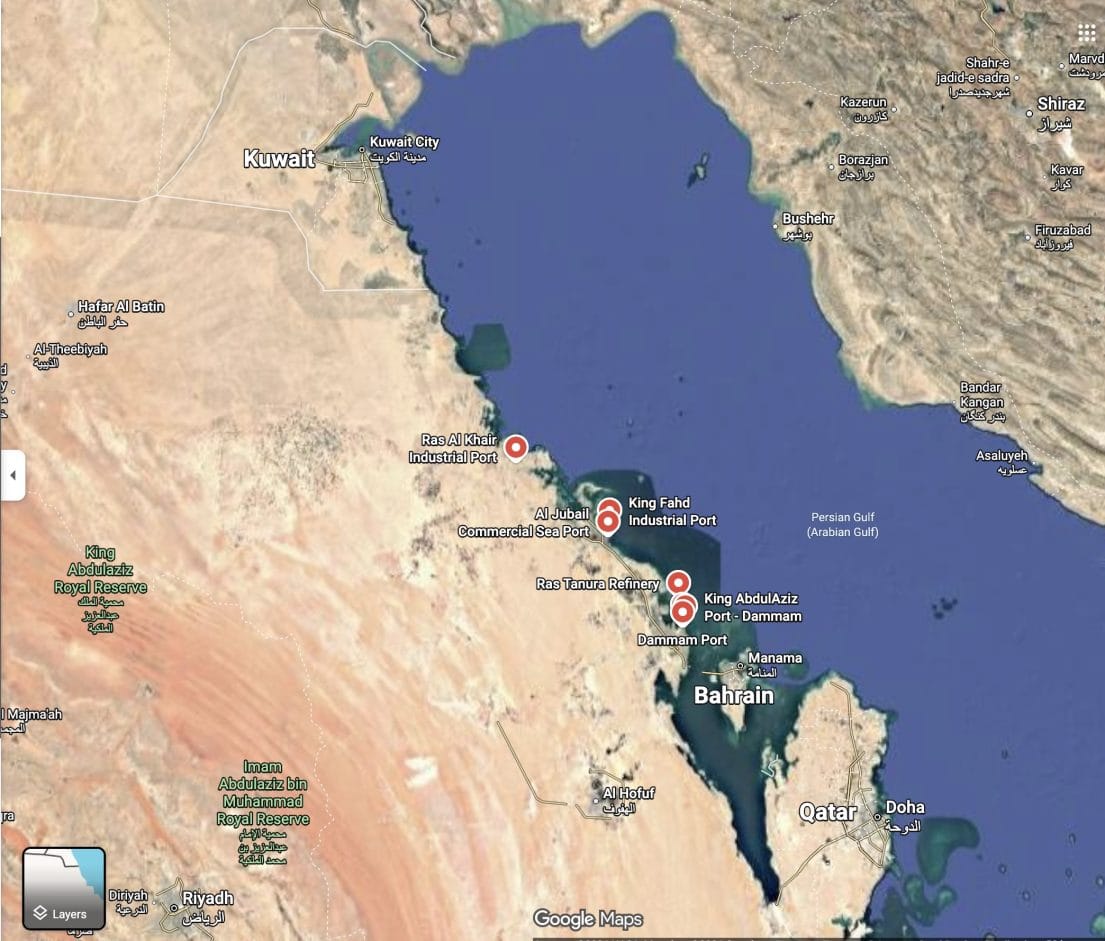
- Thus, as the Strait of Hormuz is paralysed, even though KSA loses access to its ports on the Gulf, such as Ras Al-Khair, its newest and largest port, it nevertheless may only fare relatively better than its neighbours.
- Indeed, the ports facilities of Yanbu have become key since the war. According to the Lloyd’s list, “Yanbu accounted for 11% of global seaborne crude loaded last week [3rd week of March 2026] compared to just 2% in 2025, and 30% of Very Large Crude Carrier (VLCC) demand last week vs only 5% last year”.14Greg Miller, “Houthis see no reason to ‘prevent’ Yanbu VLCC trade ‘at present’”, Lloyd’s List, 26 March 2026.
- It is also mainly through Saudi Arabia that the Gulf countries can import the goods and products they need and cannot be flown in, when planes can access their territories at all.
Saudi Arabia can still export part of its oil and gas
- Having ports outside the Persian/Arabian Gulf, the KSA can use its East-West pipeline as an alternative route for oil and gas.15IEA, Alternative routes in “Strait of Hormuz – Factsheet“, February 2026.
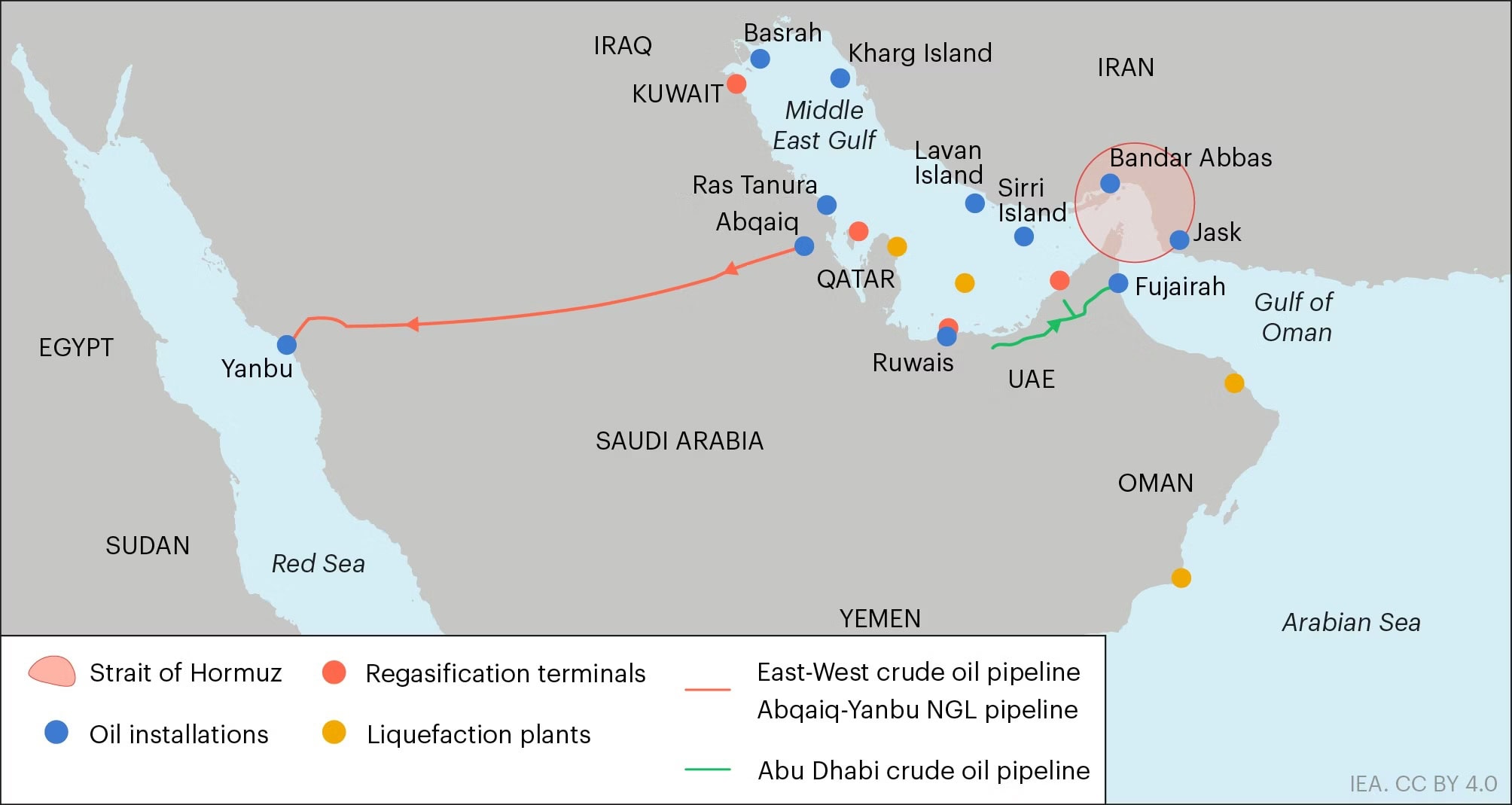
- With the closure of the Strait of Hormuz, indeed, Saudi Aramco rerouted its exports via the East-West Pipeline, which has “a capacity of 7m barrels per day” to Yanbu “with a loading capacity of around 4.5m bpd”.16Greg Miller, “Houthis see no reason to ‘prevent’ Yanbu VLCC trade ‘at present’”, Lloyd’s List, 26 March 2026.
- As a result, “Yanbu loaded 4.1m bpd of crude and condensate in the week ending March 22, more than triple the full-year 2025 average of 1.3m bpd. Last week’s volume in Yanbu was up 32% from the week before”.17Ibid.
- By 28 March 26, according to Al Arabiya, the full capacity of 7 million barrels a day was attained. Out of these, 2m bpd are for the Saudi refineries. “Crude exports via Yanbu have now reached 5 million barrels a day and the kingdom is also exporting about 700.000 to 900.000 barrels a day of oil products.”18Al Arabiya English with Bloomberg, “Saudi pipeline that bypasses Strait of Hormuz hits 7-million-barrel goal“, 28 March 26.
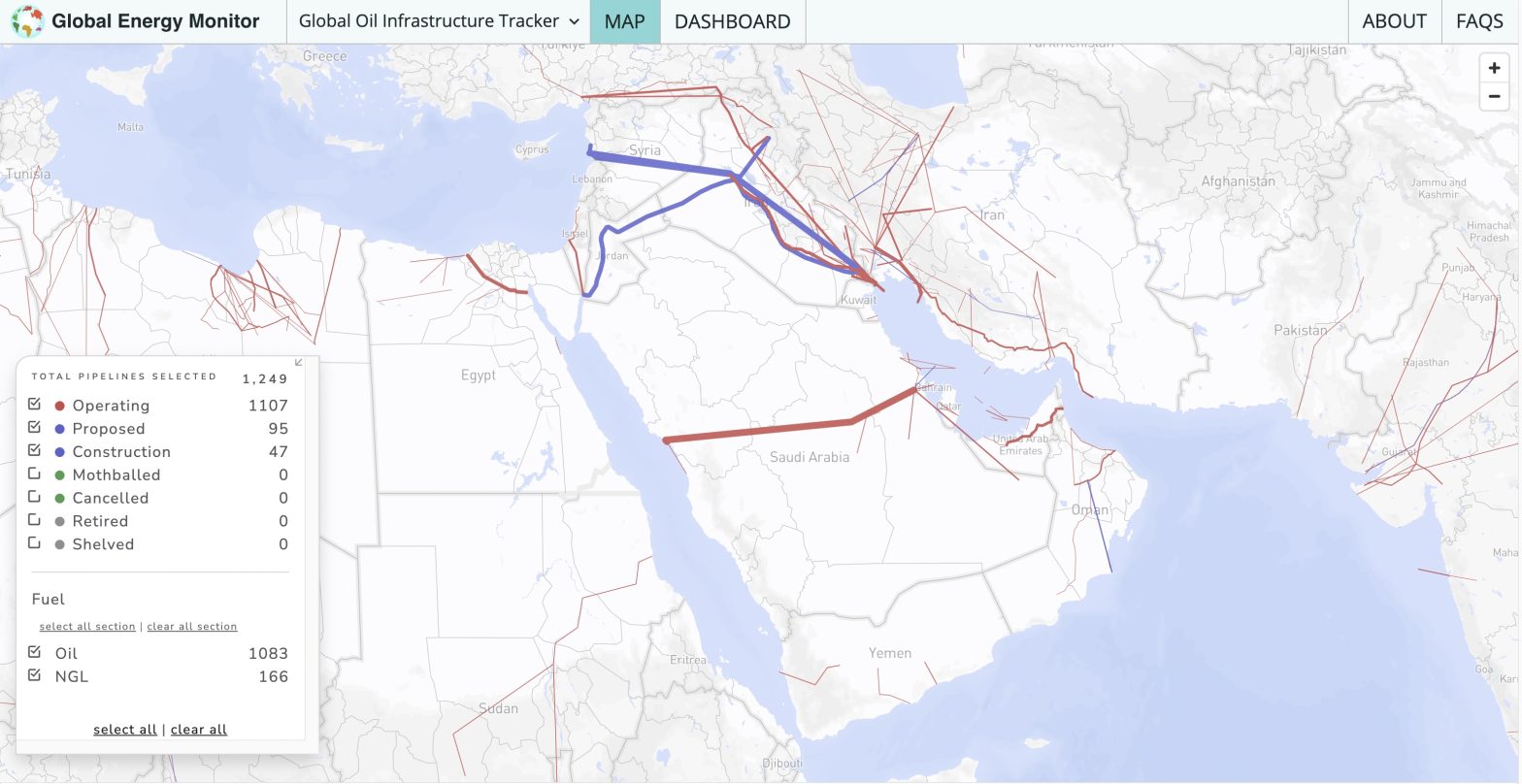
- In 2025, the amount of crude oil passing through the Strait of Hormuz was almost 15 m bpd, a third of it destined for Asia.19IEA, “Strait of Hormuz – Factsheet“, February 2026. The overall amount of oil going through the Strait reached 20 m bpd.20Ibid.
- Thus, crude oil exports out of the region sits now at one third of what it was before the start of the war. The quantity still exported by the region is actually larger, considering countries and ships that have bought and negotiated rights of transit with Iran, such as, for example, Thailand.21AFP, “Thailand says reached deal with Iran for vessels to transit Hormuz Strait“, Channel News Asia, 28 March 2026.
Meanwhile, other oil products still exported by the region represent between 14% and 18% of the pre-war quantity. - For the world, the supply shock and oil crisis remain a very vivid reality. Indeed, in a nutshell, even if the war were to stop now, the most favourable assessments estimate that at least four months would be needed to come back to normal (this does not consider a permanent post-war Iranian hold over the Strait).22Peter Armstrong, “The energy crisis has only just begun“, CBC News, 26 March 2026.
- The Saudi global leverage rises as its position in mitigating as much as possible the oil crisis and its cascading impacts is key.
- Thus, for now, Saudi Arabia also fares better than its neighbours as it can still export oil and gas.
- Furthermore, the rise of oil and gas prices also benefits the kingdom. Nonetheless, should prices continue to soar and the supply crisis also become a demand crisis, then the consequences could be less favourable to the Kingdom.23Al Arabiya English videos, What If Oil Hits $200 Globally?, 29 March 2026.
Saudi Arabia and the Houthis: Reaping the benefits of strategy?
- It is thus even more critical to see the Red Sea and the Bab el-Mandeb chokepoint free of attacks, when, in the past, the Houthis showed they could wreak havoc on maritime security there.
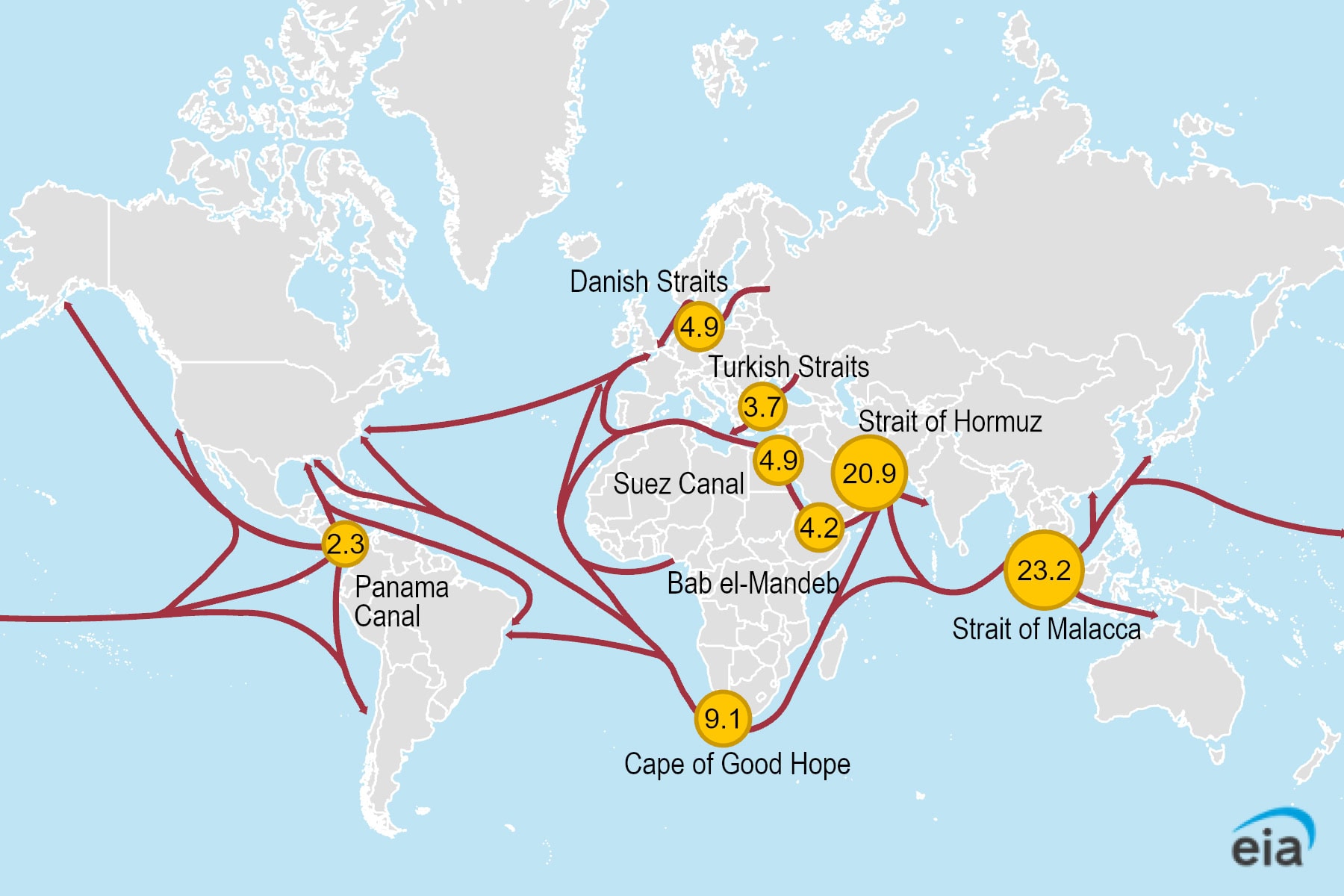
- For one month, until 28 March, the Houthis did not participate in the Iranian counter-attack.
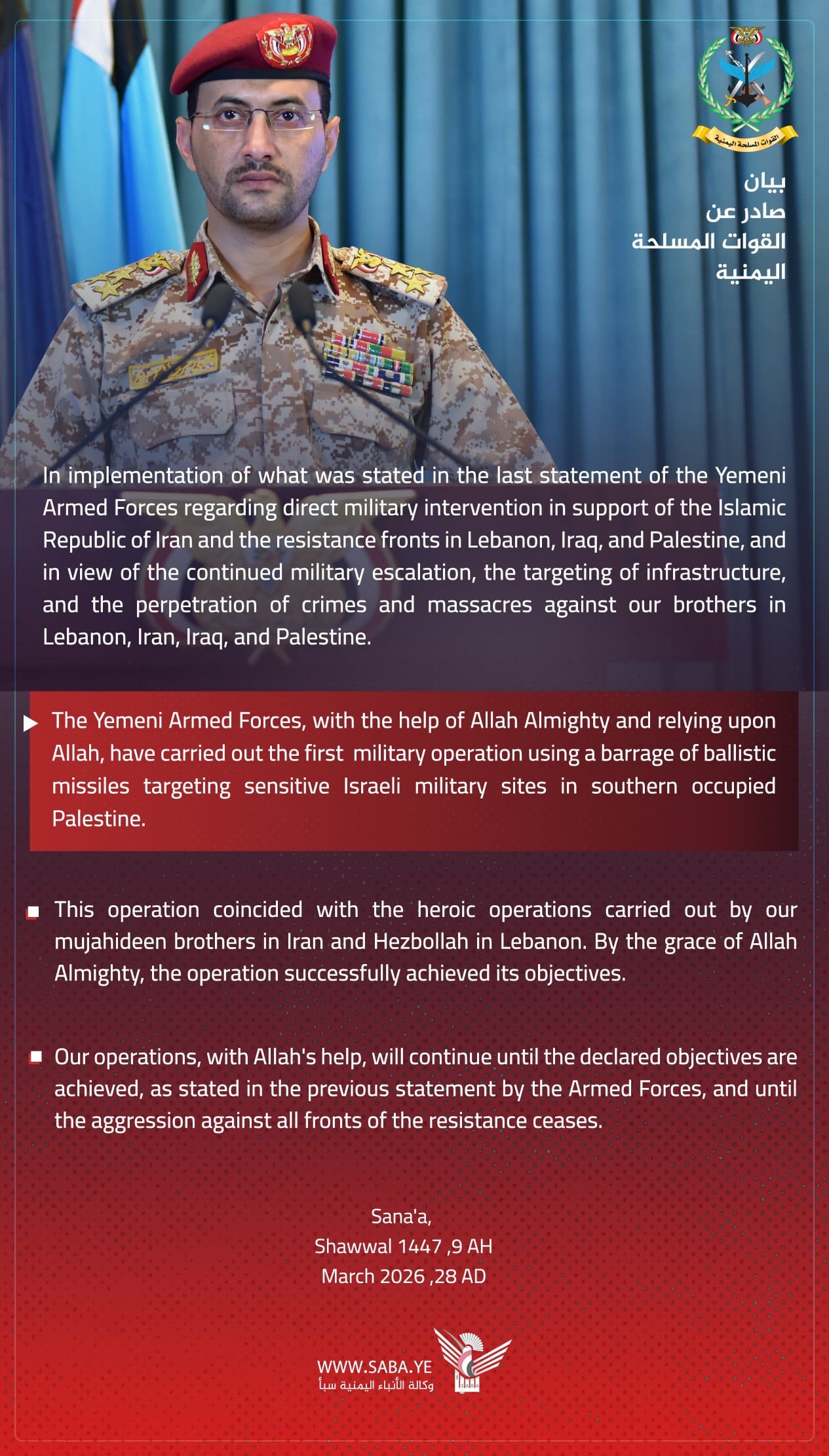
- Then,
- On 25 March 2026, Iran threatened to open a new front in Bab al-Mandeb.24Tasnim News Agency, “Opening Bab al-Mandeb Front Possible in Case of Enemy Provocation in Southern Iran: Source“, 25 March 2026.
- On 28 March, the Houthis launched a first missile on Israel, followed by a second strike and then a third strike on 30 March.25@BashaReport, 28 Mar 26; @IDFonline, 30 March 26.
- Those strikes obviously indicate that the Houthis have now entered the war, opening yet again a new front.
- However, the Houthis stroke Israel, not the Red Sea Shipping lanes nor the Bab el-Manbed Strait.
- This is where the Saudi Strategy, we signalled in our 26 February “WATCH OUT – Yemen and Saudi Arabia“, becomes fundamental.
- We should more particularly note that:
- The Saudis have been negotiating with the Houthis and that, by early February 2026, relations were considered as having “stepped up significantly”, including an implicit agreement according to which the Houthis forces would assist Yemen’s internationally recognised government in securing the Saudi-Yemeni border in exchange for Saudi funds, weapons, and ammunitions.26Memri Special Dispatch N°12356 “Report-Iran sponsored Saudi-Houthis agreement: Bin Salman sent weapons and funds to Houthis“.
- Negotiations are also mentioned by CGTN quoting Li Yanan, deputy director of the Chinese Middle East Institute at CICIR: “the Houthis’ intervention risks collateral damage to regional diplomacy, especially the fragile reconciliation between Saudi Arabia and the Houthis.”27Chen Guifang, “Houthis have entered the monthlong Middle East war: What now?“, CGTN, 29 March 2026.
- The Saudi strategy in the region, its action in Yemen and the negotiations and relations with the Houthis might protect, for a while, the Red Sea and the Bab el-Mandeb Strait from Houthi strikes. A couple of indications, however preceding the 28 March strikes could send such signals:
- Abduhlmalik al-Houthis remarks on the 11th Anniversary of the war in Yemen focused on the domestic dimension, conflicts dynamics with Saudi Arabia and demanding compensations and reparations to the latter. They signalled support to Iran but without “declaring war or new operations”.28Mohammed Albasha, “Al-Houthi Unveils $57 Billion Losses, Pressures Saudi Arabia for Compensation – Houthi Signals Support for Iran Without Declaring War or New Operations”, Basha Report’s Substack, 26 March 2026.
- Lloyd’s List contacted the Houthi’s Humanitarian Operations Coordination Center, in charge of Red Sea navigation regarding “Saudi crude trade” in the Red Sea. The HOCC answered that there was no reason for concern, and that they remained committed to “safeguarding navigation in the Red Sea and the Bab el Mandeb strait, as well as ensuring the free flow of trade.”29Greg Miller, “Houthis see no reason to ‘prevent’ Yanbu VLCC trade ‘at present’”, Lloyd’s List, 26 March 2026.
- We may make the hypothesis that the Houthis use a multiple strategy.30Other analysts have similar perspectives, e.g.Chen Guifang, “Houthis have entered the monthlong Middle East war: What now?“, CGTN, 29 March 2026; Mohammed Albasha, Basha Report’s. They strike at Israel, which is their main enemy. By doing so, they show their support to Iran, and remind all players of their strength and power, which gives them a stronger hand in any dealing with KSA. Meanwhile, they could also be looking to KSA as an alternative strong player. With KSA, they may seek their integration within the emerging new Yemen, their primary focus, while looking to obtain as much compensation and advantages as possible.
- Further research would be needed to establish this possibility, but the Houthis may also ponder whether they have a card to play in the oil and gas sector, considering the closure of the Strait of Hormuz and the destruction of facilities in the Gulf in the wake of the war. Assuming it is technically and operationally feasible, they may hope for an international pardon, should they bring their production to the world. The international status gained by Syrian President Ahmed al-Sharaa, despite having created the Al-Nusra Front with the support of al Qaeda, and fought as Al-Nusra leader before to break with al Qaeda, may not have been lost on the Houthi leadership.
- KSA, as privileged interlocutor of the Houthis, would benefit, in terms of influence, if the Houthis did not disturb further oil transit. The Kingdom has also a critical responsibility and role to play.
- Positions are fleeting and changes swift, thus the situation must continue to be closely monitored.
- The Saudi ports – as the East-West pipeline, remain, nonetheless, within range of Iranian missiles.31Greg Miller, “Houthis see no reason to ‘prevent’ Yanbu VLCC trade ‘at present’”, Lloyd’s List, 26 March 2026.
Why it matters and impacts
- Saudi Arabia is an increasingly key player in the region.
- On the short term, besides, of course, American and Israeli decisions on the one hand, Iranian ones on the other, much depends on the Houthis, KSA and the interactions between the two. The Houthis’ decisions are likely to be also influenced by the way Saudi Arabia negotiates with them, depending on their objectives. At the same time, the Houthis’ perception of Saudi Arabia’s regional power, particularly in comparaison with Iran, against the backdrop of the overall evolution of the war and the situation in Yemen, will act as a filter that influences the armed group’s decisions and actions.
- Should the Houthis successfully and repeatedly attack the Red Sea, the Bab el-Mandeb Strait and the Yanbu port, then the world would be further precipitated into a multi-dimensional deep crisis.
- On the contrary, peace in Yemen could bring in new oil and gas production to the world, partially offsetting the decrease resulting from the war destruction in the Gulf.
- In any case, as long as the war lasts, world maritime traffic and oil exports are still being at risk of direct Iranian attacks.
- It is likely that Saudi Arabia will be regionally stronger after the war against Iran than before, even more so if the Houthis do not attack the Red Sea, the Bab el-Mandeb Strait and the Yanbu port.
- As we are under the fog of war, conditions may change very quickly. The situation must be closely monitored.
→ For commissioned in-depth analysis, structured risk mapping and strategic foresight and early warning: contact us.
Further reading
Eleonora Ardemagni, “Riyadh takes the helm in Yemen“, Middle East Institute, 25 February 2026.
Hayat Gazzane, “Pays autorisés, péage… Sous quelles conditions les navires passent-ils le détroit d’Ormuz ?“, Les Echos, 25 March 2026.
EIA, “World Oil Transit Chokepoints“, 3 March 2026.
Dr Naji Abi-Aad, “Gas and Oil Pipelines in the Middle East – Merits and Demerits“, Gulf Research Center, February 2026.
IEA, “Saudi Arabia“.
Notes
- 1Michael Birnbaum, John Hudson, Karen DeYoung, Natalie Allison and Souad Mekhennet, “Push from Saudis, Israel helped move Trump to attack Iran“, The Washington Post, 28 February 2026. ↩︎
- 2Julian E. Barnes,Tyler Pager and Eric Schmitt, “Saudi Leader Is Said to Push Trump to Continue Iran War in Recent Calls“, The New York Times, 24 March 2026. ↩︎
- 3Ibid. ↩︎
- 4Ibid. ↩︎
- 5The Times of India video, “‘MBS Is Fighting With Us’: Trump Puts Stamp On Saudi Arabia’s Role In Raging Iran War“, 25 March 2026. ↩︎
- 6Hélène Lavoix, “How to Read a Large Amount of Information and Fight against Fake News“, The Red Team Analysis Society, 3 April 2019. ↩︎
- 7Mohammed Omar, “Trump Humiliates MBS on a Saudi Stage and Exposes the Alliance“, House of Saud, 28 March 2026. ↩︎
- 8Mohammed Omar, “Trump Humiliates MBS on a Saudi Stage and Exposes the Alliance“, House of Saud, 28 March 2026. ↩︎
- 9Ibid. ↩︎
- 10Mark F. Cancian and Chris H. Park, “Assessing the Air Campaign After Three Weeks: Iran War By the Numbers“, CSIS, 25 March 2026. ↩︎
- 11Mohammed Ayoob, “Saudi Arabia vs. the UAE: The Other Gulf Crisis“, The National Interest, 14 February 2026. ↩︎
- 12Ministry of Media – Saudi Arabia, “Saudi Ports Authority“, Saudipedia, 10 October 2025. ↩︎
- 13Ministry of Media – Saudi Arabia, “Saudi Ports Authority“, Saudipedia, 10 October 2025. ↩︎
- 14Greg Miller, “Houthis see no reason to ‘prevent’ Yanbu VLCC trade ‘at present’”, Lloyd’s List, 26 March 2026. ↩︎
- 15IEA, Alternative routes in “Strait of Hormuz – Factsheet“, February 2026. ↩︎
- 16Greg Miller, “Houthis see no reason to ‘prevent’ Yanbu VLCC trade ‘at present’”, Lloyd’s List, 26 March 2026. ↩︎
- 17Ibid. ↩︎
- 18Al Arabiya English with Bloomberg, “Saudi pipeline that bypasses Strait of Hormuz hits 7-million-barrel goal“, 28 March 26. ↩︎
- 19IEA, “Strait of Hormuz – Factsheet“, February 2026. ↩︎
- 20Ibid. ↩︎
- 21AFP, “Thailand says reached deal with Iran for vessels to transit Hormuz Strait“, Channel News Asia, 28 March 2026. ↩︎
- 22Peter Armstrong, “The energy crisis has only just begun“, CBC News, 26 March 2026. ↩︎
- 23Al Arabiya English videos, What If Oil Hits $200 Globally?, 29 March 2026. ↩︎
- 24Tasnim News Agency, “Opening Bab al-Mandeb Front Possible in Case of Enemy Provocation in Southern Iran: Source“, 25 March 2026. ↩︎
- 25
- 26Memri Special Dispatch N°12356 “Report-Iran sponsored Saudi-Houthis agreement: Bin Salman sent weapons and funds to Houthis“. ↩︎
- 27Chen Guifang, “Houthis have entered the monthlong Middle East war: What now?“, CGTN, 29 March 2026. ↩︎
- 28Mohammed Albasha, “Al-Houthi Unveils $57 Billion Losses, Pressures Saudi Arabia for Compensation – Houthi Signals Support for Iran Without Declaring War or New Operations”, Basha Report’s Substack, 26 March 2026 ↩︎
- 29Greg Miller, “Houthis see no reason to ‘prevent’ Yanbu VLCC trade ‘at present’”, Lloyd’s List, 26 March 2026. ↩︎
- 30Other analysts have similar perspectives, e.g.Chen Guifang, “Houthis have entered the monthlong Middle East war: What now?“, CGTN, 29 March 2026; Mohammed Albasha, Basha Report’s. ↩︎
- 31Greg Miller, “Houthis see no reason to ‘prevent’ Yanbu VLCC trade ‘at present’”, Lloyd’s List, 26 March 2026. ↩︎