
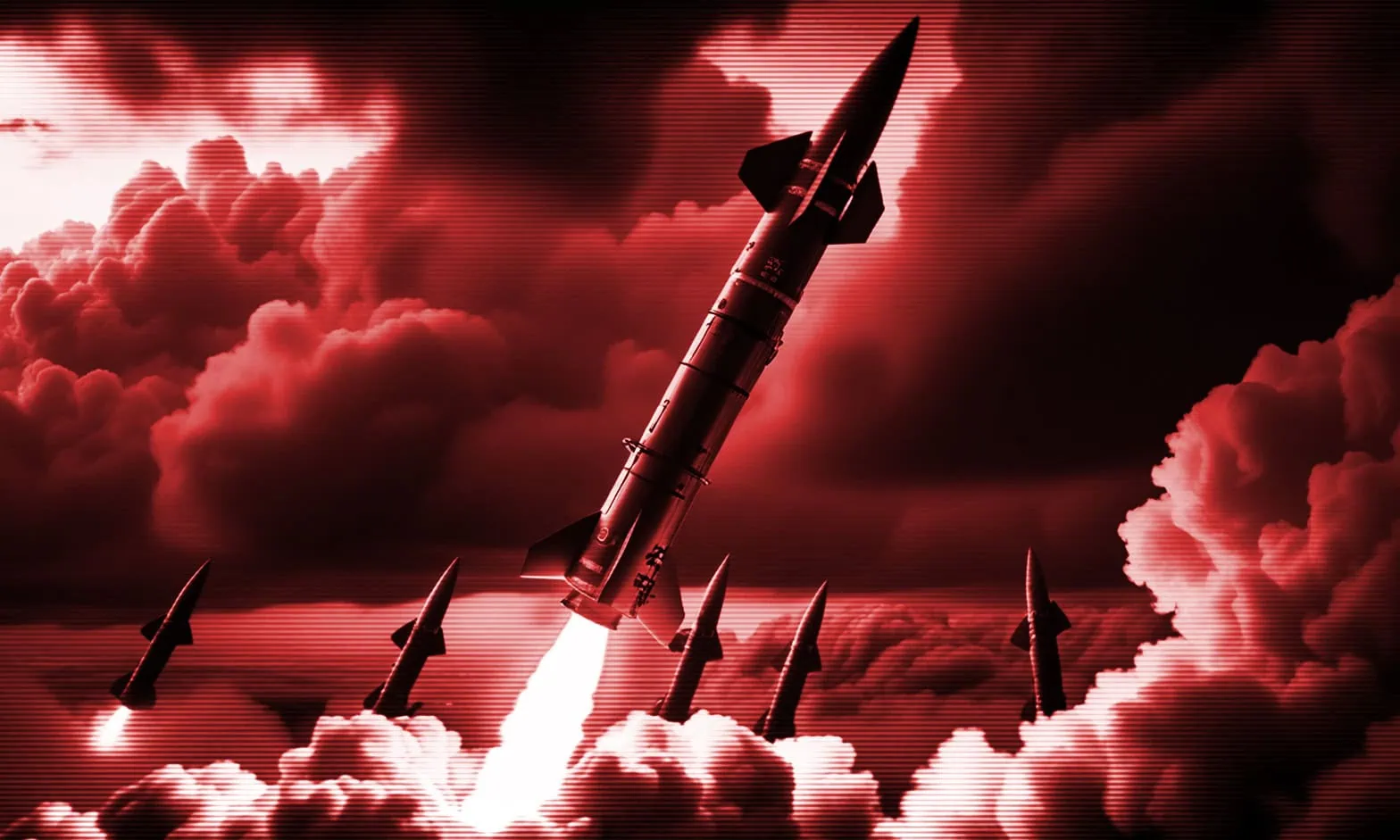
(Art direction and design; illustration
created with AI: Jean-Dominique Lavoix-Carli)
Given the extreme density of the strategic situations involved, the main focus of this article is the technological dimension of the “12 days war” between Israel and Iran, and the strategic meaning of those technological advances.
A new way of war in the Middle East ?
Infiltrated Israeli drone teams destroy Iran air defences on Iran soil, while eliminating military and political high profile persons. Israeli fighter-bombers dominate Iran air space. Iranian hypersonic missiles reach 400 km altitude before falling on Israeli precise targets…
The Israel anti-aerial defense, which compounds the Arrow, the David Sling and the Iron Dome, can’t intercept all of the Iranian missiles and drones. Massive cyber-attacks hammer Iran infrastructures. AI-led Information and psychological warfare takes place on the world stage… Then, on 21 June, 7 U.S. Air Force B-2 stealth bomber launch 12 GBU « bunker busters » against the three main Iran nuclear sites.
A singular war
Those are some of the technological and military features of the “12 days Israel-Iran war”. If we focus further on them, then they appear as deeply singular. Indeed, they correspond to the involvement of two countries in a direct hot war, yet without significant ground fighting operations.
On the contrary, the involvement of both Israeli and Iranian vectors take place in the vertical dimension, both atmospheric and spatial (Jay Pasquarette, “Rising Lion: Escalation, Objectives and the Logic of Targetting”, Small Wars Journal, 06/19/20225).
- RTAS Expertise Highlighted on Italian Television Channel LA7
- The Houthis, Bab el-Mandeb, and Maritime Transport

- The Strange Mystery of Bolivia’s Lithium Reserves

- Beyond Geopolitics: Understanding the Critical Pressures Reshaping Our World.

- WATCH OUT – The Iran War, Saudi Arabia, and the Houthis

- Chronicles of the Hyperwar – AI: AI, the New Energy Frontier (1)

- SIGNAL – The Golden Dome, a New Technological Frontier

In other words, this conflict reveals the emergence of the technological uses of strategies that we refer to as “hyper war”. In other words, this corresponds to the design of strategies that mobilize the full potential of very different domains.
Those domains concern cyberspace as well as AI-led-vectors at very high altitude and in space, as well as AI cognitive warfare. This mobilization literally encompasses not only the military of the antagonists but also its infrastructure and society.
Thus, first, we focus on the Israeli hyper offensive and on the Iranian military reaction. Then we stress the unique scale of this war, that prolongs itself into the “first space war”. From there, we’ll try to understand the way an “hyperwar” induces an evolution in war, and its consequences.
Hyperwar escalation
A chain of strikes
The Israeli political and military authorities launched the operation “Rising Lion” against Iran on 13 June 2025. This operation unfolded through aerial bombings of Iran nuclear sites, while several targeted killings of key military, political and scientific Iranian officials took place.
The bombings and killings campaign was the result of a massive hybrid operational strategy (Daria Dolzikova and Matthew Savill, “Operation Rising Lion: The first 72 hours”, The Royal United Services United-RUSI, 16 June 2025).
Indeed, the Iranian air defense system was brought down by the synergy of three different modus operandi articulated along different phases. It seems that a first sequence was the series of Israeli bombings on Iran air defences in October 2024 (Jean-Michel Valantin, “AI at War (3) – Hyperwar in the Middle East”, The Red Team Analysis Society, October 24, 2024.
According to Israeli information services, this first sequence was followed by the infiltration of Mossad commandos and Iran. Those commandos established drone arsenals that were used against a series of air defenses located in Western Iran (Benjamin Jensen, “Ungentlemanly robots: Israel’s operation “Rising Lion” and the New Way of War”, CSIS, 13 June 2025 and Mikheil Kashidze “The Mossad web: How Israeli intelligence prepared a covert strike in Iran“, The Times of Israel, 13 June 2025).
Then, in parallel, a series of cyberattacks and missile strikes hit Iranian defences. Thus, a 200-strong fleet of Israeli fighter-bombers could attack on-the-ground nuclear military. (Dolzikova and Savioll, ibid).
Target and kill
In parallel to those strikes, the Israeli military waged a campaign of targeted killings. Drone and missile strikes eliminated the heads of the Iranian Revolution Guardian Corps (IRCG), and the heads of the Iranian military chiefs of staff. Several key scientific figures of the Iran nuclear program were also killed (Dolzikova and Savill, ibid).
According to Euronews, those targeted killings were made possible by an extensive use of AI to process electronic and human intelligence. The AI processing of signals and information allowed the Israeli military to pinpoint, track and target high profile figures of the Teheran regime with an unheard of level of precision (“Israel’s spy agency used AI and smuggled-in drones to prepare attack on Iran, sources say”, Euronews, AP, 18/06/25). The synergy of bombings, sabotages, drones and cyberwarfare appears as a new form of hybrid operational warfare, at a very large scale.
The first space war
However, despite extensive damages to the Iran military, those strikes triggered an impressive array of Iranian responses. Those took the form of several waves of ballistic missile and drone attacks of the Israeli territory. It seems that the missile waves were a mix of old and new, very high-tech, ballistic missiles (Sebastian Seibdt, “What Iran reprisals against Israel reveal of its ballistic missiles capabilities”, France 24, 18/06/2025).
As it happens, between 13 and 20 June, some Iranian ballistic missiles were able to penetrate the Israeli air defences. It is the result both of the relative efficiency of the Iranian missiles and of the overuse of the Israeli defense system ( David Daoud and Ahmed Sharawi, “Iranian drones and missiles attacks on Israel” series, FDD’s Long War Journal).
It appears that those Iranian strikes made it very difficult for the Israeli multi-layered air defence system to intercept all of them. (Ari Cicurel, Yoni Tobin, “Hezbollah’s new drone threat to Israel”, The Jewish Institute for National Security of America / JINSA, July 2, 2024, Bassem Mroue, “The threat Israel didn’t foresee: Hezbollah’s drone power”, AP, August 9, 2024).
Ballistic and hypersonic power
This rate of penetration is related to strikes that appear as including several “Fattah” hypersonic missiles. Those ballistic missiles integrate AI systems in order to be able to self-correct their Mach 5 trajectory. While there is a debate about it, it appears that some of these hypersonic missiles were launched against the multi-layered Israeli defences. (“Is it a dragon? Iran’s mysterious hypersonic Fattah missile, flying at 15 times the speed of sound, goes viral”, The Economic Times, 18 June 2025 and Devika Bhattacharya, “October 2, 2024 and “ Fattah 2: How Iran used hypersonic missile to pierce Israel’s air defence”, India Today, “How Iran Fattah and Gahdr missiles defeated Israel’s advanced air systems”, The Economic Times, October 3, 2024).
As it happens, the interception of the Iranian and possibly hypersonic missiles took place at 300 km or 400 km of altitudes,thus, well above the 100 km Karman line that defines the limit between the atmosphere and the exo-atmospheric altitude and outer space. .
According to Clausewitz, the act of war is defined by the polarity between attack and defense (Carl von Clausewitz, On War, 1832,Penguin Classics, London).
It follows that the interception of ballistic missiles by the Israeli Arrow 3 system in the exo-atmospheric altitude installs transposition of the attack and-defense dialectics in the outer space medium. Thus, as stated by Adam Tooze, the “12 days war” happens to be the first space war ( Adam Tooze, “Incoming from out of space: The geo-military radicalism of Iran v. Israel 2025”, Chartbook 392, 20 June 2025.
War and fake
However, As we have seen in previous articles, since 2022 and the Ukraine war, and since 2023 and the Gaza war, the use of digital and AI technologies has transformed “classical” information warfare into “performative and cognitive warfare” (Jean-Michel Valantin, “The war in Gaza and China’s pivot to the Middle East”, The Red Team Analysis Society, November 22, 2023, “The war in Gaza and China’s pivot to the Middle East”, The Red Team Analysis Society, November 22 and Matthew Ford and Andrew Hoskins, Radical War, Data, Attention and Control in the 21st Century, Hurst Publishing, 2022).
According to BBC Verify, multiple online platforms have hosted a tsunami of fake news, fake videos and fake pictures about siraeli and Iranian damages, loss and destructions (Matt Murphy, Olga Robinson, Shayan Sardarizadeh, “Iran-Israel conflict unleash wave of disinformation”, BBC Verify–BBC, 19 June 2025). Some of them have attracted more than 100 million viewers.
Down, not down
For example, on the side of Iranian supporters, some fake pictures of a downed Israeli fighter-bomber have had tremendous international success. On the Israeli side, fake videos have shown demonstrations taking place in Teheran against the regime (BBC Verify, ibid).
Indeed, the information war strategy of both Israel and Iran triggers an enormous and emotionally turbo-charged “conflict of interpretation” of these fake pictures and videos. This “conflict of interpretations” infuses and immerses through constant dialectics the different levels of the political and military decision-making processes of belligerent states and governments. (Man, the State, and War: A Theoretical Analysis by Kenneth N. Waltz, New York, Columbia University: 1959).
Meanwhile, this performative/political efficiency infuses the public opinions all around the world with real and fake pictures. Those images trigger powerful collective emotions in Israel, in Iran as well as in the rest of the world.
Thus, the weaponization of generative AI becomes an « emotional force multiplier ». (Rayna Breueur, “How AI fakes fuel the Iran Israel war”, DW, 25 June 2025 and Hélène Lavoix “When Artificial Intelligence will Power Geopolitics – Presenting AI”, The Red Team Analysis Society, November 27, 2017 and “Exploring cascading impacts with AI”, The Red Team Analysis Society, May 17, 2023 and “Portal to AI-Understanding AI and Foreseeing the AI powered world”, “Portal to Quantum Information Science and Technology- Towards a Quantum AI World ?” The Red Team Analysis Society .).
Weaponizing social networks
This strategy is tantamount to a cognitive warfare strategy. Indeed, the global diffusion of these videos on social medias is turning them into cognitive and emotional ammunitions.
Furthermore, through the use of individual smartphones, those cognitive ammunitions impact millions of individual brains and psyches. Then, the collective addictions to social networks literally “reinforces” and distributes those “impacts” at a very large scale. (Annamaria Sabû, Gabrielas Anca, “Using artificial intelligence tools for obtaining cognitive warfare advantage”, The Defence Horizon Journal, October 2023, 2023).
Cognitive strikes
Those « cognitive strikes » are all the more powerful because of the AI produced reinforcement algorithms inherent to social networks. Those algorithms monitor the behaviour and preferences of each user. Through this knowledge, the algorithms multiply contacts between each user and videos with an high index of « popularity ». (Cathy O’Neill, Weapons of Math Destruction, How Big data increases inequality and threatens democracy, Penguin Books, 2017 and Paul Scharre, Four Battlegrounds, Power in the age of artificial intelligence, W.W. Norton & Company, 2023).
So, the very logic of social networks becomes a « cognitive force multiplier ». Thus, it turns both Iran and Israel into « performative and cognitive warfare great powers ». With such tools, Iran is now waging a cognitive war against Israel. This strategy is a new way to wage « political warfare », thanks to the weaponization of digital and AI tools.
War, what is it good for?
The military escalation between Israel and Iran from 13 to 24 June stopped, at least temporarily, after the US bombing of the three main Iran nuclear sites. At the time of writing, the concrete results of the USstrikes are still debated. However, it already appears clearly that the military escalation between Israel and Iran was a new form of highly technological hybrid warfare.
Feedback loop
Indeed, while using drones and air defences, both belligerent also used the exo-atmospheric medium as a battlefield, while extending their conflict into the collective cognitive realm through the use of generative AI.
Thus, both belligerents create a gigantic feedback loop between military, informational, cognitive and political warfare (Hélène Lavoix, “Information Warfare and the War in Ukraine”, The Red Team Analysis Society, May 24, 2022).
In this, one may see that there are numerous continuities between the operational dimension of the “12 days war” on the one hand, the Ukraine war, the Gaza war and the Red Sea war, on the other.
Indeed those different conflicts are also “laboratories” for new tactics and operational strategies deriving from the new capabilities (Jean-Michel Valantin in The Red Team Analysis, “AI at War (1) – Ukraine”, 8 March 2024 and “AI at War (2), Preparing for the U.S-China War ?“, 17 September 2024 and Jay Pasquarette, “Rising Lion: Escalation, Objectives and the Logic of Targetting”, Small Wars Journal, 06/19/20225).
The future of coming wars
These new capabilities emerge from recent technological breakthrough, such as drones, AI and the militarization of social networks. However, the opening up of exo-atmospheric medium may have deep consequences both in operational terms and in conventional deterrence terms. Indeed, if hypersonic missiles become capabilities for war in space, it opens up the possibility of other and very large scale conflicts, through the use of the exo-atmospheric medium medium.
This begs the question of the way great powers such as the U.S., China and Russia are going integrate those new capabilities to the international arms race.


Great article, Dr. Valantin! It is astonishing how war has moved away from traditional battlefields toward AI-driven, space-based, and information-centered conflicts. The idea of “cognitive warfare” is truly disturbing and highlights a new reality we are living in, often without even noticing.