
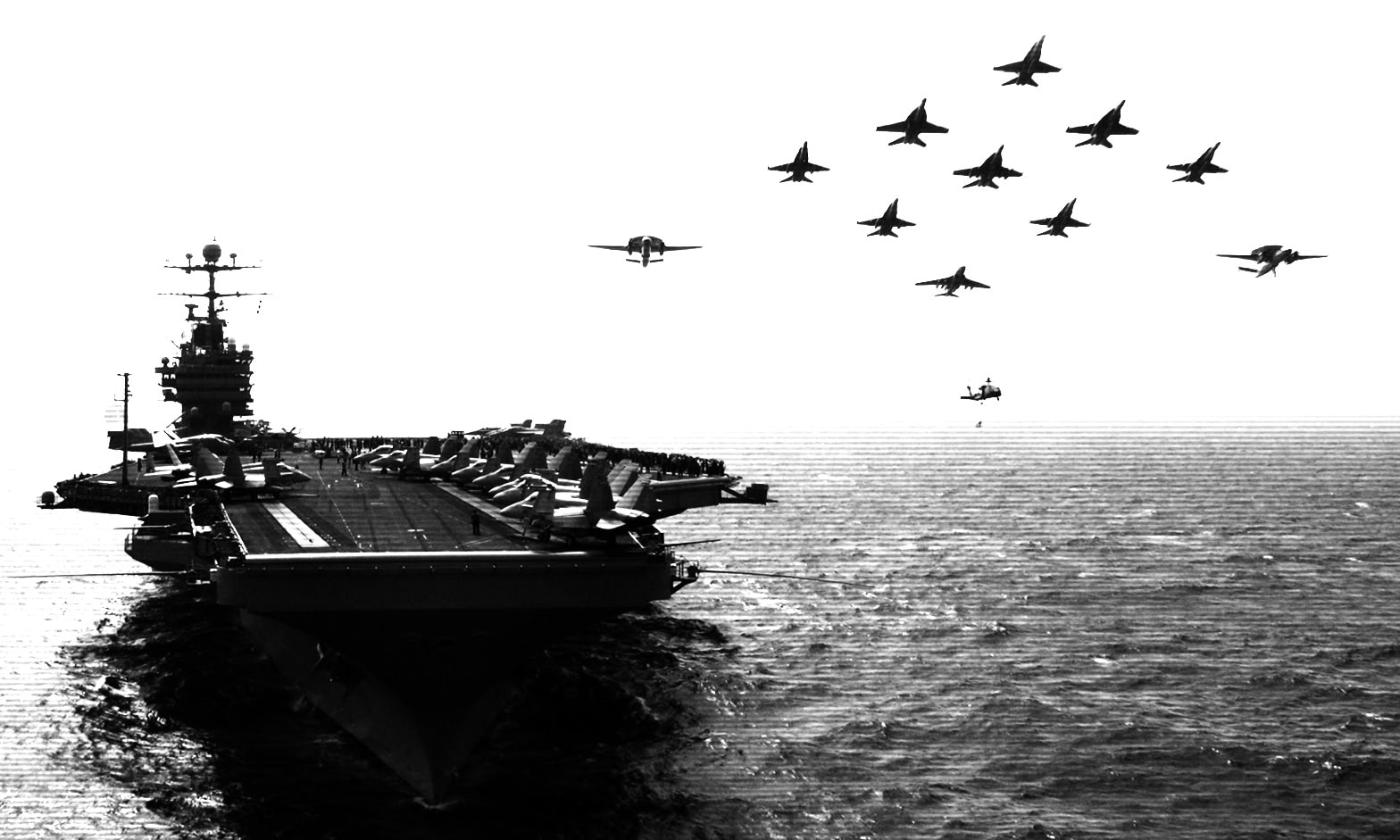
(Art design: Jean-Dominique Lavoix-Carli
Image: USS Abraham Lincoln, Public Domain)
Iran crisis
While the mullahs’ regime is carrying out appallingly violent repression against its own population, American political and military authorities are pre-positioning a maritime, air, and land military force of historic proportions in the Persian Gulf.
- On January 23, 2026, the aircraft carrier USS Abraham Lincoln and its battle group, composed of three guided-missile destroyers and a submarine, will be deployed. However, even though this deployment dramatically changes the scale of the American military presence in the Middle East-Persian Gulf region, it also entails a very large-scale military and geostrategic risk.
- Furthermore, in June 2025, the US Air Force participated in the “Twelve Day War,” which pitted Israel against Iran, with the aim of destroying Iran’s nuclear program, which, however, was only degraded. However, Iran possesses high-level military capabilities and plays a major role in China’s grand strategy of the “Belt and Road Initiative.”
- Therefore, as things stand on January 26, 2026, it is essential to grasp the interconnected issues arising from the interaction between the deep crisis within the Mullah regime and its appalling repression of Iranian protesters, and the American, Israeli, and British military mobilization.
- Furthermore, it is important to bear in mind that the Persian Gulf exports 20 million tons of oil per day, representing 20% of global production. Fifty percent of Iranian oil is exported to China.
- RTAS Expertise Highlighted on Italian Television Channel LA7
- The Houthis, Bab el-Mandeb, and Maritime Transport
- The Strange Mystery of Bolivia’s Lithium Reserves

- Beyond Geopolitics: Understanding the Critical Pressures Reshaping Our World.

- WATCH OUT – The Iran War, Saudi Arabia, and the Houthis

- Chronicles of the Hyperwar – AI: AI, the New Energy Frontier (1)

- SIGNAL – The Golden Dome, a New Technological Frontier

Thus, the confrontation between the American military and Iran is part of the escalating tensions between Washington and Beijing.
We argue here that the phenomenal scale of the American military mobilization indicates Washington’s political will to destabilize the regime. But by its very nature, this strategy implies accepting the destabilization of China’s Belt and Road Initiative and an increase in tensions with Beijing.
1. “Help is coming”
On December 28, 2026, due to catastrophic inflation, a massive water crisis, and a general deterioration of living conditions, protests against the mullahs’ regime began to multiply in Iran. These protest movements quickly spread on a massive scale. The mullahs’ regime reacted with immense violence.
The Revolutionary Guards, supported by squads from Lebanese Hezbollah, repressed, massacred, arrested, raped, and tortured tens of thousands of people. Nearly 35,000 people were reportedly killed in three weeks. The internet was blocked, and Starlink connections were jammed.1Jean-Michel Valantin, Chronicles of the Hyperwar / AI : Elon, the mullah and the satellites, 19 January 2026.
Chronicles of Hyperwar/AI (1): Elon, the Mullah and the Satellites
Faced with this situation, on January 11, 2026, President Donald Trump publicly encouraged Iranians to continue protesting and announced, “Help is on its way.”
US Military Mass
This marked the beginning of a new chapter, shifting from the ultra-violent Iranian political scene to international geostrategy.
Indeed, the aid announced by President Trump is represented by the aircraft carrier USS Abraham Lincoln and its strike group, consisting of three guided-missile destroyers and a submarine.
US Sea Power and Combat experience
The choice of this particular aircraft carrier is significant in itself, given that this ship spent several months in the Red Sea in 2024 during the protracted naval war against the Iranian-backed Houthis, a conflict that pitted the Yemeni militia against the US Navy for over two years.
This war was notably dominated by the interception of drones and ballistic missiles launched by the Yemeni militia against Israel, and by numerous airstrikes against Yemeni naval flotillas and their ground positions.
Apocalypse in the Red Sea – Anthropocene Wars (9)
The USS Lincoln and its crew are therefore well-versed in the most contemporary form of naval air warfare, which relies on the artificial intelligence (AI) coordination of satellites, radars, combat aircraft, missiles, fighter jets, and missile drone swarms to achieve its objectives while protecting ships and crews. This “maritime hyperwarfare” would be—or will be—the form of warfare appropriate for an intervention in the Persian Gulf.2Ibid.
US Air Power and Combat experience
Furthermore, the Pentagon has deployed more than 12 F-15 fighter-bombers to the region. These aircraft are members of the 494th Fighter Squadron, based in England.
In 2024, this air combat group participated in the interception of the wave of drones and missiles launched by Iran against Israel and in Operation Midnight Hammer, conducted in June 2025 against Iranian nuclear facilities.
Other air combat and bomber groups, as well as electronic warfare and aerial refueling units, are being deployed to the Persian Gulf, some of which are being withdrawn from units present in the Caribbean due to the operation in Venezuela on January 3, 2026. These are in addition to the 418 fighters and fighter-bombers under the direct command of Central Command and Eurocommand, and the 70 fighter-bombers and electronic warfare aircraft carried by the USS Lincoln.
The sheer size and military power of the USS Lincoln and its strike group are being integrated into the existing military presence in the Persian Gulf, including the Central Command base in Doha.
US Central Command is the operational command that coordinates all US land, sea, air, space, and cyber forces in the Middle East-Persian Gulf-Central Asia region, representing a force of over 20,000 personnel and their equipment and weapons systems necessary for any form of force projection in the region.
AI at War (5) – Israel, Iran and the New (AI) Way of War
Therefore, such a deployment of military capabilities, within such a short timeframe, exerts its own political pressure, both on the potential adversary and on its own military and political leadership, which could lead to intervention.
However, the mullah regime has experience in war and is fighting for its survival, which makes it particularly dangerous.
2. War for Survival and Brutalization of the Regime
The extreme violence of the repression launched since December 28, 2025, reveals the degree of brutality the mullah regime has reached, waging a veritable “internal war” against its own population. This repression is being carried out by the Revolutionary Guards and their allies. The Revolutionary Guards are a paramilitary organization under the direct authority of the Supreme Leader of the Revolution, Ayatollah Khameiney.
The Islamic Revolutionary Guard Corps (IRGC) is simultaneously a domestic and foreign intelligence service, a police force, and a repressive force. They possess their own land, sea, and air forces and control most of the country’s economic and financial centers. While the army protects the country, the IRGC protects the regime.3Ashley Lane, Iran’s Islamist Proxies in the Middle East, Wilson Center
As such, their units have been involved in all of Iran’s wars since 1980: the Iran-Iraq War, covert wars against Israel, support for Hezbollah in Lebanon and Hamas in Gaza, support for Bashar al-Assad’s regime in Syria, and the clandestine war in Iraq against the Americans between 2003 and 2010. They also play a central role in protecting Iran’s nuclear program. Their forces number approximately 125,000.4Ibid.
In the current geostrategic situation, the IRGC is fighting for its survival. If the regime falls, they are physically doomed. However, while Iran is caught in a spiral of monetary, financial, and economic collapse, exacerbated by the escalating US sanctions, the military capabilities of both the Revolutionary Guard and the Iranian army are significant, and Iranian units have extensive warfare experience.
This is true in hybrid warfare, guerrilla warfare, and high-tech warfare, as demonstrated during the war against Israel.
Finally, Iran possesses the ultimate energy weapon: the closure of the Strait of Hormuz. Blocking 20% of global oil traffic would be suicidal due to the resulting repercussions, but would have enormous global financial consequences.
Finally, the Iranians have acquired a fleet of speedboats designed for naval combat and armed with lightweight surface-to-surface missiles. Added to this are the missile and drone capabilities, which have proven their worth in Ukraine since 2022 and were purchased by the Russians.
In an environment as confined as the Persian Gulf, whose maximum width does not exceed 300 km, exchanges of strikes between American and Iranian forces would pose extreme risks to all belligerents.
However, the Revolutionary Guards (Pasdaran) possess a mindset inherent to the concept of “brutalization.” This means that the more men go into combat, the more brutal the situation imposed upon them becomes. This makes the survivors all the more brutal, and their new levels of brutality fuel the escalation of violence and brutality. Lorenzo Benadusi, Brutalizing and the Civilizing Process
The massacres of civilians that have been ongoing since December 28th demonstrate this dynamic. The Revolutionary Guards are therefore in a situation where they feel directly and physically threatened by their own people, by Israel, and by the United States.
However, they are very well-equipped, highly trained, and capable of resorting to extreme measures. Finally, this enormous potential for armed violence is part of the context of the ever-increasing conflict between the United States and China.
3. The USS Lincoln and the New Silk Road
Several concurring, but unverified, reports indicate that, since January 16 or 17, Y-20 aircraft, the Chinese military’s heavy transport planes, have made 16 landings in Tehran in 5 days. While the nature of these deliveries is unknown, they are part of a dual political and operational context.
1/ Since the end of the “12-Day War” in June 2025, marked by the destruction of nearly half of Iran’s air defenses, China has been selling Iran a significant number of HQ-9 anti-aircraft missile batteries. Those missiles are based on the excellent Russian S-300 and S-400 missile systems. Furthermore, China has made considerable progress in the field of autonomous combat drones.
The Y-20’s enormous payload capacity therefore suggests that particularly powerful Chinese weapon systems are being transported and installed in Iran with the support of the Chinese political and military authorities.
2/ This support is part of the ongoing strengthening of ties between Iran and China.
- While China and Iran have traded since antiquity, in 2016, Iran officially joined the Belt and Road Initiative, spearheaded by China.
- In 2021, the two countries signed a 25-year “comprehensive strategic partnership,” based in particular on exchanges of Chinese technologies, industrial products, and civilian and military equipment in exchange for oil. 50% of Iran’s oil production is thus exported to China.
Finally, since 2024, Iran has been a member of the BRICS+ group, co-led by Moscow and Beijing.
The infrastructural, economic, political, and military integration between Iran and China is therefore profound.
Consequently, if the infamous repression of Iranians by the mullahs’ regime were to trigger a US intervention, even a limited one, it would take place in an extremely charged strategic context.
Maintaining the necessary control to keep the level of conflict sufficiently low to prevent any form of escalation “beyond” Iran will therefore be a major strategic challenge.
This is all the more true given that Beijing’s support for Tehran is also being closely watched by China’s allies and those under its control, who are thus putting a portion of their strategic credibility on the line, without necessarily wanting to be drawn into a potential escalation.
The last week of January 2026, and the month of February 2026, are therefore already marked by a prodigious “return of the repressed” in strategic terms.
Why is this important for French and European companies?
- Like all economic actors worldwide, French companies will have to anticipate the risks posed by potential oil price spikes if clashes occur in the Persian Gulf.
- Since August 2025 and the preparations for Operation Southern Spear and the intervention in Venezuela, naval and air fleets have been called upon at a pace and scale unmatched since the “hot” warfare of the Cold War. This implies a similarly strong mobilization of US defense industries and their partners and subcontractors, which translates into markets for French electronics companies.
- Furthermore, the effects of these cross-tensions between the US and China could also lead to the risk of sanctions for Western companies involved in either or both of these countries.
Notes
- 1Jean-Michel Valantin, Chronicles of the Hyperwar / AI : Elon, the mullah and the satellites, 19 January 2026. ↩︎
- 2Ibid. ↩︎
- 3Ashley Lane, Iran’s Islamist Proxies in the Middle East, Wilson Center ↩︎
- 4Ibid. ↩︎