
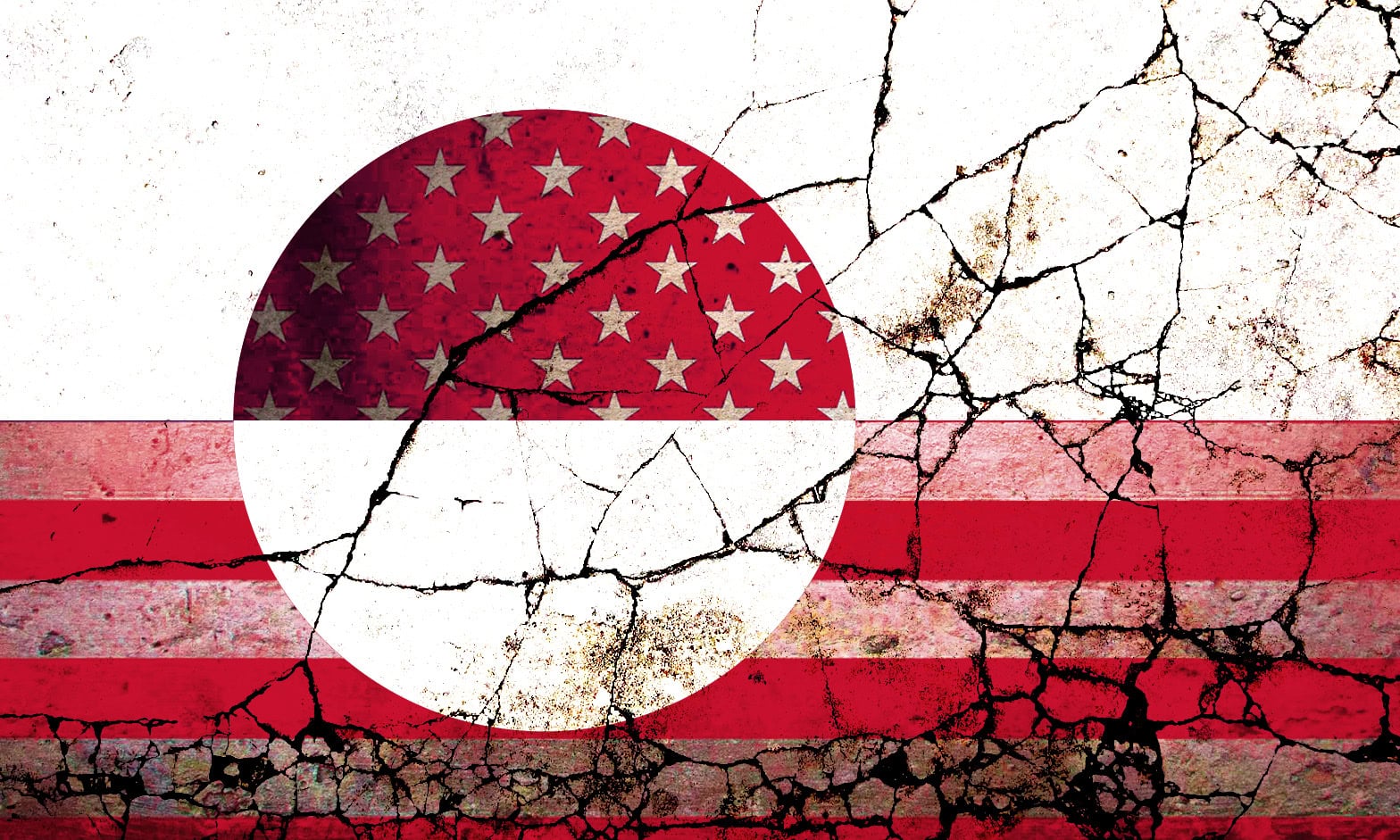
(Art design: Jean-Dominique Lavoix-Carli)
On 23 December 25, Trump declared again he wanted to take over Greenland.1James Landale and Rachel Hagan, “Trump says US ‘has to have’ Greenland after naming special envoy”, BBC, 23 December 2025.
By December 25, tensions over the issue were already high, especially between the U.S. and the Kingdom of Denmark.2See detailed timeline below. Yet, the American statements made during late December 25 and even early January 26 were also, sometimes, met with disbelief.3Lucie Oriol, “Emmanuel Macron fait-il preuve de naïveté sur Trump et le Groenland ?”, The Huffington Post, 7 January 26. Two weeks later, escalation is ongoing, despite European fears and sometimes lack of solidarity, mixing, initially, statements, very weak European troops deployment in Greenland (Operation Arctic Endurance), then tariffs, related economic threats, and strengthened Danish troops deployment.4e.g. Sarah Shamim, “Trump’s Greenland tariffs: What’s Europe’s ‘bazooka’ option to hit back?”, Al Jazeera, 20 January 2026; Denmark sends more troops to Greenland amid tensions with Trump, Al Jazeera, 20 January 2026; Katya Adler, “Confronted over Greenland, Europe is ditching its softly-softly approach to Trump”, BBC, 20 January 2026.
Should the U.S. conquer Greenland, or obtain it through any coercive or manipulative means, which looks increasingly likely, the potential impacts and consequences, would be staggering and wide-ranging, from the unraveling of NATO, to fundamental changes for the European Union, through uncertainty regarding the decoupling of American and European economies, without forgetting possible shifts in alliances worldwide, as escalation, deterrence and retaliations will take place.
Note (22 January 2026): It is not because the U.S. threat to use force against Greenland recedes following the 2026 Davos summit, as a consequence of the actions of other actors, that the whole issue of an American threat against Greenland disappears. The issue should continue to be monitored, dynamics understood and surveilled and impacts assessed.5WEF, “Davos 2026: Special Address by Donald J Trump, President of the United States of America”, Jan 21, 2026; @WhiteHouse, Trump on Greenland; .
Considering the very high severity of the risk, even though many, initially, did not believe the threat to be possible, the issue should have been put on watch early enough to allow concerned actors to design related policy and responses.
Thus, when should we have put the threat of an American conquest or coercive annexion of Greenland under watch?
To answer, we shall examine the timeline of President Trump’s statements and actions regarding Greenland, and highlight three different periods regarding the identification, selection, and monitoring of the issue, as well as its foresight analysis.
- RTAS Expertise Highlighted on Italian Television Channel LA7
- The Houthis, Bab el-Mandeb, and Maritime Transport

- The Strange Mystery of Bolivia’s Lithium Reserves

- Beyond Geopolitics: Understanding the Critical Pressures Reshaping Our World.

- WATCH OUT – The Iran War, Saudi Arabia, and the Houthis

- SIGNAL – The Golden Dome, a New Technological Frontier

- WATCH OUT – Yemen and Saudi Arabia

The first period corresponds to the emergence of the issue. The second consists in a difficult time in terms of strategic foresight and warning work, when the problem seems to disappear. The third period is the most recent one, and constitutes the last stretch of time during which concerned actors should have taken the issue into consideration.
We end our investigation in December 25 because, first, on 10 December, The Danish Defence Intelligence Service (DDIS) yearly threat assessment highlighted that the U.S. were now a threat to allies and partners. Second, the 21 December appointment of U.S. special envoy to Greenland can be seen as the trigger for the next period, which is about a broader escalation sequence. Thus these two dates can be seen as the latest dates at which the issue should have triggered the whole process of analysis, monitoring, warning, and scenarios for policy and strategy design.
Meanwhile, by retracing and following the American statements, we also understand better why and how ideas unfold and evolve.
2019 – Weak signals
During this initial period, when Trump started airing the idea to take over Greenland, the issue should have been considered at least as a weak signal to monitor.
A surveillance, i.e. gathering information, should have been implemented. Potentially concerned actors could also have started wondering in which way this American interest in Greenland could impact them, both directly and indirectly.
- The Strange Mystery of Bolivia’s Lithium Reserves
- Impacts of the U.S. Threat against Greenland: the U.S.-EU Trade Deal, the EU Parliament and the Future of Europe

- The American Threat against Greenland: When Should It Have Triggered a Watch?

- The Real War: U.S. vs. China – Video

- How to use AI for Weak Signals – Trump, the International Revolutionary?

- Uranium for the U.S. Nuclear Renaissance – 2: Towards a global geopolitical race
- Uranium for the U.S. Nuclear Renaissance – 1: Meeting Unprecedented Requirements

This implies that we would have been able to pick up on the issue as signal, thus to see it, and to select it in a sea of information. This is done through scanning, according to agenda. Because the U.S. are such a powerful player internationally with a pervasive influence and increasingly intrusive action on the domestic conditions of countries through, for example, extra-territorial sanctions, most if not all actors, public and private, should consider what is happening in and with the U.S..
At such early stages, it is absolutely key to suspend all disbelief. Disbelief may have very diverse sources, from arrogance and Dunning-Kruger effect (a side effect of the incompetence of people, when “their incompetence robs them of the metacognitive ability to realize it”), to the inability to update belief systems even when presented with new evidence.6Justin Kruger and David Dunning, “Unskilled and Unaware of It: How Difficulties in Recognizing One’s Own Incompetence Lead to Inflated Self-Assessments“, Journal of Personality and Social Psychology, vol 77, no 6, p 1121-1134, American Psychological Association (1999); A. W. Kruglanski, Webster, D. M., & Klem, A, Motivated resistance and openness to persuasion in the presence or absence of prior information. Journal of Personality and Social Psychology, 1993, 65(5), 861-876. doi: 10.1037/0022-3514.65.5.861; Anderson, Craig A., Mark R. Lepper, and Lee Ross, “Perseverance of Social Theories: The Role of Explanation in the Persistence of Discredited Information“, Journal of Personality and Social Psychology, 1980, Vol. 39, No.6, 1037-1049; Craig A. Anderson, “Belief Perseverance”. In Baumeister, Roy; Vohs, Kathleen (eds.). Encyclopedia of Social Psychology, 2007, pp. 109–110. doi:10.4135/9781412956253.n62. As such, it often implies that one may be surprised, which is what must be avoided.
When evaluating an issue or idea, one should pay attention to coherence, within the system of the actor – or event – we seek to understand. In our case, our historical knowledge and understanding of the American national interest and related policies should have forced us to go beyond disbelief and to pay serious attention to the possibility of an American threat against Greenland.
The information below, ordered chronologically, shows what should have been collected. Each piece of information adds an element of understanding to the issue. Together, they also show how President’s Trump resolve evolved and was reinforced.
15 August 2019: The Wall Street Journal reported that Trump had discussed buying Greenland with advisers “in recent weeks” and at a dinner the previous spring, asking what they thought of the idea.7Vivian Salama et al., “President Trump Eyes a New Real-Estate Purchase: Greenland, The Wall Street Journal, 16 August 2019) Reporting on the spring dinner was only known in August.
18 August 2019: Speaking to reporters before an Air Force One departure, Trump answered reporters stressing the strategic interest of Greenland for the U.S., acknowledging it belonged to their Danish allies, and that it was “a large estate deal”.
Read President Trump verbatim answers to reporters
Q In order to get your interest in Greenland, which has been widely reported, is there anything —
THE PRESIDENT: Well, Greenland, I don’t know — it got released somehow. It’s just something we talked about. Denmark essentially owns it. We’re very good allies with Denmark. We protect Denmark like we protect large portions of the world. So the concept came up and I said, “Certainly, I’d be. Strategically, it’s interesting, and we’d be interested.” But we’ll talk to them a little bit. It’s not number one on the burner, I can tell you that.
Q Would you ever make an exchange with them of any kind for U.S. territories?
THE PRESIDENT: Well, a lot of things can be done. I mean, essentially, it’s a large real estate deal. A lot of things can be done. It’s hurting Denmark very badly because they’re losing almost $700 million a year carrying it. So they carry it at a great loss. And, strategically, for the United States, it would be nice. And we’re a big ally of Denmark, and we help Denmark and we protect Denmark, and we will.
Whitehouse, Remarks by President Trump Before Air Force One Departure, August 18, 2019 – my emphasis
In fact, I’m supposed to stop. I’m thinking about going there. I’m not necessarily definitely going there, but I may be going. We’re going to Poland and then we may be going to Denmark — not for this reason at all. But we’re looking at it. It’s not number one on the burner.
21 August 21, 2019: After Danish Prime Minister Mette Frederiksen called the idea “absurd”, President Trump was upset and framed the cancellation of his planned Denmark trip as a response to that characterisation. However, he did not withdraw the notion that Greenland would be strategically attractive for the U.S.. On the contrary, President Trump further legitimated historically his earlier statement, and thus interest. He cast the U.S. as benevolent, making Denmark a favour, whilst Denmark started being perceived as ungrateful and rude.
Read President Trump verbatim answers to reporters
Q Mr. President, can you explain your decision not to go to Denmark? Is it really because they wouldn’t talk about selling Greenland?
THE PRESIDENT: No — Denmark, I looked forward to going, but I thought that the Prime Minister’s statement — that it was absurd; that it was an absurd idea — it was nasty. I thought it was an inappropriate statement. All she had to do is say, “No, we wouldn’t be interested.”
But we can’t treat the United States of America the way they treated us under President Obama. I thought it was a very not nice way of saying something. They could’ve told me “no.” This is something that’s been discussed for many years. Harry Truman had the idea of Greenland. I had the idea. Other people have had the idea. It goes back into the early 1900s. But Harry Truman, very strongly, thought it was a good idea.
I think it’s a good idea because Denmark is losing $700 million a year with it. It doesn’t do them any good. But all they had to do is say, “No, we’d rather not do that,” or “We’d rather not talk about it.” Don’t say, “What an absurd idea that is.”
Q Sir —
THE PRESIDENT: Because she’s not talking to me —
Q Mr. President —
THE PRESIDENT: Excuse me. She’s not talking to me. She’s talking to the United States of America. You don’t talk to the United States that way, at least under me.
….
Q Thank you, Mr. President. I appreciate it. So, with Greenland, it seems to be entirely off the table. Are you looking at any additional lands for potential expansion?
THE PRESIDENT: No. We’re just looking. Greenland was just an idea, just a thought. But I think when they say it was “absurd” and it was said in a very nasty, very sarcastic way, I said, “We’ll make it some other time.” We’ll go to Denmark — I love Denmark. I’ve been to Denmark. And, frankly, we’ll do it another time. Respect has to be shown to the United States.
…
Q I’m from Danish TV. A lot of Danes are disappointed today. You — the Prime Minister said the invitation is still open. What will it take for you accept it?
THE PRESIDENT: Well, we’ll meet at some time. But the Prime Minister used a terrible word when describing something that we’ve been talking about for years with our country. President Truman said, “What about Greenland?” And he talked about it very openly and it was a big deal at the time. And I brought it up again and it was discussed many other times.
And I thought it was not a nice statement — the way she blew me off — because she is blowing off the United States. And we’ve done a lot for Denmark. We’ve done a lot. I know Denmark well. I have many friends from Denmark. I have many people from Denmark that live in the United States. And we treat countries with respect.
Whitehouse, Remarks by President Trump Before Air Force One Departure, August 21 2019 – my emphasis
30 August 2019: The U.S. Congressional Research Service published a brief: Greenland, Denmark, and U.S. Relations, signalling the issue was serious enough. It highlighted the strategic importance of Greenland for the U.S., as well as the options available to the U.S. regarding that territory.
2 December 2019: President Trump refused to answer a question on Greenland after a bilateral meeting with German Chancelor.
Read President Trump verbatim answer to reporters
Q Will you address Greenland during that Den- —
PRESIDENT TRUMP: Because I can’t imagine — I can’t imagine — will we discuss Greenland? What do you think? (Inaudible). (Laughs.) Huh?
Q Do you still want to buy Greenland?
PRESIDENT TRUMP: That’s a very — that’s a good — she must be in the real estate business. (Laughter.) That’s a very good question.
So, we’ll go directly back. I think we’ve done plenty of press conferences. Unless you’re demanding a press conference, we’ll do one, but I think we’ve answered plenty of questions.
Whitehouse, Remarks by President Trump and Chancellor Merkel of the Federal Republic of Germany Before Bilateral Meeting, December 4, 2019 – my emphasis
2020–2024 Irrelevance or absence of open source information?
This period is probably the most difficult to handle in terms of foresight and warning. There is apparently no open source information, and interest wanes. As a result, what should be done? Should we abandon the monitoring? Keep it in a light way? On the contrary, use time to deepen the analysis?
Even though there is apparently no sign of interest, first, we should not underestimate the disruption and shock the COVID pandemic created. If we remember, the state of emergency as declared by the World Health Organization (WHO) for the pandemic lasted from 30 January 2020 to 5 May 2023.8United Nations News, “WHO chief declares end to COVID-19 as a global health emergency”, 5 May 2023. The first two years were acute disruptive phases to usual affairs. Thus, the COVID pandemic may very well have had a strong impact on American’s interest in Greenland, as it overshadowed everything else.
In the meantime in January 2021, President Trump was replaced by President Biden, who then focused on Ukraine.
As far as Mr Trump is concerned for the 2021-2024 period, we found, however with hindsight, one mention of Mr Trump interest in Greenland. Ideally, the election campaign as well as related Republican documents, should also have been monitored at the time.
Finally, the absence of open source information does not mean that there is no information and no interest on an issue. If we are not part of a state’s intelligence service, then we work with open source information. Thus, we do not have access to classified information. Even if we work for a state’s intelligence service, we do not have, obviously, full access to other states classified information. Hence, we must always consider the possibility that classified documents on a topic may exist. Only research, once archives are opened will be able to clarify this point.
In any case, during this period, the American National Interest remained the priority of the American administration.9See for an explanation and introductory references, Hélène Lavoix, “The American National Interest”, The Red Team Analysis Society, 22 June 2022.
Greenland remained a key strategic territory for the U.S., considering Arctic geopolitics, including polar transit routes and corridors, as well as resource endowment, notably in the context of competition with China and Russia.
In terms of anticipation, considering limited resources, during those uncertain times two options can be chosen. First, one can continue monitoring the issue, even though it brings no new information or hardly any. The cost is minimal, and this ensures that, with the monitoring system remaining active, we will be notified if or when the problem re-emerges.
Second, and this must be decided according to the potential severity of the impact for one’s organisation, and according to available resources, we may use the lull to develop peacefully a full strategic foresight and warning analysis, including causal modelling of the issue and scenarios. As a result, we shall be fully ready once events start escalating again.
In the case of Greenland, its strategic geographical location and its natural resources endowment should have weighted in the decision to keep the issue on watch and to deepen the analysis.
2020 to 2024: Official statements regarding any purchase or conquest of Greenland were not found.
14 September 2022: Publication by The New York Times of the article “Cosmetics Billionaire Convinced Trump That the U.S. Should Buy Greenland“, from journalists Peter Baker and Susan Glasser book The Divider (interviews carried out in 2021). 10Ed Cumming, “The cosmetics billionaire behind Trump’s bid to buy Greenland”, The Telegraph via YahooNews, 19 January 26.
January 2024: According to CNN, but with hindsight, Mike Waltz would have told Fox News in January 2024 that the Trump administration interest in Greenland was “about critical minerals” and “natural resources”.11Issy Ronal, “Why does Trump want Greenland and why is it so important?”, CNN, 6 January 2026.
December 2024–December 2025
Once month after he was elected, thus extremely rapidly, President then elect Trump revived the Greenland issue. Then, all concerned actors should have considered an American annexion of Greenland as a serious strategic foresight and warning issue. They should have started the full and detailed analytical process, including scenario-building. And, ofc course, they should have monitored the issue.
Each new statement by the American President on Greenland heightened the importance of the issue.
At the very least, the 4 March 25 speech to the Congress should have sent strong warning signals that it was necessary to consider the issue.
Starting from late March, we enter a new period when, according to Danish official reactions, the U.S. have moved from statements to actions.
Depending on who you are, and on how the different scenarios arising from the American threat against Greenland may affect your activities, the mitigation or response policies you will need to design will vary. Thus, if attention is only being paid to the issue now, it may already be too late. Still, late anticipation is always preferable to no anticipation—and to the constraints of crisis management.
Note that, by May 25, the Kingdom of Denmark had obviously seriously considered the issue as it was able to detect U.S. adversary intelligence collection and U.S. covert operations.
22 December 2024: After his election and before inauguration, Trump revived the 2019 discussions and wrote on his network TruthSocial:
“For purposes of National Security and Freedom throughout the World, the United States of America feels that the ownership and control of Greenland is an absolute necessity. Ken will do a wonderful job in representing the interests of the United States.”
Donald J. Trump @realDonaldTrump 22 December 2024
7 January 2025: At a press conference at Mar-a-Lago, President Trump reasserted the importance of Greenland for the American national security, both in economic and strategic terms. Meanwhile, he did not rule out force and economic coercion to protect those interests as far as Greenland is concerned. Any possible future Danish argument was brushed away.
Read President Trump answers to journalists
Question 00:31:15-00:31:33 (17 sec): Mr. President, thank you. I wanted to touch on the world on fire that you mentioned, but let’s start if we could with your references to Greenland and the Panama Canal and so forth. Can you assure the world that, as you try to get control of these areas, you are not going to use military or economic coercion?
Donald Trump 00:31:33-00:31:34 (1 sec)
No.Question 00:31:34-00:31:52 (18 sec): And can you tell us a little bit about what your plan is? Are you going to negotiate a new treaty? Are you going to ask the Canadians to hold a vote? What is the strategy? And I —
Donald Trump 00:31:52-00:32:12 (19 sec)
I can’t assure you — you’re talking about Panama and Greenland. No, I can’t assure you on either of those two. But I can say this, we need them for economic security. The Panama Canal was built for our military.Question 00:32:12-00:32:12 ( sec): [Inaudible]?
Donald Trump 00:32:12-00:32:32 (20 sec)
I’m not going to commit to that. Now it might be that you’ll have to do something. Look, the Panama Canal is vital to our country. It’s being operated by China — China. And we gave the Panama Canal to Panama; we didn’t give it to China. And they’ve abused it. They’ve abused that gift. It should have never been made, by the way.…..
Donald Trump 00:50:20-00:50:43 (22 sec)
Well, we need Greenland for national security purposes. I’ve been told that for a long time, long before I even ran. I mean people have been talking about it for a long time. You have approximately 45,000 people there. People really don’t even know if Denmark has any legal right to it, but if they do, they should give it up because we need it for national security.Donald Trump 00:50:43-00:51:07 (24 sec)
That’s for the free world. I’m talking about protecting the free world. You look at — you don’t even need binoculars, you look outside, you have China ships all over the place. You have Russian ships all over the place. We’re not letting that happen. We’re not letting it happen. And if Denmark wants to get to a conclusion — but nobody knows if they even have any right title or interest.Donald Trump 00:51:07-00:51:16 (9 sec)
The people are going to probably vote for independence or to come into the United States. But if they did — if they did do that, then I would tariff Denmark at a very high level.Question 00:51:16-00:51:20 (3 sec)
Have you asked your staff to draw up plans for acquisition? Are you acting —Donald Trump 00:51:20-00:51:23 (4 sec)
No, we’re not at that stage, but we have people — I haven’t even entered office yet.….
Question 00:53:38-00:53:45 (7 sec)
But sir, real fast, you said you were considering military force to acquire Panama and Greenland. Are you also considering military force to annex and acquire Canada?Donald Trump 00:53:45-00:54:06 (21 sec)
Transcript, Press Conference: Donald Trump Holds a Media Event at Mar-a-Lago – January 7, 2025, via RollCall.com Factbase.
No — economic force because Canada and the United States, that would really be something. You get rid of that artificially drawn line and you take a look at what that looks like, and it would also be much better for national security. Don’t forget, we basically protect Canada. But here’s the problem with Canada — so many friends up there.
12 January 2025: Vice President-elect JD Vance reasserted the perspective of his President on Fox News Sunday, according to The Hill.
Read Vice President-elect Vance statement
“We don’t have to use military force” because “we already have troops in Greenland.”
“Greenland is really important for America strategically,” …“It has a lot of great natural resources. We also need to make sure that Greenland is properly cared for from an American security perspective, and frankly, the current leadership, the Danish government has not done a good enough job of securing Greenland.”
Quote from the Interview of Vice President-elect JD Vance in Fox News Sunday as reported in Sarah Fortinsky, “Former ambassador to Denmark: NATO would be compelled to respond to Greenland invasion“, The Hill, 13 January 2025.
10 to 16 January 2025: Greenland and Denmark made efforts to discuss Greenland with President Trump, which would have ended, according to the Financial Times, in a “fiery call” between Donald Trump and Denmark’s prime minister over Greenland, as reported later by The Guardian.12Sarah Rucker, « Denmark, Greenland call for meeting with Trump to strengthen US ties », San, 14 Jan 2025; The Financial Times « Donald Trump in fiery call with Denmark’s prime minister over Greenland », 24 January 2025; Maya Yang, « Trump again demands to buy Greenland in ‘horrendous’ call with Danish PM », The Guardian, 28 January 2025. One official interviewed about the call is reported to have said: “He [President Trump] was very firm. It was a cold shower. Before, it was hard to take it seriously. But I do think it is serious and potentially very dangerous.”13Ibid, The Guardian
19 February 2025: On board Air Force One, Donald Trump reasserted again the same perspective on Greenland, that the U.S. needed it for national and international security and that, as a result “we have to have Greenland”.
Read President Trump answers to journalists
Question 00:13:18-00:13:20 (2 sec): You haven’t brought up Greenland in a — in a while. Are you seeing —
Donald Trump 00:13:20-00:13:34 (14 sec): No, no, very — we need Greenland from the standpoint of national security and international security. We have to do something with Greenland. We have to protect Greenland. But we need it for national security, and we need it, maybe more importantly, for international security.
Question 00:13:36-00:13:42 (6 sec): Can I just follow up? Are you seeing it as part of any of the discussions you’re having with Europeans and Putin in some sort of peace deal?
Donald Trump 00:13:42-00:14:01 (19 sec): No, no. We have to have Greenland because of the national security picture, even more so now than it would have been 20 years ago, 30 years ago, when they talked about it then too. You know, they used to talk about it. Years ago, they were talking about Greenland, but much more so now with, you know, modern weaponry, planes and the speed of planes, and all of the things.
Donald Trump 00:14:01-00:14:05 (4 sec): So, we have to have Greenland. Thank you very much.
Transcript, Press Gaggle: Donald Trump Speaks to Reporters On Board Air Force One – February 19, 2025, via RollCall.com Factbase.
4 March 2025 – President Trump’s Speech to Congress: In an address before Congress, Trump again asserted strongly the American interest in terms of national and international security for Greenland. He ended with the warning: “One way or the other we are going to get it.”
Read President Trump on Greenland
And I also have a message tonight for the incredible people of Greenland. (Laughter.) We strongly support your right to determine your own future, and, if you choose, we welcome you into the United States of America.
We need Greenland for national security and even international security, and we’re working with everybody involved to try and get it. But we need it, really, for international world security. And I think we’re going to get it. One way or the other, we’re going to get it.
We will keep you safe. We will make you rich. And together, we will take Greenland to heights like you have never thought possible before.
Remarks by President Trump in Joint Address to Congress, 4 March 2025, US Embassy and Consulates in Italy
23-28 March 2025: The U.S. presidency organised an official delegation to Greenland, including Second Lady Usha Vance, National Security Advisor Michael Waltz and Energy Secretary Chris Wright, which sparked diplomatic row, because of the presence of the National Security Advisor. Finally, Vice-President Vance and his wife travelled to Greenland on 28 March and visited solely the U.S. Pituffik Space Base.14Miranda Bryant, “Anger in Greenland over Usha Vance and Mike Waltz’s planned visit this week”, The Guardian, 24 March 2025 and “JD Vance to expect frosty reception in Greenland amid diplomatic row”, The Guardian, 28 March 2025.
Very clearly Vice-President Vance stated again the Presidency position and its consistency. He also made clear that the goal was to “get Greenland”, and that now they were attempting to obtain Greenland by enticing Greenlanders in choosing the U.S.. In that case military force would not be necessary. However, the untold but very obvious threat is that, should that fail, they would try other means, including force until Greenland has become American.
Read Extracts from Vice-President Vance remarks
Q The president has previously not ruled out military force when he’s talking about taking over Greenland, but your rhetoric today is more about encouraging the Greenlandic people to vote for independence. Do you think the rhetoric has changed about that, or what — what’s your message there?
THE VICE PRESIDENT: No, I — I don’t think it’s changed at all. Look, the president has said, clearly, he doesn’t think that military force is going to be necessary, but he absolutely believes that Greenland is an important part of the security not just of the United States but of the world and, of course, the people of Greenland too.
It’s — it’s very simple. I think the president has been very consistent here from his State of the Union, from his Inaugural Address, and every public statement that he’s made: This territory, Greenland, really matters for the security of the United States. It’s extremely vulnerable right now. And if the people of Greenland were willing to partner with the United States — and I think that they ultimately will partner with the United States — we could make them much more secure, we could do a lot more protection, and I think they’d fare a lot better economically as well.
This has to happen. And the reason it has to happen — I hate to say it — is because our friends in Denmark have not done their job in keeping this area safe. They — they just haven’t done it.
It’s very simple. For — for all of our — our friends in the American media who attack the administration for pointing out the obvious, what is the alternative? To give up the North Atlantic? To give up the Arctic to China, to Russia, and to other regimes that don’t have the best interest of the American people at heart?
We have no other option. We need to take a significant position in Greenland to keep the people here safe, but to keep our own country safe too.
…
Q Trump said this week the U.S. would “go as far as we have to go” to acquire Greenland. In that same vein, will — on that question, are there plans that have been drafted to use military force to take over Greenland?
THE VICE PRESIDENT: Well, what the president has said, like — is — is that we need to have more of a position in Greenland. We need it, again, for the safety of the American people.
And what we think is going to happen is that the Greenlanders are going to choose, through self-determination, to become independent of Denmark, and then we’re going to have conversations with the people of Greenland from there.
So, I — I think that talking about anything too far in the future is way too premature. We do not think that military force is ever going to be necessary. We think this makes sense. And because we think the people of Greenland are rational and good, we think we’re going to be able to cut a deal, Donald Trump style, to ensure the security of this territory but also the United States of America.
Remarks by the Vice President to U.S. Troops at Pituffik Space Base and an Exchange with Reporters in Avannaata Municipality, Greenland, 28 March 2025, The American Presidency Project.
April-Mai 2025 onwards (tentative dates – deduction): Considering Denmark decision in early May 2025 to summon U.S. ambassador and corresponding reporting, we can deduce that, some time before the summon, the U.S. ordered its intelligence services to increase collection of information on Greenland.15Robert Tait and Miranda Bryant, “Denmark to summon US envoy over report of Greenland spying directive”, The Guardian, 7 May 25 They are notably meant to focus on “Greenland’s independence movement and attitudes to American efforts to extract resources on the island”.16Ibid.
April to August 2025 onwards (tentative dates – deduction): Denmark again summoned U.S. ambassador, this time because of American attempts at “conducting covert operations in Greenland”.17Paul Kirby, “US tells Denmark to ‘calm down’ over alleged Greenland influence operation, BBC News, 28 August 2025. The objective would be to promote dissent against Denmark in Greenland and rapprochement with the U.S.18Ibid.
10 December 2025: The Danish Defence Intelligence Service (DDIS) released the public version of its Intelligence Outlook 2025, where it yearly assesses threats (English version released on 18 Dec, Danish version on 10 Dec). There, it highlighted, that the U.S. had become a threat to allies, and thus to the Kingdom of Denmark. The way the threat is however portrayed in the chapter on the Arctic, is put in very diplomatical language indeed.
Read Extracts from DDIS annual threat assessments
p.7 Main Conclusions:
Meanwhile, the United States is leveraging its economic and technological strength as instruments of power, also against allies and partners.p.9 Great powers are increasingly prioritizing their own interests and wielding power to achieve their objectives. Russia continues its invasion of Ukraine while conducting hybrid war against NATO and the West. China is deploying its economic and, increasingly, military power to pressure other states, and is also supporting Russia’s war in Ukraine. Together, China and Russia are at the centre of a group of countries seeking to reduce Western influence, particularly that of the United States, worldwide. Meanwhile, the United States is leveraging its economic and technological strength as instruments of power, also against allies and partners. While the future of China-US relations is uncertain, the two will remain strategic rivals in the long term.
p. 10 Distrust on the rise among states
The use of power by the United States, China and Russia, in different ways, has deepened distrust between states – even among traditional partners and allies.p.32 The Arctic: The intensifying great power competition in the Arctic has brought significant international attention to the region, particularly with the growing US interest in Greenland and its implications for US national security. At the same time, this attention increases the risk of espionage – including cyber espionage – and attempts of influence operations targeting the entire Kingdom of Denmark.
DDIS’s annual risk assessment, INTELLIGENCE OUTLOOK 2025, 10 Dec 25/18 Dec 25; My emphasis.
Conclusion – Towards the next phase
The end of December 2025 marks the transition with the next period, which is about escalation to attempt to deter President Trump from moving ahead with his will to conquer Greenland.
We are thus at the start of a period that is akin to crisis management.
The issue should obviously now be on the watch of all concerned actors. If it is not, then it is high time to consider it.
Even though the crisis has started, it is nonetheless necessary to take an anticipatory perspective, as next moves, impacts and likelihoods still need to be foreseen.
21, 22 and 23 December 2025: Trump appointed Jeff Landry as a special envoy for Greenland, who accepted, answering: “Thank you @realDonaldTrump! It’s an honor to serve you in this volunteer position to make Greenland a part of the U.S. This in no way affects my position as Governor of Louisiana!”
The next day, speaking to reporters at Mar‑a‑Lago Trump said: “We need Greenland for national security, not for minerals.” In the same exchange he added that Greenland is “essential” for U.S. security, invoked Russian and Chinese activity in the Arctic (“you see Russian and Chinese ships all over the coast”), and insisted the U.S. has “many sites for minerals and oil” elsewhere.
Notes
- 1
- 2See detailed timeline below. ↩︎
- 3Lucie Oriol, “Emmanuel Macron fait-il preuve de naïveté sur Trump et le Groenland ?”, The Huffington Post, 7 January 26. ↩︎
- 4e.g. Sarah Shamim, “Trump’s Greenland tariffs: What’s Europe’s ‘bazooka’ option to hit back?”, Al Jazeera, 20 January 2026; Denmark sends more troops to Greenland amid tensions with Trump, Al Jazeera, 20 January 2026; Katya Adler, “Confronted over Greenland, Europe is ditching its softly-softly approach to Trump”, BBC, 20 January 2026. ↩︎
- 5WEF, “Davos 2026: Special Address by Donald J Trump, President of the United States of America”, Jan 21, 2026; @WhiteHouse, Trump on Greenland; . ↩︎
- 6Justin Kruger and David Dunning, “Unskilled and Unaware of It: How Difficulties in Recognizing One’s Own Incompetence Lead to Inflated Self-Assessments“, Journal of Personality and Social Psychology, vol 77, no 6, p 1121-1134, American Psychological Association (1999); A. W. Kruglanski, Webster, D. M., & Klem, A, Motivated resistance and openness to persuasion in the presence or absence of prior information. Journal of Personality and Social Psychology, 1993, 65(5), 861-876. doi: 10.1037/0022-3514.65.5.861; Anderson, Craig A., Mark R. Lepper, and Lee Ross, “Perseverance of Social Theories: The Role of Explanation in the Persistence of Discredited Information“, Journal of Personality and Social Psychology, 1980, Vol. 39, No.6, 1037-1049; Craig A. Anderson, “Belief Perseverance”. In Baumeister, Roy; Vohs, Kathleen (eds.). Encyclopedia of Social Psychology, 2007, pp. 109–110. doi:10.4135/9781412956253.n62. ↩︎
- 7Vivian Salama et al., “President Trump Eyes a New Real-Estate Purchase: Greenland, The Wall Street Journal, 16 August 2019) ↩︎
- 8United Nations News, “WHO chief declares end to COVID-19 as a global health emergency”, 5 May 2023. ↩︎
- 9See for an explanation and introductory references, Hélène Lavoix, “The American National Interest”, The Red Team Analysis Society, 22 June 2022. ↩︎
- 10Ed Cumming, “The cosmetics billionaire behind Trump’s bid to buy Greenland”, The Telegraph via YahooNews, 19 January 26. ↩︎
- 11
- 12Sarah Rucker, « Denmark, Greenland call for meeting with Trump to strengthen US ties », San, 14 Jan 2025; The Financial Times « Donald Trump in fiery call with Denmark’s prime minister over Greenland », 24 January 2025; Maya Yang, « Trump again demands to buy Greenland in ‘horrendous’ call with Danish PM », The Guardian, 28 January 2025. ↩︎
- 13Ibid, The Guardian ↩︎
- 14Miranda Bryant, “Anger in Greenland over Usha Vance and Mike Waltz’s planned visit this week”, The Guardian, 24 March 2025 and “JD Vance to expect frosty reception in Greenland amid diplomatic row”, The Guardian, 28 March 2025. ↩︎
- 15Robert Tait and Miranda Bryant, “Denmark to summon US envoy over report of Greenland spying directive”, The Guardian, 7 May 25 ↩︎
- 16Ibid. ↩︎
- 17
- 18Ibid. ↩︎