

This post will present the experiment – assessing a sample of open source predictions for the year 2012 – address the methodological problems encountered while creating the evaluation itself, and underline the lessons learned. The second part (forthcoming) will discuss results.
Category Archives: Methodology of Strategic Foresight and Early Warning
Useful Rules for Strategic Foresight and Risk Management from Taleb’s The Black Swan

This second article on The Black Swan: the impact of the highly improbable by Nassim Nicholas Taleb emphasises some of the author’s points that are crucial for foresight and warning. Likewise, they are necessary for any work dealing with the future and its anticipation, from risk management to horizon scanning through early warning. The methodology of SF&W and risk management allows addressing these points. They should become rules and principles all analysts follow. Indeed, without paying attention to them, good analysis is impossible. The first article on The Black Swan can be accessed here. Humility (Notably pp.190-200) Considering uncertainty, but also our imperfect condition of human beings, the complexity of the social world, feedbacks, our more than insufficient knowledge and understanding, …
Taleb’s Black Swans: The End of Foresight?

Since Nassim Nicholas Taleb published his bestseller The Black Swan: the impact of the highly improbable back in 2007, “Black Swans” and “Black Swans events” have become part of everyday language. They are used as a catchphrase to mean two different things. First, as was the case in the Brookings interesting interactive “briefing book” Big Bets and Black Swans: Foreign Policy Challenges for President Obama’s Second Term, “black swans” represent high impact, low probability events, what is also known as wild cards.[i] Second, “black swans” refer to events that could absolutely not be predicted, as, for example for the Economist in ”The prediction games: Our winners and losers from last year’s edition”. Unfortunately, in this case, the label “black swans” excuses foresight …
Continue reading “Taleb’s Black Swans: The End of Foresight?”
2013 Predictions’ Yield (2)

Second part of the list of open sources predictions for 2013 related to conventional and unconventional national security.
End of Year Predictions: the 2013 Yield
Open sources predictions for 2013 published on the web related to conventional and unconventional national security and as foreword a few methodological posts on predictions and forecasts.
2012 Predictions Database
A database of open source 2012 predictions, and graph on selected issues.
Trial by Fire for Foresight: The 2012 Predictions of The Economist

The Economist shows the lead in a courageous yet hardly ever done exercise: going back to our own foresight and assess, in the light of the present, what was right and what was wrong. It provides us with an example of how such lessons learned could be endeavoured, underlines questions that should be asked and key challenges for anticipation, and exemplifies how biases can derail foresight.
Pattern – Higher Global Temperatures, Earlier Impacts and the Shale Fuels Bounty

We most probably need to get ready for a 2C temperature rise and its harsh impact on the world relatively rapidly as a temperature rise of 6C – and above – by the end of the century is increasingly probable. Indeed, interests and current challenges and tensions are most likely to favour shale fuels’ production and policies and adversely affect “green efforts”. Other ecological adverse impacts on global security issues such as water and biodiversity may be enhanced and must be monitored. Citizens’ mobilization on those issues may evolve as trade-offs will be done, and as impacts will be felt.
Pattern – Towards Polarization in the Western World?
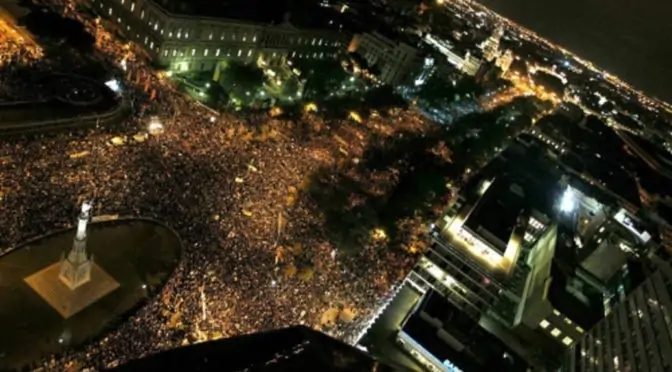
The pattern that has been emerging over at least the beginning of the second decade of the twenty-first century is a rising polarization within Western society – or societies. In this article, we identified and analysed the trend through the related signal – the 14 November 2012 strikes. We evaluated the evolution toward polarization as …
Continue reading “Pattern – Towards Polarization in the Western World?”
The Power of Maps

Maps are both necessary tools for analysis and crucial delivery visuals for foresight and warning products. They constitute a very powerful type of delivery form, as they change both the world and the mind. The pivotal importance of maps and of the process of mapping has notably been shown, in the case of the birth of nations and of nationalism, by two remarkable books: Imagined Communities by Benedict Anderson and Siam Mapped: A History of the Geo-Body of a Nation by Winichakul Thongchai. Building upon the findings of those master-works, as well as on my own (PhD) research, this post explains the power of maps and then outlines contemporary evolutions, examples and possibilities. Why are maps special instruments of power? …
Continue reading “The Power of Maps”