(Art design: Jean-Dominique Lavoix-Carli on a photo by Francesco Ungaro) The war(*) in Ukraine is hastening changes in international politics in many different ways. The possibility to see the conflict morphing into World War III acts as a convincing spur for continuing efforts at understanding and adapting. Concerned and informed actors are thus trying to …
As the Islamic State loses ground in Mesopotamia, in the west in Syria with the defeat in Palmyra (e.g. Adam Withnall The Independent, 27 March 2016), in the north with an increasingly large territory recaptured by the Kurds (e.g. Avi Asher-Schapiro, Vice News, 22 Dec 2015) and in the east in Iraq, first with the battle of Ramadi (“Battle of Ramadi (2015–16)“, Wikipedia) and now with the start of Iraqi “Operation Conquest” to free Mosul (Paul D. Shinkman, US News, 24 March 2016), it could be tempting to discard the Islamic State and its Khilafah as a bygone threat and a now inconsequential enemy . If this string of victories against the Islamic State is definitely important and crucial in the war against the Khilafah, …
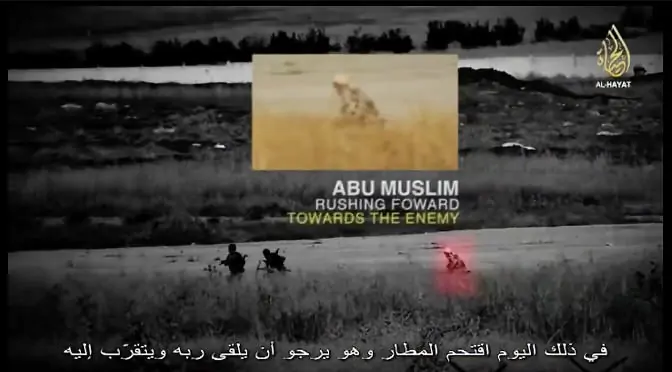
last update: selected 10 videos… updated dates for all the latest issue of magazines, Amaq in Bengali, al-Bayan in Bengali. The defeated attack by the Islamic State on Ben Guerdane in Tunisia on 7 March 2016 probably indicated a worrying shift in tactics and strategy, which must be considered (e.g. Vanessa Szakal, “Mainstream Media on Ben Guerdane: victory and foreboding in Tunisia“, Nawaa, 11 March 2016). This attack may be seen as having been heralded by a significant call made by the Islamic State to the Islamic Maghreb through five psyops videos published over two days (19-20 January 2016). In parallel, Al-Qaeda in the Islamic Maghreb started to copycat the Islamic State’s type of videos (Andrea Spada, “Al-Qaeda tries to imitate Daesh in new threatening …
The remaining part of this article is for our members. Make sure you get real analysis and not opinion, or, worse, fake news. Log in and access this article.
Since we published our sub-series on the Islamic State psyops products and foreign fighters (The Foreign Fighters’ Threat; Attracting Foreign Fighters (1), 23 March 2015, and Foreign Fighters’ Complexes (2) 30 March 2015), new psyops products related to this theme have been released. Below is an update considering the new products, with implications in terms of geographical expansion and deepening of message for selected targeted audience. The list of the videos is given at the bottom of the post. It is all the more important to consider these new products and impacts that some complacency of a sort appears to be developing in North America – and potentially Europe? – regarding the Islamic State: one could, somehow, accommodate a potentially winning Islamic State (e.g. Ronald Tiersky, “ISIS Could …
The remaining part of this article is for our members. Make sure you get real analysis and not opinion, or, worse, fake news. Log in and access this article.
After having seen the threats linked to the existence of foreign fighters within the Islamic State (The Foreign Fighters’ Threat), we focused on identifying the reasons why those foreign fighters would join the Islamic State, using the latter psyops products and locating them within the framework of existing findings (Attracting Foreign Fighters (1)). With that post, we presented the psyops “recruiting” products used for this study, then, taking stock of the research done on foreign fighters by the International Center for the Study of Radicalisation and Political Violence (ICSR) and by the Sufan Group, we focused on two core elements that are meant to be present for all recruited foreign fighters: a quest for meaning and purpose and a need for belonging. Using the Islamic State …
The remaining part of this article is for our members. Make sure you get real analysis and not opinion, or, worse, fake news. Log in and access this article.
After having pointed out the main risks entailed by the existence of foreign fighters within the ranks of the Islamic State and by their rising numbers (see The Islamic State Psyops – The Foreign Fighters’ Threat), we shall now turn to the reasons that push individuals to join the Islamic State. Within the framework of existing findings resulting from current research, notably by the International Center for the Study of Radicalisation and Political Violence (ICSR) and by the Sufan Group, we shall analyse the Islamic State psyops products and underline the specific points utilised in the recruitment effort. Indeed, the increase in foreign fighters mobilization as underlined previously would tend to imply that the Islamic State is relatively successful in recruiting, thus that it knows well enough …
The remaining part of this article is for our members. Make sure you get real analysis and not opinion, or, worse, fake news. Log in and access this article.
Each week our scan collects weak – and less weak – signals… Read the 19 March scan → World – The deadly attack on the Bardo museum in Tunisia, on 18 March, reminded the world that the Salafi-Jihadi threat is far from being overcome, despite some lassitude displayed by crowds and media over such attacks. One of the interesting signals to notice here, is the small number of crowdsourced articles referring to the attack. Only three articles found their way in The Weekly, when the casualties are far more important than those of the Charlie Hebdo attacks in Paris or of the shooting in Denmark, to say nothing of the impacts to Tunisia’s economy and more broadly polity, and in terms of spread of Jihadi attacks, threat …
The remaining part of this article is for our members. Make sure you get real analysis and not opinion, or, worse, fake news. Log in and access this article.
One of the many issues that needs to be addressed regarding the Islamic State is that it attracts foreign fighters, as abundantly reported in the media. This issue is also one of the focuses of the latest issue of the Islamic State psyops product, Dabiq 7 (12 Feb 2015), as it features in five articles: “Major operations in Libya and Sinai” (foreign fighters from Tunisia and Sudan), pp. 40-41; “Among the believers are men: Abu Qudamah al-Misri” (foreign fighters from the UK), pp. 46-49; “A brief interview with Umm Basir al-Muhajirah” (foreign fighter from France), pp. 50-51; “The good example of Abu Basir al-Afriqi” (foreign fighter from France), pp. 68-71; “Interview with Abu Umar al-Baljiki” (foreign fighters from Belgium), pp. 72-75. This …
The remaining part of this article is for our members. Make sure you get real analysis and not opinion, or, worse, fake news. Log in and access this article.
Each week our scan collects weak – and less weak – signals… We present below some of the most interesting or relevant features for each section. Read the 19 February scan → World (all matters related to war, international and national security) – The focus this week stems from the White House Summit on Countering Violent Extremism currently held in Washington D.C. (see White House Fact sheet). First, in a very “Washingtonian” way, the summit leads to the publication of a host of reports and articles, as think tanks, newspapers, researchers, experts and pundits try to have their voices heard by policy-makers, some of them having been crowd-sourced here and worth checking and reading. Second, the summit forces the various actors to face an issue that …
The remaining part of this article is for our members. Make sure you get real analysis and not opinion, or, worse, fake news. Log in and access this article.
The dreadful burning alive of the captive Jordanian pilot by the Islamic State and its video broadcast by Al-Furqan Media Foundation, as well as the reactions it succeeded in eliciting, such as Jordan’s retaliations (e.g. ISIS Study Group, 3 Feb 2015; BBC News, 6 February 2015), show once more the crucial importance to fully consider the Islamic State psyops as they are completely part of the war it wages and of the order it thus aims at establishing. These psyops, beyond the influence they aim at generating (see “A Framework“), offer us a way inside the Islamic State and its Khilafah’s worldview. Understanding the latter is crucial is we want to fight the Islamic State victoriously, because its belief system and induced actions impact all other actors, be …
The remaining part of this article is for our members. Make sure you get real analysis and not opinion, or, worse, fake news. Log in and access this article.
GDPR, Privacy and Cookies
The Red Team Analysis Society uses cookies to ensure that we give you the best experience on our website. This includes cookies from third party social media websites if you visit a page which contains embedded content from social media. Such third party cookies may track your use of the Red Team Analysis Society website.
If you click on "Accept", you accept our policy, we'll assume that you are happy to receive all cookies on the Red Team Analysis Society website and this will close this notice. Accept AllGDPR and Cookie Policy
Privacy & Cookies Policy
Privacy Overview
This website uses cookies to improve your experience while you navigate through the website. Out of these, the cookies that are categorized as necessary are stored on your browser as they are essential for the working of basic functionalities of the website. We also use third-party cookies that help us analyze and understand how you use this website. These cookies will be stored in your browser only with your consent. You also have the option to opt-out of these cookies. But opting out of some of these cookies may affect your browsing experience.
Necessary cookies are absolutely essential for the website to function properly. This category only includes cookies that ensures basic functionalities and security features of the website. These cookies do not store any personal information.
Functional cookies help to perform certain functionalities like sharing the content of the website on social media platforms, collect feedbacks, and other third-party features.
Performance cookies are used to understand and analyze the key performance indexes of the website which helps in delivering a better user experience for the visitors.
Analytical cookies are used to understand how visitors interact with the website. These cookies help provide information on metrics the number of visitors, bounce rate, traffic source, etc.
Advertisement cookies are used to provide visitors with relevant ads and marketing campaigns. These cookies track visitors across websites and collect information to provide customized ads.