

This article focuses on the first of the scenarios depicting a Salafist victory, where Al-Qaida (AQ) becomes the dominant force on the battlefield, defeats the other actors, then works towards establishing the caliphate. In our previous scenario we detailed the scenario of a nationalist victory where the new government guides Libya towards a secular and nationalist state where Sharia is not a source of governance. Note: Considering the future names of potential factions that would result from a new split between the unity government, we shall use the label nationalist for those that supported the nationalist-dominated Council of Representatives (COR) and any future anti-Islamist factions; Islamist to note those that supported the General National Congress (GNC) and any future pro-political …
Continue reading “Scenarios for the Future of Libya – Sc 4.1 An Al-Qaida Victory”
Lessons from the Conflict in Ukraine – Geopolitics, Uncertainties and Business (4)

This article identifies lessons we can learn from the impact of the conflict in Ukraine on businesses, as presented in the first part, to continue enhancing our understanding of the way businesses and the corporate world could usefully anticipate or foresee geopolitical and political risks and uncertainties.
From the way to identify which crises and geopolitical uncertainties can be – sometimes unexpectedly – of concern to a company (Lesson 1) to the best timing for starting the anticipation process (Lesson 2), the need to think outside the ideological box (Lesson 3) and multi-dimensionally (Lesson 4) and to understand “national interest” and its evolution (Lesson 5), the impacts of the war in Ukraine bring us a wealth of understanding and points out many necessary if not crucial improvements that may be endeavoured. These will thus be added to the points previously identified in “Lessons from and for the Brexit – Geopolitics, Uncertainties, and Business (2)”, after a general framework was defined in “Businesses and Geopolitics: Caught up in the Whirlwinds?” (1).
Impacts of the Conflict in Ukraine – Geopolitics, Uncertainties and Business (3)

With this article and the next one, we use the instability and conflict in Ukraine and the related impacts on businesses to continue enhancing our understanding of the way businesses and the corporate world could usefully anticipate or foresee geopolitical and political risks and uncertainties. RTAS Expertise Highlighted on Italian Television Channel LA7 The Houthis, Bab el-Mandeb, and Maritime Transport The Strange Mystery of Bolivia’s Lithium Reserves Beyond Geopolitics: Understanding the Critical Pressures Reshaping Our World. WATCH OUT – The Iran War, Saudi Arabia, and the Houthis SIGNAL – The Golden Dome, a New Technological Frontier WATCH OUT – Yemen and Saudi Arabia We review two major impacts of the war in Ukraine. First we look at the “surprising” cost of sanctions related to Ukraine …
Continue reading “Impacts of the Conflict in Ukraine – Geopolitics, Uncertainties and Business (3)”
Scenarios for the Future of Libya – Sc 3.2 A Nationalist Libya

This article focuses on the second of the scenarios depicting a total victory for one Libyan faction, where the nationalist coalition – loyal to a non-Islamist and nationalist government – is victorious and guides Libya towards a secular and nationalist state where Sharia is not a source of governance. In our previous scenario we detailed the scenario of an Islamist victory where the new government gradually, with different paths according to speed, implements Sharia law and puts Libya on the path towards an Islamic state. Note: Considering the future names of potential factions that would result from a new split between the unity government, we shall use the label nationalist for those that supported the nationalist-dominated Council of Representatives (COR) …
Continue reading “Scenarios for the Future of Libya – Sc 3.2 A Nationalist Libya”
Scenarios for the Future of Libya – Sc 3.1 An Islamist Libya
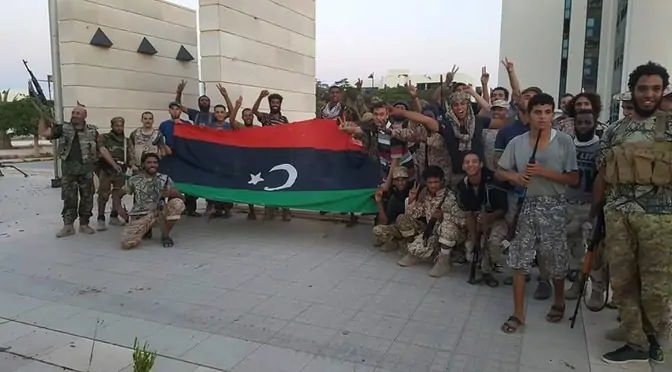
In our previous article we detailed three sub-scenarios of combined partition and spill over where Libya disappears as such through the creation of three new states, while consequent weaknesses is the cause of spill over to neighboring nations. We thus concluded the series of scenarios 2, which depicted a continuing civil war but with different terms, i.e. change of terrain or actors (see Mitchell, “Scenarios for the Future of Libya Within the Next Three to Five Years,” June 1, 2015; and Lavoix, “How to Analyze Future Security Threats (4): Scenarios and War,” December 30, 2013). This article focuses on the first of the two possible scenarios detailing a total victory in Libya, either by the Islamists or the nationalists. Scenario …
Continue reading “Scenarios for the Future of Libya – Sc 3.1 An Islamist Libya”
Scenarios for the Future of Libya – Sc 2.4 Partition and Spill Over

Featured image: United Nations Photo, [CC BY-NC-ND 2.0], via Flickr In our previous article, we detailed a partition scenario where Libya splits into independent states along tribal and provincial lines, as well as a north-south axis, and in the one before, we focused on various possible spill over. This article focuses on a combination of the two cases, partition and spill over scenarios. In the first scenario, the Amazigh, Tuareg, and Toubou tribes outright declare independence and break away from the Libyan state, which leads to significant spill over in Algeria, Niger, and Chad. In the second scenario, Libya is partitioned along provincial lines, which leads to spill over in all directions. In the last scenario, Libya splits apart along …
Continue reading “Scenarios for the Future of Libya – Sc 2.4 Partition and Spill Over”
Scenarios for the Future of Libya – Sc 2.3 Libya’s Partition

Image: Council of Representatives Government posted on the Council of Representatives Facebook Page, 1 September 2016 In our previous article, we detailed a spillover scenario where conflict spills over in all directions, including Europe, Algeria, Niger, and Egypt. This article is focusing on possible scenarios depicting Libya’s partition that could stem from the Libyan war. In the first scenario, the Amazigh, Tuareg, and Toubou tribes move from ideas of autonomy to outright declaring independence and breaking away from the Libyan state as a result of marginalization and lack of security. In the second scenario, Libyans begin declaring independence and breaking away from the rest of Libya along provincial lines. In the last scenario, Libya splits apart along a north-south axis …
Continue reading “Scenarios for the Future of Libya – Sc 2.3 Libya’s Partition”
Fighting the Islamic State’s Terrorism at Home – Truly Defend and Strike Back

This is the second part of the series looking for a third way to – truly – fight against the Islamic State’s – and other salafi-jihadi’s – terrorist attacks at home, away from polarisation. Unfortunately, in the light of the spat of terrorist attacks in Bangladesh, Turkey, Saudi Arabia, in France again and again, in Germany and on 22 March 2017 in London, especially considering the way these attacks were carried out, this series of two articles becomes even more salient (e.g. “1–2 July 2016 Dhaka attack“, Wikipedia; “Istanbul airport attack: Isis behind deaths of at least 41, PM says“, The Guardian, 29 June 2016; “Nineteen people arrested over Saudi Arabia attacks“, Al Jazeera, 8 July 2016, “Nice attack: At least …
Continue reading “Fighting the Islamic State’s Terrorism at Home – Truly Defend and Strike Back”
The Libyan War Spills Over to Egypt, Algeria, Niger and Europe – Scenarios for the Future of Libya

This article is the second of our series focusing on scenarios depicting the range of spillover that could stem from the Libyan war. In our previous article, we detailed two scenarios of spillover that initiate a renewed war encompassing more than just Libya. We discussed a case of spillover in one direction – where Europe is drawn into this renewed war, as well as spillover in two directions, where Algeria and Niger are also drawn into the war. In this article, we shall conclude the spillover scenarios with a contagion taking place in all directions (west towards Algeria, south towards Niger, east towards Egypt, and north towards Europe). It is important to note our choices for spillover sub-scenarios. There are …
Fighting the Islamic State’s Terrorism at Home – The Third Way

On 12 and 13 June 2016, two terrorist attacks claimed by the Islamic State (also known as ISIS) reminded the Western population, with immediate impact on the U.K. “Brexit” polls (see below), that the war waged against them and all non-Salafis had not ended. The first attack took place against a gay nightclub in Orlando, U.S., killing 50 and wounding 48 people (e.g. BBC News, 13 June 2016). The second occurred in Magnanville, France (e.g. BBC News, 14 June 2016). There, a jihadi stabbed to death a police commanding officer, who was coming back from work, then killed the police officer’s partner under the eyes of their three and half boy in their home. The attacks generated political reactions showing that the debate has polarised but without truly evolving since the first recent …
Continue reading “Fighting the Islamic State’s Terrorism at Home – The Third Way”