Log In

Facing the Fog of War in Syria: The Tragedy of Kurdistan

This post is an update for the State of Play: The Kurds in the Syrian civil war. It can be read independently, but readers will be able to refer to the initial post for background.

A general call to arms to fight Jihadis
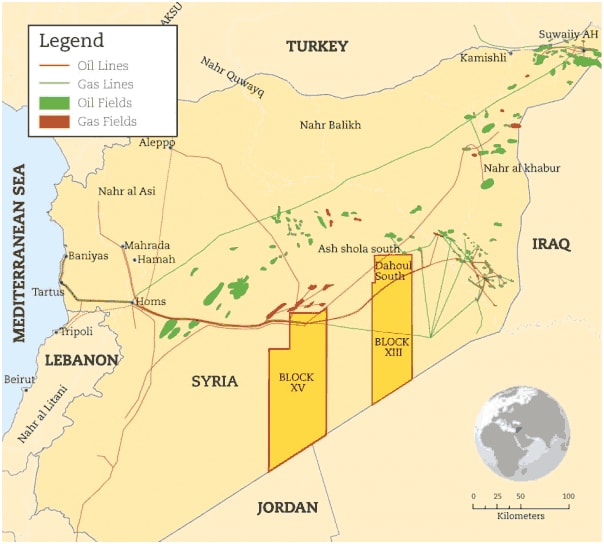
– Since first clashes erupted on 12 July 2013, intensifying on 16 July, notably over and in the city of Ras al-Ain, the YPG (The People’s Defence Units – see updated mapping of actors below) has been fighting Jahbat-al Nosra (JAN) and the Islamic State of Iraq and Al-Sham (ISIS or ISIL) (van Wilgenburg, Al-Monitor, July 16 2013). At the end of July, fighting was raging in the area of the oil fields of Rmeilan “around the main production facility” (Mohammad Ballout, As-Safir, translated by Al Monitor, 30 July 2013). Other groups “from Ahrar al-Sham, Ahrar Ghoweiran, the Free Syrians Brigades and the Umma brigade,” as well as the “Jazeera Free Brigades”, “composed of Arab Shummar clans” are also “participating in the military operations taking place in the triangle formed by the other important oil fields of Suwaidiyah, Rmeilan and the Tel Koujar-Rabihah crossing, adjacent to the Iraqi border.” (Ballout, Ibid).

On 30 July 2013, the struggle became a war within the war in Syria, after the YPG issued, in Hasaka province, “a general call to arms for all persons able to carry a weapon to join their ranks in order to defend the YPG held areas from the attacks of the Islamic State of Iraq and al-Sham, al-Nusra Front and allied rebel groups” (Facebook, SOHR, 30 July).
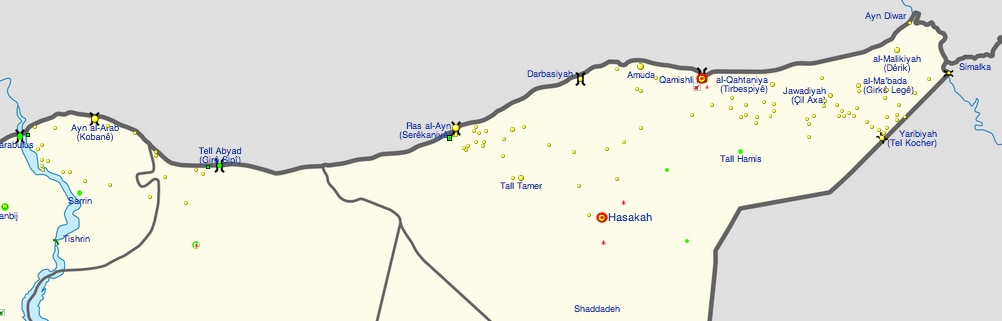
hasaka fighting

Various assumptions have been made to explain this call to arms, linking it to the assassination of “Issa Ibrahim Hiso, a prominent member of the Democratic Union Party (PYD) on July 30”, to the visit of Saleh Muslim, the co-leader of the PYD to Turkey, which would have a disruptive potential, notably for the Al-Assad regime, and to ISIS and JAN (van Wilgenburg, Al-Monitor, July 31). However, first, Ballout (Ibid.) sees, as one of the main engines of the war between the Kurds and the Jihadis, control over the oil-rich areas of Hasaka province. Indeed, being able to access and exploits the oil fields means much in terms of resources thus money, crucial to mobilize supporters and soldiers, arm and pay the latter and thus wage the war. Second, ISIS strategy is to expand in Northern Syria, as explained – and foreseen – by Aymenn Jawad Al-Tamimi (Syria Comment, 18 July), where ISIS reproduces what it did in both the Aleppo and Idlib regions, “seeking … to consolidate control over outlying towns, particularly those of strategic importance along or near the border with Turkey” such as Tel Abyad, where, among others, oil can be smuggled out (Ballout, Ibid.) Thus, the reasons given by the YPG itself for the call to arms, i.e. attacks by ISIS, JAN and other groups, are probably the most accurate. The YPG would thus act as the last Northeastern stand against ISIS expansion, while trying to preserve the means of its monetary survival, meanwhile denying it to others.

Fighting in Hasaka province is still ongoing and, at the time, could be followed on the PYD info website, on MESOP, on Wladimir van Wilgenburg’s blog and on the Syrian Observatory for Human Rights (SOHR – down). It extends to the northern part of the Raqqah province, where, for example, on 2 November 2013 “ISIS raid[ed] the KNC office in Raqqah and arrest[ed] some Kurdish activists” (Wladimir van Wilgenburg’s blog).

The population within Kurdish dominated areas, as in the rest of the country, has also to face the consequences of air raids by the Syrian air force, as the latter shells villages where the presence of ISIS and Jan are reported (e.g. PYD info, 19 Oct 2013).

Meanwhile, in Aleppo province, clashes take place for domination of villages and areas between the YPG on the one hand and various configurations of factions including always ISIS, and sometimes Ahrar al-Sham (van Wilgenburg, MESOP, 30 October 2013).

This war within a war has three major consequences.

First steps towards the end of endemic Kurdish infighting?

On the importance of military forces on the ground during a civil war

First, as the population increasingly perceives the YPG as its protector, the war against Jihadis further legitimizes the YPG and thus enhances the power of the PYD over its rivals (van Wilgenburg, Al Monitor 25 October 2013 & 13 October 2013). This is all the more important because infighting has not abated among Syrian Kurds. Thus, a rising support for the YPG could be seen as a weak signal announcing the victory of one group – the PYD – over the others, or rather a supremacy that would be sufficient enough on the ground not to potentially mar anymore overall political and military progress.

The PYD would then have to play carefully its hand to assert its position, ending as much as possible the divisions while integrating other factions. It could build on the latest effort at overcoming divisions as can be understood the 10 July PYD announcement of its intention to start working towards the “formation of an interim administration in Western Kurdistan” (ANHA, 10 July 2013) probably after consultation with other Kurdish leaders, including of opposing groups, within and without Syria (van Wilgenburg, Al Monitor, 19 July 2013). This, de facto, emphasized the difficulty to see the Supreme Kurdish Council (SKC) play its full role, as underlined by van Wilgenburg (ibid). The SKC would be replaced by an “interim administration within three months” while, a referendum on a draft constitution and parliamentary elections” would be organised “within six months” (Ibid.). By 13 August, consultations had been held “to form a council comprised of around 100 members that will be in charge of civil administration” (Ibrahim Hemeidi, Al-Hayat, translated in Al Monitor, 14 August 2013). This decision, sometimes criticized by other Kurdish parties afraid it would increase the PYD’s strength, was also not welcomed elsewhere, as it was feared it would start a process of partition within Syria (van Wilgenburg, 19 July). Since then Saleh Muslim, leader of the PYD, notably during his trips to Istanbul to meet with Turkish authorities, has repeatedly emphasized that the objective was to set up an administration and not a government, and that no secession was envisioned (e.g. Hemeidi, Al-Hayat).

In this framework of fear for the future, the last stand offered by the YPG against Jihadis may also contribute to quell anxieties to see Arabs excluded and discriminated against within regions dominated by Kurds (Andrea Giloti, Al Monitor, 8 October 2013). Indeed, there has been evidence of Arab villagers being grateful to the YPG for “liberating them” from and “supporting them” against Jihadis and their potentially stringent rule, while protecting them from “mistaken” looting (van Wilgenburg, Al Monitor, 13 October 2013, Giloti, Ibid). The potentiality to see sectarianism sowed needs however to be kept in mind and envisioned..

Unity among Kurds is, however, far from being achieved. Early October, the four parties that had so far funded the alliance called the Democratic Political Union (KDP), which controlled the Kurdish National Council (KNC), merged “into a single party under the banner of the Kurdistan Democratic Party of Syria (KDP-S), currently led by Abdulhakim Bashar” (see updated mapping), an attempt by parties supported by Barzani (President of the Kurdistan Regional Government of Iraq) to rejuvenate the old party created in 1957 that had then fragmented (van Wilgenburg, Al Monitor, 19 October 2013). This renovated party seems, however, to be fraught with the same divisions as the overall Kurdish factions. Furthermore, if its leaders claim representing many people on the ground, the YPG and PYD, of course, refute this claim.

Mapping of the Kurdish political actors in the region – November 2013 – Download: The Kurds in Syria - November 2013

Meanwhile, even fighters affiliated initially with the KDP and thus who used to oppose the YPG preeminence have started joining the latter in their fight against jihadis (Van Wilgenburg, 25 October).

Geneva 2 and international support

Kurdish infighting finds its mirror image among international actors (who supports whom), and both express themselves perfectly well in relation to the always more uncertain Geneva 2. According to Van Wilgenburg (19 July 2013), the PYD is “closer to the PKK and the Patriotic Union of Kurdistan. Some claim this front [Qandil or Slemani front] is closer to Iran, Russia and Syria and more critical of Turkey….the second Erbil front led by Barzani is closer to Turkey.”

On 7 September 2013, the KNC decided to join the NC (Ara News, 8 Sept 2013). However, part of the KNC would want to attend Geneva as KNC, some as KNC and, if impossible, be represented by the NC, whilst others want to go as part of the KSC (Van Wilgenburg, 9 October 2013). The U.S. and Turkey would be supportive of the KNC and its representation by the NC (Ibid.).

On the contrary, the PYD wants to attend Geneva “not as part of the Syrian National Coalition but as an independent Kurdish movement”, which is opposed by Turkey, and believes the end solution “must include Assad” not to see all Alawites killed (Taraf, Interview of Muslim, translated by Al Monitor, 26 October 2013). Russia supports the presence of the PYD dominated SKC at Geneva (van Wilgenburg, 9 October 2013). As a result, even politically, part of the KNC finally has an aim similar to the PYD.

Turkey: a key challenging role?

Second, the war between the YPG and Jihadis highlights the potentially murky and certainly challenging role of Turkey in the Syrian conflict. Although Turkey repeatedly denied it, it would have been “supporting al-Nusra and other radical Islamist groups against the Syrian Kurds” and as the strongest force against the Al-Assad regime, but would be now reconsidering or being more cautious in its support (Semih Idiz, Al-Monitor, 13 August 2013). Meanwhile, Saleh Muslim repeatedly asked Turkey to intervene and keep the jihadists in check (Amberin Zaman, Taraf, translated by Al Monitor, 4 August 2013; Taraf, 26 October 2013). What Saleh Muslim asked could be logical but not always that easy to obtain. Indeed, the border between Turkey and Syria is very long and probably impossible to control strictly. One may think, as a comparison, about the difficulty of the U.S. to surveil and control its border with Mexico. The Jihadi strategy to expand towards the border with Turkey means a need to secure logistics and supply but this may also happen without full and active Turkish support.

Warning about the sterilization of Western Kurdistan

“it will be a long time before the soil is suitable for agriculture, groundwater will no longer be suitable for use and surface and sea water will be at stake. The air will, in short, be poisonous.”

Finally, and most importantly for the future, the war between the YPG and jihadis dominated groups draws attention to an ecological catastrophe in the making in Western Kurdistan, and more generally around all Syrian oil fields.

As seen above, one of the main engines of the war between the Kurds and the Jihadis, besides those underlined by Al-Tamimi, is control over oil fields and their exploitation (Ballout, 30 July 2013). When the various groups are not fighting over controlling fields, “militant factions and Kurdish protection units (YPG) take charge of oil extraction, refining and selling on their own account” (Alaa Halabi, As-Safir, translated by Al Monitor, 28 October 2013). They extract crude oil, sell some of it as such and “refine part of it using primitive refining methods, whereby derivatives such as diesel and gasoline are sold to citizens or traders” (Ibid.). Not only are derivatives of poor quality, but the environmental consequences are tragic. It is worth citing Halabi’s article at length:

“The source added…’Also, militant factions, local factions and some investors own about 2,000 primitive refineries. …These refineries emit smoke and fumes into the air, which leads to further pollution. This has caused the formation of a black cloud over the eastern region of Syria, which will have disastrous results for the area’s residents, water sources and agricultural land, which will inevitably be deserted.’ … Salah al-Jani, a petrochemical engineer, explained ‘When hydrocarbons go out of their cycle [in the case of primitive refining] — into wells, pipes or tanks — the composition of environmental components will be radically changed. In such a case, it will be a long time before the soil is suitable for agriculture, groundwater will no longer be suitable for use and surface and sea water will be at stake. The air will, in short, be poisonous. The associated water — when produced it must be separated before being transported, and it is also called class water — contains salts that threaten plant life, surface water and groundwater. It also carries natural radioactive compounds called NORM, with a level of concentration that cannot be neglected and of an intensity that lasts for years.”

Diseases related to primitive refining already have been noted, from skin infections and cancers to birth defects.

This ongoing environmental tragedy has the potential to finally terminate all hopes for Kurds to ever be free to live according to their own way of life on their land, whatever the political system and the ruler in power. If they do not succeed in finally asserting control over the land where the oil fields are located and then in imposing proper refining, which would indeed demand the end of infighting and the support of international actors, then their only choice will be to run away from this land for which they fought and suffered so much.
The Red (Team) Analysis Weekly No124, 31 October 2013

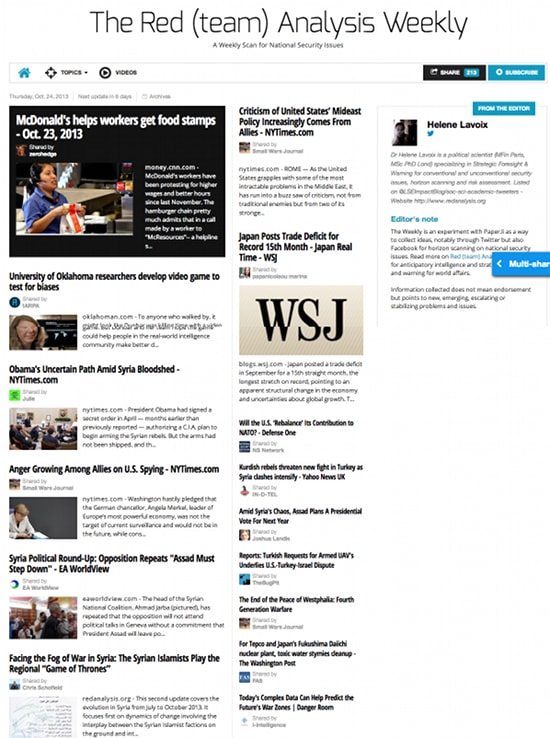
A new world order in the making: America, Britain and Russia – The world is changing and the decisions taken by the various actors are not only reactions to those changes and their anticipated direction and impact, but also contributions towards the very evolution of the system. We thus see the U.S. revising – rather towards a wished lessened involvement – its Middle-East policy, while the region is in turmoil and being redesigned. Meanwhile, it seeks to step up its Asia-Pacific involvement (its strategic pivot to Asia), yet promoting a military strengthening of its partners, when the region already knows a rising level of tension. Could it be that those new American regional roles, notably when seen together, have the potential to both favour instability, even wars (what was tried to be avoided), while accelerating an American loss of influence? Meanwhile, Russia, as symbolized by Putin being voted the most powerful person of the year, gains in influence and power, and positions itself actively on all theaters, including newer ones such as the Arctic. Interestingly, the U.K., faithful to its history and despite the crisis (or spurred by it), also seems to be engaged in a pro-active strategy, which takes act of the changing world order: after having “cemented” the role of “London as renminbi hub” to build on the title of an article of the Financial Times (Lucy Hornby and Patrick Jenkins, 15 October 2013), it moves towards being the “first Western country to issue sovereign Islamic bonds”. The birth of the multi-polar world is indeed in full swing.

Click on the image below to read on Paper.Li

horizon scanning, strategic warning, global risk, national security

Somali Piracy: a Model for Tomorrow’s Life in the Anthropocene?

Pirates, scientists and climate change

Piracy, Red (Team) Analysis, strategic foresight strategic warning, anticipatory intelligenceIt was like the wild west out there”. This comment was not made by a soldier after fighting in the streets of Bagdad, or by a police officer coming back from a difficult raid in a dangerous favela in Rio. No, it was made by Peter deMenocal, a marine geologist of Columbia university, quoted in an article recently published in The Atlantic (Schiffman, 16 Oct 2013). The article describes how a science vessel braved Somali pirates to extract sediments from the seabed of the Indian ocean.
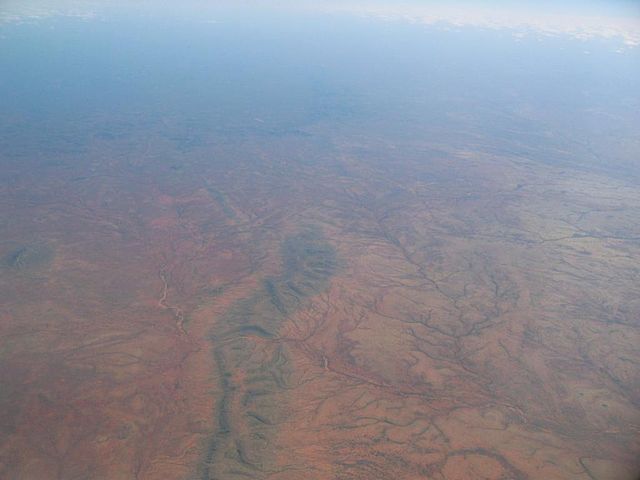
Those sediments were used to study the way Eastern Sahara and the Horn of Africa became a desert. The results show that the transformation of what was once a wet and green area into an arid desert was not the result of a gradual process, but, in fact, a very quick transformation, that took one or two hundred years. The former theory was supporting the hypothesis that the process had lasted thousand years. One hundred years, on the contrary, represents only three or four human generations, with grand parents able to explain the changes to their children’s children. The dynamics that were involved were as followed: the less it rained, the more vegetation died, the more the topsoil lost its humidity, absorbing more and more heat, and so accelerating further the decline of vegetation, while disturbing rain and weather patterns, which favoured the emergence of aridity, in a series of interlocked feedback loops.

Piracy, Somalia, Red Team Analysis, anticipatory intelligence

Thus, it shows that climate and weather patterns, and thus, life conditions for vegetal, animal and human species, do not evolve gradually, but are sensitive to different kinds of forcing. This new perspective on desertification pushed a Columbia university’s scientist to ask the US Navy to protect a new scientific expedition in the Indian Ocean. But this demand was not accepted… (Schiffman, ibid.).

The “Pirates lake”

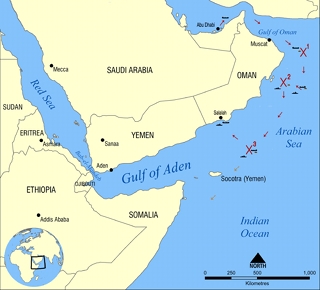
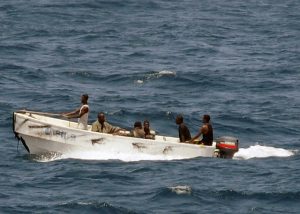
The Gulf of Aden is one of the most important maritime routes on earth and home to two crucial chokepoints, because it links the Red Sea, as well as, through Suez, the Mediterranean Sea, and through Bab-el-Mandeb, the Arabian sea, to the Indian Ocean. And it is rife with Somali pirates. Those pirates attack all kinds of ships, stop them, take the crews as hostages, and know how to exact very significant ransoms from governments and private shipping companies. For example, at the peak of pirates attacks, more than 58 millions dollars were exacted through ransoms in 2009 and 238 millions dollars in 2010 (Oceans beyond Piracy, The Economic Cost of Piracy). Yet, the total cost must not only include ransoms, but also insurance, re-routing, deterrent security equipment of naval forces, of pirate prosecution, of piracy deterrent organizations. Finally, one must also add macro-economic cost, such as cost to regional trade, food price inflation, and reduced foreign revenue (ibid).

Piracy, Red (Team) Analysis, strategic foresight strategic warning, anticipatory intelligence

Starting with the beginning of the 21st century (Parenti, Tropic of Chaos, 2011), Somali piracy home-made, small-scale tradecraft, is a tentative reconversion of a few (very) poor Somali fishermen. It quickly became an industrial activity, generating tens to hundreds of millions of dollars a year, carried out by pirate fleets better equipped and armed through the years, and going farther and farther away in the Indian ocean (Valin, EchoGeo, 2009). They turned a whole swathe of the Indian Ocean into a “pirates lake”, leading major actors such as the members of the insurance market, Lloyd’s, to raise insurance premiums, thus costing five to six billions dollars a year to global trade.

Piracy, Red (Team) Analysis, strategic foresight strategic warning, anticipatory intelligence

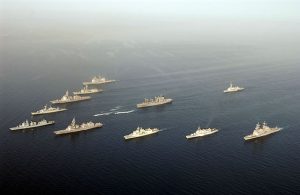
European, US, Russian and Asian governments have had to divert some of their Navies in the region, integrating their naval forces, for example through the “combined task to force 150”, composed of EU, NATO, US, Japanese, Russian, Indian and Chinese vessels, to fight back at the pirates.

Isn’t it strange to think that some of the poorest people of our world, inhabiting a devastated and highly peripheral country, have become such a powerful force in the shaping of maritime traffic, which is nothing else but the very core of globalization?

Somalia, a case study in collapse

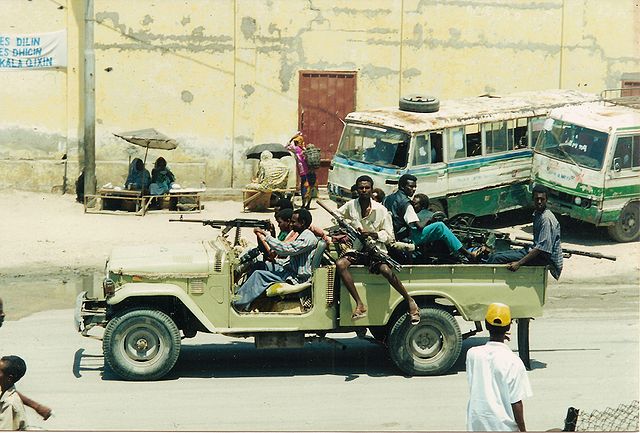
During the seventies and the eighties, Somalia, ruled by Siad Barre and his proxies, started a game of shifting alliances between the U.S.S.R. and the United States, in order to conquer the Ogaden region from its socialist ally and neighbour, Ethiopia (Smith, Négrologie, 2003). The war ended as a massive military, political and financial failure for the Barre regime. A series of drought, coupled with economic stresses driven by the fiscal demands of the failing state, destroyed the fragile agricultural and pastoral economy of the country (Parenti, Ibid). Barre fled in 1991, while the country was sinking into civil war, agricultural desolation, armed and dangerous factionalism (Bowden, Dirty Wars, 2013).

Piracy, Red (Team) Analysis, strategic foresight strategic warning, anticipatory intelligence

Now, Somali people are either being subjected everyday of their (rather short) existence to the brutality of the life with militias or having to become militiamen, while enduring a harsh and unforgiving environment, dominated by an arid climate, progressively worsened by global warming. For example, the structural lack of rainwater makes it difficult to drink, to eat, to be healthy (in 2009-2010, a new famine was triggered by the failure of yearly precipitations, and between 2010 and 2012, an estimated 258,000 excess deaths was attributable to severe food insecurity and famine in southern and central Somalia – see 2013 FAO FEWSNET report). Furthermore, as military sociology has exposed over the last forty years, the more and longer people and combatants are being brutalized by battle and war conditions the more brutal they become (Bartov, Hitler’s Army, 1992).

Piracy, Red (Team) Analysis, strategic foresight strategic warning, anticipatory intelligenceThis toughness was experienced in Mogadishu in 1993, by the U.S. Special Forces, Rangers and Delta Forces, in their vain tentative to catch the famous warlord Mohamed Farrah Aïdid. Mark Bowden, author of the “Lawless sea, piracy and environmental collapse
Piracy, Red (Team) Analysis, strategic foresight strategic warning, anticipatory intelligence

If state failure, social disintegration and heightened climate pressure on a vulnerable agricultural and pastoral society made Somalia a place of thriving violence and misery (Parenti, Ibid.), it furthermore opened a huge corridor of lawlessness off its coast. Somalia has indeed a very large stretch of coastline, 3330 km long. Thus, since the beginning of the new phase of the civil war, starting shortly after 2001-2002, the affirmation of three uneasy and fragile regional zones and the short-lived but very violent “islamic courts”, which destroyed many warlords before their disintegration (and transformation into Islamic Al-Shaabab militias), the exclusive economic zone of Somalia has been systematically pillaged by fishing fleets from numerous countries, composed of massive high sea trawlers, often under pavilion of convenience (Tharoor, Time World, 18 April 2009). Reports establish that, each year, more than three hundred millions dollars worth of seafood are fished and taken from under-equipped Somali fishermen (e.g. Dagne, CRS Report: Somalia, CFR, March 12, 2007).

Other reports show that, in the meantime, numerous ships have illegally shed toxic industrial wastes, even radioactive wastes, from Europe (some of these shipments certainly being organised by Napolitano mafia), off Somali coastline (Ould-Abdallah, UN envoy, 2008). A UN environment program report (2005, 2007) establishes that dumping these residues off Somali coastline costs 2.50 dollars, against 250 dollars for a clean destruction in Europe. The “success” of the Somalian sea region came also from the overfishing of other parts of the Indian Ocean and of the Mediterranean Sea. The depletion of fish stocks in other parts of the world oceans made for a stark contrast with the life thriving sea of the Gulf of Aden and Arabian Sea region, because of the small indigenous fishing operations, which had a preservation effect on the biological resource.

This led to an epidemic of chronic illness among the littoral Somalian population, from skin to respiratory ailments, while these communities where losing their source of food and finance. Meanwhile they were subjected to a series of long heat waves, droughts and disorganized monsoons, as the impact of climate change is increasingly stronger in the region (UNEP report, 2005; Britain weather service). Fishermen had nowhere to go and no choice, their hinterland being ravaged by the new coalitions at war, notably the new Islamist militias named Al Shaabab (Bahadur, 2012).

Piracy, Red (Team) Analysis, strategic foresight strategic warning, anticipatory intelligence

The sea being their only available resource and the only world they knew, all their wealth being tied to the sea, as fishing and cargo boats, if fishing could no longer be an available resource, then fishermen moved into the piracy business, only changing the purpose of vessels and crews. Pirates quickly became very efficient at taking ship crews as hostages and at exacting ransoms from private shipping companies and governments. This new activity gives a very special geopolitical status to Somali pirates because their presence in the Gulf of Aden and the Arabian Sea is a very severe threat in one of the main maritime corridors, through which pass most of the oil tankers and trade ships from the Mediterranean Sea and the Arabian Sea to the Indian Ocean. In other words, they are a threat not only to international trade, but also to international energy lines, hence the important military international reaction.

The number of incidents between military vessels and pirates, added to an important use of private security professionals by shipping companies, seems to have had an effect in deflecting a growing number of attacks (237 attacks in 2011, 75 in 2012 – International Chamber of Commerce, 16 January 2013), while numerous Somali crews were arrested. However, pirates are also going deeper and deeper in the Indian Ocean. The decrease in number of attacks is not only caused by international and private reactions and repression, but also by a new metamorphosis of piracy, with many pirate operations selling their services for the “protection” of ships crossing the Gulf of Aden and part of the Arabian Sea. Another evolution is that, if the number of attacks  and successful hijacking are decreasing, these operations have become very organised and some specialists expect more violent attacks or hijack high-profile targets, as oil tankers, as well as new tactics, involving several ships with better armed crews (Bahadur interview on CBC, 23 June 2013).

Pirates as “eco-warriors” ?

As Edward Luttwak neatly points out, the logic of strategy is of a paradoxical nature (Luttwak, 1987). Every action reverses in its opposite, largely because of the reactions and the unintended consequences it triggers, and because of its inner effects on those who implement it. If the causes of piracy are civil war, climate, overfishing and criminal pollution, piracy also has numerous feedback effects on these different areas.

Numerous researchers in maritime biology establish that, by making trawlers avoiding the Somali off coast region, marine life is recovering, helping fishermen to better their catches and having very beneficial effects for the food and financial security of the coastal communities (Jill Craig, 2 August 2012, Voice of America). However, at the same time, the financial success of pirates has attracted the attention of militias, among which the Islamist militia Al Shaabab, which started to racket the pirates in order to insure a steady cash flow for their own agenda, linked to Al-Qaeda, especially in Yemen (Parenti, 2011, ibid.), on the other side of the Gulf of Aden.

It should be noted that, even if piracy is an inherently dangerous activity, becoming increasingly more lethal because of the logistics of small boats at sea and because of the international military cooperation and growing use of private security, which translates into numerous naval battles, sinking, drowning and arrests, there is a never-ending flow of volunteers for piracy from the hinterland. This situation comes as no surprise, given that mass hunger is back in Somalia since the dire droughts in 2010 and 2011, which Britain weather service, after having surveyed the weather patterns of the whole region, explicitly link to global warming. If Kenya and Ethiopia could benefit of international food relief, it was not the case for Somalia, because of the security situation for numerous NGOs.

Thus, Somali pirates “exchange” their political and environmental crisis for an activity that means a security crisis for the world shipping and energy industries.

Thus, Somali pirates “exchange” their political and environmental crisis for an activity that means a security crisis for the world shipping and energy industries. Their success attracts numerous young volunteers, all the more so since the return of extreme drought since 2010 as seen, who have been subjected to a pitiless process of “brutalization” by social, political, economic, national and international forces, while the planetary ecological global change is aggravating the overall dynamic. Decades of civil war, combined with disastrously long drought, which bring very poor harvests and worsen human and animal access to water, have made of Somalia one of the toughest and hardest place on earth to survive. Somali pirates have thus become hard-as-stone survivors, immersed in a warrior culture, projected on the Gulf of Aden, the Arabian Sea and the Indian Ocean, in a region destabilized by war, climate change and competition for marine resources.

Given the fact that the set of social, political and environmental conditions from which has emerged Somali is not only still active, but worsens and impacts the whole region of the horn of Africa and of the Red Sea, one can only expect to see this violent social process spread to the whole region, potentially adopting new forms, ways and means, with similar numerous regional, international and global economic and strategic effects.

Piracy, a metaphor for tomorrow’s life on a new and dangerous planet?

The emergence and development of Somali piracy is not an “exotic” and aberrant appendix to globalization. Instead, it reveals the complex intricacies between contemporary social, economic and planetary dynamics. The way fishing industry overexploited the Arabian Sea and Somali Exclusive Exploitation Zone and the way those areas have been used by industries and the Italian mafia as dumping site for toxic wastes is symptomatic of the trends that threaten marine life and sea water quality currently, on a global scale. Furthermore, these two ways to use – and abuse – the sea combine themselves into a looming world health problem, sea food having become a vector of bio-concentration of chemical pollution, which is absorbed by consumers on a global scale (Roberts, The Ocean of Life, 2012).

This overexploitation obliged Somali fishermen, under the pressure of further and non-viable impoverishment, to become pirates. The political, food and climate situation of the country, awash with weapons, changed piracy into the equivalent of an economic boom, a quasi industrial revolution but in the sector of violent services, feeding on maritime globalization, illegal overfishing and pollution, under a harsh and changing climate.

In other words, Somalian piracy is a perfect example of the way a human society reacts and adapts itself to the strange and retroactive mix of environmental pressure (in this case, climate change and the overexploitation of seafood added to waste dumping by non Somali actors), social and political collapse and war. This situation is typical of what a growing number of geophysicists and biologists define as “the Anthropocene”, this new geological and biological era where the human species has become the principal source of pressure on the planetary environment, and where multiple feedbacks emerge from planetary environment and put societies under new kind of pressures. As the Royal society sums it up:

“Anthropogenic changes to the Earth’s climate, land, oceans and biosphere are now so great and so rapid that the concept of a new geological epoch defined by the action of humans, the Anthropocene, is widely and seriously debated.” (Zalasiewicz, Royal Society, 2011).

Hence, piracy is a quite successful adaptive response of coastal Somali communities to the local and regional manifestations of this new condition of humanity on this planet, defined by James Howard Kunstler in 2005 as “the long emergency”.

Is it possible to influence this new social-planetary trend?  Or shall we be condemned to only adapt ourselves to a permanently changing global situation, with multiple and dire impacts in very diverse areas?  The terrible effects of these trends on the Horn of Africa lead us to wonder what is going to happen in other areas similarly impacted by these new sets of feedback loops, such as Central America, the Arctic… and a lot of major coastal cities around the world.

The Red (team) Analysis Weekly No123, 24 October 2013

Japan, an exemplary case for a complex world? The situation of Japan can be seen as a perfect case that exemplifies the complex dynamics into which we are taken. Absence of foresight and warning as well as refusal to consider the reality of environmental risk – and to act accordingly – plays a large part in the Fukushima continuing tragedy, which, added to the lasting Syrian war and related international quagmire, means a rising energy bill. Meanwhile, delocalization stops the country to see its exports increasing sufficiently. As a result, Japan knows its longest series of trade deficit since 1979, which may only degrade further its already dire financial situation, considering its public deficit. We thus have the interplay of many factors, some of them apparently far away or deemed impossible or unimportant, all converging. Could this type of configuration spread, making the situation of McDonald’s workers the most probable future for the worldwide middle class? And, if the middle class continues shrinking (check the videos), what will happen to liberal democracies, while the Westphalian state is questioned from without and within? One way forward could come from the University of Oklahoma’s researchers, as they developed a new video game aiming at mitigating biases. If awareness of and struggle against biases was to be generalized, and, among others, applied to the need to reinvest in policy-making – to say nothing of the need to have a real strategy – then the odds to see our future improving, at individual, country and world level, would be considerably strengthened. Shall we decide to use this opportunity?

Click on the image below to read on Paper.Li

Red team Analysis, horizon scanning, weak signal, political risk, strategic warning, anticipatory intelligence

Facing the Fog of War in Syria: The Syrian Islamists Play the Regional “Game of Thrones”

This update covers the evolution in Syria from July to October 2013. It focuses first on dynamics of change involving the interplay between the Syrian Islamist factions on the ground and international players – especially the declaration of an “Islamic framework” and then the creation of the Islam Army, with impact on the overall situation, and provides an updated mapping for Syrian Islamist groups. It then looks at evolutions related to the National Coalition of Syrian Revolution and Opposition Forces. Syrian Sunni factions intending to install an Islamist state in Syria (For background and past state of play, see here) It is within those groups that we have been witnessing throughout September-October 2013 the most potent changes. As always, and as Lund stressed …

The Red (team) Analysis Weekly No122, 17 October 2013

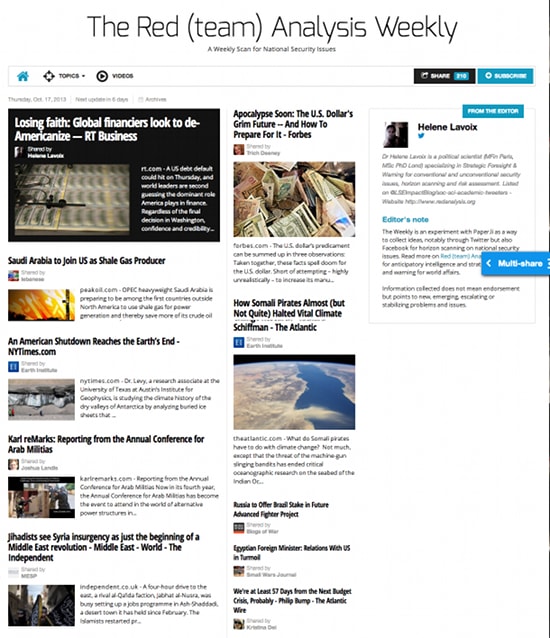
One of the most important signals of the week was not only, unsurprisingly, the last episode in the never-ending politician American infighting over the debt ceiling, but also, the perceptible fatigue across a wide range of world actors, who were being taken hostage by representatives they had not elected over issues that did not concern them. Even Americans despised the bickering and its huge impact borne by others, if polls and surveys are to be believed. One of the major impact we may envision is that we may well be leaving the dollar dominated world we have known. The cost for the U.S. will be very high on all fronts. That will also mean major changes for the world, including in terms of instability, which may not be good news considering all other elements (from a changing energy security map to turmoil in the Middle East without forgetting new armament and technological changes), also feeding into a generalizing uncertainty. This episode and its global impact could also indicate that we have now, beyond doubt, entered a period of evolution and transition, where complexity is a reality (see for example how piracy may impact climate change research) and feedbacks are very strong and escalating, and will remain so until we – the actors – find how to stabilize our world system.

Click on the image below to read on Paper.Li

Horizon scanning, weak signal, early warning, strategic warning, national security, red team analysis

Climate Change, a Geostrategic Issue? Yes!

“Winter is coming” This is the motto of the Starks, the eminent feudal family depicted in “Game of Thrones”, the fantasy novel series, by George R.R. Martin [1]. Its members are involved in numerous and interlocking power struggles between the different Houses of a kingdom, whose ruler is weak ( and meets a sad fate). This continent is dominated by a strange climate, divided in two seasons, a summer and a winter, each potentially lasting several years. Winters can be fearfully cold and snowy, induce mass starvation for a very long time, as well as terrible conflicts, and decide, by their harshness, like war, of the destiny of nations. When “Winter is coming”, the moment has come to get prepared for times dominated by cold, despair and …

The remaining part of this article is for our members. Make sure you get real analysis and not opinion, or, worse, fake news. Log in and access this article.

Welcome to a new Author on Climate Change Security

The Red (Team) Analysis Society welcomes Dr Jean Michel Valantin, who will focus on issues and problems related to climate change and national security. Dr Jean-Michel Valantin (PhD Paris) is specialised in strategic studies and defense sociology, and more particularly in environmental geostrategy. He is the author of Menaces climatiques sur l’ordre mondial (Climatic threat on the world order), Ecologie et gouvernance mondiale (Ecology and world governance), Guerre et Nature, l’Amérique prépare la guerre du climat (War and nature: America gets ready for climate war), and of Hollywood, the Pentagon and Washington: The Movies and National Security from World War II to the Present Day.

With his first article, “Climate change, a geostrategic issue? Yes!”, he explains why climate change should also be seen from a geostrategic perspective, and underlines, through concrete examples, that, actually, the evolution in strategic thinking has already started. He thus prepares us to explore:

“These forces [that] are reshaping the whole international relationships web, as well as the fabric of nations, societies and communities. They are causing new kinds of tensions, which are the engines of actual, and coming, conflicts, struggles, revolutions, and wars.”

The Red (team) Analysis Weekly No121, 10 October 2013

This week among the major clusters of signals that emerge, we have those about Turkey, its geopolitics and growing Islamism, then the chronicles of an environmental catastrophe in the making, including resources depletion, with the rising importance of a “Gold Rush to Space” as one counterweight. In this framework, if we look at another – unsurprising – cluster, the U.S. government shutdown (and risk of default – but they would not dare, would they?), and turn to the very interesting “Un-Official Government Shutdown Clock”, we shall see that the NASA counts 97% of furloughed employees, the EPA 93% and the DOE 69%. Thus, to direct challenges to national security the shutdown represents, amply emphasized and documented, we may see another one being outlined, a challenge in terms of strategic choices and vision. The cluster on drones and “killer robot insects” is an indication of the changes taking place in warfare, while the more ancient but always efficient psychological operations continue unabated, as with Syria. Meanwhile, the agony of Greece and Greeks exemplifies a world that has changed, with its growing wealth and skyrocketing inequality and their so often forgotten, slowly emerging political consequences, at national and international level (including the progressive loss of legitimacy of international institutions, see the articles on the IMF  and Greece and the U.N. and Haiti).

Click on the image below to read on Paper.Li

horizon scanning, weak signal, warning, global risk, political risk, national security


Facing the Fog of War in Syria: Updates

As underlined when we started the series on Syria, one of the analytical challenges we face, in terms of strategic foresight and warning, is the fog of war. The, at time, rapid evolution of the situation, fits badly with any static mean to deliver analysis. We need, of course, to monitor what is happening, but also to regularly integrate this surveillance in our strategic analysis and finally to make it known to concerned audience (readers, decision-makers, policy-makers). After having outlined the methodological difficulties and presented the solution chosen, we shall focus on the updates themselves. Methodology: challenges and imperfect solutions First, in terms of periodicity and content of publication (delivery in SF&W jargon), a right balance must be found between …

The remaining part of this article is for our members. Make sure you get real analysis and not opinion, or, worse, fake news. Log in and access this article.