When exploring how geopolitics and critical mineral supply chains — here, Lithium — may interact and impact each other, the first thing to do is to find out where the deposits of a critical mineral are located, how much resource is estimated within those deposits and, finally, which part of those resources can be estimated as reserves. This is the fundamental basis for analysis.
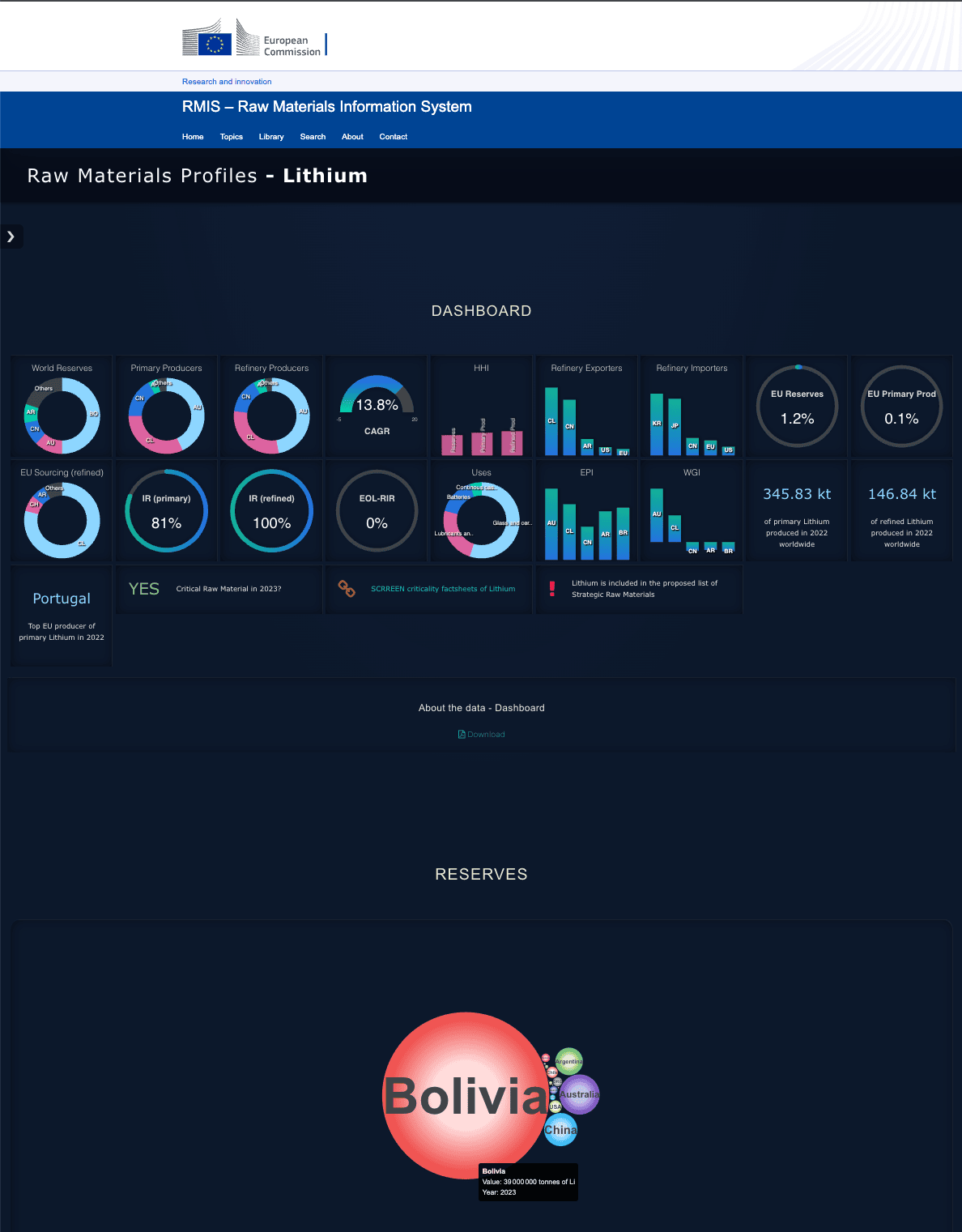
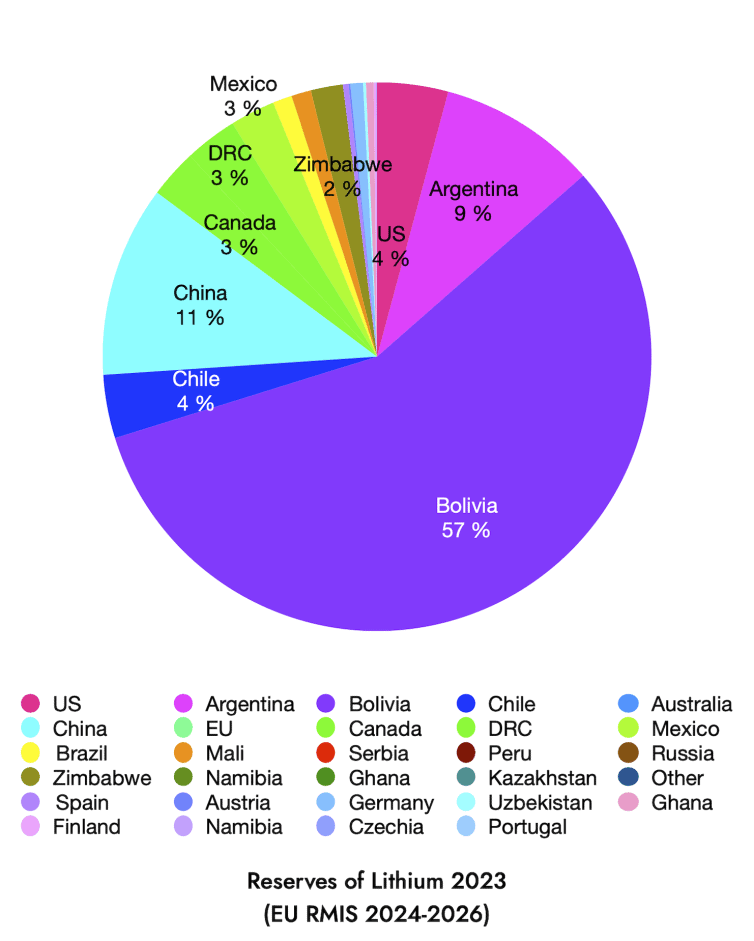
Now, when seeking the most recent assessment of the amount of Lithium resources and reserves worldwide, if we follow the data provided by the European Commission RMIS – Raw Materials Information System, we discover that the country holding the largest reserve of Lithium in the world would be Bolivia, with 39 million tonnes (data for 2023 — latest data available).
Screenshot of the RMIS Lithium factsheet (accessed 10 July 2026)
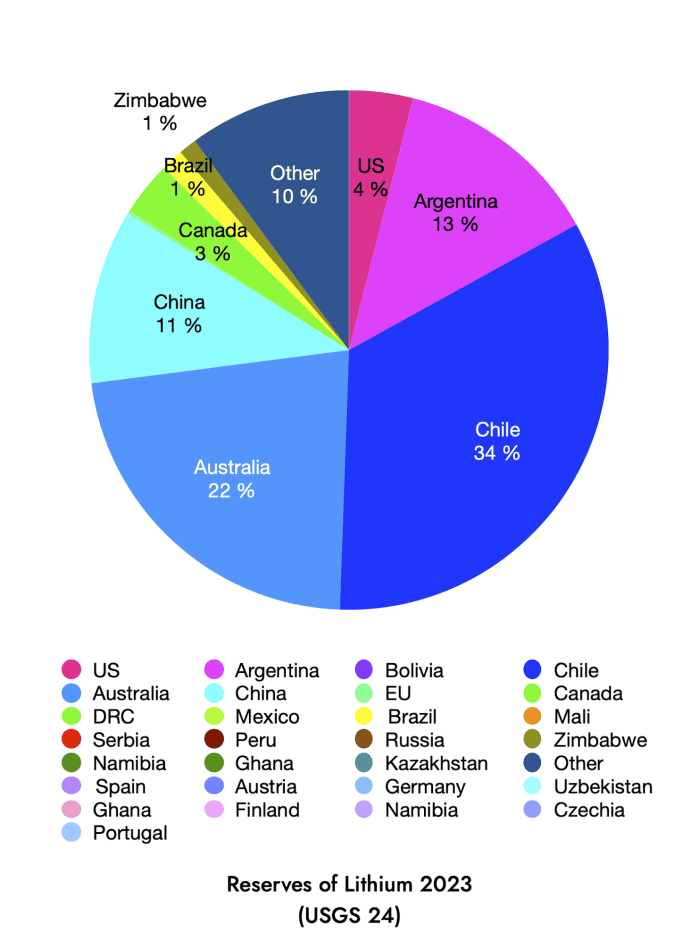
This would represent 57% of world reserves according to RMIS, 1.9 times the entire world reserves of 2023 according to the U.S. Geological Survey (USGS), Mineral Commodity Summaries, 2024, “Lithium” (pp.110–111, data for 2023), considered internationally as the “Gold Standard” for such information, and 1.05 times the entire world reserves of 2025, according to USGS 2026.
We are thus faced with a strange mystery. How much lithium does Bolivia actually hold as reserves? Do those reserves truly reach 39 million tonnes, or should we rather trust the USGS? How and why does the EC-RMIS reach such a figure for a mineral that is critical for the EU, notably used in Lithium batteries necessary for Electric Vehicles and electrification? Should all actors involved in the Lithium supply chain rush to Bolivia? Or are the reserves given by the EC-RMIS simply a mistake?
This is what we shall investigate in this article. In the first part, we explain why it matters, in geopolitical terms, to know which actors produce which knowledge and what status that knowledge holds in the world. Along the way we present the USGS, the major actor in the production of knowledge on mineral resources and reserves worldwide (and thus on lithium), and the European Commission RMIS – Raw Materials Information System, alongside other European actors.
In the second part we focus on the mystery itself — the discrepancies between the official figures given by the European Commission and those of the USGS — and seek to explain where the difference could come from. Along the way we highlight elements that should be strengthened to ensure decision-makers have access to better knowledge on this critical mineral.
Geopolitics for Lithium 2040: Eight Scenarios for the Upstream Supply Chain
Most reports on critical minerals acknowledge that geopolitics matters. This one focuses on what this actually means — through eight scenarios built on a causal model of 383 variables and 1,528 relationships, using structural analysis (Godet, revisited with network centrality measures). Read more…
Official sources, knowledge production and geopolitics
Why the source of knowledge matters
As political scientists, we do not transform ourselves into geologists or resource-and-reserve specialists. We rely on serious assessments provided by official sources and reputable experts.
Which reserves of Lithium — or of any other critical mineral or resource, for that matter — a country holds is key to any political and geopolitical analysis pertaining to the Lithium supply chain.
Which reserves our own country holds, compared with the reserves held by other countries, in the context of demand and international competition for the resource, is critical for a government, as it determines its strategy regarding Lithium and its exploitation, through both domestic and international actors.
Which reserves exist in the world, and what the status of our influence and diplomatic relations is with each country holding reserves — compared with the influence and relations of other countries also seeking Lithium — is key for any state needing Lithium.
These calculations are then complicated by the international situation, geology, technology, the capital necessary for mining and extraction, the specifics of the supply chain, and so on. Yet for government officials and strategists, building a first picture of who holds what is the foundation.
Because this vision will determine what governments do regarding Lithium, international relations analysts, business strategists, and firms involved in the supply chain — from mining to capital investment — must also understand it.
This means that we must understand who officially says what and who sets the norms for knowledge.
The Architecture of the Critical Minerals Competition: Mapping Geopolitical Risk
This strategic foresight report based on a 161-variable Causal Graph Model uses centrality measures to reveal the levers shaping the future of supply chain and how the system can structurally evolve.Read more…
The IEA, the USGS, and the making of normative knowledge
For Lithium, the first two official sources to consult are the USGS for reserves and production, and the International Energy Agency (IEA) for supply and demand. For another mineral such as uranium, for example, we would also need to take into account the “recognised global reference on uranium,” jointly prepared by the Nuclear Energy Agency (NEA) and the International Atomic Energy Agency (IAEA) — the “Red Book.”
As far as critical mineral reserves are concerned, the IEA uses USGS figures (see for example, IEA, Global Critical Minerals Outlook 2025 p.211), as well as for its regional outlooks, alongside the USGS, S&P Global (2025), and the European Commission (2025), RMIS – Raw materials’ profiles (IEA, Ibid. p.259). We do not know, however, which source corresponds to which piece of information.
The IEA, as an international organisation, represents a consensual body of knowledge shared by the international order of states and thus holds normative power. This normative power is in turn granted to the sources it uses, since that usage amounts to a kind of international validation.
As a result, USGS knowledge becomes the standard and the norm, accepted and recognised even by international agencies. Meanwhile, the USGS is also part of the US administration. Thus, irrespective of the quality and validity of its work, when the USGS shares knowledge with the world, this is knowledge held by the US — still, for now, the most powerful state in the world.
If we remain at the international and state levels that concern us primarily here in terms of geopolitics, the actors producing knowledge should ground it in their own capabilities: their experts, their geological services, reputable companies of their own nationality and, ideally, without overseas ties. If a country wants to be sovereign and independent, it cannot depend solely and exclusively on knowledge produced by other countries or by entities from other countries. The absence of ties to foreign territory, capital, or interest more broadly is essential to ensure that the knowledge produced — the fundamental building block for policy — is not tainted, even involuntarily, by others’ national interest. That knowledge must remain independent of outside influence.
When one uses USGS data, then, despite its reputation, we must keep its origin in mind. Of course, a power such as the US must produce data that are as accurate as possible, lest it lose influence in international knowledge production. Nonetheless, it is always useful to bear in mind where knowledge originates.
For example, the USGS defines itself as follows:
Created by an act of Congress in 1879, the USGS provides science for a changing world, which reflects and responds to society’s continuously evolving needs. As the science arm of the Department of the Interior, the USGS brings an array of earth, water, biological, and mapping data and expertise to bear in support of decision-making on environmental, resource, and public safety issues.
Among other things, it produces the knowledge upon which the entire US policy on mineral resources is built — from the list of critical minerals to all related domestic and foreign American action, from trade and diplomacy to possibly more aggressive moves such as Trump’s vision on Greenland, and perhaps one day invasion to secure resources.1e.g. Hélène Lavoix, “The American Threat against Greenland: When Should It Have Triggered a Watch?“, the Red Team Analysis Society, 21 January 2026. If the USGS were wrong one day, the entire strategy and policy of the US would be skewed and, ultimately, the US would fail to secure its national interest.
Thus, even though other states should, for reasons of state and national interest, always bear in mind the origin of figures shared by the USGS, the national and international obligations placed on the USGS mean that its process for producing knowledge may itself be considered a standard, or at least a useful example.
For instance, in the USGS Mineral Commodity Summariesappendix, where all terms are defined and sources for the data are given — for example in “Part B—Sources of Reserves Data” — we find :
“National information on reserves for most mineral commodities found in this report, including those for the United States, is derived from a variety of sources. The ideal source of such information would be comprehensive evaluations that apply the same criteria to deposits in different geographic areas and report the results by country. In the absence of such evaluations, national reserves estimates compiled by countries for selected mineral commodities are a primary source of national reserves information. Lacking national assessment information by governments, sources such as academic articles, company reports, presentations by company representatives, and trade journal articles, or a combination of these, serve as the basis for national information on reserves reported in the mineral commodity sections of this publication…”
Mineral Commodity Summaries 2024, appendix ,”Part B—Sources of Reserves Data”, p. 210.
We now have a picture of the normative production of knowledge on the resources and reserves of critical minerals, and an ideal vision of what this could, or should, look like for a single state.
The EU’s fragmented knowledge production on critical minerals
As far as the European Union is concerned, a list of Critical Raw Materials and one of Strategic Materials were set by the 2024 Critical Raw Materials Act. A review of those lists is due by 24 May 2027 and every three years thereafter. The European Commission RMIS – Raw Materials Information System, led and maintained by the Joint Research Centre (JRC), is in charge of those lists, and notably produces raw material profiles, country profiles, and factsheets.
Alongside this, we find another initiative, SCRREEN 3, coordinated by the French Geological Survey (BRGM), a EU consortium comprising “16 partners and 8 affiliated entities from 12 countries” financed through the European Union’s Horizon Europe Research and Innovation Programme under Grant Agreement N° 101138060, which supports the review and validation of Critical Raw Materials data. It is “running from January 2024 to December 2027, with a budget of €2.99 million”.2Call for Experts for the 2nd SCRREEN3 Validation Workshop.
As an indication – although a direct comparison is impossible, since we would need to consider the share of the JRC budget devoted to minerals plus, possibly, the budget of every relevant agency in each member state – US President Trump requested $892.7 million for the USGS for fiscal year 2027, while the enacted budget for the agency in 2026 was $1.420 billion.3“The U.S. Geological Survey (USGS): FY2027 Budget Request“, EveryCRSReport.com, 16 April 2026.
SCRREEN participates – or should participate – in the Raw Materials Information System (RMIS), as explained at a 2024 JRC / European Health and Digital Executive Agency (HaDEA) Technical Workshop “Channeling knowledge from European projects into the Raw Materials Information System (RMIS)” on 9th – 10th October 2024.
The very existence of this link suggests that two distinct factsheets on Lithium exist for the European Union. How, or whether, the data from one feeds into the other is not made transparent.
The EC-RMIS could be considered a compiler of data, but not a producer of knowledge on a par with the USGS. In future, part of that role may fall to the Geological Service for Europe (GSEU), or a similar structure — yet these remain “only” projects, “funded by the European Union,” and thus carry no official character.
One may wonder whether the multiplication of projects, programmes, networks, and consortia under a “European Union” umbrella is conducive to the best possible use of resources, or to an optimal strategy.
Let us now turn to our initial mystery — the official European Commission statement on Bolivia’s Lithium reserves, and on world Lithium reserves more generally — compared with USGS knowledge.
Explaining the Gap Between EC-RMIS and USGS Figures
Discrepancies and outdated data
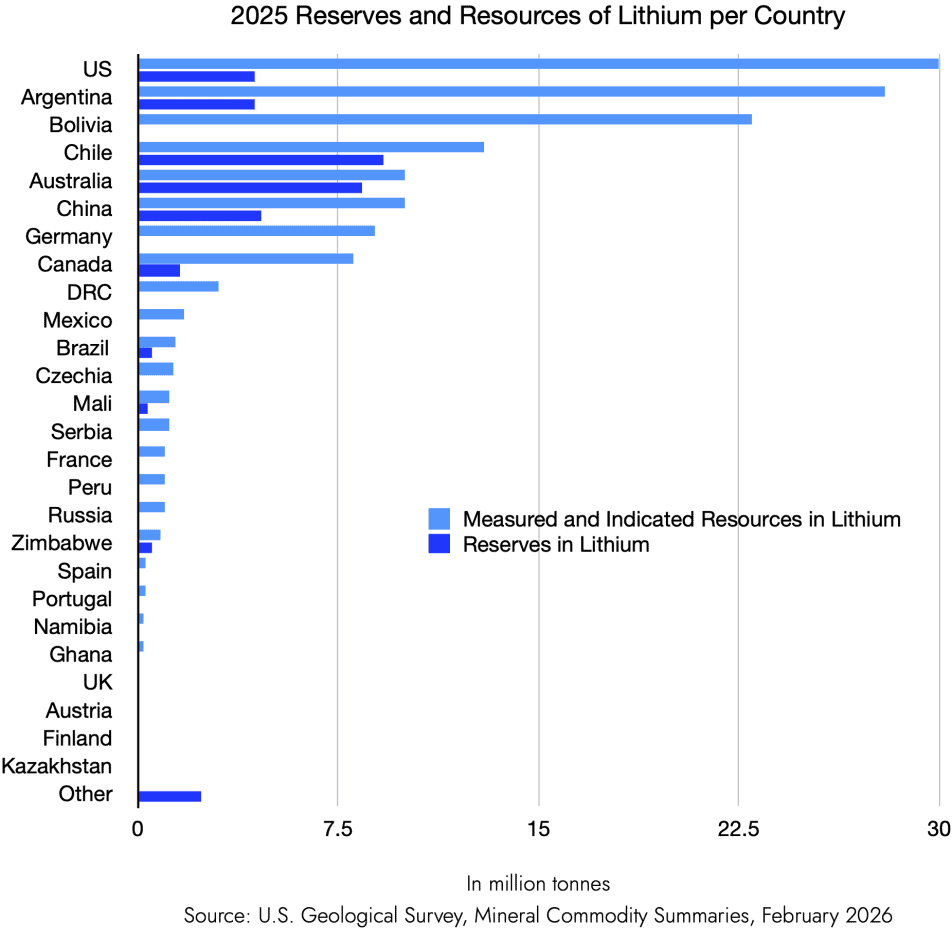
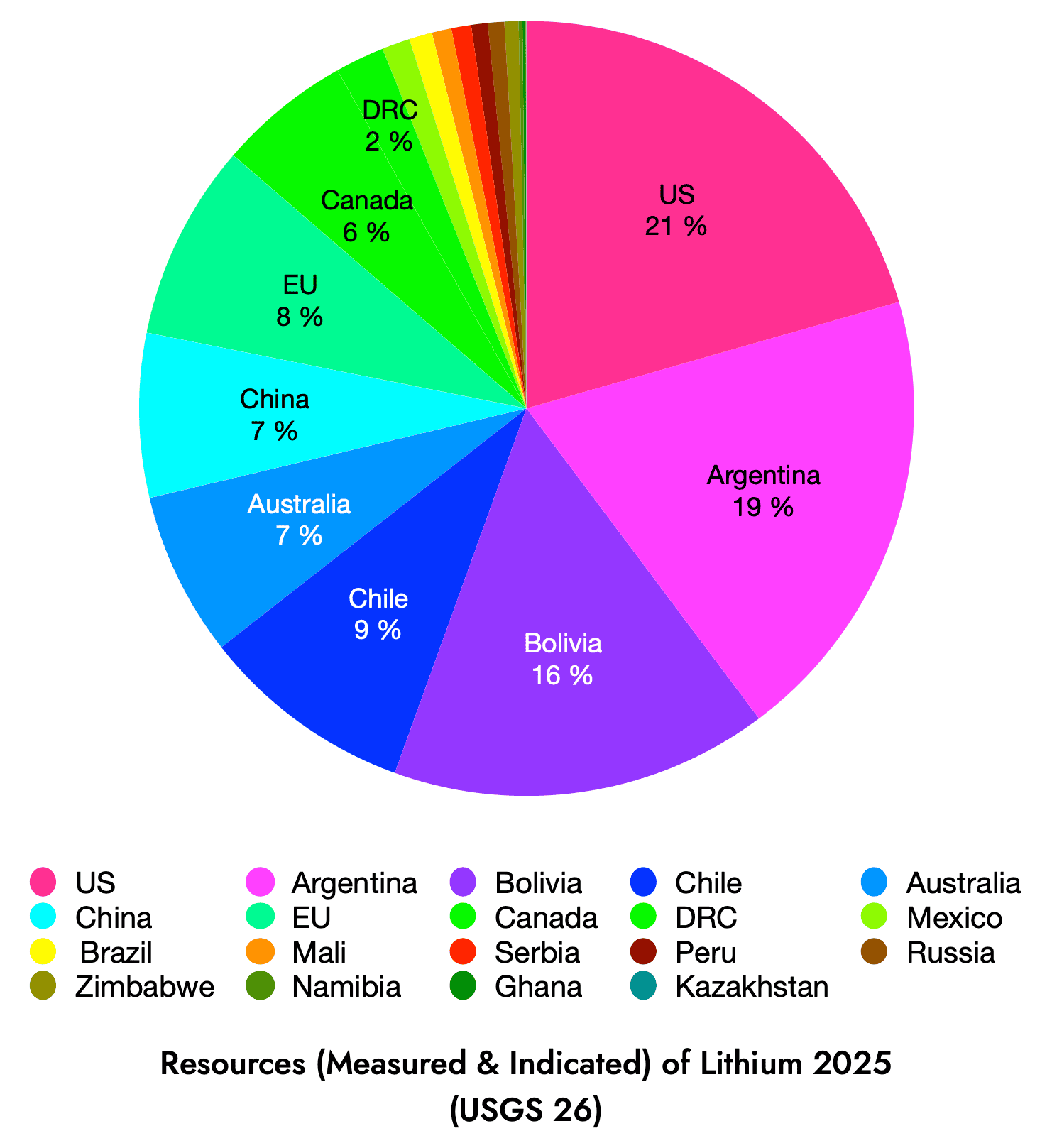
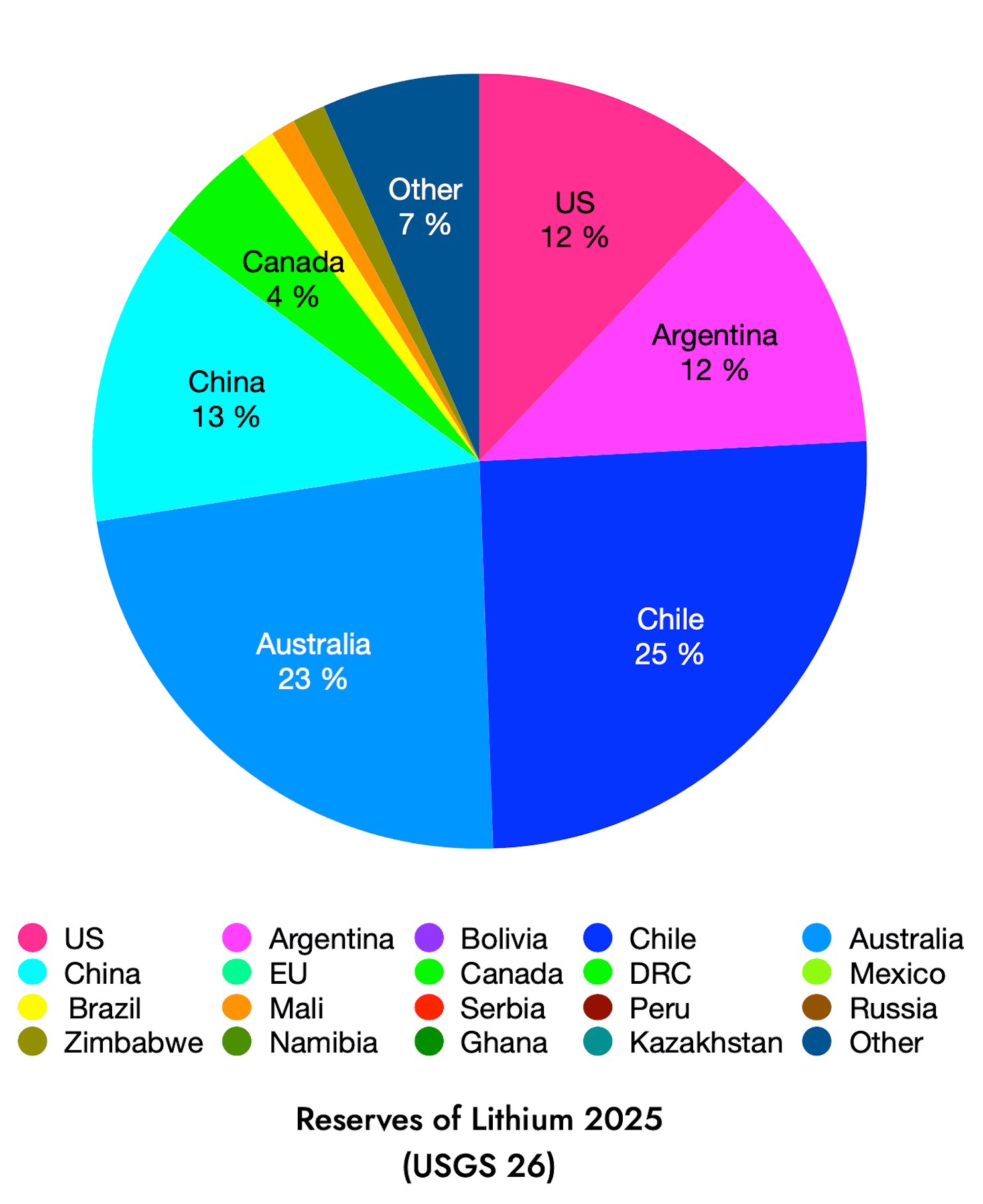
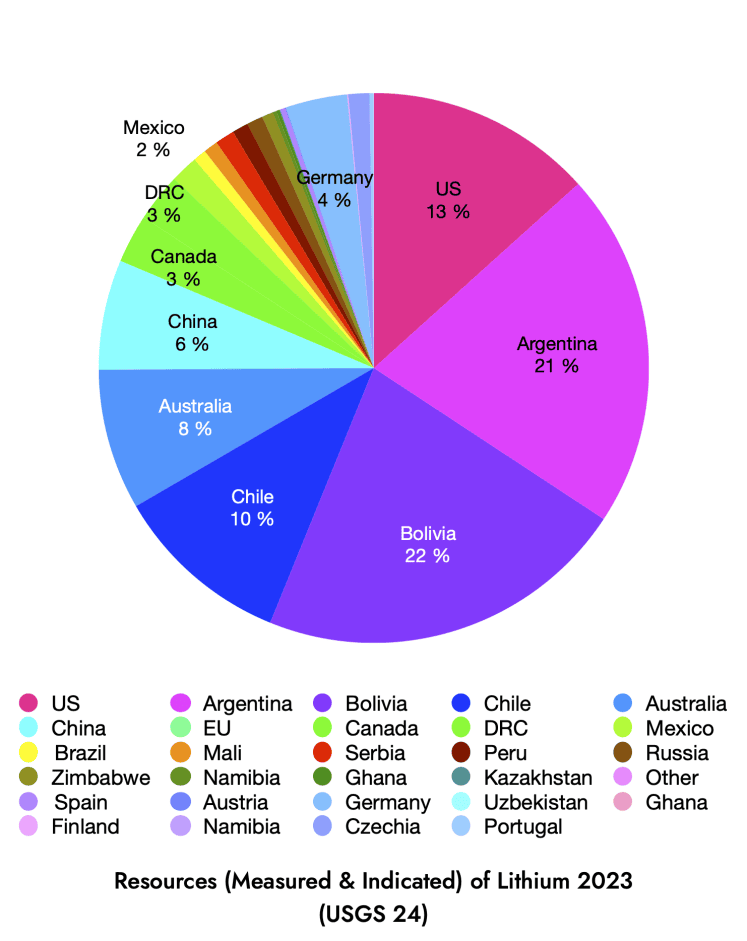
For lithium, according to USGS 2026 public data, we have the following figures, as displayed on the charts below:
More specifically, Bolivia’s resources reach 23 million tonnes, and there are no reserves. We may assume that, when the USGS collected its data, Bolivia was not yet exploiting any lithium mine, and thus had no reserves.
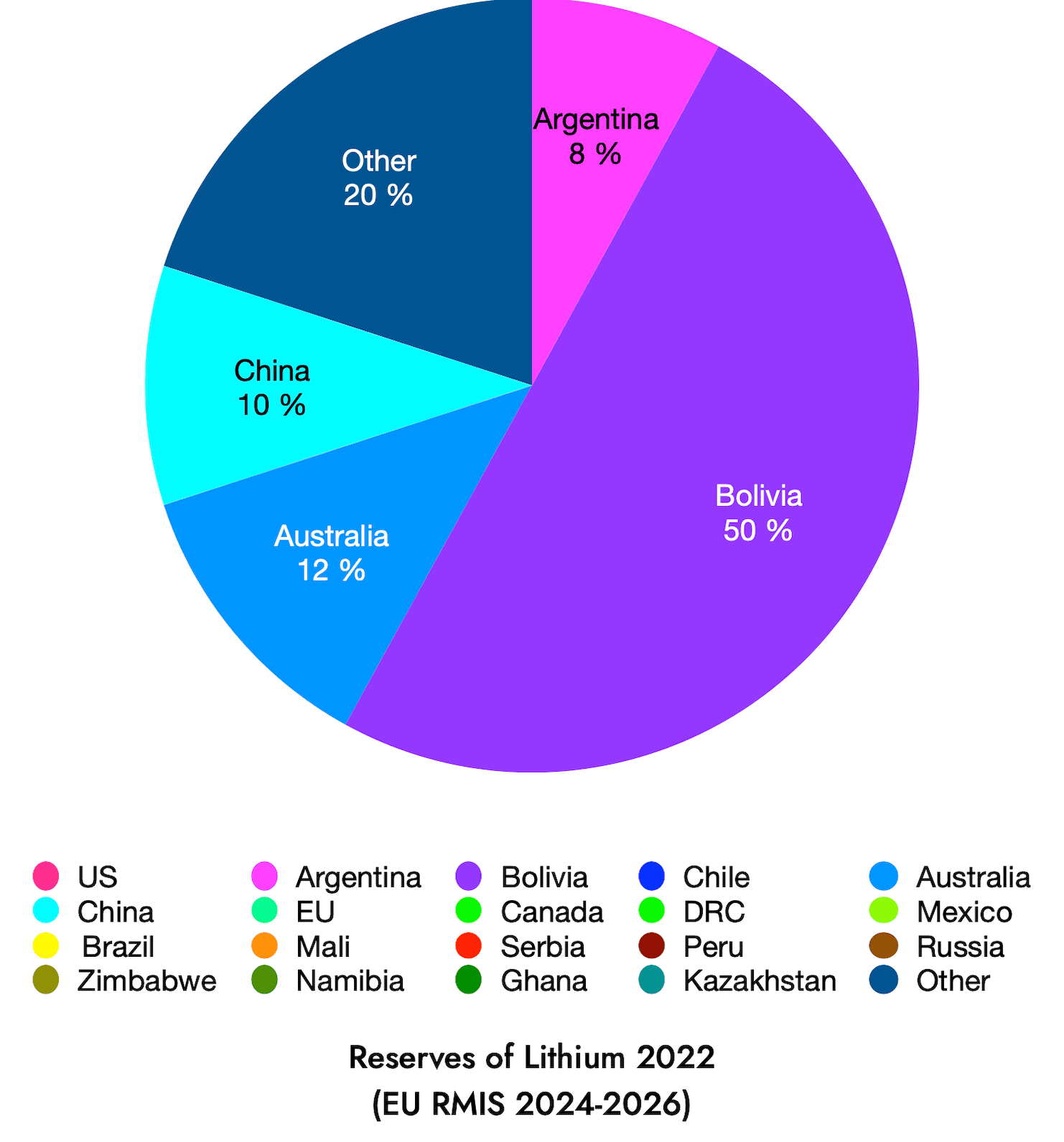
Now, if we look at the EC-RMIS Lithium profile, the first chart shows the top five holders of Lithium reserves in the world as Bolivia 50%, Australia 12%, China 10%, Argentina 8%, and other 20%. EU reserves reach 1.2%. No year is given for this data. If we download “About the data – Dashboard” and look at the chapter for Lithium, we read: “Reference Year: 2022… Latest RMIS Dashboard update: November 2024.” Let us compare those figures with the USGS 2026 figures for 2025:
The figures are radically different, notably for Bolivia. The RMIS “reserves” correspond neither to USGS reserves nor to USGS resources. The USGS notes that resources were considerably revised worldwide in 2025, so some of the discrepancy may stem from that revision, and from earlier ones. Meanwhile, the first data presented by the RMIS date from 2022 — hardly comparable to the far more recent USGS 2026 Critical Summary.
This alone shows that the three-year revision cycle set out in the EU Critical Raw Materials Act is far too long. It implies, as the charts show, that EU policymakers and other decision-makers relying on EU data are working from outdated figures — which could carry serious consequences when dealing with critical and strategic materials. And if the discrepancy is already known, the RMIS data discarded and the USGS is treated as the real standard, then EU taxpayer resources are being spent producing data that goes unused.
For its part SCRREEN 3 is carrying out its own revision of its Critical Raw Materials factsheets, with the latest round taking place over the summer 2026.4Call for Experts for the 2nd SCRREEN3 Validation Workshop. However, a look at the draft version of the Lithium factsheet (SCRREEN/2025) shows that, for reserves and resources, it uses USGS data published in 2025 – i.e. 2024 figures. It states: “Global measured and indicated lithium resources reached approximately 115 million tonnes, according to the latest USGS data.”5Ibid. The newer USGS 2026 report instead reads: “Owing to continuing exploration, measured and indicated lithium resources have increased substantially worldwide and total about 150 million tons.”
Thus, despite the effort involved, the newly synthesised knowledge is already outdated before it is even published. As with the EC-RMIS dashboard, this points to a serious problem for national interest, strategy, and policymaking.
Bolivia’s Reserves Under Closer Scrutiny: The 2023 Data
Below the first charts on the RMIS dashboard, Lithium reserves are broken down and presented as bubbles. Bolivia’s reserves are shown crushing all others, as shown in the first screenshot.
We should therefore compare this 2023 data with the USGS 2023 data, published in the 2024 report:
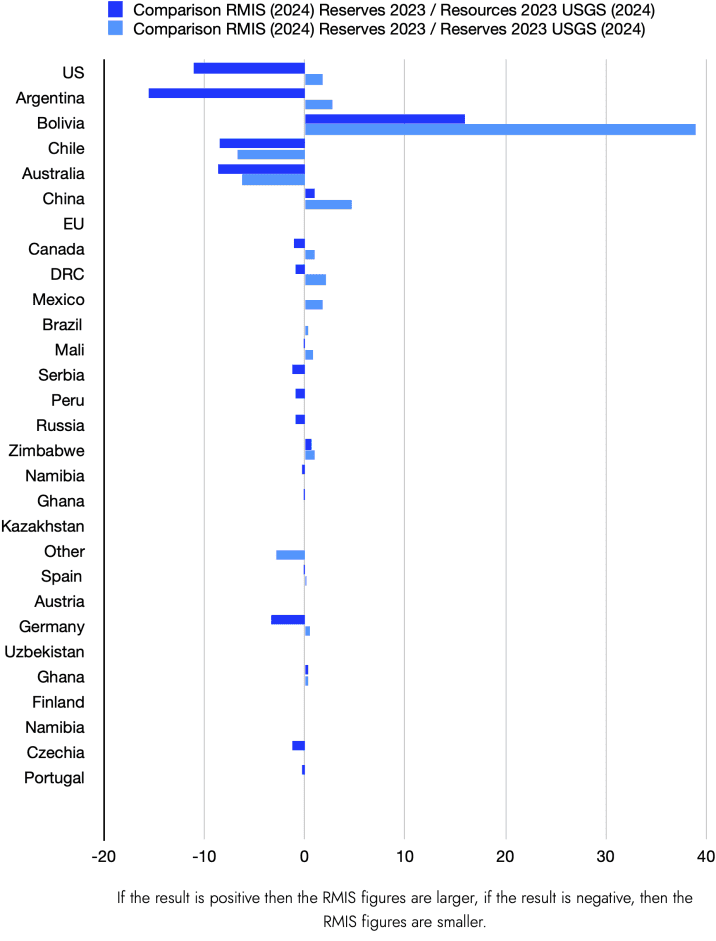
For 2023, the discrepancies are even larger than those observed above. Comparing the figures country by country, we obtain the following result:
No obvious pattern emerges — there is no systematic over- or under-estimation that might point toward an explanation.
For its part, SCRREEN3, across its various Lithium factsheets, uses USGS data for resources and reserves. The forthcoming edition, relying on USGS 2025, like the 2023 factsheet relying on USGS 2022 (thus 2021 data), shows Bolivia with 23 million tonnes of resources and no reserves (tables 9 and 10).
Let us try to unpack the EC-RMIS data.
What does the EC-RMIS mean by “reserve”?
What resources and reserves actually are is well codified in the mining world, even though different systems exist. Specialists working across those systems are aware of the differences, specify which system they use, and make an effort to keep their data consistent across countries.
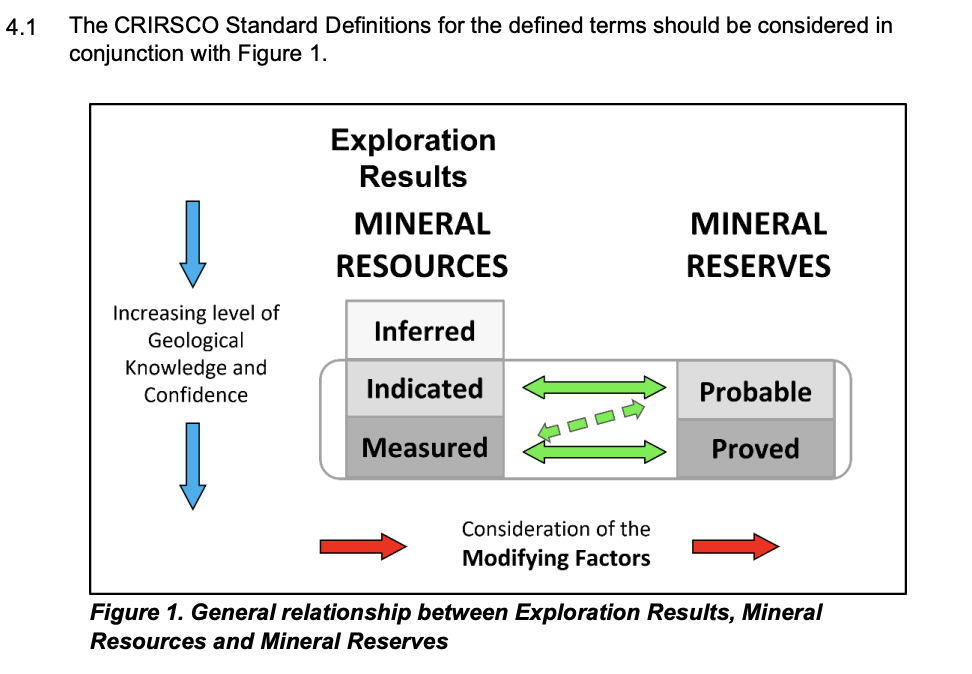
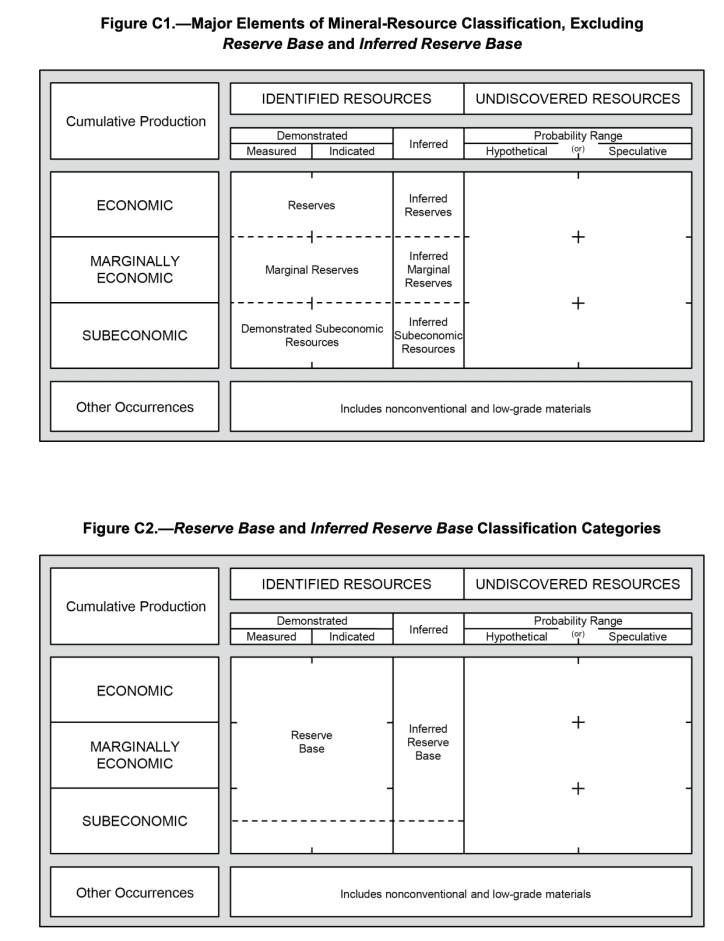
Internationally, the system evolved out of the interactions between three frameworks: the American USGS Circular 831, the Australasian Code for Reporting of Exploration Results, Mineral Resources and Ore Reserves (the JORCCode), and the CIM Definition Standards for Mineral Resources & Mineral Reserves (interested readers may find detail on the historical contribution of each here).
The resulting common CRIRSCO standard has now been adopted by many countries’ mining industry representatives, which is not the same as state’s entities. That standard is defined as below:
What must be noted is that moving from resources to reserves requires a number of factors to be satisfied, demanding evaluation and expertise by a “competent person.” These modifying factors include: mining and metallurgy (do we have the technology to separate lithium from magnesium?), infrastructure (are there roads, water, and electricity to run the plant?), law and environment (does the company hold the necessary environmental permits?), and society and government (does the local community or the sovereign state allow extraction?).
As far as the USGS is concerned, definitions of resources and reserves are still governed by USGS Circular 831, which differs from the CRIRSCO standard:
Resources are categorised as “Measured and Indicated” and grouped together under the term “Demonstrated.” Reserves are explicitly defined as the portion of those “Demonstrated” resources that is economically extractable at the time of determination.
Unfortunately, “economically extractable” (USGS) does not map exactly onto the “modifying factors” of the CRIRSCO standard.
As for the EU-RMIS, the two available information sheets tell us that “the mineral reserves estimate provided by (S&P, 2024) are mostly based on CRIRSCO reporting standards (last update May 2024).” The word “mostly” is worrying, since it suggests no real effort at standardisation was made, in contrast to the USGS’s approach. This may be a first source of discrepancy.
In any case, the EC-RMIS deals in reserves, not resources. Given the different logic of the two systems — CRIRSCO and USGS — some discrepancy between figures is to be expected. But since the USGS remains the gold-standard reference for resources and reserves, we still need to compare against it.
At first glance, the CRIRSCO modifying factors should be stricter than the USGS’s “economic viability” test. We would therefore expect all RMIS reserve figures to be smaller than USGS ones — which is not the case, as shown below (we have also kept the USGS resource figures for reference, in that case RMIS figures should always be smaller, thus appear in negative in the chart below):
The most striking incoherence concerns Bolivia’s reserves. They reach 39 million tonnes according to the EC-RMIS, yet do not exist at all for the USGS (production has not yet started, or may be about to, with a Chinese and a Russian firm involved).6Muflih Hidayat, “Bolivia Lithium Development: Massive Reserves Meet Production Challenges”, Discovery Alert (Mining News), 24 October 2025. Comparing RMIS’s Bolivian reserves with the USGS’s Bolivian resources (23 million tonnes), the RMIS figure exceeds the USGS one by 15 million tonnes — not a small margin.
While the discrepancy is most striking for Bolivia, very significant gaps also appear across most other figures. Since none of them are explained, it becomes effectively impossible to rely on the EC-RMIS for Lithium reserves at all.
It seems likely that the RMIS did not standardise the data it collected across countries, nor check the plausibility of its results against USGS findings.
Whose Data Is It? The Sources Behind EC-RMIS
The RMIS relies entirely on S&P 2024 for its data — that is, S&P Global’s Global Mining Intelligence platform. (We contacted S&P Global to ask whether they could help explain the differences, but had not received a reply as of publication.)
This is a surprising choice. First, how can a quasi-state entity rely entirely on a market-based one? The logics and interests involved are not the same. Second, how can an entity representing sovereign, independent states rely on an American private firm, given the various tensions between the EU and the US — tensions that predate the election of President Trump.
The USGS, by contrast, does not rely exclusively on data from a commercial firm, however reputable, even an American one.
To hand the production of state knowledge over to a foreign firm is to give up sovereignty and independence.
The EU could instead have been expected to compile and standardise world data on critical minerals sourced from its own member states — assuming such data exists at all.
Conclusion
It is impossible to rely on the 2024 EC-RMIS data for Lithium reserves, even though these are the Commission’s official statistics.
The difficulty of making sense of the gap with the USGS figures unfortunately discredits the entire factsheet as potentially unreliable — even where other figures in it may well be correct (we did not check them). No sensible decision-maker or researcher will spend the time needed to compare and verify every figure in the factsheet, unless specifically tasked to do so.
Worse, the problem identified here for Lithium reserves could also cast doubt on the entire RMIS effort for other Critical Minerals, should other major unexplained inconsistencies come to light.
In terms of influence, this reflects poorly on the European Commission and on the European Union as a whole.
Furthermore, where Lithium is concerned, if decision-makers ground strategies, policies, and actions in RMIS data, the consequences could be serious.
Other EU-funded initiatives and projects rely, for world data, on the USGS. While this may be the only realistic option, it is also a risky one, should the US one day withdraw or alter its USGS publications.
Policy recommendations
The European Union should ensure that the official data it provides is correct, and should allocate sufficient resources to this task on a permanent basis.
All European institutions and member states should, as rapidly as possible, take every measure necessary to ensure the official knowledge produced is valid.
Given how essential they are, data on critical minerals should be revised yearly, not every three years.
Efforts should be made to regain Europe’s independence in knowledge production, as this is key to effective action.
The European Parliament (EP) – and concerned Committees – should make sure the 2024 EU Critical Raw Materials Act is updated accordingly.
Some of the articles in this category are open access, you can read them freely. Some articles are premium: if you are a member or purchased an access plan, please log in. Become a member.
Originally published 9 October 2023, under the title “How to Create New Civilizations (1)? Challenges and Pressures“. Significantly revised and updated for our Featured Insight series. Time to read: 13 to 19 minutes
The first decades of the 21st century present human societies with many challenges. At times, it appears our very civilizations are at stake. Can we create new better-adapted civilizations? What are the alternatives? What can we learn from the works that have examined the history of civilisations?
Between the two world wars of the 20th century, British historian Arnold Toynbee wrote such a masterful history of civilizations in 12 volumes, published in 1934 and 1939 for the first 6 volumes, then between 1954 and 1961 for the last ones: Arnold Toynbee, A Study of History, Oxford University Press, 1934 [tomes 1-3], 1939 [tomes 4-6], 1954 [tomes 7-10], 1959 [tome 11], 1961 [tome 12]. In 1946, D. C. Somervell, also a British historian, published an abridged version of the first 6 volumes (the second part was published in 1957). This is the work we shall use here: D. C. Somervell, A Study of History: Abridgement of Vols I-VI, with a preface by Toynbee, Oxford University Press 1946.
Toynbee’s work was acclaimed when it was published but has long fallen into quasi oblivion, while it was also criticised. Students and researchers mention it, but few have read it, would it be only the abridged version. Yet.
In this series of articles, we present Toynbee’s argument on the life and fate of civilizations, moving from petrification to genesis or disappearance, from genesis to growth or break down, from break down to petrification or disintegration, and finally back to genesis or disappearance. We highlight corresponding examples and cases for our 21st century world and stress lessons we could learn from Toynbee.
After explaining briefly how a new civilization emerges, this first article focuses on one of the two series of factors that are necessary for the genesis of a civilization: challenges.
A brief outline of genesis
For Toynbee, the best unit of analysis to understand history is “societies”, understood as wholes. It is neither nations, states nor nation-states. As examples, Toynbee gives, among others, the Hellenic society, the “Orthodox Christian, the Islamic, the Hindu and the Far Eastern Societies”, etc. (p. 567).
According to him, “civilized societies” or civilizations are born out of “primitive societies”, which had become static. These “higher civilizations” are less numerous but usually far larger than their primitive ancestors. Then, some of these “civilised societies”, in turn, became static and evolved – or not – into newer societies or civilizations. For example, the Orthodox Christian society and the Western Christian society evolved out of the Graeco-Roman or Hellenic society (this does not of course rule out other types of inputs). As another example, the Hindu society evolved out of an Indic society (pp. 35-36, 12-15, 20-21; pp.567-568).
Hence, Toynbee argues that, in the course of their lives, civilizations tend to petrify, to become static. Then, pressures and challenges may provide the static society with a stimulus that allows to overcome petrification and to become dynamic anew. In that case, we have the creation of a new civilization, a genesis. This process, however, is not a fatality. The initial civilization may fail to answer properly the challenge faced and succumb (pp. 48-163).
As highlighted by the historian, being able to move out of petrification towards dynamism depends upon two factors, or rather a factor and a process (Ibid.).
First, a challenge, which creates a pressure, needs to be overcome. The existence of this challenge and its strength will determine the outcome: i.e. genesis of a new civilization or disappearance of the petrified civilization (Ibid.).
Second (next article), what matters is the process of response to the challenge. Its success or failure in eliciting the proper answer will lead to various outcomes.
Challenges and their strength
The “Golden Mean”
First of all, Toynbee points out that the challenges and pressures must be neither too weak nor too severe, but have a medium intensity he calls the “Golden Mean” (pp. 140-163).
For example, letting aside for now an in-depth discussion on the state of our civilization, or civilizations, if we think about today’s climate change’s immense challenge, we may imagine that the initial impacts brought about by the first 0.5°C of temperature rise above pre-industrial average were not enough to constitute a pressure for stimulus leading to change.
Unfortunately, the cumulated effects over time of a certain level of temperature rise – to be determined – might also prove too much.
In between, we may hope that a “golden mean” temperature increase will be achieved, which will generate the ideal stimulus.
Which “Golden Mean”?
One of the difficulties here resides in evaluating the strength of the pressure, when looking at the future. In our example, which level of temperature rise would constitute too severe a pressure and which level would be the “Golden Mean”?
It would appear logical that the strength of the pressure varies according to previous achievements of a civilization. What may have been a perfect challenge for an early civilization, may not be anymore a challenge at all for current civilizations.
For example, facing a temperate climate with four seasons forces inhabitants, for instance, to anticipate and plan ahead, to develop storage facilities to be able to survive during winter and early spring months. However, for early 21st century civilizations, a temperate climate does not constitute anymore a challenge with related strong stimulus. This will be true as long as we can benefit from the thousands of years of achievements across all fields that allowed us to overcome the pressure stemming from a temperate climate. Nonetheless, we should neither discard nor forget this initial challenge. Indeed, current civilizations could, because of other challenges and processes, internal and external, end up losing what they achieved. In that case, the initial challenge that was not operating anymore would become salient again.
What has been close to happen in Europe during the winter 2022-2023 could constitute an example for this case. Faced with skyrocketing electricity prices owing to the war in Ukraine, the obvious and usual way to handle both winter time and goods production suddenly became far from being that obvious and led to series of challenges long forgotten. Similarly, the US-Israel war against Iran and the related energy shock can lead to the return of old challenges.
What could be happening with the impacts of climate change, for example in terms of extreme weather events, would, similarly, question the way we have learned to handle temperate climate after millennia of experience. First, the old temperate climate may be gone, which would question the relevance of experience and achievements. Second, the habit to “just rely” on consumer goods being always available in shops and supermarkets may become obsolete, if and when supply chains break down. In that case, as consumers have been so spoiled most only know how to shop, then the ways of life allowing for survival will have to be reinvented.
As another example, following the end of World War II then of the Cold War, many came to believe that war on the territory of geographical Europe had become impossible. The war in Ukraine showed us otherwise. War does not disappear because we have a long period of peace nor because ideology wants it. The COVID 19 pandemic is also another example of a past known pressure that initially was met with disbelief, because it was unthinkable our 21st century world would know such a thing as a global pandemic.1e.g. Helene Lavoix, “The Coronavirus COVID-19 Epidemic Outbreak is Not Only about a New Virus“, RTAS, 12 Feb 2020. It nevertheless took place.
We can find many other examples of such return of the unthinkable, with impact on the challenges faced and their level of intensity: Could the post-1945 UN base international order disappear? U.S. President Trump’s actions show that it is indeed possible. Could alliances that were believed to be engraved in stone change, evolve or even die? Again, U.S. President Trump’s actions – from Greenland‘s to insults against Saudi Arabia’s Crown Prince, or against Europe – show that it is totally possible.
Even though for a very long time a challenge and pressure have existed at an extremely low level of intensity, it does not mean that they are gone.
Meanwhile, the intensity of the challenge is dynamically relative to the achievements of a civilization.
Furthermore, we may deduce from Toynbee’s argument that the series of challenges and pressures that befall a society at the same time must not be cumulatively too severe nor too weak.
For example, could the early 21st century civilizations face at the same time the impacts of climate change with 1.5°C of temperature rise, a world war and a pandemic more deadly than the COVID-19?
Five types of challenges and pressures
Having highlighted the importance of the relative strength of the pressure, Toynbee identifies five types of challenges that may lead to a stimulus capable of generating an answer that lifts a civilization out of its petrification. The stimulus and resulting response, then, should allow the society to become dynamic again, developing highest achievements.
Hard countries – climate change again
First, we have “hard countries”, i.e. a geographical and ecological environment that is hard and challenging for human beings, yet within the bounds of the “Golden Mean” (pp.88-98).
We can use again the example given above of climate change. In that light, and assuming we, as a species, survive, climate change and its impact on our environment could be seen as an opportunity. This would demand, however, that we make sure to keep the challenge of the resulting environment within the “Golden Mean”. In that case, we could create new, better or higher civilizations.
New grounds – the case for outer space
Second, Toynbee stresses the importance of “new grounds”. He means that for a society to have to live or travel lengthily in new unfamiliar environments, in new spaces, generates challenges that are fruitful if their strength is located within the “Golden Mean” (pp. 99-107).
A 21st century example of such a “new ground”s” could be outer space. The efforts endeavoured by humanity to discover and understand outer space and then to travel there, whatever the goal, correspond perfectly to Toynbee’s challenge.
Alongside these material endeavours, we find attempts to regulate human activities in space or part of it, starting with the Outer Space Treaty of 1967. On 13 October 2020, the American launched the Artemis Accords (“Principles for Cooperation in the Civil Exploration and Use of the Moon, Mars, Comets, and Asteroids for Peaceful Purposes”). In September 2023, Germany became the 29th nation to sign it. As of May 2025, 55 states have signed the Accords.3U.S. State Department, the Artemis Accords. Perceiving the Artemis Accords as a way to project American domination and order in space, China countered with an all-encompassing “Proposal of the People’s Republic of China on the Reform and Development of Global Governance“, notably “to prevent new ‘new frontiers’ from militarization caused by major power competition.4Yang Shengand Zhang Yuying, “China issues proposal on reform, devt of global governance“, 13 September 2023, Global Times. Incidentally, the Chinese new frontiers include “The deep sea, polar regions, outer space, cyberspace and digital technology and artificial intelligence (AI)”.5“Proposal of the People’s Republic of China on the Reform and Development of Global Governance“. They may all be seen as “new grounds”. Note that the Chinese new frontiers almost perfectly correspond to what we call extreme environments (see portal to Extreme Environments Security).
Activities in outer space and attempts at regulating them start outlining an original response to the challenge of outer space for human beings. That early answer could have the potential to pave the way for a new civilization, following Toynbee’s “new grounds” type of challenge.
Sudden blow – The other side of the military defeat of enemies
According to Toynbee, a “sudden crushing defeat” can “generate a stimulus for the defeated party.” The author refers to war (pp. 108-111).
One of Toynbee’s examples is the rise of Prussia. Following the defeats of Jena (1806) and notably the treaties of Tilsit (1807) during the Napoleonic wars, Prussia found the energy and way to totally regenerate its army, administration and educational system. As a result, it became far stronger and “the chosen vessel for the new wine of German nationalism” (p.110).
Tentatively, a potential example for the early 21st century of a “sudden crushing defeat” could be, for Armenia, the dissolution of the separatist government of Nagorno-Karabakh according to a 20 September 2023 agreement, and the resulting massive exodus, after Azerbaijan’s lightning offensive on 19 September 23.6e.g. France 24 “Nagorno-Karabakh announces dissolution as more than 75,000 flee separatist enclave“, 28 September 2023; Masha Gessen, “The Violent End of Nagorno-Karabakh’s Fight for Independence“, The New Yorker, 29 September 2023. Without hindsight though, it is impossible to know if we are indeed in a case relevant for Toynbee. What we may say is that a potential is there, despite the tragedy.
As another example, should a war take place between China and the U.S., the victorious country might well give its enemy a stimulus for achieving a newer and better civilization.
Similarly, should Ukraine and NATO or then Ukraine and the EU have defeated Russia in Ukraine, then the result could have been to provide Russia with a stimulus – according to the strength of the pressure – to launch a string of further in-depth reforms that would potentially make it far stronger. The alternative holds also potentially true, should a defeat of Ukraine and the EU against Russia be finally acknowledged in a peace treaty. It could potentially provide the EU with a stimulus for in-depth reforms (including political organisation) making it stronger.
Continuous external pressure – Another look at migrants’ routes?
With the idea of a “continuous external pressure”, Toynbee refers to people who are inhabiting the margins or frontiers areas of a territory and, as a result, are submitted to constant pressures and attacks from other peoples. According to him, this type of constant pressure generates the stimulus necessary for a better development (pp. 111-125).
Tentatively, even though the circumstances are far from being similar to those described by Toynbee, we may imagine that areas constantly confronted to flows of migrants may constitute a kind of 21st century frontiers areas.
In the case of the Mediterranean sea, the frontiers areas would be largely located as displayed on the Reliefweb/OCHA maps below, not only at arrival but also departure points:
Similarly, in the Americas, frontiers areas could be found along the main routes, their cities and border points (see maps below from the IOM, Migration Trends in the Americas, Global Compact for Migration, Feb 2023 and March June 2023):
For Toynbee, the factor he names “penalizations” refers to groups of people who have suffered centuries of exclusion at the hand of others. He states that this “penalization” may lead those who suffer it to put exceptional energy and creativity in the only avenues open to them. In turn, this may lead to the development of higher and newer societies or civilizations (pp. 125-139).
One of the examples Toynbee provides is the “hordes of slaves” imported by Rome in the last two century B.C. out of which arose the “Freedmen” as well as Christianity (pp. 126-128; p.572).
In the 21st century, everything being equal, we may wonder if those who were left behind during now more than a century of urbanization consequent to industrialisation may not be considered as somehow “penalized.” Possibly, the rural migrants could also be considered as “penalized” in Toynbee’s meaning. However, in this later case, as rural migrants adapt and integrate, the penalization may not last long enough to truly create the conditions of pressure for stimulus described by Toynbee.
As another example, peoples who have yet to be recognised as such and did not succeed in getting a state on their own, such as, for example, the Kurds, who are spread over four countries (Iran, Iraq, Turkey, Syria), could also be candidates, potentially, for experiencing the penalization factor of Toynbee. The disparity of the Kurdish situations according to each of the four countries where they live shows the difficulty of applying the idea of “penalization” to a “people” without a thorough analysis. Beforehand, specific analyses should be done accounting notably for the birth and development of an “imagined community”, to borrow from Benedict Anderson (Imagined Communities, Verso: 1991). Nonetheless, the interesting ideas that were promoted by the Syrian Kurds in terms of economic and political development are a signal of the novelty and energy that tragic pressure may generate.7H. Lavoix, “The Kurds in Syria – State-Building, New Model and War“, 22 May 2017.
To summarize, Toynbee presents five types of challenges which, according to the strength of the pressure generated, may create a stimulus that favours the creation of new civilizations. In the first decades of the 21st century, such challenges are present and often acute, globally and locally.
How can populations build upon the stimulus triggered and turn it into an adequate response thereby building new civilizations? This is what we shall explore with the second article of this series.
Watch Out briefs flag geopolitical and security developments that may carry significant second-order and longer-term implications. They are designed to support early awareness and strategic monitoring. For in-depth analysis, structured risk mapping, strategic foresight and early warning, please contact us.
What
Saudi Arabia is a key actor in the US-Israel vs Iran war thanks to its strategy and geographical location. As a result of the conflict, Saudi Arabia could see its place as major regional actor enhanced.On the short term, much hinges on future Houthis’ actions.
Hearsay regarding the Kingdom of Saudi Arabia support for the war against Iran
In contradiction with Saudi official statements, reputable American newspapers reportedly state support by the Kingdom of Saudi Arabia (KSA) for the U.S.-Israel war against Iran:
According to The Washington Post, the Kingdom of Saudi Arabia reportedly supported President Trump in starting the war against Iran.1Michael Birnbaum, John Hudson, Karen DeYoung, Natalie Allison and Souad Mekhennet, “Push from Saudis, Israel helped move Trump to attack Iran“, The Washington Post, 28 February 2026.
Similarly, according to The New York Times, at the end of March 2026, Saudi Crown Prince Mohammed bin Salman reportedly favoured and supported, in unofficial communication with the American Presidency, the continuation of the war to bring the Iranian government and regime down.2Julian E. Barnes,Tyler PagerandEric Schmitt, “Saudi Leader Is Said to Push Trump to Continue Iran War in Recent Calls“, The New York Times, 24 March 2026. The Saudi leader is meant to have stressed the “’historic opportunity’ to remake the Middle East”.3Ibid.
Publicly, however, KSA calls for a “peaceful resolution to this conflict”.4Ibid.
President Trump appeared to confirm the support of the Saudi leader by highlighting, in a press conference, that “Saudi Crown Prince Mohammed bin Salman is ‘a warrior'”, claiming that “Saudi Arabia is ‘fighting with us’”.5The Times of India video, “‘MBS Is Fighting With Us’: Trump Puts Stamp On Saudi Arabia’s Role In Raging Iran War“, 25 March 2026.
The problem with using hearsay as source is that it is impossible for anyone to check the validity of the source and the quality of information.6Hélène Lavoix, “How to Read a Large Amount of Information and Fight against Fake News“, The Red Team Analysis Society, 3 April 2019. This absolutely goes against any proper analysis, making it far more difficult if not impossible. The U.S. system is familiar with this process of publishing hearsay as “hidden insiders information”, any unhappy political opponent using newspapers to leak possibly true information to try obtaining something. The only thing we can seriously infer from such leaks are that there is disagreement within the American system. However, it is impossible to assess the truth and the relevance of the leaked information, as we have no verbatim and as it is impossible to know who said what, why, when and how: words can be repeated out of context, the person sharing the leak may not understand the full picture, etc. There are a host of reasons for which such information should be taken with caution. On the other hand, it cannot either be neglected.
As a result, here, besides other negative consequences which are out of scope of this brief, we consider that these hearsay and leaks highlight the fear of the U.S. Presidency to see their war against Iran backfiring. Meanwhile, singling out Saudi Arabia and the Crown Prince stresses the important role played by the Kingdom in the American Middle East history and strategy, while stressing the Kingdom’s critical role in the region.. The two newspapers article have nonetheless potentially domestic impacts, as explained in an interesting Saudi analysis,7Mohammed Omar, “Trump Humiliates MBS on a Saudi Stage and Exposes the Alliance“, House of Saud, 28 March 2026. as well as international ones.
Now, on 27 March, at the FII Priority summit backed by the Saudi Public Investment, the American President also insulted the Saudi Crown Prince, with certain dire consequences for any relationship between the U.S. and Saudi Arabia,8Mohammed Omar, “Trump Humiliates MBS on a Saudi Stage and Exposes the Alliance“, House of Saud, 28 March 2026. without forgetting American standing on the world stage.
As a result, it is highly likely that the Kingdom of Saudi Arabia will reinforce its objective of sovereign independence.9Ibid. Hence, the strength of Saudi Arabia’s regional power, including vis a vis the U.S., becomes even more important for the kingdom.
Last but not least, President Trump also most probably made a mortal enemy of Crown Prince Mohammed bin Salman.
Iranian attacks cause relatively less direct damage to Saudi Arabia than to its neighbours
Even though KSA is also victim of Iranian attacks,10Mark F. Cancian and Chris H. Park, “Assessing the Air Campaign After Three Weeks: Iran War By the Numbers“, CSIS, 25 March 2026. considering Saudi’s territory compared with the size of its neighbours, the strikes may appear as less intense.
Against the backdrop of tensions with the United Arab Emirates (UAE), particularly in the economic sphere,11Mohammed Ayoob, “Saudi Arabia vs. the UAE: The Other Gulf Crisis“, The National Interest, 14 February 2026. Saudi Arabia could seize the opportunity presented by these Iranian attacks, as they diminish the appeal of the United Arab Emirates – and Dubai in particular – to foreign businesses and expatriates.
Saudi Arabia benefits from ports on the Red Sea
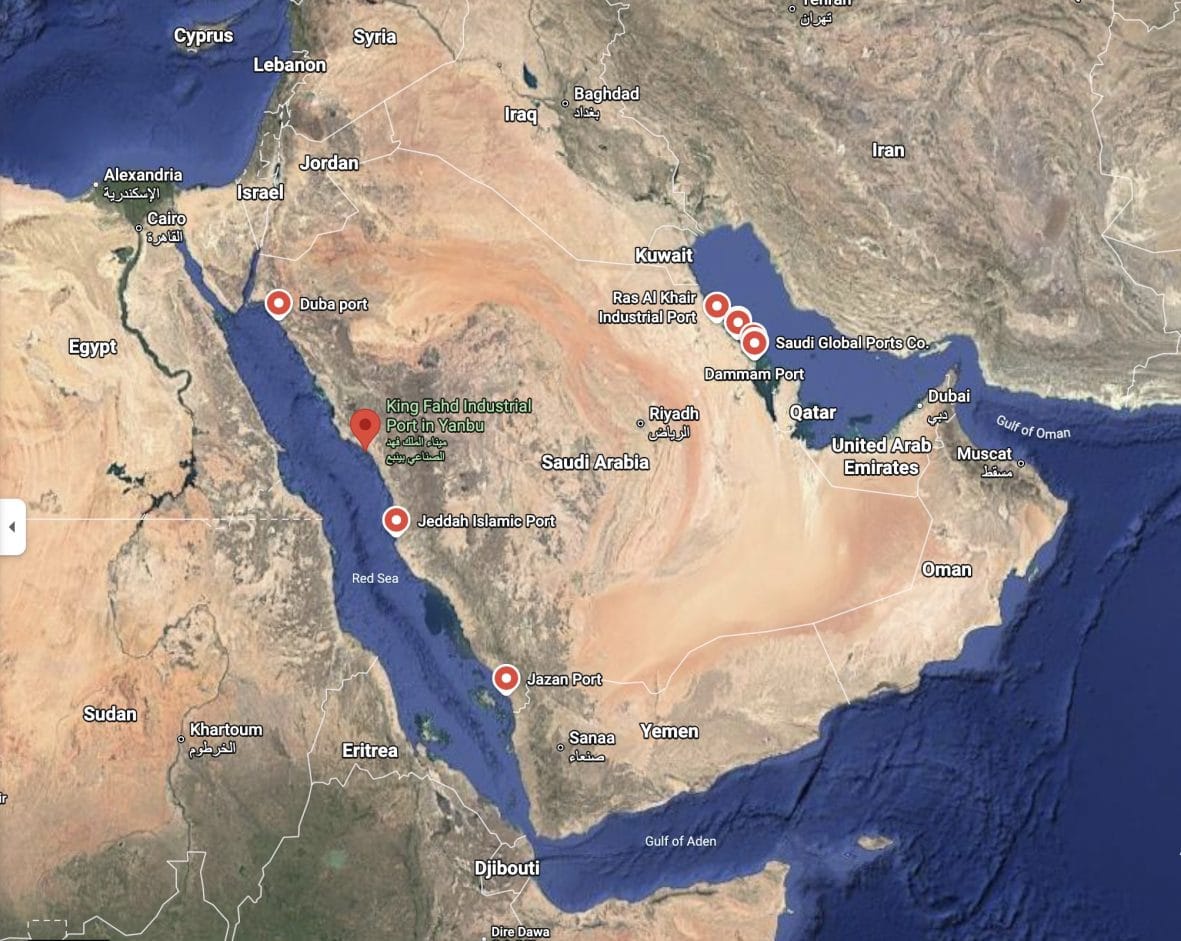
KSA is not locked in the Persian/Arabian Gulf. On the contrary from its neighbours, five out of nine of its ports are on the Red Sea.12Ministry of Media – Saudi Arabia, “Saudi Ports Authority“, Saudipedia, 10 October 2025.
The five Saudi ports on the Red Sea are:13Ministry of Media – Saudi Arabia, “Saudi Ports Authority“, Saudipedia, 10 October 2025.
King Fahad Industrial Port in Yanbu (the largest Saudi ports in terms of capacity, and in terms of loading crude oil, refined products and petrochemicals on the coast of the Red Sea, with thirty-four docks and ten terminals);
Yanbu Commercial Port (one of the oldest ports, capacity of 13.5 million t, twelve docks and two terminals);
Jeddah Islamic Port (the second-largest Saudi port, “handles more than 75 percent of the cargo coming through Saudi ports”);
Jazan Port (the smallest Saudi port, includes twelve docks and one terminal);
Duba Port (the second smallest Saudi port in terms of capacity, includes six docks and three terminals).
Ports of Saudi Arabia
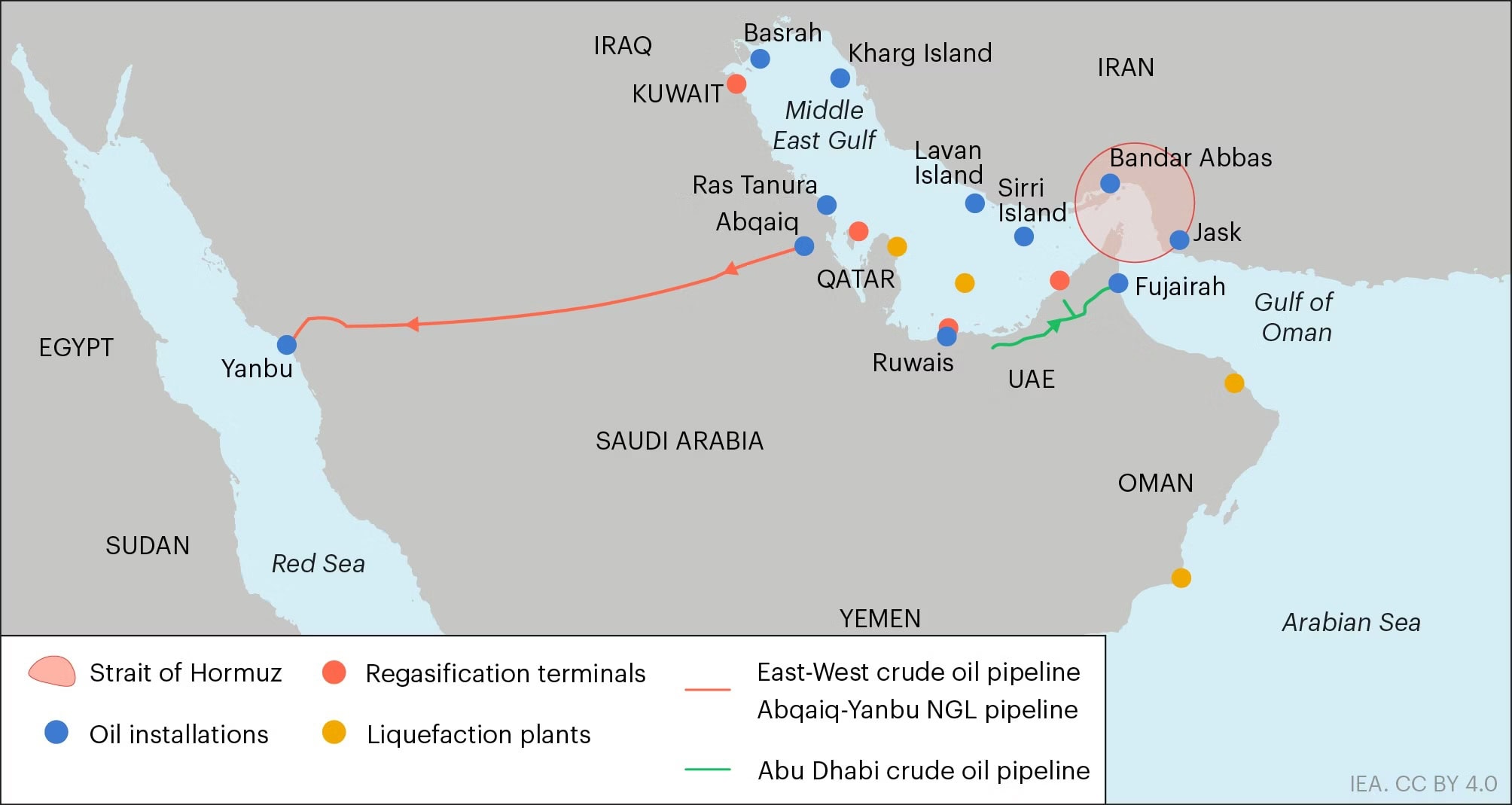
Thus, as the Strait of Hormuz is paralysed, even though KSA loses access to its ports on the Gulf, such as Ras Al-Khair, its newest and largest port, it nevertheless may only fare relatively better than its neighbours.
Indeed, the ports facilities of Yanbu have become key since the war. According to the Lloyd’s list, “Yanbu accounted for 11% of global seaborne crude loaded last week [3rd week of March 2026] compared to just 2% in 2025, and 30% of Very Large Crude Carrier (VLCC) demand last week vs only 5% last year”.14Greg Miller, “Houthis see no reason to ‘prevent’ Yanbu VLCC trade ‘at present’”, Lloyd’s List, 26 March 2026.
It is also mainly through Saudi Arabia that the Gulf countries can import the goods and products they need and cannot be flown in, when planes can access their territories at all.
Saudi Arabia can still export part of its oil and gas
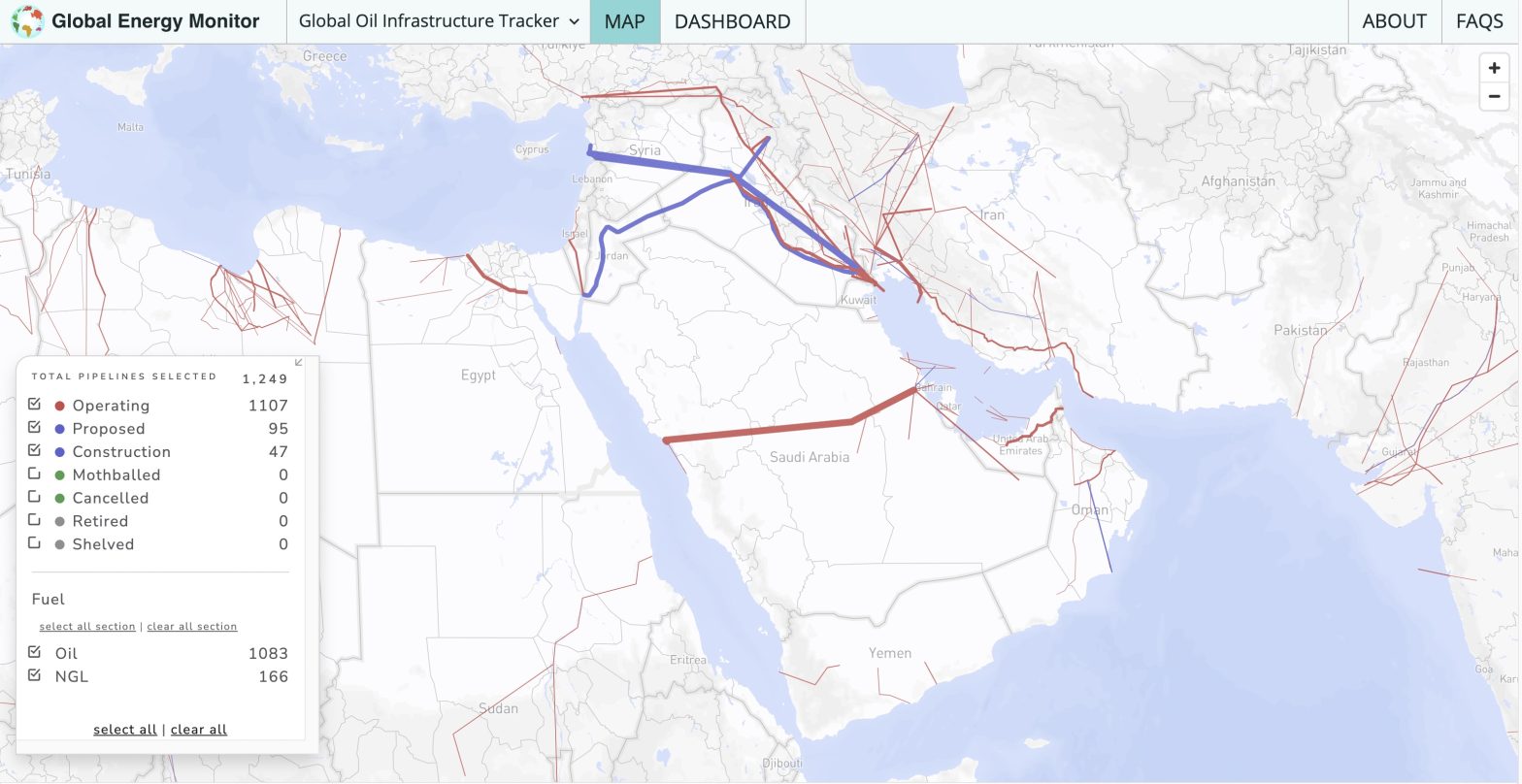
Having ports outside the Persian/Arabian Gulf, the KSA can use its East-West pipeline as an alternative route for oil and gas.15IEA, Alternative routes in “Strait of Hormuz – Factsheet“, February 2026.
With the closure of the Strait of Hormuz, indeed, Saudi Aramco rerouted its exports via the East-West Pipeline, which has “a capacity of 7m barrels per day” to Yanbu “with a loading capacity of around 4.5m bpd”.16Greg Miller, “Houthis see no reason to ‘prevent’ Yanbu VLCC trade ‘at present’”, Lloyd’s List, 26 March 2026.
As a result, “Yanbu loaded 4.1m bpd of crude and condensate in the week ending March 22, more than triple the full-year 2025 average of 1.3m bpd. Last week’s volume in Yanbu was up 32% from the week before”.17Ibid.
By 28 March 26, according to Al Arabiya, the full capacity of 7 million barrels a day was attained. Out of these, 2m bpd are for the Saudi refineries. “Crude exports via Yanbu have now reached 5 million barrels a day and the kingdom is also exporting about 700.000 to 900.000 barrels a day of oil products.”18Al Arabiya English with Bloomberg, “Saudi pipeline that bypasses Strait of Hormuz hits 7-million-barrel goal“, 28 March 26.
Global Energy Monitor, Global Oil and NGL pipeline, Global Oil Infrastructure Tracker, accessed 27 March 2026.
In 2025, the amount of crude oil passing through the Strait of Hormuz was almost 15 m bpd, a third of it destined for Asia.19IEA, “Strait of Hormuz – Factsheet“, February 2026. The overall amount of oil going through the Strait reached 20 m bpd.20Ibid.
Thus, crude oil exports out of the region sits now at one third of what it was before the start of the war. The quantity still exported by the region is actually larger, considering countries and ships that have bought and negotiated rights of transit with Iran, such as, for example, Thailand.21AFP, “Thailand says reached deal with Iran for vessels to transit Hormuz Strait“, Channel News Asia, 28 March 2026. Meanwhile, other oil products still exported by the region represent between 14% and 18% of the pre-war quantity.
For the world, the supply shock and oil crisis remain a very vivid reality. Indeed, in a nutshell, even if the war were to stop now, the most favourable assessments estimate that at least four months would be needed to come back to normal (this does not consider a permanent post-war Iranian hold over the Strait).22Peter Armstrong, “The energy crisis has only just begun“, CBC News, 26 March 2026.
The Saudi global leverage rises as its position in mitigating as much as possible the oil crisis and its cascading impacts is key.
Thus, for now, Saudi Arabia also fares better than its neighbours as it can still export oil and gas.
Furthermore, the rise of oil and gas prices also benefits the kingdom. Nonetheless, should prices continue to soar and the supply crisis also become a demand crisis, then the consequences could be less favourable to the Kingdom.23Al Arabiya English videos, What If Oil Hits $200 Globally?, 29 March 2026.
Saudi Arabia and the Houthis: Reaping the benefits of strategy?
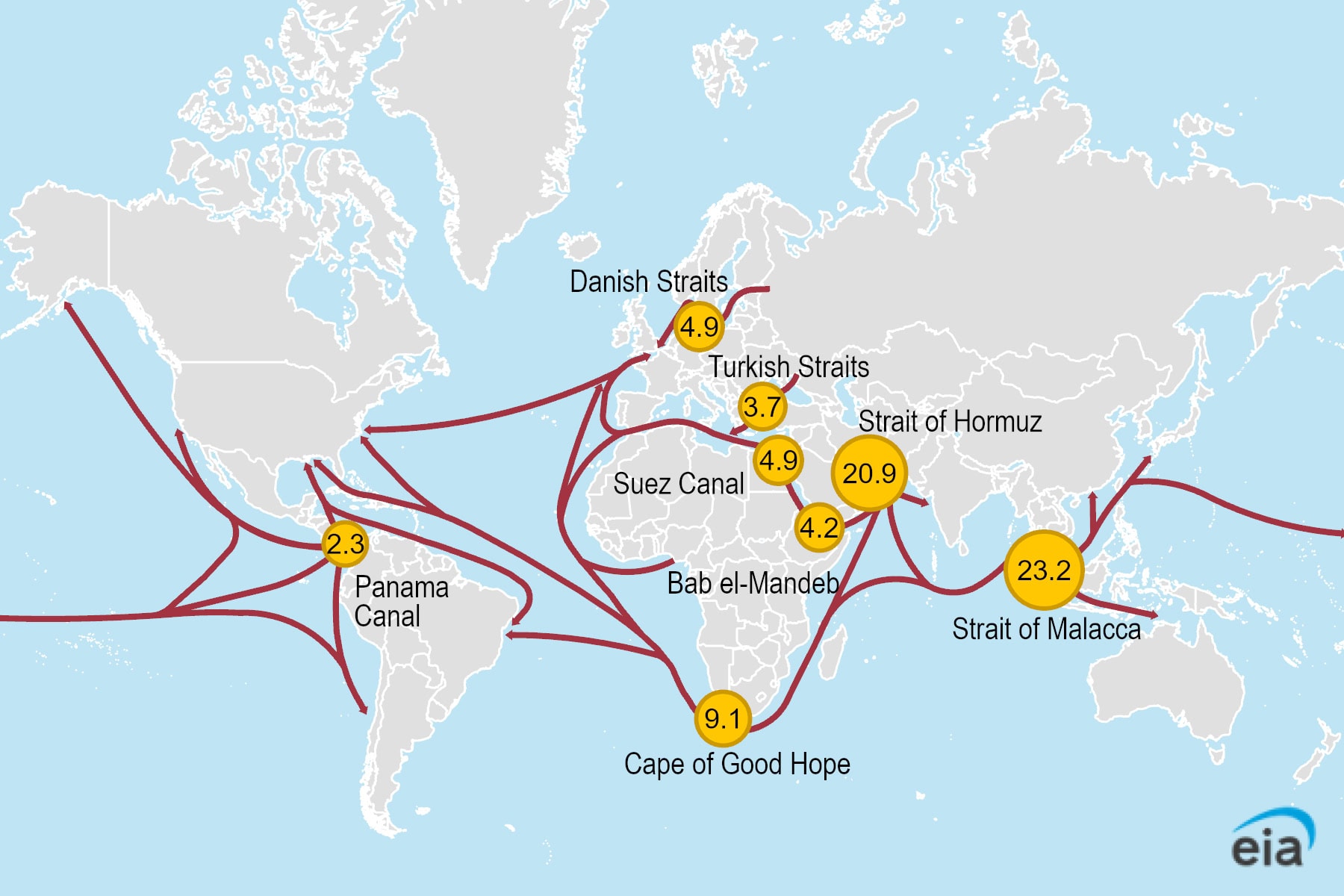
It is thus even more critical to see the Red Sea and the Bab el-Mandeb chokepoint free of attacks, when, in the past, the Houthis showed they could wreak havoc on maritime security there.
Map of daily transit volumes of petroleum and other liquids through world maritime oil chokepoints (million barrels per day) – first half of 2025 by U.S. Energy Information Administration (EIA) analysis using Data source: U.S. Energy Information Administration (EIA) analysis, based on Vortexa tanker tracking; World Bank; and Panama Canal Authority data, using EIA conversion factors and calculations.
For one month, until 28 March, the Houthis did not participate in the Iranian counter-attack.
The Saudis have been negotiating with the Houthis and that, by early February 2026, relations were considered as having “stepped up significantly”, including an implicit agreement according to which the Houthis forces would assist Yemen’s internationally recognised government in securing the Saudi-Yemeni border in exchange for Saudi funds, weapons, and ammunitions.26Memri Special Dispatch N°12356 “Report-Iran sponsored Saudi-Houthis agreement: Bin Salman sent weapons and funds to Houthis“.
Negotiations are also mentioned by CGTN quoting Li Yanan, deputy director of the Chinese Middle East Institute at CICIR: “the Houthis’ intervention risks collateral damage to regional diplomacy, especially the fragile reconciliation between Saudi Arabia and the Houthis.”27Chen Guifang, “Houthis have entered the monthlong Middle East war: What now?“, CGTN, 29 March 2026.
The Saudi strategy in the region, its action in Yemen and the negotiations and relations with the Houthis might protect, for a while, the Red Sea and the Bab el-Mandeb Strait from Houthi strikes. A couple of indications, however preceding the 28 March strikes could send such signals:
Abduhlmalik al-Houthis remarks on the 11th Anniversary of the war in Yemen focused on the domestic dimension, conflicts dynamics with Saudi Arabia and demanding compensations and reparations to the latter. They signalled support to Iran but without “declaring war or new operations”.28Mohammed Albasha, “Al-Houthi Unveils $57 Billion Losses, Pressures Saudi Arabia for Compensation – Houthi Signals Support for Iran Without Declaring War or New Operations”, Basha Report’s Substack, 26 March 2026.
Lloyd’s List contacted the Houthi’s Humanitarian Operations Coordination Center, in charge of Red Sea navigation regarding “Saudi crude trade” in the Red Sea. The HOCC answered that there was no reason for concern, and that they remained committed to “safeguarding navigation in the Red Sea and the Bab el Mandeb strait, as well as ensuring the free flow of trade.”29Greg Miller, “Houthis see no reason to ‘prevent’ Yanbu VLCC trade ‘at present’”, Lloyd’s List, 26 March 2026.
We may make the hypothesis that the Houthis use a multiple strategy.30Other analysts have similar perspectives, e.g.Chen Guifang, “Houthis have entered the monthlong Middle East war: What now?“, CGTN, 29 March 2026; Mohammed Albasha, Basha Report’s. They strike at Israel, which is their main enemy. By doing so, they show their support to Iran, and remind all players of their strength and power, which gives them a stronger hand in any dealing with KSA. Meanwhile, they could also be looking to KSA as an alternative strong player. With KSA, they may seek their integration within the emerging new Yemen, their primary focus, while looking to obtain as much compensation and advantages as possible.
Further research would be needed to establish this possibility, but the Houthis may also ponder whether they have a card to play in the oil and gas sector, considering the closure of the Strait of Hormuz and the destruction of facilities in the Gulf in the wake of the war. Assuming it is technically and operationally feasible, they may hope for an international pardon, should they bring their production to the world. The international status gained by Syrian President Ahmed al-Sharaa, despite having created the Al-Nusra Front with the support of al Qaeda, and fought as Al-Nusra leader before to break with al Qaeda, may not have been lost on the Houthi leadership.
KSA, as privileged interlocutor of the Houthis, would benefit, in terms of influence, if the Houthis did not disturb further oil transit. The Kingdom has also a critical responsibility and role to play.
Positions are fleeting and changes swift, thus the situation must continue to be closely monitored.
Saudi Arabia is an increasingly key player in the region.
On the short term, besides, of course, American and Israeli decisions on the one hand, Iranian ones on the other, much depends on the Houthis, KSA and the interactions between the two. The Houthis’ decisions are likely to be also influenced by the way Saudi Arabia negotiates with them, depending on their objectives. At the same time, the Houthis’ perception of Saudi Arabia’s regional power, particularly in comparaison with Iran, against the backdrop of the overall evolution of the war and the situation in Yemen, will act as a filter that influences the armed group’s decisions and actions.
Should the Houthis successfully and repeatedly attack the Red Sea, the Bab el-Mandeb Strait and the Yanbu port, then the world would be further precipitated into a multi-dimensional deep crisis.
On the contrary, peace in Yemen could bring in new oil and gas production to the world, partially offsetting the decrease resulting from the war destruction in the Gulf.
In any case, as long as the war lasts, world maritime traffic and oil exports are still being at risk of direct Iranian attacks.
It is likely that Saudi Arabia will be regionally stronger after the war against Iran than before, even more so if the Houthis do not attack the Red Sea, the Bab el-Mandeb Strait and the Yanbu port.
As we are under the fog of war, conditions may change very quickly. The situation must be closely monitored.
→ For commissioned in-depth analysis, structured risk mapping and strategic foresight and early warning: contact us.
In both the United States and China, the exponential growth of the AI sector is putting immense pressure on the energy systems of both major powers. This demand for electricity affects the entire AI production and usage chain.
The increase in usage by individuals, businesses, and government agencies is draining smartphone batteries, and the power consumption of laptops and desktop computers, along with the proliferation of data centers, requires generating quantities of electricity that were never anticipated by the designers and managers of the power grid.
Finally, semiconductor manufacturers and suppliers are facing ever-increasing demands, and their electricity consumption is also skyrocketing. Conversely, the oil and gas and nuclear sectors are investing heavily in AI to optimize their operations, from exploration to production, equipment use, and administrative and financial tasks.
However, the AI sector is developing too rapidly compared to the energy sector’s capacity to adapt. Hence the already underway plans to deploy new generations of data centers in orbit, in order to benefit from solar energy and space cooling. This results in a radical transformation of the space, AI, and energy production sectors, a transformation that is also influencing the geopolitical competition between China and the United States.
In this first part, we examine the American dimension of this new AI-energy-space geopolitics. We argue here that this new energy frontier of AI is transforming global geopolitics, giving rise to “spatiopolitics,” whose feedback effects are accelerating further transformations.
I. Energy for AI…
The Great Devourer of Electricity
The International Energy Agency estimates that in 2024, the global electricity consumption of data centers was equivalent to 415 terawatt-hours, or 1.5% of global electricity consumption.
This figure was achieved after five years of a 12% annual increase in electricity consumption due to the rise of AI. If this rate of increase continues, it implies a doubling of electricity consumption every five years. Given that this rate is highly likely to increase, the doubling of electricity consumption is likely to be much faster than anticipated.
But in the United States, these figures take on a whole new dimension. Considering only the electricity consumption of data centers , this reached 32 gigawatts in 2024, and the anticipated increase in 2030 could reach over 124 gigawatts. For reference, 1 gigawatt represents 1 million kilowatts, or 1 billion watt-hours. 1CSIS, “The Electricity Supply Bottleneck On U.S. AI Dominance,” March 3, 2025
Electricity generation is therefore a major physical limitation to the development of AI, while generation capacity can quickly become a crucial competitive advantage in the AI race between the US and China.
The Data Center Season
Furthermore, the electricity consumption of the AI sector directly competes with the needs of both individuals and all other sectors of activity, including all types of industry and the global rise of electric vehicles, which are themselves inextricably linked to the spread of new AI applications. In January 2026, President Trump even issued an executive order decoupling residential electricity bills from data center consumption.
In the United States, the combination of massive investments and substantial support from the federal government has led to a proliferation of data center construction by the various GAFAM companies. For example, on February 4, 2026, Google announced that it had achieved annual revenue of $402.8 billion in 2025.
This result represents a 15% increase compared to 2024, while also including a net profit of $132 billion. According to Sundar Pinchas, CEO of Alphabet, Google’s parent company, these staggering figures are attributable to the penetration of enterprise AI solutions by Gemini, Google’s AI platform. Between November 2025 and January 2026, the number of monthly Gemini users jumped from 650 million to 750 million.
Furthermore, Google’s other activities, including its search function, YouTube, and advertising, generated hundreds of billions of dollars. The Google Cloud division alone generated $70 billion.
But the “cloud” is by no means a metaphysical concept, as the metadata “clouds” are stored in Google’s network of data centers. Maintaining Google’s expansion therefore requires the expansion of the company’s physical infrastructure, particularly in the form of data centers.
Faced with this need, Alphabet announced it would invest $175 billion in building new data centers by 2026, almost double the amount allocated to data centers in 2025. It’s worth noting that Microsoft, Meta, OpenAI, and Amazon are announcing similar investments to build new data centers by 2026.
Electricity in America
2026 will therefore be dominated by the need to generate the electricity required for these new data centers, while continuing to power the existing infrastructure.
This pressure from the AI sector will largely contribute to the more than 16% increase in electricity demand by 2030. Gas-fired power plants already provide 43% of electricity production in the United States, while coal accounts for 16% and nuclear power 18.6%.
The remainder coming from renewable energy sources. U.S. Energy Information Administration
Moreover, it is a mature, well-mastered technology. Faced with the explosion in the number of data centers, US electricity companies have also embarked on a race to build gas-fired power plants.
This has resulted in a profound reorganization of the American landscape, with the emergence of what we call “The Great Disruptor,” namely the coupling of the “California-Arizona” GAFAM-TSMC technological duo with the oil&gas “Texas-Louisiana” energy duo.
Arizona, the new AI Frontier
Indeed, the establishment in Arizona of the first factory of TSMC, the Taiwanese semiconductor giant, and the construction of three more factories by 2030, representing an investment of $200 billion, is transforming this semi-desert state into a new AI hypercenter.
This is attracting all the GAFAM companies and investors. But at precisely the same time, Texas and Louisiana are once again becoming major oil and gas powers. This phenomenon is due to the ongoing combination of the oil and shale gas revolution, of which Texas, with the exploitation of the gigantic Permian Basin, has become the center.
In other words, Texas and Louisiana produce the gas necessary to meet the energy needs of the data centers and supercomputers of the GAFAM companies located in Arizona and California.
Thus, shale gas production is literally the energy base of the American AI power race. Furthermore, Venezuela’s colossal natural gas reserves are already attracting the attention of American companies.
II. AI for Energy
With the global rollout of the artificial intelligence (AI) revolution, all major oil companies—whether American, French, Saudi, Russian, Chinese, British, etc.—are integrating these technologies into all their operations, from exploration and production to downstream.
AI is becoming a tool for optimizing efficiency, from geological exploration to equipment management, without neglecting the financial aspect.
AI for Oil
At the same time, the oil and gas industry is generating colossal revenues, reaching $5.95 trillion in 2024. These revenues are also funding the development of the artificial intelligence sector. Indeed, the oil industry is heavily dependent on data.
Oil companies need geological data to prospect for new deposits and manage currently operating fields. Oil refining requires the production of a highly accurate and constant data stream.
The Everything AI Optimization
The same applies to the storage of oil and petroleum products, as well as to reserve management. This is also true for transportation, by pipeline, tanker, carrier, and truck fleets. Furthermore, the sale and exchange of oil and petroleum products at the global, regional, and local levels generate a considerable amount of financial, legal, and regulatory data.
In other words, on a global scale, the oil industry constitutes a massive engine of extremely complex data. This is why the emerging family of artificial intelligence (AI) technologies is intersecting with the oil and gas industry: technologies such as deep learning rely on the classification and interpretation of big data.
The same applies to the need to anticipate demand and new reserves.
Oil as Data
For example, Exxon Mobil, the American giant, uses AI to optimize its energy consumption, particularly at refineries. British Petroleum integrates AI algorithms into its exploration services. Shell uses predictive AI to improve the utilization and efficiency of its equipment while reducing downtime.
Through this predictive maintenance approach, AI algorithms analyze sensor data from equipment and machinery at refineries and drilling sites to anticipate breakdowns, thus enabling timely maintenance and avoiding costly unplanned shutdowns.
It is worth noting that, since the 2000s, the United States has been the country where the two major revolutions in the oil and shale gas industry and artificial intelligence have taken place. Moreover, these two revolutions followed parallel timelines.2Loretta Napoleoni, Technocapitalism: The Rise of the New Robber Barons and the Fight for the Common Good, Seven Stories Press, 2024
Furthermore, the shale oil technological revolution, with horizontal drilling and hydraulic fracturing, has made the United States a net producer and exporter of oil and gas.3Daniel Yergin, The New Map: Energy, Climate, and the Clash of Nations, 2020.
AI for Hydraulic Fracking
However, this new approach relies on heavy equipment that requires significant and ongoing investment. Shale oil companies face highly complex challenges, such as optimizing extraction, modeling reservoirs, forecasting production, and adapting to evolving demand. Integrating AI allows these companies to optimize various aspects of their operations, thereby securing revenue while mitigating risks.
The US shale oil and gas industry, heavily reliant on technology, is integrating machine learning, particularly to accelerate drilling operations.
This alliance between the American AI and shale oil sectors also guarantees oil and gas production for the US domestic market. This development is of strategic importance for the growth of the AI sector.
Indeed, the proliferation of data centers, the training of AI models, and the widespread adoption of AI are generating increasing demand for electricity.
Hélène Lavoix, “Uranium for the American Nuclear Renaissance (2): Towards a Global Geopolitical Race”; Goldman Sachs, “GS Sustain: Generational Growth: AI, Data Centers, and the Next Explosion in US Electricity Demand,” April 29, 2024.
III. The Space Race for energy
However, the dual race for electricity production and AI optimization cannot fully meet the anticipated increase in electricity consumption by the US AI sector.
This results in a new race to orbital space to install new generations of data centers. The installation of data centers in space aims to address the physical constraints that the proliferation of data centers is encountering on Earth, namely the limited availability of electricity and water.
Space is energy
That’s why SpaceX is considering developing specialized versions of its Starlink satellite constellations, which, equipped with interconnected AI, could achieve the computing power of terrestrial data centers. These satellite-data center constellations will be powered by solar panels, and the satellites will be cooled by sub-zero space temperatures. Cesareo Contreras, The next Great Space Race : Building data centers in Orbit, Phys.org, 7 January, 2026.
Furthermore, as the only company in the world to have made spaceflight profitable through the number of flights and its mastery of reusable rocket landings, SpaceX is uniquely positioned to undertake the effort of launching data centers into orbit.
These satellites will be an improved version of its Starlink constellations, equipped with Nvidia’s H100 super semiconductors, powered by solar panels and passively cooled by space temperatures.
Finally, since November 2025, an American satellite has been equipped with Nvidia H100 chips and runs “Gemma,” Google’s AI model. Furthermore, SpaceX is considering developing specialized versions of its Starlink satellite constellations, which, equipped with interconnected AIs, could achieve the computing power of terrestrial data centers.
Titan
To acquire the technological and capital resources necessary for this strategy, Elon Musk has just merged SpaceX and xAI (the parent company of its AI, Grok). Meanwhile, the June 2026 IPO of this entity, which effectively merges the launch vehicle, satellite (Starlink, SpaceX’s satellite division), and AI sectors with xAI-Grok, could reach $1.5 trillion.
In other words, the race for AI power is transforming American and global energy geopolitics, turning it into an AI-energy “space politics.” This transformation is beginning to materialize as early as 2026. It will trigger a triple growth in the AI, space, and energy sectors, and thus in the associated infrastructure and mineral resources, while also transforming the very nature of American power.
Why is this important for French and European companies?
Many French companies possess cutting-edge expertise in aerospace, energy, and electronics. These sectors are experiencing rapid growth in the US due to the convergence of AI, energy, and space. They therefore need to establish a presence in the market, and to do so, they need to learn about these new, high-potential markets.
Furthermore, the same logic applies to the financial sector, particularly in the world of investment funds. North American companies, facing difficulties, are engaging in a “rush for critical minerals” central to the manufacture of AI hardware.
Finally, entering the US market will also allow them to discover the opportunities presented by the military dimension of the AI/space/AI vortex.
Notes
1
CSIS, “The Electricity Supply Bottleneck On U.S. AI Dominance,” March 3, 2025 ↩︎
2
Loretta Napoleoni, Technocapitalism: The Rise of the New Robber Barons and the Fight for the Common Good, Seven Stories Press, 2024 ↩︎
3
Daniel Yergin, The New Map: Energy, Climate, and the Clash of Nations, 2020. ↩︎
The Golden Dome, heavily promoted by the Trump administration, is a technostrategy/industrial strategy that is already mobilizing major players in the space and AI sectors, including SpaceX, Starlink, Palantir, and Anduril. In this new landscape shaping the relationship between industry and defense in the US, French and European companies can play a vital role, while integrating into a rapidly expanding market, by taking into account the key trends summarized below .
On January 21, 2026, at the World Economic Forum in Davos, President Donald Trump particularly emphasized the importance of Greenland for the strategic “Golden Dome” project, announced in the early days of his presidency in 2025.
Indeed, the geography of the American and Eurasian continents dictates that the trajectory of any potential intercontinental ballistic missile strikes would take them over the North Pole. Aerospace surveillance of the Arctic is therefore a strategic imperative for countering Russian and Chinese technological and industrial developments, particularly in the field of hypersonic missiles, which necessitate significant adjustments to US defense.1Clayton Swope, The Golden Dome as a Service, CSIS, June 5, 2025.
This strategic renewal takes the form of the “Golden Dome” program. This space defense program is based on protecting US territory with a network of observation, early warning, and combat satellites. This first layer is complemented by a second technological layer, composed of anti-missile and laser weapon systems that will be pre-positioned in low Earth orbit from US territory to the Arctic.
The Golden Dome is thus an architecture of integrated systems within a common AI architecture, capable of coordinating and communicating with each other and with ground-based military and political command centers.
This program, announced on January 27, 2025, one week after President Trump’s inauguration, is a central element of the Trump administration’s policy. Indeed, it lies at the intersection of strategic and military challenges, technological and industrial challenges linked in particular to American policy, and the challenges of integrating AI into the space and military sectors, and the installation of data centers in orbit.
On June 15, 2025, the Pentagon launched its first call for tenders, amounting to $151 billion, over 10 years. In two rounds, on December 2 and 18, 2025, 2,440 companies were selected. SHIELD Award Contract Guide : Everything you Need to Know in January 2026
In other words, the “Golden Dome” is both a program for aggregating and accelerating industrial and AI challenges, and thus for merging the aerospace industry and Silicon Valley.
Beginning the deployment of the Golden Dome as early as 2027/28 aims to:
Accelerate the integration of AI (“smartening”) within the Pentagon;
Strengthen the development of the American defense industry;
Strengthen the American space industry;
Converge all the above trends.
All within the framework of “reempowering” the American industry in the face of its competitors, particularly China, by installing AI/defense infrastructure in orbit, so as to impose US preeminence before the Chinese can do the same.
1. The Golden Dome: From National Security to Reindustrialization
Context
The “Golden Dome” project is part of the history of the race for a missile defense shield, officially launched by President Reagan in 1983, and of the adaptation of the American defense establishment to the deployment of hypersonic missiles by Russia, China, and Iran, while North Korea is now equipped with ballistic missiles armed with nuclear weapons. It is worth noting that hypersonic missiles incorporate significant AI capabilities.
The Golden Dome also establishes strong continuities between the United States National Security Strategy, the National Defense Strategy, and the American space strategy.
This entire system is also one of the driving forces behind the Trump administration’s reindustrialization policy. Space, a new defense infrastructure
Major names in the aerospace and defense industrial and technological base have been selected, such as Northrop Grumman, Raytheon, L3 Harris, and Boeing. It should be noted that the British company BAE Systems has also been selected.
Enter New Space
But space has entered a new phase of conversion into a defense infrastructure. This is particularly true of low Earth orbit, where private satellite constellations, such as those of SpaceX/Elon Musk’s Starlink, or satellite observation systems like those of Maxar are deployed.
This integration of the “New Space” sector —an ecosystem of private companies involved in the space industry that have managed to make their activities profitable— revealed its strategic dimension in 2022 during the Russian offensive in Ukraine.
Starlink, for example, maintains Ukraine’s internet connection, including that of the military, while Maxar’s space-based observation capabilities allow for monitoring developments in the theater of operations.
Finally, the Starlink constellation dedicated to Ukraine also provides the infrastructure for the transmission of data streams generated by drones and their analysis by the AI systems of the Pentagon and Palantir, the private data aggregation company specializing in security issues.
It is this intertwining of satellite, cyberspace, and military capabilities that has enabled the rise of the combat drone sector, and thus the development of new industries, such as Anduril, which has become the American giant in combat drones.
New Competitors
It is in the context of the war in Ukraine and the new arms race, which now pits the US against China, Russia, North Korea, and Iran. As it happens, Russia and China’s industrial and military lead in hypersonic missiles.
The distinctive feature of these missiles, in addition to their speed, is their ability to alter their trajectory while guaranteeing impact on their initial target. Several cases have been identified both in Ukraine following Russian strikes and in Israel following Iranian strikes, despite the excellence of Israel’s multi-layered air defense system, known as “Iron Dome/David’s Sling/Arrow.”
Thus, the “Golden Dome” program, announced for 2025, is both a very large-scale transposition and a transformation of the “Iron Dome” missile defense concept.
The launch of the Golden Dome thus mobilizes both industries directly linked to space and defense, as well as their subcontracting chains, across all related fields. The Golden Dome is therefore both a defense project and an industrial project on a US scale.
The evolution of the initial funding for the Golden Dome, which increased from $151 billion over 10 years in January 2026, indicates the priority given to this program by the Trump administration.
The space war has begun
This new age of aerospace is also reflected in the resurgence of the missile industry. Since 2022, stockpiles of various missile categories have suffered significant depletion due to the ongoing war in Ukraine, support for Israel in the Gaza War, the war in the Red Sea against the Houthis, the war in Lebanon, and the war against Iran. Thus, in 2020, the stockpile of Tomahawk missiles was 9,000 units, and has shrunk to 4,000 by 2025.
Faced with this attrition, the US government is massively increasing missile orders from the aerospace industry. For example, Raytheon and Lockheed Martin are expected to produce 740 Patriot (PAC-2/PAC-3) anti-aircraft missiles by 2025—the same class as those used in Ukraine and Israel. This production rate is double the current level: before 2023, only 350 units of this model were produced annually. In both 2023 and 2024, production reached 500.
This acceleration is also evident elsewhere. Thus, the US Army, responsible for deploying Patriot missile battalions, has secured a fourfold increase in overall production, which, by 2026, will rise from 3,000 to 13,000 units per year—if Boeing and Lockheed Martin have the industrial capacity.2Meghann Myers, Army aims to quadruple Patriot missile procurement, Defense One, July 8, 2025.
Finally, the “12-Day War” between Iran, Israel, and the United States in June 2025 was quite literally the first space war.
Almost all the clashes involved salvos of Iranian ballistic and hypersonic missiles against those of Israel’s high-, medium-, and low-altitude air defense system, which was operating at full capacity. Furthermore, a single night of US air defense use incurs enormous costs, at least $1 billion per night.
The New Age of Lasers
Faced with this technological and financial reality, the American system is responding by promoting laser weapon systems within the Golden Dome architecture.
Directed-energy weapon systems are now a largely mature technology. When the American industrial base can mass-produce them, these weapon systems can be deployed from the tactical level—in combat situations—with weapon systems ranging from 10 to 30 kW, to the strategic level, such as missile defense, with a power of 300 kW.
The New Technological and Industrial Age
In other words, the Golden Dome is a gigantic scientific, technological, and industrial attractor for all players linked to the aerospace industry ecosystem and, therefore, in particular, for the highly complex electronic components needed for the various layers of equipment. This results in the possibility of rapid evolution of the associated markets, which the industries involved must anticipate.
This forward-looking effort is all the more important given that the Golden Dome program relies on and reinforces the militarization of AI.
2. Silicon Valley: Political and Infrastructural Support for the Golden Dome
During his speech in Davos on January 20, 2026, President Trump emphasized Greenland’s importance to the Golden Dome. This strategic interest in Greenland runs throughout the entire sequence of events that began with President Trump’s re-election in November 2025, highlighting the influence of major Silicon Valley companies.
Indeed, due to its geography, Greenland will play a strategic role in the deployment of the Golden Dome over the North Pole.
Greenland and the Silicon Valley
Thus, on December 22, 2024, President-elect Donald Trump, who would be inaugurated 28 days later, announced that Ken Howery would be appointed ambassador to Denmark. This choice is particularly significant in demonstrating the joint involvement of the Trump administration and Silicon Valley in strengthening Greenland’s integration into the American strategic system.
Ken Howery is, in fact, one of the founding members of PayPal, along with Elon Musk and Peter Thiel. He then became one of the co-founders of Founders Fund, the largest venture capital fund in Silicon Valley, led by Peter Thiel, himself the founder of Palantir, the “Google of spies,” and a high-level investor in Facebook/Meta and Google.
The Founders Fund also helped the young J.D. Vance create his own venture capital fund in Silicon Valley before he became Vice President under President Trump. Ken Howery’s appointment as ambassador to Denmark is therefore a signal of Greenland’s major geostrategic importance for the combined strategies of the US federal government and American AI and space giants, or hybrid players like Elon Musk’s SpaceX/xAI.
This company revolutionized space transportation with SpaceX and its reusable rockets, and satellite operations with Starlink, while simultaneously merging space and AI through its company xAI with SpaceX.
The same is true for Starshield, Starlink’s subsidiary dedicated to military communication satellite constellations, already operated by the American and Italian militaries, among others.
This merger will be the subject of a historic IPO, likely in June 2026, expected to reach nearly $1.5 trillion.
Space X, Palantir and Anduril in space
But other giants in civilian-military AI and drones are also included in the Golden Dome program. This is notably the case for Palantir, which has proven itself as an aggregator of Data for military and operational purposes during the war in Ukraine.
Anduril, the autonomous combat drone giant, is also on the list of contractors. Given that Anduril partners with, among others, Palantir and OpenAI to enhance the autonomy of combat drones and swarms, as well as their communication and cyber warfare capabilities, Anduril’s participation is significant both in itself and as a technological hub for AI integration at the Golden Dome.
In April 2025, SpaceX, Palantir, and Anduril visited the Pentagon to present how they would build nearly 1,000 satellites and launch them into orbit to provide observation, communication, and early warning capabilities, while also preparing a separate fleet of combat satellites equipped with missiles and lasers to intercept and destroy enemy missiles and drones.3Lauren C. Watson and Ben Watson, The D Brief: Space Force’s new war plan; Musk, Palantir, Anduril eye ‘Golden Dome’ contracts; DOD’s race for small reactors; And a bit more, Defense One, April 17, 2025.
Renewing the US industrial base
In parallel, the Pentagon is forging a massive partnership with Grok, Elon Musk’s generative AI developed by xAI, to optimize all administrative and operational processes within the Department of War.
The data processing, autonomy, and speed requirements generated by the various layers of the Golden Dome will be so significant that AI will be present at all levels, as well as an essential tool for integrating and coordinating the different components.
In other words, the Golden Dome program is profoundly altering the American aerospace/AI industrial landscape across all its components.
The companies involved will therefore need to anticipate this evolution in order to position themselves early and benefit from it. This is particularly true for companies specializing in computing capabilities and connectivity.
3. Geography of Opportunities
Hyperscaling the US industry
The Golden Dome should therefore be considered a “hyperscaler” for generating industrial and financial opportunities. But these will be distributed according to both industrial and political geography.
For French and European companies present in the United States and established in the sectors affected by the Golden Dome, including its connectivity, this geography extends from Paris to the American territory.
It must be used to gather upstream the information that companies will need to be particularly competitive in the markets amplified by the Golden Dome.
Political Geography of US industrial opportunities
France (Paris)
U.S. Embassy;
French American Foundation
United States:
Washington D.C. / Alexandria:
French Embassy in Washington;
Missile Defense Agency-Department of War / Pentagon;
House Defense Committee;
Northrop Grumman, Boeing, Lockheed Martin;
Lobbying firms;
Specialized think tanks;
Ohio
Columbus, Anduril Industrial Park;
California
SpaceX;
GAFAM;
Arizona (Phoenix)
TSMC (ultra-high-performance semiconductors. One factory already built, three more planned by 2030, $500 billion investment from Taiwan in Arizona);
Softbank (Japanese innovation investment giant. Announced $1 trillion in investments in AI industrial parks by 2030);
Representatives from Apple, Nvidia, AMD, Google, PayPal, Amazon, Oracle, Microsoft, and Meta, which are building their new data centers in Arizona.
Including these players, involved in the Golden Dome and the expansion of the AI sector in aerospace, will allow French digital and connectivity companies to fully benefit from the effects related to anticipating the quantity and nature of orders triggered by the financing and implementation of the Golden Dome.
Watch Out briefs flag emerging geopolitical and security developments that may carry significant second-order and longer-term implications. They are designed to support early awareness and strategic monitoring. For in-depth analysis, structured risk mapping, strategic foresight and early warning, please contact us.
What
Saudi Arabia’s strategy and actions in Yemen are entering a new phase and must be actively monitored within their broader regional and global strategic context.
Context
Early 2026 US-Iran Stand-off and negotiations in the Gulf.
The 2026 American Security Strategy is defined by a new approach to the Middle East: “Shift Burdens, Build Peace“, focused on empowering regional partners. → The Middle East is no longer the top US priority although remaining important with empowered “Middle East partners”. Thus space has been created for stronger regional leadership.
Yemen has been in civil war since 2014, with major domestic, regional and maritime security consequences.
The Houthis, supported by Iran, have significantly contributed to Red Sea maritime insecurity.
Tensions between the United Arab Emirates (UAE) and the Kingdom of Saudi Arabia (KSA), notably over Yemen at the end of 2025. KSA has pushed the UAE out of Yemen and is now the dominant Gulf external actor in the conflict.
Why it matters and impacts
Since December 2025, transit lanes have cautiously been reopening. → Any shift in Yemen or Gulf dynamics could directly affect maritime security.
Gulf and broader Middle East power dynamics are being redrawn, with KSA playing an increasingly ambitious regional role. → How these emerging dynamics will evolve — and how sustainable they are — must be actively monitored.
China’s positioning in response to these changes is strategically critical in the context of growing US–China tensions.
The future territorial and political configuration of Yemen is at stake, including:
a possible end to the civil war;
and/or the re-emergence of South Yemen.
Sources: Reuters; EurasiaReview; US National Security Strategy (Nov 2025) and 2026 National Defense Strategy.
→ For in-depth analysis, structured risk mapping and strategic foresight and early warning on Yemen and Gulf dynamics: contact us.
Following the 2026 summit in Davos, the American threat on Greenland has taken a less dramatic turn. However, the issue has not disappeared. Meanwhile, the impacts of the crisis are wide-ranging and will be long-lasting.
As a result, we must continue monitoring how events unfold. Critically, we also need to identify all dynamics linked to the issue to foresee impacts and their severity, so as to be able to answer them adequately.
In this article, while also updating the evolution of the trilateral situation between Greenland, Denmark and the U.S., we focus on one dynamic triggered by the U.S. threat on Greenland, which then, in turn, impacts the very future of Europe, as well as all actors in their everyday dealing with the U.S.. We examine the consequences of the crisis on the U.S.-EU trade framework signed over the Summer 2025.
We explain first why and how the ratification of the framework was frozen. Then we look at the next stages, highlighting that a return to the past is very unlikely. Following interactions between actors, notably within the European Parliament (EP), we underline the existence of two poles behind a united approach for Europe. Finally, we outline two major impacts: further instability in terms of international trade and possible futures for the European Union.
Freezing the U.S.-EU Trade Framework
Escalation
As American President Trump was escalating the issue over Greenland during the first weeks of January 2026, the European institutions and the European member states came to Denmark and Greenland’s aide, thus demonstrating the strength of union over disunion, whatever the level of support actually given.
The EU imports and exports (goods) to the U.S. per EU member states – 2023 in USD bn – Data: World Bank
In retaliation, on 17 January, President Trump threatened to levy up to 25% tariffs on those eight European countries.
“… Starting on February 1st, 2026, all of the above mentioned Countries (Denmark, Norway, Sweden, France, Germany, The United Kingdom, The Netherlands, and Finland), will be charged a 10% Tariff on any and all goods sent to the United States of America. On June 1st, 2026, the Tariff will be increased to 25%. This Tariff will be due and payable until such time as a Deal is reached for the Complete and Total purchase of Greenland. …”
The U.S. – EU trade (goods) imbalance unpacked – 2023 in USD bn – Data: World Bank
As a result, on 18 January, the European Parliament (EP) froze the United States-European Union framework on an agreement on reciprocal, fair and balanced trade, which had been signed over the Summer 2025.2We should note that this agreement only concerns trade in goods where the balance of trade is favourable to the EU and not services where it is unfavourable to the EU. In 2024, the EU imported €334.8 billion worth of goods imports from the US and exported €532.3 billion worth of goods to the US, thus showing a surplus of €197.5 billion. However, the EU imported €482.5 billion worth of services imports from the US and exported €334.5 billion worth of services to the US, thus showing a deficit of €148 billion. As a whole the EU trade surplus with the U.S. is 49,5 billion (Source: EU-US trade: facts and figures). Indeed, to come into force, the trade framework must be ratified by the European Parliament (see the box below for the EU process of adoption of new formal trade agreements; note that the US-EU framework is not considered as a usual trade agreement, thus the initial stage would be absent, the stages described in this article are in red). Because of President Trump’s threats the Parliament considered the ratification vote planned for the end of January was impossible.
German MEP Bernd Lange (Progressive Alliance of Socialists and Democrats – S&D, the second largest group of the current EP), chair of the Parliament’s International Trade Committee (INTA), said “he would ask the European Commission next week to use the Anti-Coercion Instrument (ACI) – the bloc’s so-called ‘trade bazooka’.”3Sofia Sanchez Manzanaro, “Trump’s latest tariffs threaten to torpedo EU-US trade pact”, Euractiv, 17 January 2026. This was in line with S&D President Iratxe García’s statement, who called to suspend the EU-US trade deal and activate the Anti-Coercion Instrument.4S&Ds Press Release, S&Ds: EU-US trade deal must remain frozen until strategy clear, 23 January 2026.
Similarly, Manfred Weber, the leader of the European People’s Party – EPP (Christian Democrats), the largest group at the European Parliament, which holds the Presidency of the Foreign Affairs Committee (AFET), stated it was impossible to approve the EU-US deal.5Ibid., Euractiv, 18 January 2026.
We thus had, indeed, a united reaction of the European Parliament.
Davos de-escalation
Then, the Davos events unfolded.
On 21st January, first, during his speech, President Trump explained he would not use force to take Greenland, yet continued to express despise against Europeans as well as threats.
Read Extracts from President Trump speech at Davos
….
THE PRESIDENT: 00:19:36-00:20:01 (25 sec) And perhaps no current issue makes the situation more clear than what’s currently going on with Greenland. Would you like me to say a few words on Greenland? [Laughter] I was going to leave it out of the speech, but I thought I think I would have been reviewed very negatively. I have tremendous respect for both the people of Greenland and the people of Denmark, tremendous respect. But every NATO ally has an obligation to be able to defend their own territory. And the fact is no nation or group of nations is in any position to be able to secure Greenland other than the United States. We’re a great power, much greater than people even understand. I think they found that out two weeks ago in Venezuela. … After the war we gave Greenland back to Denmark. How stupid were we to do that? But we did it. But we gave it back. But how ungrateful are they now? So, now, our country and the world face much greater risks than it did ever before because of missiles, because of nuclear, because of weapons of warfare that I can’t even talk about. Two weeks ago, they saw weapons that nobody ever heard of. They weren’t able to fire one shot at us. They said what happened.
Everything was discombobulated. They said we’ve got him in our sights, pressed the trigger, and nothing happened. No anti-aircraft missiles went up. There was one that went up about 30 feet and crashed down, right next to the people that sent it. They said what the hell is going on. Those defensive systems were made by Russia and by China.
So, they’re going to go back to the drawing boards, I guess. Greenland is a vast, almost entirely uninhabited and undeveloped territory. It’s sitting undefended in a key strategic location between the United States, Russia and China. That’s exactly where it is, right smack in the middle — wasn’t important, nearly, when we gave it back. You know, when we gave it back, it wasn’t the same as it is now. It’s not important for any other reason. You know, everyone talks about the minerals.There’s so many — there’s no rare earth, no such thing as rare earth, there’s rare processing. But there’s so much rare earth and this to get to this rare earth, you’ve got to go through hundreds of feet of ice.
That’s not the reason we need it. We need it for strategic national security and international security.This enormous unsecured island is actually part of North America on the northern frontier of the Western Hemisphere. That’s our territory. It is therefore a core national security interest of the United States of America.
And in fact, it’s been our policy for hundreds of years to prevent outside threats from entering our hemisphere. And we’ve done it very successfully. We’ve never been stronger than we are now. That’s why American presidents have sought to purchase Greenland for nearly two centuries. You know, for two centuries, they’ve been trying to do it. They should have kept it after World War II, but they had a different president.
That’s all right. People think differently. Much more necessary now than it was at that time, however. In 2019, Denmark said that they would spend over $200 million to strengthen Greenland’s defenses. But as you know, they spent less than 1 percent of that amount — 1 percent, there’s no sign of Denmark there, and I say that with great respect for Denmark whose people I love, whose leaders are very good.
It’s the United States alone that can protect this giant mass of land, this giant piece of ice, develop it and improve it and make it so that it’s good for Europe and safe for Europe and good for us. And that’s the reason I’m seeking immediate negotiations to once again discuss the acquisition of Greenland by the United States, just as we have acquired many other territories throughout our history, as many of the European nations have. They’ve acquired — there’s nothing wrong with it. Many of them, some went in reverse actually, if you look. Some had great vast wealth, great vast lands all over the world. They went in reverse. They’re stuck back where they started, that happens too, but some grow. But this would not be a threat to NATO.
This would greatly enhance the security of the entire alliance, the NATO alliance. The United States is treated very unfairly by NATO; I want to tell you that. And when you think about it, nobody can dispute it. We give so much and we get so little in return. And I’ve been a critic of NATO for many years and yet I’ve done more to help NATO than any other president by far — than any other person….. …. But then more importantly I got NATO to pay 5 percent and now they were paying and now they are paying. So, something nobody said was possible. They said we will never go up higher than 2 percent, but they went to 5 percent and now they’re paying the 5. They didn’t pay the 2 and now they’re paying the 5, and they’re stronger for it and they have an excellent, by the way, secretary general who’s possibly in the room. Mark, are you here? Yes, he’s here. Hello, Mark. We never asked for anything and we never got anything.We probably won’t get anything unless I decide to use excessive strength and force where we would be frankly unstoppable. But I won’t do that, OK? Now everyone’s saying, oh good. That’s probably the biggest statement I made because people thought I would use force.
I don’t have to use force. I don’t want to use force; I won’t use force.All the United States is asking for is a place called Greenland where we already had it as a trustee but respectfully returned it back to Denmark not long ago after we defeated the Germans, the Japanese, the Italians and others in World War II, we gave it back to them. … So, what we have gotten out of NATO is nothing except to protect Europe from the Soviet Union and now Russia. I mean we’ve helped them for so many years. We’ve never gotten anything, except we pay for NATO, and we paid for many years until I came along, we paid for, in my opinion, 100 percent of NATO because they weren’t paying their bills.
And all we’re asking for is to get Greenland, including right title and ownership, because you need the ownership to defend it. You can’t defend it on a lease. Number one, legally, it’s not defensible that way totally. And number two, psychologically, who the hell wants to defend a license agreement or a lease, which is a large piece of ice in the middle of the ocean where, if there is a war, much of the action will take place on that piece of ice. Think of it — those missiles would be flying right over the center of that piece of ice. All we want from Denmark for national and international security, and to keep our very energetic and dangerous potential enemies at bay, is this land on which we’re going to build the greatest golden dome ever built.
Then, followed a meeting between U.S. President Donald Trump and NATO Secretary General Mark Rutte. It resulted in a “framework of a future deal with respect to Greenland”. The framework was far from being clear apart from an “unlimited timeframe” according to the President and was to be specified during negotiations over the next two weeks.6Youtube video, “President Trump comments after the meeting with Mark Rutte”, KTVU FOX 2 San Francisco, 21 January 2026. It nonetheless led to further de-escalation, as President Trump abandoned his threat of levying tariffs on the eight nations involved in the Exercise Arctic Endurance.7Ibid.
We may think that we would go back to the situation before escalation took place, but that would be a mistake.
No return to the past
First, on 22 January 2026, even though President Trump appeared as appeased by the new framework for Greenland, the planned Emergency EU summit on the issue went ahead. There, EU leaders, reportedly, stood together for a more united and independent Europe, even if the different states showed varying degrees of support to the idea.8e.g. Politico, “This was the moment EU leaders agreed Europe must go it alone”, 23 January 2026.
Nonetheless, a return to business as usual was indeed what European Parliament President Roberta Metsola (EPP) thought would occur. Indeed, after the 22 January emergency EU summit, she stated that it was now necessary to proceed rapidly with the vote of the U.S.-EU deal.9Eddy Wax/Sofia Sanchez Manzanaro/Thomas Moller-Nielsen, “European Parliament chief pledges to close EU-US trade pact”, Euractiv, 22 January 2026
Meanwhile, the President of the Council of the European Union, António Costa, adopted a position similar to Metsola, stating that although Europeans must be respected, although only Denmark and Greenland can decide for matters about themselves, and that they have the full support of the European Union, although respecting the principles of international law, notably territoriality and sovereignty was paramount, nonetheless, “Our focus must now be on moving forward on the implementation of that deal. The goal remains the effective stabilization of the trade relations between the European Union and the US“.10European Council, “Oral conclusions drawn by President António Costa following the informal meeting of the members of the European Council of 22 January 2026”, 23 January 2026. The President of the Council thus hoped, too, for an immediate return to business as usual.
But this is not what happened.
Indeed, the very vagueness of the “framework for Greenland”, the shock created by the escalation and the behaviour of the U.S., which had gone from being an allie to carrying out threats, President Trump’s continuous boasting, his contempt and scorn for Europe and European leaders, his repeated disregard for the principles of the international order since he came to power in 2024, by speech and deeds, for example Venezuela and then the threat against Greenland, to highlight some of the most important factors, created the very conditions that allowed new dynamics to unfold.11e.g. Statement of International Law Scholars on the United States Military Aggression against Venezuela, Völkerrechtsblog, 30.01.2026; Hélène Lavoix, “How to use AI for Weak Signals – Trump, the International Revolutionary?”, The Red Team Analysis Society, 14 March 2025. These dynamics constitute part of the impacts for the Greenland crisis.
On 23 January 2026, the S&D, in its quality of lead of the Committee on International Trade, published a press release stating that the EU-US trade deal must remain frozen until strategy clear. The decision regarding when to vote on the EU-US trade deal was to be taken on 27 January 2026. The S&D notably wanted to know more and “in writing” about the so-called framework decided between President Trump and NATO Secretary General Mark Rutte. Meanwhile, the press release scolded EP President Metsola, reminding her of her place and role.
The European Union and New Trade Agreements
“In the opening stages, the Council authorises the European Commission to negotiate a new trade agreement on behalf of the EU. This is done through a ‘negotiating mandate’. With this authorisation, the Council provides negotiating directives which include the objectives, scope and possible time limits of the negotiations. Nota: the US-EU framework being not a conventional trade deal, this step did not concern the framework.
The Commission then negotiates with the partner country on behalf of the EU, in close cooperation with the Council and the European Parliament.
After agreement on the text of the deal is reached with partners, the Commission submits a formal proposal for adoption to the Council.
Following discussions, the Council adopts a decision on the signing of the agreement on behalf of the EU.
It then sends the signed agreement to the European Parliament for consent.
The parliamentary committees carry out Parliament’s in-depth work. They examine legislative proposals, amend them and vote on them during their monthly meetings.
The parliamentary committees then submit their report to Parliament as a whole.
Parliament adopts [or not] the text of the legislative proposal at its plenary session.
In the final stages, once the European Parliament has given its consent, the Council adopts the decision to conclude the agreement.
Once agreement is reached between Parliament and the Council, the legislative act is published in the Official Journal.
It is then transposed into national legislation, and applies to all European citizens.”
As planned, on 27 January, as reported by Politico according to interviews, discussions taking place behind closed doors, “The European Parliament … postponed its decision to unfreeze the EU-U.S. trade deal — but signalled it would do so at a later date”.12Max Griera, “EU Parliament delays decision to unfreeze US trade deal” , Politico, 27 January 2026.
Meanwhile, it seems that the European Commission also wanted to see the deal ratified and said so to the Committee.13Ibid. The members of the European Parliament (MEPs) thus felt that they are those responsible for making sure the Commission does not bow to the U.S..14Ibid.
The trade commission meets again on 4 February 2026 and will then decide on next steps, which could be to unfreeze, or not, the ratification of the deal, and when a vote could take place.15Ibid; Max Griera, “EU Parliament eyes US trade deal approval with Trump-proof safeguards”, Politico, 28 January 2026.
In the meantime, the MEPs of the Trade Committee discuss behind closed doors how to amend the U.S.-EU framework to make sure it protects the EU from any further American threats or aggressive actions.16For this entire paragraph, Griera, “EU Parliament …”, Politico, 28 January 2026. Reportedly, the S&D and Renew envision safeguard clauses voiding the deal in case of threats to territorial sovereignty. They also want to better define and specify the terms of the deal: for example new American tariffs threat would automatically suspending the framework. For their parts, the MEPs of the EPP, which is pushing for a rapid adoption of the U.S.-EU trade framework and thus for a return to business as usual, would agree with safeguard clauses, but possibly restricted to specific items and not with an effect on the complete deal. They oppose the S&D demand to the European Commission to investigate a possible American coercion aiming at forcing Denmark to abandon Greenland, which then would trigger the EU’s Anti-Coercion Instrument. All would agree on a clause giving power to the European Commission to review the deal after a set period of time, while the items on steel must be revised.
If the members of the trade commission agree relatively rapidly on the text, then they could vote on the latter on 23-24 February, but, again, this will be decided on 4 February.17Ibid.
The modifications of the U.S.-EU framework, as well as the decision to vote upon the amended text and when to do so will depend upon the way other events and dynamics unfold.
For example, the start of the technical talks through a working group between the U.S., Denmark, and Greenland over Arctic security on 28 January can be seen as a positive signal.18Aamer Madhani Associated Press, “Rubio says technical talks with Denmark, Greenland officials over Arctic security have begun”, ABC News, 28 January 2026. However, even if Denmark’s foreign minister Lars Lokke Rasmussen welcomed the start of the talks, qualifying them of ““very constructive”, he also highlighted:
“It’s not that things are solved but it is good because now we are back to what we agreed in Washington exactly two weeks and a day ago. After that, there was a major detour. Things were escalating but now we are back on track.”
Thus, the members of the Trade Committee most probably consider those two elements: things are back to normal, but this is very similar to what happened before escalation; hence we absolutely need to make sure no such tension and escalation can start again. They are also very likely to be influenced by all the other speeches, statements and events taking place and informing their vision of the Trump Presidency, notably with regard to Europe, but not only.
Update 11 February 26: You can follow how things evolve with the following: Trade Committee press release 4 February 26 and then the agreement reached within the Trade Committee on 10 February 26 here, with a vote planned for end of February or March (no press release form the Trade Committee yet).
Impacts
Imports and exports and related strategy
The first series of impacts that results from this dynamics triggered by the Trump’s Presidency is that the U.S.-EU trade deal is still not in place, that the deal will be more protective of Europe and Europeans, and less one-sided towards the U.S.. However, the very stability and predictability that were meant to be a major EU objective for this deal, as explained by the European Commission, remain elusive. Stability cannot be created between two actors in a highly volatile and uncertain world when one of the actors is the very engine of instability and change.19E.g. Hélène Lavoix, How to use AI for Weak Signals – Trump, the International Revolutionary?, The Red Team Analysis Society, 14 March 2025.
As a result, European companies must develop agile policies regarding their imports, exports and related strategy. These policies must fully integrate the uncertainty regarding trade, notably in terms of tariffs. To be fully agile, they must monitor geopolitical dynamics, notably those fostering related uncertainty, so as to be able to foresee changes, including temporary ones, and to respond accordingly. Sufficient treasury may notably become necessary to offset possible surprises.
The future of Europe
Second, as far as the European Union is concerned, and no less important, we see here, despite talks about unity, diverse if not opposite positions continuing to take place among the European political groups, member states and institutions.
At first glance, this leads to three main possible evolutions for the European Union.
If we take the positions and actions regarding the U.S.-EU trade framework as indications, we have two poles.
A pole would attract actors who want to go back to business as usual, and want to see the trade deal signed as soon as possible, for the good of business. Yet, as a result from the U.S. threat against Greenland, those European groups may have started gravitating slightly away from that pole, as may show the fact that they could accept clauses of safeguard added to the U.S.-EU framework. The future directions of these positions will need to be closely monitored. The groups gravitating around this pole are the EPP (centre-right), the ECR (right-wing led by Italian Prime Minister Giorgia Meloni Party, with 24 MEP followed by Poland with 20 MEPs) and the Patriots (far-right, led by French Marine Le Pen Party, the Rassemblement National with 30 MEPs, followed by Hungary with 11 MEPs).20Max Griera, “EU Parliament delays decision to unfreeze US trade deal” , Politico, 27 January 2026.
The specifics of each country in terms of trade with the U.S. most probably play their part in the positions of the MEPs and Groups vis à vis the way to handle the U.S.-EU trade framework. For example, in terms of goods, Germany is the first partner of the U.S.. In 2023, it was also responsible for 52% of the trade surplus with the U.S. (counting only surpluses). The EPP constitutes the largest European parliamentary group for Germany, as shown in the European Parliament table “MEPs by Member State and political group“, with 32% of its MEPs, followed equally by the Greens, ESN and then S&D with 15% each. German MEPs also constitute the largest national group within the EPP (16,6 %), followed by Poland (12,29%) and then Spain (11,76%). It is thus logical that the EPP supports a return to normal and a rapid ratification for the U.S.-EU deal, as it is very important for Germany. We can reason similarly for Italy and the ECR, Italy being the third European partner of the U.S. and running the second most important trade surplus (for goods).21Max Griera, “EU Parliament delays decision to unfreeze US trade deal” , Politico, 27 January 2026. The related rapprochement taking place between Germany’s Chancellor Merz and Italy Prime Minister Meloni could be one further indication of the strengthening of that pole.22James Angelos et al. “The EU’s new power couple: Merz and Meloni”, Politico, 23 January 2026; Transcript of the Joint Press Conference, 23 January 2026.
At the opposite end, the other pole attracts those who want to be cautious when dealing with an actor promoting deep change and ready to use bullying methods, such as the Trump administration, and those who also want to make sure that Europe is independently strong, and seen as such. The EP groups belonging here are the S&D (socialists), Renew (liberals, which holds the presidency of the Committee on Security and Defence – SEDE) and the Greens. The Left also called not only to freeze the vote but to completely reject the deal.23The Left, “European Parliament halts US Trade Deal”, 21 January 2026.
Assuming all members of a group vote according to the line of this group, which is likely not to be true, we have 350 MEPS for the business as usual pole and 312 MEPs for a stronger Europe with “strategic autonomy”. Remain the ESN (Europe of Sovereign Nations) and the Non-aligned MEPS, for a total of 57 people, which can thus sway the balance.
Considering the complex EU machinery, and despite the interesting role taken by the Parliament in the case of the dynamics triggered by the U.S. threat on Greenland on the U.S.-EU trade deal, the position of each component of each EU institution, including the member states should be analysed in detail to obtain more precise scenarios.
The European Union, in the future, could thus swing towards either pole or also fracture. That last scenario could stem either from a refusal by one of the poles to change, although here the latest developments may indicate that this could become less likely, or from blockage. Indeed, because so many lines of influence run through the European institutions, one possibility is that they annul each other. Then, they could also favour an overall immobilism, highly dangerous when faced with the current tense and changing international context.
A wise strategy would be to make sure of its resilience, whatever the future outcome.
We should note that this agreement only concerns trade in goods where the balance of trade is favourable to the EU and not services where it is unfavourable to the EU. In 2024, the EU imported €334.8 billion worth of goods imports from the US and exported €532.3 billion worth of goods to the US, thus showing a surplus of €197.5 billion. However, the EU imported €482.5 billion worth of services imports from the US and exported €334.5 billion worth of services to the US, thus showing a deficit of €148 billion. As a whole the EU trade surplus with the U.S. is 49,5 billion (Source: EU-US trade: facts and figures) ↩︎
3
Sofia Sanchez Manzanaro, “Trump’s latest tariffs threaten to torpedo EU-US trade pact”, Euractiv, 17 January 2026. ↩︎
e.g. Politico, “This was the moment EU leaders agreed Europe must go it alone”, 23 January 2026. ↩︎
9
Eddy Wax/Sofia Sanchez Manzanaro/Thomas Moller-Nielsen, “European Parliament chief pledges to close EU-US trade pact”, Euractiv, 22 January 2026 ↩︎
10
European Council, “Oral conclusions drawn by President António Costa following the informal meeting of the members of the European Council of 22 January 2026”, 23 January 2026. ↩︎
11
e.g. Statement of International Law Scholars on the United States Military Aggression against Venezuela, Völkerrechtsblog, 30.01.2026; Hélène Lavoix, “How to use AI for Weak Signals – Trump, the International Revolutionary?”, The Red Team Analysis Society, 14 March 2025. ↩︎
12
Max Griera, “EU Parliament delays decision to unfreeze US trade deal” , Politico, 27 January 2026 ↩︎
While the mullahs’ regime is carrying out appallingly violent repression against its own population, American political and military authorities are pre-positioning a maritime, air, and land military force of historic proportions in the Persian Gulf.
On January 23, 2026, the aircraft carrier USS Abraham Lincoln and its battle group, composed of three guided-missile destroyers and a submarine, will be deployed. However, even though this deployment dramatically changes the scale of the American military presence in the Middle East-Persian Gulf region, it also entails a very large-scale military and geostrategic risk.
Furthermore, in June 2025, the US Air Force participated in the “Twelve Day War,” which pitted Israel against Iran, with the aim of destroying Iran’s nuclear program, which, however, was only degraded. However, Iran possesses high-level military capabilities and plays a major role in China’s grand strategy of the “Belt and Road Initiative.”
Therefore, as things stand on January 26, 2026, it is essential to grasp the interconnected issues arising from the interaction between the deep crisis within the Mullah regime and its appalling repression of Iranian protesters, and the American, Israeli, and British military mobilization.
Furthermore, it is important to bear in mind that the Persian Gulf exports 20 million tons of oil per day, representing 20% of global production. Fifty percent of Iranian oil is exported to China.
Thus, the confrontation between the American military and Iran is part of the escalating tensions between Washington and Beijing.
We argue here that the phenomenal scale of the American military mobilization indicates Washington’s political will to destabilize the regime. But by its very nature, this strategy implies accepting the destabilization of China’s Belt and Road Initiative and an increase in tensions with Beijing.
1. “Help is coming”
On December 28, 2026, due to catastrophic inflation, a massive water crisis, and a general deterioration of living conditions, protests against the mullahs’ regime began to multiply in Iran. These protest movements quickly spread on a massive scale. The mullahs’ regime reacted with immense violence.
The Revolutionary Guards, supported by squads from Lebanese Hezbollah, repressed, massacred, arrested, raped, and tortured tens of thousands of people. Nearly 35,000 people were reportedly killed in three weeks. The internet was blocked, and Starlink connections were jammed.1Jean-Michel Valantin, Chronicles of the Hyperwar / AI : Elon, the mullah and the satellites, 19 January 2026.
Faced with this situation, on January 11, 2026, President Donald Trump publicly encouraged Iranians to continue protesting and announced, “Help is on its way.”
US Military Mass
This marked the beginning of a new chapter, shifting from the ultra-violent Iranian political scene to international geostrategy.
Indeed, the aid announced by President Trump is represented by the aircraft carrier USS Abraham Lincoln and its strike group, consisting of three guided-missile destroyers and a submarine.
US Sea Power and Combat experience
The choice of this particular aircraft carrier is significant in itself, given that this ship spent several months in the Red Sea in 2024 during the protracted naval war against the Iranian-backed Houthis, a conflict that pitted the Yemeni militia against the US Navy for over two years.
This war was notably dominated by the interception of drones and ballistic missiles launched by the Yemeni militia against Israel, and by numerous airstrikes against Yemeni naval flotillas and their ground positions.
The USS Lincoln and its crew are therefore well-versed in the most contemporary form of naval air warfare, which relies on the artificial intelligence (AI) coordination of satellites, radars, combat aircraft, missiles, fighter jets, and missile drone swarms to achieve its objectives while protecting ships and crews. This “maritime hyperwarfare” would be—or will be—the form of warfare appropriate for an intervention in the Persian Gulf.2Ibid.
US Air Power and Combat experience
Furthermore, the Pentagon has deployed more than 12 F-15 fighter-bombers to the region. These aircraft are members of the 494th Fighter Squadron, based in England.
In 2024, this air combat group participated in the interception of the wave of drones and missiles launched by Iran against Israel and in Operation Midnight Hammer, conducted in June 2025 against Iranian nuclear facilities.
Other air combat and bomber groups, as well as electronic warfare and aerial refueling units, are being deployed to the Persian Gulf, some of which are being withdrawn from units present in the Caribbean due to the operation in Venezuela on January 3, 2026. These are in addition to the 418 fighters and fighter-bombers under the direct command of Central Command and Eurocommand, and the 70 fighter-bombers and electronic warfare aircraft carried by the USS Lincoln.
The sheer size and military power of the USS Lincoln and its strike group are being integrated into the existing military presence in the Persian Gulf, including the Central Command base in Doha.
US Central Command is the operational command that coordinates all US land, sea, air, space, and cyber forces in the Middle East-Persian Gulf-Central Asia region, representing a force of over 20,000 personnel and their equipment and weapons systems necessary for any form of force projection in the region.
Therefore, such a deployment of military capabilities, within such a short timeframe, exerts its own political pressure, both on the potential adversary and on its own military and political leadership, which could lead to intervention.
However, the mullah regime has experience in war and is fighting for its survival, which makes it particularly dangerous.
2. War for Survival and Brutalization of the Regime
The extreme violence of the repression launched since December 28, 2025, reveals the degree of brutality the mullah regime has reached, waging a veritable “internal war” against its own population. This repression is being carried out by the Revolutionary Guards and their allies. The Revolutionary Guards are a paramilitary organization under the direct authority of the Supreme Leader of the Revolution, Ayatollah Khameiney.
The Islamic Revolutionary Guard Corps (IRGC) is simultaneously a domestic and foreign intelligence service, a police force, and a repressive force. They possess their own land, sea, and air forces and control most of the country’s economic and financial centers. While the army protects the country, the IRGC protects the regime.3Ashley Lane, Iran’s Islamist Proxies in the Middle East, Wilson Center
As such, their units have been involved in all of Iran’s wars since 1980: the Iran-Iraq War, covert wars against Israel, support for Hezbollah in Lebanon and Hamas in Gaza, support for Bashar al-Assad’s regime in Syria, and the clandestine war in Iraq against the Americans between 2003 and 2010. They also play a central role in protecting Iran’s nuclear program. Their forces number approximately 125,000.4Ibid.
In the current geostrategic situation, the IRGC is fighting for its survival. If the regime falls, they are physically doomed. However, while Iran is caught in a spiral of monetary, financial, and economic collapse, exacerbated by the escalating US sanctions, the military capabilities of both the Revolutionary Guard and the Iranian army are significant, and Iranian units have extensive warfare experience.
This is true in hybrid warfare, guerrilla warfare, and high-tech warfare, as demonstrated during the war against Israel.
Finally, Iran possesses the ultimate energy weapon: the closure of the Strait of Hormuz. Blocking 20% of global oil traffic would be suicidal due to the resulting repercussions, but would have enormous global financial consequences.
Finally, the Iranians have acquired a fleet of speedboats designed for naval combat and armed with lightweight surface-to-surface missiles. Added to this are the missile and drone capabilities, which have proven their worth in Ukraine since 2022 and were purchased by the Russians.
In an environment as confined as the Persian Gulf, whose maximum width does not exceed 300 km, exchanges of strikes between American and Iranian forces would pose extreme risks to all belligerents.
However, the Revolutionary Guards (Pasdaran) possess a mindset inherent to the concept of “brutalization.” This means that the more men go into combat, the more brutal the situation imposed upon them becomes. This makes the survivors all the more brutal, and their new levels of brutality fuel the escalation of violence and brutality. Lorenzo Benadusi, Brutalizing and the Civilizing Process
The massacres of civilians that have been ongoing since December 28th demonstrate this dynamic. The Revolutionary Guards are therefore in a situation where they feel directly and physically threatened by their own people, by Israel, and by the United States.
However, they are very well-equipped, highly trained, and capable of resorting to extreme measures. Finally, this enormous potential for armed violence is part of the context of the ever-increasing conflict between the United States and China.
3. The USS Lincoln and the New Silk Road
Several concurring, but unverified, reports indicate that, since January 16 or 17, Y-20 aircraft, the Chinese military’s heavy transport planes, have made 16 landings in Tehran in 5 days. While the nature of these deliveries is unknown, they are part of a dual political and operational context.
1/ Since the end of the “12-Day War” in June 2025, marked by the destruction of nearly half of Iran’s air defenses, China has been selling Iran a significant number of HQ-9 anti-aircraft missile batteries. Those missiles are based on the excellent Russian S-300 and S-400 missile systems. Furthermore, China has made considerable progress in the field of autonomous combat drones.
The Y-20’s enormous payload capacity therefore suggests that particularly powerful Chinese weapon systems are being transported and installed in Iran with the support of the Chinese political and military authorities.
2/ This support is part of the ongoing strengthening of ties between Iran and China.
While China and Iran have traded since antiquity, in 2016, Iran officially joined the Belt and Road Initiative, spearheaded by China.
In 2021, the two countries signed a 25-year “comprehensive strategic partnership,” based in particular on exchanges of Chinese technologies, industrial products, and civilian and military equipment in exchange for oil. 50% of Iran’s oil production is thus exported to China.
Finally, since 2024, Iran has been a member of the BRICS+ group, co-led by Moscow and Beijing. The infrastructural, economic, political, and military integration between Iran and China is therefore profound. Consequently, if the infamous repression of Iranians by the mullahs’ regime were to trigger a US intervention, even a limited one, it would take place in an extremely charged strategic context.
Maintaining the necessary control to keep the level of conflict sufficiently low to prevent any form of escalation “beyond” Iran will therefore be a major strategic challenge.
This is all the more true given that Beijing’s support for Tehran is also being closely watched by China’s allies and those under its control, who are thus putting a portion of their strategic credibility on the line, without necessarily wanting to be drawn into a potential escalation.
The last week of January 2026, and the month of February 2026, are therefore already marked by a prodigious “return of the repressed” in strategic terms.
Why is this important for French and European companies?
Like all economic actors worldwide, French companies will have to anticipate the risks posed by potential oil price spikes if clashes occur in the Persian Gulf.
Since August 2025 and the preparations for Operation Southern Spear and the intervention in Venezuela, naval and air fleets have been called upon at a pace and scale unmatched since the “hot” warfare of the Cold War. This implies a similarly strong mobilization of US defense industries and their partners and subcontractors, which translates into markets for French electronics companies.
Furthermore, the effects of these cross-tensions between the US and China could also lead to the risk of sanctions for Western companies involved in either or both of these countries.
On 23 December 25, Trump declared again he wanted to take over Greenland.1James Landale and Rachel Hagan, “Trump says US ‘has to have’ Greenland after naming special envoy”, BBC, 23 December 2025.
By December 25, tensions over the issue were already high, especially between the U.S. and the Kingdom of Denmark.2See detailed timeline below. Yet, the American statements made during late December 25 and even early January 26 were also, sometimes, met with disbelief.3Lucie Oriol, “Emmanuel Macron fait-il preuve de naïveté sur Trump et le Groenland ?”, The Huffington Post, 7 January 26. Two weeks later, escalation is ongoing, despite European fears and sometimes lack of solidarity, mixing, initially, statements, very weak European troops deployment in Greenland (Operation Arctic Endurance), then tariffs, related economic threats, and strengthened Danish troops deployment.4e.g. Sarah Shamim, “Trump’s Greenland tariffs: What’s Europe’s ‘bazooka’ option to hit back?”, Al Jazeera, 20 January 2026; Denmark sends more troops to Greenland amid tensions with Trump, Al Jazeera, 20 January 2026; Katya Adler, “Confronted over Greenland, Europe is ditching its softly-softly approach to Trump”, BBC, 20 January 2026.
Should the U.S. conquer Greenland, or obtain it through any coercive or manipulative means, which looks increasingly likely, the potential impacts and consequences, would be staggering and wide-ranging, from the unraveling of NATO, to fundamental changes for the European Union, through uncertainty regarding the decoupling of American and European economies, without forgetting possible shifts in alliances worldwide, as escalation, deterrence and retaliations will take place.
Note (22 January 2026): It is not because the U.S. threat to use force against Greenland recedes following the 2026 Davos summit, as a consequence of the actions of other actors, that the whole issue of an American threat against Greenland disappears. The issue should continue to be monitored, dynamics understood and surveilled and impacts assessed.5WEF, “Davos 2026: Special Address by Donald J Trump, President of the United States of America”, Jan 21, 2026; @WhiteHouse, Trump on Greenland; .
Considering the very high severity of the risk, even though many, initially, did not believe the threat to be possible, the issue should have been put on watch early enough to allow concerned actors to design related policy and responses.
Thus, when should we have put the threat of an American conquest or coercive annexion of Greenland under watch?
To answer, we shall examine the timeline of President Trump’s statements and actions regarding Greenland, and highlight three different periods regarding the identification, selection, and monitoring of the issue, as well as its foresight analysis.
The first period corresponds to the emergence of the issue. The second consists in a difficult time in terms of strategic foresight and warning work, when the problem seems to disappear. The third period is the most recent one, and constitutes the last stretch of time during which concerned actors should have taken the issue into consideration.
We end our investigation in December 25 because, first, on 10 December, The Danish Defence Intelligence Service (DDIS) yearly threat assessment highlighted that the U.S. were now a threat to allies and partners. Second, the 21 December appointment of U.S. special envoy to Greenland can be seen as the trigger for the next period, which is about a broader escalation sequence. Thus these two dates can be seen as the latest dates at which the issue should have triggered the whole process of analysis, monitoring, warning, and scenarios for policy and strategy design.
Meanwhile, by retracing and following the American statements, we also understand better why and how ideas unfold and evolve.
2019 – Weak signals
During this initial period, when Trump started airing the idea to take over Greenland, the issue should have been considered at least as a weak signal to monitor.
A surveillance, i.e. gathering information, should have been implemented. Potentially concerned actors could also have started wondering in which way this American interest in Greenland could impact them, both directly and indirectly.
This implies that we would have been able to pick up on the issue as signal, thus to see it, and to select it in a sea of information. This is done through scanning, according to agenda. Because the U.S. are such a powerful player internationally with a pervasive influence and increasingly intrusive action on the domestic conditions of countries through, for example, extra-territorial sanctions, most if not all actors, public and private, should consider what is happening in and with the U.S..
At such early stages, it is absolutely key to suspend all disbelief. Disbelief may have very diverse sources, from arrogance and Dunning-Kruger effect (a side effect of the incompetence of people, when “their incompetence robs them of the metacognitive ability to realize it”), to the inability to update belief systems even when presented with new evidence.6Justin Kruger and David Dunning, “Unskilled and Unaware of It: How Difficulties in Recognizing One’s Own Incompetence Lead to Inflated Self-Assessments“, Journal of Personality and Social Psychology, vol 77, no 6, p 1121-1134, American Psychological Association (1999); A. W. Kruglanski, Webster, D. M., & Klem, A, Motivated resistance and openness to persuasion in the presence or absence of prior information. Journal of Personality and Social Psychology, 1993, 65(5), 861-876. doi: 10.1037/0022-3514.65.5.861; Anderson, Craig A., Mark R. Lepper, and Lee Ross, “Perseverance of Social Theories: The Role of Explanation in the Persistence of Discredited Information“, Journal of Personality and Social Psychology, 1980, Vol. 39, No.6, 1037-1049; Craig A. Anderson, “Belief Perseverance”. In Baumeister, Roy; Vohs, Kathleen (eds.). Encyclopedia of Social Psychology, 2007, pp. 109–110. doi:10.4135/9781412956253.n62. As such, it often implies that one may be surprised, which is what must be avoided.
When evaluating an issue or idea, one should pay attention to coherence, within the system of the actor – or event – we seek to understand. In our case, our historical knowledge and understanding of the American national interest and related policies should have forced us to go beyond disbelief and to pay serious attention to the possibility of an American threat against Greenland.
The information below, ordered chronologically, shows what should have been collected. Each piece of information adds an element of understanding to the issue. Together, they also show how President’s Trump resolve evolved and was reinforced.
15 August 2019: The Wall Street Journal reported that Trump had discussed buying Greenland with advisers “in recent weeks” and at a dinner the previous spring, asking what they thought of the idea.7Vivian Salama et al., “President Trump Eyes a New Real-Estate Purchase: Greenland, The Wall Street Journal, 16 August 2019) Reporting on the spring dinner was only known in August.
18August 2019: Speaking to reporters before an Air Force One departure, Trump answered reporters stressing the strategic interest of Greenland for the U.S., acknowledging it belonged to their Danish allies, and that it was “a large estate deal”.
Read President Trump verbatim answers to reporters
Q In order to get your interest in Greenland, which has been widely reported, is there anything —
THE PRESIDENT: Well, Greenland, I don’t know — it got released somehow. It’s just something we talked about. Denmark essentially owns it. We’re very good allies with Denmark. We protect Denmark like we protect large portions of the world. So the concept came up and I said, “Certainly, I’d be. Strategically, it’s interesting, and we’d be interested.” But we’ll talk to them a little bit. It’s not number one on the burner, I can tell you that.
Q Would you ever make an exchange with them of any kind for U.S. territories?
THE PRESIDENT: Well, a lot of things can be done. I mean, essentially, it’s a large real estate deal. A lot of things can be done. It’s hurting Denmark very badly because they’re losing almost $700 million a year carrying it. So they carry it at a great loss. And, strategically, for the United States, it would be nice.And we’re a big ally of Denmark, and we help Denmark and we protect Denmark, and we will. In fact, I’m supposed to stop. I’m thinking about going there. I’m not necessarily definitely going there, but I may be going. We’re going to Poland and then we may be going to Denmark — not for this reason at all. But we’re looking at it. It’s not number one on the burner.
21 August 21, 2019: After Danish Prime Minister Mette Frederiksen called the idea “absurd”, President Trump was upset and framed the cancellation of his planned Denmark trip as a response to that characterisation. However, he did not withdraw the notion that Greenland would be strategically attractive for the U.S.. On the contrary, President Trump further legitimated historically his earlier statement, and thus interest. He cast the U.S. as benevolent, making Denmark a favour, whilst Denmark started being perceived as ungrateful and rude.
Read President Trump verbatim answers to reporters
QMr. President, can you explain your decision not to go to Denmark? Is it really because they wouldn’t talk about selling Greenland?
THE PRESIDENT: No — Denmark, I looked forward to going, but I thought that the Prime Minister’s statement — that it was absurd; that it was an absurd idea — it was nasty. I thought it was an inappropriate statement. All she had to do is say, “No, we wouldn’t be interested.”
But we can’t treat the United States of America the way they treated us under President Obama. I thought it was a very not nice way of saying something. They could’ve told me “no.” This is something that’s been discussed for many years. Harry Truman had the idea of Greenland. I had the idea. Other people have had the idea. It goes back into the early 1900s. But Harry Truman, very strongly, thought it was a good idea.
I think it’s a good idea because Denmark is losing $700 million a year with it. It doesn’t do them any good. But all they had to do is say, “No, we’d rather not do that,” or “We’d rather not talk about it.” Don’t say, “What an absurd idea that is.”
Q Sir —
THE PRESIDENT: Because she’s not talking to me —
Q Mr. President —
THE PRESIDENT: Excuse me. She’s not talking to me. She’s talking to the United States of America. You don’t talk to the United States that way, at least under me.
….
Q Thank you, Mr. President. I appreciate it. So, with Greenland, it seems to be entirely off the table. Are you looking at any additional lands for potential expansion?
THE PRESIDENT: No. We’re just looking.Greenland was just an idea, just a thought. But I think when they say it was “absurd” and it was said in a very nasty, very sarcastic way, I said, “We’ll make it some other time.” We’ll go to Denmark — I love Denmark. I’ve been to Denmark. And, frankly, we’ll do it another time. Respect has to be shown to the United States.
…
Q I’m from Danish TV. A lot of Danes are disappointed today. You — the Prime Minister said the invitation is still open. What will it take for you accept it?
THE PRESIDENT: Well, we’ll meet at some time. But the Prime Minister used a terrible word when describing something that we’ve been talking about for years with our country. President Truman said, “What about Greenland?” And he talked about it very openly and it was a big deal at the time. And I brought it up again and it was discussed many other times.
And I thought it was not a nice statement — the way she blew me off — because she is blowing off the United States. And we’ve done a lot for Denmark. We’ve done a lot. I know Denmark well. I have many friends from Denmark. I have many people from Denmark that live in the United States. And we treat countries with respect.
30 August 2019: The U.S. Congressional Research Service published a brief: Greenland, Denmark, and U.S. Relations, signalling the issue was serious enough. It highlighted the strategic importance of Greenland for the U.S., as well as the options available to the U.S. regarding that territory.
2 December 2019: President Trump refused to answer a question on Greenland after a bilateral meeting with German Chancelor.
Read President Trump verbatim answer to reporters
Q Will you address Greenland during that Den- —
PRESIDENT TRUMP: Because I can’t imagine — I can’t imagine — will we discuss Greenland? What do you think? (Inaudible). (Laughs.) Huh?
Q Do you still want to buy Greenland?
PRESIDENT TRUMP: That’s a very — that’s a good — she must be in the real estate business. (Laughter.) That’s a very good question.
So, we’ll go directly back. I think we’ve done plenty of press conferences. Unless you’re demanding a press conference, we’ll do one, but I think we’ve answered plenty of questions.
2020–2024 Irrelevance or absence of open source information?
This period is probably the most difficult to handle in terms of foresight and warning. There is apparently no open source information, and interest wanes. As a result, what should be done? Should we abandon the monitoring? Keep it in a light way? On the contrary, use time to deepen the analysis?
Even though there is apparently no sign of interest, first, we should not underestimate the disruption and shock the COVID pandemic created. If we remember, the state of emergency as declared by the World Health Organization (WHO) for the pandemic lasted from 30 January 2020 to 5 May 2023.8United Nations News, “WHO chief declares end to COVID-19 as a global health emergency”, 5 May 2023. The first two years were acute disruptive phases to usual affairs. Thus, the COVID pandemic may very well have had a strong impact on American’s interest in Greenland, as it overshadowed everything else.
In the meantime in January 2021, President Trump was replaced by President Biden, who then focused on Ukraine.
As far as Mr Trump is concerned for the 2021-2024 period, we found, however with hindsight, one mention of Mr Trump interest in Greenland. Ideally, the election campaign as well as related Republican documents, should also have been monitored at the time.
Finally, the absence of open source information does not mean that there is no information and no interest on an issue. If we are not part of a state’s intelligence service, then we work with open source information. Thus, we do not have access to classified information. Even if we work for a state’s intelligence service, we do not have, obviously, full access to other states classified information. Hence, we must always consider the possibility that classified documents on a topic may exist. Only research, once archives are opened will be able to clarify this point.
In any case, during this period, the American National Interest remained the priority of the American administration.9See for an explanation and introductory references, Hélène Lavoix, “The American National Interest”, The Red Team Analysis Society, 22 June 2022.
Greenland remained a key strategic territory for the U.S., considering Arctic geopolitics, including polar transit routes and corridors, as well as resource endowment, notably in the context of competition with China and Russia.
In terms of anticipation, considering limited resources, during those uncertain times two options can be chosen. First, one can continue monitoring the issue, even though it brings no new information or hardly any. The cost is minimal, and this ensures that, with the monitoring system remaining active, we will be notified if or when the problem re-emerges.
Second, and this must be decided according to the potential severity of the impact for one’s organisation, and according to available resources, we may use the lull to develop peacefully a full strategic foresight and warning analysis, including causal modelling of the issue and scenarios. As a result, we shall be fully ready once events start escalating again.
In the case of Greenland, its strategic geographical location and its natural resources endowment should have weighted in the decision to keep the issue on watch and to deepen the analysis.
2020 to 2024: Official statements regarding any purchase or conquest of Greenland were not found.
January 2024: According to CNN, but with hindsight, Mike Waltz would have told Fox News in January 2024 that the Trump administration interest in Greenland was “about critical minerals” and “natural resources”.11Issy Ronal, “Why does Trump want Greenland and why is it so important?”, CNN, 6 January 2026.
December 2024–December 2025
Once month after he was elected, thus extremely rapidly, President then elect Trump revived the Greenland issue. Then, all concerned actors should have considered an American annexion of Greenland as a serious strategic foresight and warning issue. They should have started the full and detailed analytical process, including scenario-building. And, ofc course, they should have monitored the issue.
Each new statement by the American President on Greenland heightened the importance of the issue.
At the very least, the 4 March 25 speech to the Congress should have sent strong warning signals that it was necessary to consider the issue.
Starting from late March, we enter a new period when, according to Danish official reactions, the U.S. have moved from statements to actions.
Depending on who you are, and on how the different scenarios arising from the American threat against Greenland may affect your activities, the mitigation or response policies you will need to design will vary. Thus, if attention is only being paid to the issue now, it may already be too late. Still, late anticipation is always preferable to no anticipation—and to the constraints of crisis management.
Note that, by May 25, the Kingdom of Denmark had obviously seriously considered the issue as it was able to detect U.S. adversary intelligence collection and U.S. covert operations.
22 December 2024: After his election and before inauguration, Trump revived the 2019 discussions and wrote on his network TruthSocial:
“For purposes of National Security and Freedom throughout the World, the United States of America feels that the ownership and control of Greenland is an absolute necessity. Ken will do a wonderful job in representing the interests of the United States.”
7 January 2025: At a press conference at Mar-a-Lago, President Trump reasserted the importance of Greenland for the American national security, both in economic and strategic terms. Meanwhile, he did not rule out force and economic coercion to protect those interests as far as Greenland is concerned. Any possible future Danish argument was brushed away.
Read President Trump answers to journalists
Question 00:31:15-00:31:33 (17 sec): Mr. President, thank you. I wanted to touch on the world on firethat you mentioned, but let’s start if we could with your references to Greenland and the Panama Canal and so forth. Can you assure the world that, as you try to get control of these areas, you are not going to use military or economic coercion?
Donald Trump 00:31:33-00:31:34 (1 sec) No.
Question 00:31:34-00:31:52 (18 sec): And can you tell us a little bit about what your plan is? Are you going to negotiate a new treaty? Are you going to ask the Canadians to hold a vote? What is the strategy? And I —
Donald Trump 00:31:52-00:32:12 (19 sec) I can’t assure you — you’re talking about Panama and Greenland. No, I can’t assure you on either of those two. But I can say this, we need them for economic security. The Panama Canal was built for our military.
Question 00:32:12-00:32:12 ( sec): [Inaudible]?
Donald Trump 00:32:12-00:32:32 (20 sec) I’m not going to commit to that. Now it might be that you’ll have to do something. Look, the Panama Canal is vital to our country. It’s being operated by China — China. And we gave the Panama Canal to Panama; we didn’t give it to China. And they’ve abused it. They’ve abused that gift. It should have never been made, by the way.
…..
Donald Trump 00:50:20-00:50:43 (22 sec) Well, we need Greenland for national security purposes. I’ve been told that for a long time, long before I even ran. I mean people have been talking about it for a long time. You have approximately 45,000 people there. People really don’t even know if Denmark has any legal right to it, but if they do, they should give it up because we need it for national security.
Donald Trump 00:50:43-00:51:07 (24 sec) That’s for the free world. I’m talking about protecting the free world. You look at — you don’t even need binoculars, you look outside, you have China ships all over the place. You have Russian ships all over the place. We’re not letting that happen. We’re not letting it happen. And if Denmark wants to get to a conclusion — but nobody knows if they even have any right title or interest.
Donald Trump 00:51:07-00:51:16 (9 sec) The people are going to probably vote for independence or to come into the United States. But if they did — if they did do that, then I would tariff Denmark at a very high level.
Question 00:51:16-00:51:20 (3 sec) Have you asked your staff to draw up plans for acquisition? Are you acting —
Donald Trump 00:51:20-00:51:23 (4 sec) No, we’re not at that stage, but we have people — I haven’t even entered office yet.
….
Question 00:53:38-00:53:45 (7 sec) But sir, real fast, you said you were considering military force to acquire Panama and Greenland. Are you also considering military force to annex and acquire Canada?
Donald Trump 00:53:45-00:54:06 (21 sec) No — economic force because Canada and the United States, that would really be something. You get rid of that artificially drawn line and you take a look at what that looks like, and it would also be much better for national security. Don’t forget, we basically protect Canada. But here’s the problem with Canada — so many friends up there.
12 January 2025: Vice President-elect JD Vance reasserted the perspective of his President on Fox News Sunday, according to The Hill.
Read Vice President-elect Vance statement
“We don’t have to use military force” because “we already have troops in Greenland.”
“Greenland is really important for America strategically,” …“It has a lot of great natural resources. We also need to make sure that Greenland is properly cared for from an American security perspective, and frankly, the current leadership, the Danish government has not done a good enough job of securing Greenland.”
10 to 16 January 2025: Greenland and Denmark made efforts to discuss Greenland with President Trump, which would have ended, according to the Financial Times, in a “fiery call” between Donald Trump and Denmark’s prime minister over Greenland, as reported later by The Guardian.12Sarah Rucker, « Denmark, Greenland call for meeting with Trump to strengthen US ties », San, 14 Jan 2025; The Financial Times « Donald Trump in fiery call with Denmark’s prime minister over Greenland », 24 January 2025; Maya Yang, « Trump again demands to buy Greenland in ‘horrendous’ call with Danish PM », The Guardian, 28 January 2025. One official interviewed about the call is reported to have said: “He [President Trump] was very firm. It was a cold shower. Before, it was hard to take it seriously. But I do think it is serious and potentially very dangerous.”13Ibid, The Guardian
19 February 2025: On board Air Force One, Donald Trump reasserted again the same perspective on Greenland, that the U.S. needed it for national and international security and that, as a result “we have to have Greenland”.
Read President Trump answers to journalists
Question 00:13:18-00:13:20 (2 sec): You haven’t brought up Greenland in a — in a while. Are you seeing —
Donald Trump 00:13:20-00:13:34 (14 sec): No, no, very — we need Greenland from the standpoint of national security and international security. We have to do something with Greenland. We have to protect Greenland. But we need it for national security, and we need it, maybe more importantly, for international security.
Question 00:13:36-00:13:42 (6 sec): Can I just follow up? Are you seeing it as part of any of the discussions you’re having with Europeans and Putin in some sort of peace deal?
Donald Trump 00:13:42-00:14:01 (19 sec): No, no. We have to have Greenland because of the national security picture, even more so now than it would have been 20 years ago, 30 years ago, when they talked about it then too. You know, they used to talk about it. Years ago, they were talking about Greenland, but much more so now with, you know, modern weaponry, planes and the speed of planes, and all of the things.
Donald Trump 00:14:01-00:14:05 (4 sec): So, we have to have Greenland. Thank you very much.
4 March 2025 – President Trump’s Speech to Congress: In an address before Congress, Trump again asserted strongly the American interest in terms of national and international security for Greenland. He ended with the warning: “One way or the other we are going to get it.”
Read President Trump on Greenland
And I also have a message tonight for the incredible people of Greenland. (Laughter.) We strongly support your right to determine your own future, and, if you choose, we welcome you into the United States of America.
We need Greenland for national security and even international security, and we’re working with everybody involved to try and get it. But we need it, really, for international world security. And I think we’re going to get it. One way or the other, we’re going to get it.
We will keep you safe. We will make you rich. And together, we will take Greenland to heights like you have never thought possible before.
23-28 March 2025: The U.S. presidency organised an official delegation to Greenland, including Second Lady Usha Vance, National Security Advisor Michael Waltz and Energy Secretary Chris Wright, which sparked diplomatic row, because of the presence of the National Security Advisor. Finally, Vice-President Vance and his wife travelled to Greenland on 28 March and visited solely the U.S. Pituffik Space Base.14Miranda Bryant, “Anger in Greenland over Usha Vance and Mike Waltz’s planned visit this week”, The Guardian, 24 March 2025 and “JD Vance to expect frosty reception in Greenland amid diplomatic row”, The Guardian, 28 March 2025.
Very clearly Vice-President Vance stated again the Presidency position and its consistency. He also made clear that the goal was to “get Greenland”, and that now they were attempting to obtain Greenland by enticing Greenlanders in choosing the U.S.. In that case military force would not be necessary. However, the untold but very obvious threat is that, should that fail, they would try other means, including force until Greenland has become American.
Read Extracts from Vice-President Vance remarks
Q The president has previously not ruled out military force when he’s talking about taking over Greenland, but your rhetoric today is more about encouraging the Greenlandic people to vote for independence. Do you think the rhetoric has changed about that, or what — what’s your message there?
THE VICE PRESIDENT: No, I — I don’t think it’s changed at all. Look, the president has said, clearly, he doesn’t think that military force is going to be necessary,but he absolutely believes that Greenland is an important part of the security not just of the United States but of the world and, of course, the people of Greenland too.
It’s — it’s very simple. I think the president has been very consistent here from his State of the Union, from his Inaugural Address, and every public statement that he’s made: This territory, Greenland, really matters for the security of the United States. It’s extremely vulnerable right now. And if the people of Greenland were willing to partner with the United States — and I think that they ultimately will partner with the United States — we could make them much more secure, we could do a lot more protection, and I think they’d fare a lot better economically as well.
This has to happen. And the reason it has to happen — I hate to say it — is because our friends in Denmark have not done their job in keeping this area safe. They — they just haven’t done it.
It’s very simple. For — for all of our — our friends in the American media who attack the administration for pointing out the obvious, what is the alternative? To give up the North Atlantic? To give up the Arctic to China, to Russia, and to other regimes that don’t have the best interest of the American people at heart?
We have no other option. We need to take a significant position in Greenland to keep the people here safe, but to keep our own country safe too.
…
Q Trump said this week the U.S. would “go as far as we have to go” to acquire Greenland. In that same vein, will — on that question, are there plans that have been drafted to use military force to take over Greenland?
THE VICE PRESIDENT: Well, what the president has said, like — is — is that we need to have more of a position in Greenland. We need it, again, for the safety of the American people.
And what we think is going to happen is that the Greenlanders are going to choose, through self-determination, to become independent of Denmark, and then we’re going to have conversations with the people of Greenland from there.
So, I — I think that talking about anything too far in the future is way too premature. We do not think that military force is ever going to be necessary. We think this makes sense. And because we think the people of Greenland are rational and good, we think we’re going to be able to cut a deal, Donald Trump style, to ensure the security of this territory but also the United States of America.
April-Mai 2025 onwards (tentative dates – deduction): Considering Denmark decision in early May 2025 to summon U.S. ambassador and corresponding reporting, we can deduce that, some time before the summon, the U.S. ordered its intelligence services to increase collection of information on Greenland.15Robert Tait andMiranda Bryant, “Denmark to summon US envoy over report of Greenland spying directive”, The Guardian, 7 May 25 They are notably meant to focus on “Greenland’s independence movement and attitudes to American efforts to extract resources on the island”.16Ibid.
April to August 2025 onwards (tentative dates – deduction): Denmark again summoned U.S. ambassador, this time because of American attempts at “conducting covert operations in Greenland”.17Paul Kirby, “US tells Denmark to ‘calm down’ over alleged Greenland influence operation, BBC News, 28 August 2025. The objective would be to promote dissent against Denmark in Greenland and rapprochement with the U.S.18Ibid.
10 December 2025: The Danish Defence Intelligence Service (DDIS) released the public version of its Intelligence Outlook 2025, where it yearly assesses threats (English version released on 18 Dec, Danish version on 10 Dec). There, it highlighted, that the U.S. had become a threat to allies, and thus to the Kingdom of Denmark. The way the threat is however portrayed in the chapter on the Arctic, is put in very diplomatical language indeed.
Read Extracts from DDIS annual threat assessments
p.7 Main Conclusions: Meanwhile, the United States is leveraging its economic and technological strength as instruments of power, also against allies and partners.
p.9 Great powers are increasingly prioritizing their own interests and wielding power to achieve their objectives. Russia continues its invasion of Ukraine while conducting hybrid war against NATO and the West. China is deploying its economic and, increasingly, military power to pressure other states, and is also supporting Russia’s war in Ukraine. Together, China and Russia are at the centre of a group of countries seeking to reduce Western influence, particularly that of the United States, worldwide. Meanwhile, the United States is leveraging its economic and technological strength as instruments of power, also against allies and partners. While the future of China-US relations is uncertain, the two will remain strategic rivals in the long term.
p. 10 Distrust on the rise among states The use of power by the United States, China and Russia, in different ways, has deepened distrust between states – even among traditional partners and allies.
p.32 The Arctic: The intensifying great power competition in the Arctic has brought significant international attention to the region, particularly with the growing US interest in Greenland and its implications for US national security. At the same time, this attention increases the risk of espionage – including cyber espionage – and attempts of influence operations targeting the entire Kingdom of Denmark.
The end of December 2025 marks the transition with the next period, which is about escalation to attempt to deter President Trump from moving ahead with his will to conquer Greenland.
We are thus at the start of a period that is akin to crisis management.
The issue should obviously now be on the watch of all concerned actors. If it is not, then it is high time to consider it.
Even though the crisis has started, it is nonetheless necessary to take an anticipatory perspective, as next moves, impacts and likelihoods still need to be foreseen.
21, 22 and 23December 2025: Trump appointed Jeff Landry as a special envoy for Greenland, who accepted, answering: “Thank you @realDonaldTrump! It’s an honor to serve you in this volunteer position to make Greenland a part of the U.S. This in no way affects my position as Governor of Louisiana!”
The next day, speaking to reporters at Mar‑a‑Lago Trump said: “We need Greenland for national security, not for minerals.” In the same exchange he added that Greenland is “essential” for U.S. security, invoked Russian and Chinese activity in the Arctic (“you see Russian and Chinese ships all over the coast”), and insisted the U.S. has “many sites for minerals and oil” elsewhere.
Notes
1
James Landale and Rachel Hagan, “Trump says US ‘has to have’ Greenland after naming special envoy”, BBC, 23 December 2025. ↩︎
Lucie Oriol, “Emmanuel Macron fait-il preuve de naïveté sur Trump et le Groenland ?”, The Huffington Post, 7 January 26. ↩︎
4
e.g. Sarah Shamim, “Trump’s Greenland tariffs: What’s Europe’s ‘bazooka’ option to hit back?”, Al Jazeera, 20 January 2026; Denmark sends more troops to Greenland amid tensions with Trump, Al Jazeera, 20 January 2026; Katya Adler, “Confronted over Greenland, Europe is ditching its softly-softly approach to Trump”, BBC, 20 January 2026. ↩︎
5
WEF, “Davos 2026: Special Address by Donald J Trump, President of the United States of America”, Jan 21, 2026; @WhiteHouse, Trump on Greenland; . ↩︎
6
Justin Kruger and David Dunning, “Unskilled and Unaware of It: How Difficulties in Recognizing One’s Own Incompetence Lead to Inflated Self-Assessments“, Journal of Personality and Social Psychology, vol 77, no 6, p 1121-1134, American Psychological Association (1999); A. W. Kruglanski, Webster, D. M., & Klem, A, Motivated resistance and openness to persuasion in the presence or absence of prior information. Journal of Personality and Social Psychology, 1993, 65(5), 861-876. doi: 10.1037/0022-3514.65.5.861; Anderson, Craig A., Mark R. Lepper, and Lee Ross, “Perseverance of Social Theories: The Role of Explanation in the Persistence of Discredited Information“, Journal of Personality and Social Psychology, 1980, Vol. 39, No.6, 1037-1049; Craig A. Anderson, “Belief Perseverance”. In Baumeister, Roy; Vohs, Kathleen (eds.). Encyclopedia of Social Psychology, 2007, pp. 109–110. doi:10.4135/9781412956253.n62. ↩︎
7
Vivian Salama et al., “President Trump Eyes a New Real-Estate Purchase: Greenland, The Wall Street Journal, 16 August 2019) ↩︎
8
United Nations News, “WHO chief declares end to COVID-19 as a global health emergency”, 5 May 2023. ↩︎
9
See for an explanation and introductory references, Hélène Lavoix, “The American National Interest”, The Red Team Analysis Society, 22 June 2022. ↩︎
10
Ed Cumming, “The cosmetics billionaire behind Trump’s bid to buy Greenland”, The Telegraph via YahooNews, 19 January 26. ↩︎
11
Issy Ronal, “Why does Trump want Greenland and why is it so important?”, CNN, 6 January 2026. ↩︎
12
Sarah Rucker, « Denmark, Greenland call for meeting with Trump to strengthen US ties », San, 14 Jan 2025; The Financial Times « Donald Trump in fiery call with Denmark’s prime minister over Greenland », 24 January 2025; Maya Yang, « Trump again demands to buy Greenland in ‘horrendous’ call with Danish PM », The Guardian, 28 January 2025. ↩︎
Miranda Bryant, “Anger in Greenland over Usha Vance and Mike Waltz’s planned visit this week”, The Guardian, 24 March 2025 and “JD Vance to expect frosty reception in Greenland amid diplomatic row”, The Guardian, 28 March 2025. ↩︎
15
Robert Tait andMiranda Bryant, “Denmark to summon US envoy over report of Greenland spying directive”, The Guardian, 7 May 25 ↩︎
On January 8, 2025, faced with the scale of the popular uprising, Iranian political authorities shut down almost all internet access in Iran.
But this shutdown was different from those imposed during other uprisings, including the one in 2022.
Indeed, the cybersecurity units of the Revolutionary Guards also managed to jam the signals of the Starlink satellite constellation, which Elon Musk had made freely available to opponents of the Mullah regime. To achieve this, thousands of Starlink antennas were smuggled into the country.
However, since 2022 and the war in Ukraine, Starlink has become a major US player in what we call “hyperwar,” namely the transformation of warfare by AI.
The jamming of Starlink by Iranian authorities in the context of the near-total internet blackout they imposed sheds light on the extremely rapid evolution of the scope and methods of hyperwarfare and its consequences.
I. Starlink vs. Russia, Iran
Since 2022, Elon Musk has decided to deploy Starlink satellite constellations over Ukraine to maintain the country’s connection despite the Russian offensive.
It was then that Starlink revealed its full strategic power, becoming the infrastructure that ensured the Ukrainian state’s access to the internet, particularly for the Ukrainian army.
Indeed, within the first 24 hours of the conflict, Elon Musk positioned a constellation of satellites over Ukraine, while also deploying tens of thousands of portable antennas.
It was this access to Starlink that enabled the securing of Ukrainian state administrative data in the Amazon Web Services cloud. Starlink also guaranteed uplink connections for Ukrainian drone fleets to US military satellites and Palantir’s private satellites, dedicated to analyzing the transmitted data and translating it into firing solutions, as well as for communications and coordination of Ukrainian troops.1Joscha Abels, “In the sky over Iran, Elon Musk and Starlink step into geopolitics – not for the first time”, The Conversation, 26 June 2025.
Despite efforts, Russian cyberwarfare and electronic warfare units were unable to jam Starlink for a very long time. However, initial successes in this area were recorded starting in 2024.
In Iran, in 2022, a Starlink constellation was deployed to support the protest movement, maintaining open communication between the protesters and the rest of the world. Despite prolonged repression, Starlink communications remained open.2Vera Bergengruen, “How Tech giants helped turn Ukraine into a giant AI war lab”, Time Magazine, February 8, 2024
SpaceX/Starlink thus appears as much as an industrial player as a new communication, data transmission, and processing infrastructure, playing a strategic role by escalating these situations from “war” to “hyperwar” by encompassing them within and through its satellite constellations.
These constellations “channel” the flow of upstream and downstream signals and data, which are thus effectively integrated into American influence strategies.
II. The Iranian Strategic Rupture
In this context, the extension of the complete internet blackout by Iranian authorities to Starlink represents a technological and strategic revolution: the adversaries of the United States have thus succeeded in countering the Starlink infrastructure, which played a crucial role in connecting domestic protest with communication to the outside world.
It would appear that the Revolutionary Guards have at their disposal simple and accessible means of jamming the satellites’ GPS signals. Starlink communications operate on the principle of the signal transmitted from one satellite to another by a ground-based antenna.
But if the coordination between satellites is degraded by the jamming of their GPS signals, the coordination necessary to maintain the continuity of the signal emitted from Earth is no longer ensured, hence the resulting jamming, which neutralizes uplinks, VPNs, and even dedicated intranets.
Conversely, this jamming allows the Revolutionary Guards to combine ultra-violent armed repression with the equivalent of cyberwarfare against their own population. This can only lead to the fragmentation and destabilization of the opposition, while, unfortunately, the regime retains its monopoly on the means of violence, as well as on access to the internet.
III. On the Future of Starlink and Hyperwarfare
However, this effective jamming of Starlink in January 2026 is part of other forms of opposition to Elon Musk’s company. Thus, research published on November 5, 2025, by Chinese scientists highlights the possibility of jamming signals between ground antennas and a constellation of over 10,000 Starlink satellites.
This would require deploying a distributed fleet of at least a thousand drones and balloons equipped with jammers at medium altitude.
While this number may seem significant to a European observer, the chosen industrial production capabilities could almost certainly meet this demand without difficulty.
Thus, in the event of a siege or attack on Taiwan, deploying a Starlink constellation over Taiwan would not diminish the effectiveness of the Chinese strategy.
So, Chinese military research and Iran’s implementation of Starlink jamming demonstrate that the advantage the United States holds in terms of hyperwarfare knows now a relative degradation.
It is therefore crucial to monitor how SpaceX/Starlink will react to this situation, but also how US adversaries will exploit it.
Why is this important for French and European companies?
A growing number of French individuals and companies, such as Air France, rely on Starlink services. They must therefore contact the company to explore how to maintain business continuity despite the asymmetric attacks that are sure to occur in the coming days, weeks, and months.
SpaceX/Starlink is undergoing a major reorientation of its business due to the ongoing revolution in the deployment of data centers in space. Strengthening space equipment against jamming risks could present an opportunity for French electronics companies to support SpaceX/Starlink in meeting the new needs the company will express.
From a cultural perspective, it is urgent that French companies understand that digital/cyber/AI infrastructure, both terrestrial, underwater, and in space, is rapidly becoming a battleground between global and regional powers. Training managers and appointing dedicated leaders to address these issues is now a very short-term existential imperative for businesses.
Notes
1
Joscha Abels, “In the sky over Iran, Elon Musk and Starlink step into geopolitics – not for the first time”, The Conversation, 26 June 2025. ↩︎
The Red Team Analysis Society uses cookies to ensure that we give you the best experience on our website. This includes cookies from third party social media websites if you visit a page which contains embedded content from social media. Such third party cookies may track your use of the Red Team Analysis Society website.
If you click on "Accept", you accept our policy, we'll assume that you are happy to receive all cookies on the Red Team Analysis Society website and this will close this notice. Accept AllGDPR and Cookie Policy
Privacy & Cookies Policy
Privacy Overview
This website uses cookies to improve your experience while you navigate through the website. Out of these, the cookies that are categorized as necessary are stored on your browser as they are essential for the working of basic functionalities of the website. We also use third-party cookies that help us analyze and understand how you use this website. These cookies will be stored in your browser only with your consent. You also have the option to opt-out of these cookies. But opting out of some of these cookies may affect your browsing experience.
Necessary cookies are absolutely essential for the website to function properly. This category only includes cookies that ensures basic functionalities and security features of the website. These cookies do not store any personal information.
Functional cookies help to perform certain functionalities like sharing the content of the website on social media platforms, collect feedbacks, and other third-party features.
Performance cookies are used to understand and analyze the key performance indexes of the website which helps in delivering a better user experience for the visitors.
Analytical cookies are used to understand how visitors interact with the website. These cookies help provide information on metrics the number of visitors, bounce rate, traffic source, etc.
Advertisement cookies are used to provide visitors with relevant ads and marketing campaigns. These cookies track visitors across websites and collect information to provide customized ads.