During a meeting with senior leaders and decision-makers, one participant remarked how difficult it is to warn about impending or future danger. Doing so entails the risk of being labelled negative or unpleasant, and ultimately pushed aside. In such conditions, how can we carry out proper strategic foresight and early warning if telling inconvenient truths puts us at risk of exclusion?
This story is not an isolated case, but repeats itself again and again across all organisations. It permeates our social and personal life. It blinds politics and geopolitics. Crises often end in congratulations for the way they were “managed,” when many should never have occurred in the first place.
What is happening and how can we overcome this challenge? Can ancient wisdom and current research help us understand—and solve—the problem? And how can we ensure we deliver strategic foresight and early warning without being silenced?
To explore these questions, start with the short video below “Why the Messenger Gets Shot”, then dive deeper into the issue with the article‘Why the Messenger Got Shot and how to Avoid this Fate’, which also served as the basis for the video (created with NotebookLM) and includes the complete bibliography. Finally, discover a concrete illustration of these dynamics, which contribute, along other factors, to shape our world today: the outcome of COP30 and Iceland’s new commendable stance on the potential slowing of the Atlantic Meridional Overturning Circulation (AMOC).
Watch the video
For the subtitles in French: in settings, you need to choose ‘on’ for subtitle, then English auto-generated, then automatic translation: French.
The outcome of the 30th UN climate conference (COP30) can be seen as the result of a case of motivated ignorance at work, besides a host of operating and interacting factors related to international relations.
The COP30 is finally hailed as “not a failure”, when, for example, neither the transition away from fossile fuels, nor deforestation were tackled practically and included in the final document, and thus when the COP30 fell truly short of success (e.g. Fiona Harvey,”‘Fossil fuel giants finally in the crosshairs’: Cop30 avoids total failure with last-ditch deal”, The Guardian, 25 Nov 2025; Damian Carringtonet al., “UN warns world losing climate battle but fragile Cop30 deal keeps up the fight“, The Guardian, 23 Nov 2025).
Yet, according to Simon Stiell, the UN’s climate chief,
“COP30 showed that climate cooperation is alive and kicking, keeping humanity in the fight for a livable planet, with a firm resolve to keep 1.5C within reach [see UNEP assessment below].
I’m not saying we’re winning the climate fight. But we are undeniably still in it, and we are fighting back.
Here in Belem, nations chose unity, science, and economic common sense.
This year there has been a lot of attention on one country stepping back.
But amid the gale-force political headwinds, 194 countries stood firm in solidarity – rock-solid in support of climate cooperation.
…
For the first time, 194 nations said in unison:
‘…the global transition to low greenhouse gas emissions and climate-resilience is irreversible and the trend of the future.’
194 nations agreed this word by word, because it is the truth – backed up by investment flows into renewables that now double fossil fuels.
This is a political and market signal that cannot be ignored….”
Worse still, thirty climate conferences have resulted in greenhouse gases being emitted at ever increasing levels, with global temperatures likely exceeding 1.5°C above pre-industriallevelsover the next decade, to say nothing of the following decades, as explained by the United Nations Environment Programme: “The world is likely to exceed a key global warming target soon. Now what?“. Yet, year after year, the same system with the same consequences is applied.
As a result too of the repeated failure to address climate change, another expected consequence is starting to be increasingly likely: the Atlantic Meridional Overturning Circulation (AMOC) is possibly slowing down (e.g. Gerard McCarthy, Maynooth University et al. “Is the Atlantic ocean’s “wobble” a warning for Ireland?”, Raidió Teilifís Éireann, 10 September 2025). In a nutshell, at best, this slowing down would mean that, in Europe but also in the tropics, and along the North Atlantic track for storms, “drier summers and stormier conditions will exacerbate the impacts of climate change, even if warming is muted” (Ibid).
Here, Iceland appears not to have shot the messenger, on the contrary. It has overcome the bias of motivated ignorance and seriously considers the threat.
Will other countries follow Iceland and overcome motivated ignorance? Indeed impact will not be limited to countries directly hit but have ripple effects on the entire world, including China and India, for example. Will considering an AMOC slowdown be done soon enough to allow for necessary actions? How would the international world look like in that case?
The tension between the U.S. and China, marked by constant ups and downs between the two giants, has become a permanent feature of the 21st-century international order. It impacts us all. It must be mainstreamed into our analyses, into the way we anticipate and foresee the future. What is going on, at a deep level? What do we need to understand?
On 3 September 2025 China celebrated the 80th anniversary of Japan’s WWII surrender. All eyes were turned towards the military parade, which was indeed impressive, and the related diplomatic meetings. The Commemorative Gala marking the 80th anniversary of Japan’s WWII surrender* was as fascinating and meaningful, however benefiting from far less coverage in the West. China broadcast it live on China Central Television (CCTV.com), the national television broadcaster of China. The video can still be watched on the Youtube Channel of the South China Morning Post (SCMP):
In the framework of the current normative war, the closing tableau of the gala (starting 1:30:28), titled “Singing and dancing with a shared destiny” (歌舞命运与共), is particularly important. It stresses China’s vision for the future and how China perceives its own role in promoting this shared destiny of peace for the world.
The major symbol used is the flight of doves, which universally evokes peace. We may also wonder if the flowers (stage wall and side curtains, and carried by the children) are not a subtle reference to the thought of Xi Jinping when he proposed the Global Civilization Initiative (全球文明倡议 – quán qiú wén míng chàng yì):
“A single flower does not make spring, while one hundred flowers in full blossom bring spring to the garden [“一花独放不是春,百花齐放春满园。”]. As the future of all countries are closely connected, tolerance, coexistence, exchanges and mutual learning among different civilizations play an irreplaceable role in advancing humanity’s modernization process and making the garden of world civilizations flourish. [在各国前途命运紧密相连的今天,不同文明包容共存、交流互鉴,在推动人类社会现代化进程、繁荣世界文明百花园中具有不可替代的作用。]
Here, I wish to propose the Global Civilization Initiative. [在此,我愿提出全球文明倡议。]”
Finally, the song “Shared Destiny” (KuGou Music) spells out and reinforces the message (see lyrics below).
China thus goes on asserting its strength and power – the military parade, while promoting an enticing international and civilizational goal presented in a bewitching form – the gala.
Two different visions of the world order, everyday reasserted, with two champions, the U.S. and China, are thus at war, more than ever. Let us not be collateral damages in this clash of titans.
Notes
*The full title of the Commemoration in English is:
“Justice Will Prevail A Cultural Performance Commemorating the 80th Anniversary of the Victory of the Chinese People’s War of Resistance Against Japanese Aggression and the World Anti-Fascist War.”
**The lyrics of the final song of the Chinese Gala “Justice Will Prevail” are (references from “命运与共” (Shared Destiny), Baidu):
Different skin tones, yet gazing at the same starry sky Different eyes, yet tears equally clear A thousand destinies intertwine along the lines of latitude and longitude Heartbeats beat in unison, praying for the same dream May the night sky be peaceful, with lights shining in every home Children no longer hide in the corners of ruins A thousand stories unfold, joy and sorrow resonate with us Breathing in unison, sailing together through the waves Believe in the future, a song we sing together Singing of the turbulent road we’ve traveled, reaching for the vast expanse of the sea and sky Believe in the future, a song we walk side by side From the red of the sunrise in the east to the boundless universe We share smiles, we share goodwill in the world We share hardships, we share dreams for the future We share smiles, we share goodwill in the world We share hardships, we share dreams for the future Believe in the future, a song we sing together Singing of the turbulent road we’ve traveled, reaching for the vast expanse of the sea and sky Believe in the future, a song we walk side by side From the red of the sunrise in the east To the boundless universe, may our footsteps sing together as we chase even higher dreams.
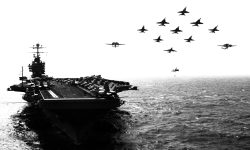
Since 17 August 2025, the US Southern Command has dramatically scaled up its presence and activity in the Caribbean. For example, the Command has deployed 4,000 Marines against narco-terrorist cartels.
Warships as well as bombers, spy planes, troops from the Marine Corps, and a fleet of drones compose this build-up. In mid-November, the USS Gerald Ford carrier and its combat group will be joining US forces in the Caribbean. Unseen but inextricably bound to the US military system are the satellite constellations.
They play a major role in communication, uplink redirection, observation, and targeting (Jean-Michel Valantin in The Red Team Analysis, “AI at War (1) – Ukraine”, 8 March 2024). It is those massive electronic and optronic capabilities that allow the US Navy to encompass the Caribbean zone of operations. That is how US Navy warships, helicopters, and drones have launched strikes. Since September, they have sunk 14 boats and one submarine, allegedly manned by narco-traffickers (Cancian and Park, ibid).
… To international competition
According to CSIS, China has heavily invested in numerous ports in Latin America and the Caribbean Sea (Henry Ziemer, Jaehyun Han and Hayden Power-Riggs, No Safe Harbor, Evaluating the risk of China’s port projects in Latin American and the Caribbean, CSIS, June 26, 2025). It is also the case in the countries that compose the isthmus from Panama to Mexico. The same thing happened on the Atlantic and Pacific coasts of Latin America.
Also according to CSIS, those ports have become de facto hubs of Chinese influence. So, the US Navy build-up takes place explicitly in order to strike at narco-traffic from Venezuela. However, one can also understand this force projection as an operation of counter-influence.
This new strategic situation raises the question: how to understand what is at stake? Indeed, why does this naval projection of power happen? Could it alter Chinese influence in the Latin America and Caribbean (LAC) region?
Whose Gulf, whose Caribbean Sea, whose Western Hemisphere ?
On 20 January 2025, during his inaugural address, President Trump declared that the US would take back the Panama Canal to China (The President, The Inaugural Dress, The White House, January 20, 2025).
Whose Gulf?
He also added that the Gulf of Mexico would be renamed the “Gulf of America” (The President, The Inaugural Address, The White House, January 20, 2025). Since this address, there have been many interpretations about this initiative. As the “Gulf of America” and the Caribbean Sea open onto each other through the Yucatan Channel. In other words, the renaming of the “Gulf of Mexico” may appear as a political/geopolitical operation.
It is strategic semantics that directly puts the Caribbean Sea under US political/geopolitical influence / unofficial sovereignty.
Whose Caribbean Sea?
Since 20 January, the US Executive branch has been very active regarding Mexico, Latin America, and the Caribbean. On 20 January, President Trump signed a series of executive orders that designate drug cartels as terrorist organizations. According to the phrasing of Executive Order 14157, cartels and other transnational organizations “threaten the safety of the American people, the security of the United States, and the stability of the international order in the Western Hemisphere.”
The State Department announced the designation of Tren de Aragua, Mara Salvatrucha (MS-13), Cártel de Sinaloa, Cártel de Jalisco Nueva Generación, Cártel del Noreste (formerly Los Zetas), La Nueva Familia Michoacana, Cártel de Golfo (Gulf Cartel), and Cárteles Unidos as Foreign Terrorist Organizations (FTO) and Special Designated Global Terrorists (SDGT).
“The intent of designating these cartels and transnational organizations as terrorists is to protect our nation, the American people, and our hemisphere. That means stopping the campaigns of violence and terror by these vicious groups both in the United States and internationally. These designations provide law enforcement additional tools to stop these groups” (Marco Rubio, Secretary of State, Terrorist designations of International Cartels, Press Statement, U.S State department, February 20, 2025).
In other words, those official declarations and executive orders allow the mobilization of the whole US defense and national security apparatus against those transnational criminal organizations that originate and operate from Colombia, Venezuela, Central America, and Mexico to the United States.
The same day, President Trump signed a series of executive orders that define new sanctions against Venezuela and its executive branch. President Maduro chiefly among them, who is accused of supporting narco-terrorism. A $50 million reward is placed on his head.
Whose Panama Canal?
Then, as soon as February 2025, BlackRock, the giant US private equity fund, started negotiations with the Chinese Hong Kong-based CK Hutchinson (“China Blocks BlackRock’s $23 Billion Panama Canal Ports Deal: How Beijing Sank a Landmark Investment“, Defense News, July 11, 2025). The latter bought the Pacific and Atlantic terminals of the Panama Canal in 2021. This took place after Panama had joined the Chinese Belt & Road Initiative in 2017.
Then, in August 2025, the Trump administration hitBrazil with a 50% tariff hike (Josh Boak, “Trump signs order to justify 50% tariffs on Brazil”, AP, 31 July 2025). Two weeks later, the US Navy build-up in the Caribbean started, then the strikes against narco-trafficker boats began. In the same timeline, the Trump administration harshly condemns the Colombian government and slashes counter-narcotics aid funds.
Meanwhile, Javier Milei, president of Argentina, did benefit from strong political and financial support and aid from Washington D.C. For example, in the midst of the Argentinian legislative election campaign, Washington agreed to a 20 billion dollar swap deal with the Argentinian peso. This aid was meant to restore the Argentinian peso (“Argentina’s Javier Milei wins in decisive midterms as Trump loan looms large”, ABC, 27 October, 2025).
Whose Western Hemisphere?
These different actions and operations are all led under the political imperative of the “defense of the Western Hemisphere” encompasses the whole American continent from its northern to its southern extremities. As it happens in the US political and strategic tradition, he Western Hemisphere (John Mearsheimer, The Tragedy of Great Powers Politics, W. W. Norton & Company, 2014).
This point appears as being a core tenet of the current Latin American-Caribbean US Grand Strategy. Its political centrality reveals itself on 25 September, during President Trump’s speech to the annual United Nations General Assembly. On this occasion, he declared his admiration for former president James Monroe (1817-1825).
When James Monroe was in office, he devised a core US foreign policy doctrine based on the interdiction of foreign influences in the American continent. Thus, the Monroe Doctrine defines the whole of the American continent as being forbidden to any other great power influence, except the United States. From a historical point of view, this doctrine has been especially applied in the Caribbean and in Latin America (Mearsheimer, ibid).
In September 2025, President Trump revives this principle by rejecting “the interference of foreign nations in this hemisphere and in our own affairs.”
In the 19th century, the implementation of the Monroe Doctrine allowed the US to extirpate what was left of European influence in Latin America and the Caribbean. During the Cold War, hard strategies were devised to fight Soviet-communist Cuban influence in the “Southern Cone”, that is to say the continuity from Central America to Southern America and the Caribbean (Allen Frazier, “U.S Deploys F-35 fighters to Cold-war era Puerto Rico base as Venezuela tensions escalate”, Military.com, 04 November, 2025).
Thus, the declarations of President Trump and of his administration about the defense of the Western Hemisphere appear as being strongly coherent with current foreign and military policy in the Caribbean.
Nowadays, the LAC US foreign policy of defense of the Western Hemisphere seems to aim to directly target Chinese influence in the Southern Cone.
Fighting the BRI
Thus, we may interpret the US Naval build-up in the Caribbean and in the vicinity of Venezuela as being part of a large-scale strategy. This new strategy could be qualified as a “Monroe Doctrine-oriented – counter-influence strategy”. In that case, the strikes against vessels suspected of narco-trafficking seem to have several layers of strategic meaning.
Strike
They are indeed interventions against “narco-terrorist operations”. But one can understand them as well as demonstrations of the political will of the Trump administration to openly use military force against actors whose influence and operations the US no longer tolerates in the Western Hemisphere.
In order to evaluate the degree of risk associated with Chinese influence in LAC ports and maritime terminals, CSIS has devised an interactive ranking based on several indicators. According to this ranking, it appears that several Atlantic and Pacific LAC ports are at risk of Chinese influence ( Henry Ziemer, Jaehyun Han and Haidan Power-Riggs, “No Safe Harbor: Evaluating the Risk of China’s Ports projects in Latin America and the Caribbean“, CSIS, June 26, 2025) .
The indicators used by CSIS to define, from the US point of view, the level of risk associated with the Chinese presence in a LAC port point at the ways Chinese organizations can use LAC ports to gather intelligence, and having ties with the People’s Liberation Army or with the Chinese Communist Party, to have an important degree of control over supply chains.
As it happens, there is another category of risk, that are not part of the CSIS indicators, but that are often mentioned by members of the administration, that are Chinese criminal organizations shipping precursor chemicals for Fentanyl in LAC ports.
Fentanyl connection
This drug is an extremely dangerous synthetic opioid. Since 1999, Fentanyl has been responsible for more than 500,000 deaths. There have been one million lethal overdoses in the US over the last 26 years. Chinese criminal organizations ship chemical precursors for Fentanyl, that LAC criminal organizations receive (“Are Fentanyl overdose deaths rising in the US?”, USA Facts, 24 October 2025). Then, narco cartels transform the chemicals into Fentanyl,transport it and sell it in the US.
As of February 2025, The US administration reinforces its capabilities at the border. The aim of this mobilization is to fight the drug cartels, while degrading the flow of drugs exported in the US, especially of Fentanyl. That’s why US drones are patrolling Mexican skies at the Mexico-US border, while the Pentagon raises the number of troops on the border (Rojoef Manuel, “US Army testing AR goggles, anti-drone guns on Mexico border”, The Defense Post, August 22, 2025).
Iran and Russia in the Caribbean
However, it appears that the system of interactions between LAC ports and China’s influence is much more complex than indicated by CSIS. For China, projecting investments and companies in Latin America and its ports is part of its global projection all around the world, in order to gather and channel the multiple resources the “Empire of Middle” needs for its ultra-rapid development.
Thus, Latin America is an attractor for China because of its massive biological, mineral and energy deposits. In this regard, Latin America as the same function for China than it had for the United States since 1823 and the officialization of the “Monroe doctrine”.
Indeed, between 2013 and 2022, 22 of 46 Latin American and Caribbean states have adhered to the Chinese Belt & Road Initiative (BRI). This Grand Strategy is aimed at ensuring the constant flow of energy resources, commodities, and products from the outside world into China (Jean-Michel Valantin, “China” section, The Red Team Analysis Society).
Enter Iran
Facing this US military build-up, President Maduro has requested military support from Russia, China, and Iran. From a geopolitical point of view, it is important to note that these three countries are members of the “BRICS +” organization. And that, de facto, BRICS+ directly challenges US global influence (Fatma Zehra Solmaz, “Maduro turns to Moscow, Beijing Teheran as US presence builds in the Caribbean”, Anadolu Ajansi, 01 November 2025). Indeed, Iran and China are also part of the international network that supports Russia in its war against Ukraine.
And since 2006, at least, Iran has played a direct role in the Venezuelan oil industry. A fleet of Iranian tankers is shipping Iranian fuel to Venezuela. They then load Venezuelan oil and sell it to Iran, as well as China and India (Alfie Shaw, “Venezuela to strengthen Iran oil pact”, Offshore Technology, 14 March 2024). Despite the 25% tariffs imposed by the Trump administration on countries buying Venezuelan oil, the “Iran connection” allows Venezuela to maintain minimal activity in its oil industry.
Venezuelan terminals where these Iran-Venezuela fuel-oil swaps take place benefit from Chinese investments that help maintain this vital infrastructure in operational condition. Among those terminals, the port of Puerto Cabello is of special interest. This port exports chemicals, among them petroleum products. It is also connected to refineries in the hinterland. The CSIS report pinpoints the Puerto Cabello port as being at a “34% risk level” due to Chinese influence (Ziemer et al., ibid).
However, it is hard to imagine how the current US administration could keep on tolerating the Iran presence in its own sphere of influence, given the state of tensions with the Islamic republic. Especially after the U.S bombing on Iran nuclear sites duing he Israel-Iran war in June 2025 (Jean-Michel Valantin, “AI at War (5) – Israel, Iran and the New (AI) Way of War“, The Red Team Analysis Society, June 30, 2025) ?
China in Latin America
As it happens, those flows of resources are necessary for the current industrial and capitalist development of the 1.4 billion strong “Middle Kingdom” (Jean-Michel Valantin, “China and the New Silk Road – From oil wells to the moon … and beyond”, The Red (Team) Analysis Society, July 6, 2015). China has been deploying the BRI, which attracts the interest and commitment of numerous Asian, African, and Middle Eastern countries. The BRI is an expression of Chinese philosophical and strategic thought that was started in 2013(Valantin, “China and the New Silk Road: the Pakistani strategy”, The Red Team Analysis, May 18, 2015).
It is grounded in an understanding of the spatial dimension of China, in the geographic sense. In the Chinese conception of things, space is a medium to spread Chinese influence and power to the “outside”. But it also allows the Middle Kingdom to “draw in” what it needs from the “outside” to the “inside” (Quynh Delaunay, Naissance de la Chine moderne, L’Empire du Milieu dans la globalisation, 2014). This is why we qualify some spaces as being “useful” to the deployment of the BRI. That is why each “useful space” is related, and “useful”, to other “useful spaces”.
Useful ports
In the LAC area, the BRI manifests its influence through, among other venues, massive Chinese investments in ports. It is the case, for example, of the Jamaican port of Kingston (Ziemer, ibid). However, in the case of the fusion of the Chinese BRI and LAC ports, the nature of the risk appears as being deeply linked to the way China attracts LAC commodities.
Indeed, de facto, those commodities “shift” away from the US sphere of influence and economy. In the same dynamic, they become a medium for Chinese social, economic, technological, and political development.
Useful LAC
In the same dynamic, the different countries that become involved in the deployment of the BRI become its “useful spaces”. Hence, the LAC continental region is a fundamental “useful space” for China. As a result, LAC ports are de facto of great interest for the BRI. Indeed, they are points of access to LAC commodity basins. Thus, those become useful spaces.
Thus, Chinese investments in LAC ports increase the LAC region capabilities to respond to Chinese commodity needs. De facto, those resources are extracted from the Southern Cone.
Port wars as resources wars
However, as we have seen, since the publication of the Monroe Doctrine in 1823, the US authorities consider this region as being the US sphere of direct influence and control.
Thus, the reinforcement of the US military presence in the Caribbean Sea appears to be of dramatically strong strategic significance.
US Power projection…
Obviously, the US Navy and CIA impose mounting military and political pressure upon President Maduro’s regime.
Furthermore, this pressure keeps on mounting. Since September 2025, The US Air Force has been utilizing the Cold War-era Air base in Puerto Rico. On top of this, the USS Gerald Ford, the mightiest of the US carrier fleet, is pre-positioned in the Caribbean Sea in mid-November (Bernd Debusmann Jr, “US Aircraft carrier group arrives in Caribbean”, BBC, 12 November 2025). All this massive military presence points at a strong political affirmation and defense of US national interests, both in the Caribbean as well as throughout the whole Western Hemisphere.
That is why, in this context, it is important to keep in mind that, from World War II to the end of the 1990s, Venezuela was the main foreign supplier of oil to the United States. This ended with the advent of the Chávez socialist regime in 1998.
Since then, bad management and the US sanctions regime have blocked the flow of Venezuelan oil towards the US. However, as seen, the Chinese investments in ports and Iran’s oil swap policy are reorienting this flow outside of the US sphere of influence (Mohammed Added, “Venezuela has the world’s most oil: Why doesn’t it earn more from exports?”, Al Jazeera, 4 September 2025).
Also, it is worth noting that this US build-up takes place in the area of the Atlantic point of entry of the Panama Canal. As it happens, Panama is one of the 22 LAC countries that are members of the Chinese BRI.
… vs Chinese influence
At the same time, those resources are no longer available to the United States. Their exports of commodities sustain China’s resiliency against US tariffs, while powering Chinese well-being and economic growth.
For example, the Pacific port of Chancay, in Peru, is now a hub between Asia, and especially China, and Peru. Through roads and railways, it is also becoming a terrestrial hub between Columbia, Ecuador, Chile, Bolivia, and Brazil. COSCO, the main Chinese shipbuilder and shipowner, has invested 3.5 billion dollars in the modernization of the Chancay mega-terminal (“Brazil, China discuss railway from Peruvian port to Brazil territory”, The Strait Times, 10 May 2025).
Thus, the Chancay port supports the Chinese importations of commodities as well as products exports. Thus, it si also a strategic entry in LAC Pacific side, thus a way to mitigate the US trade tariffs ( Jean-Michel Valantin, “Trump Geopolitics (2) – The US vs China geoeconomic war”, The Red Team Analysis Society, May 5, 2025).
Linking Atlantic to Pacific
As it happens in all the countries that adhere to the Chinese BRI, Chinese companies build several of those infrastructures. Brazil is not a BRI member, but it is a founding member of BRICS+. In November 2024, President Xi Jinping was present for the inauguration of the port of Chancay. Since then, discussions have started between the Brazilian government and Chinese operators in order to connect Chancay to the south of Brazil.
Furthermore, this would connect Chancay with the complex of mines of the “Lithium Valley”. This mining complex is currently being developed in Minas Gerais, the fourth largest state by area and the second largest in number of inhabitants in Brazil, and the- neighboring among others the province of Bahia.
Thus, lithium could be transported to Chancay, then shipped to China. Those exports would support the massive lithium-ion battery industries, central to the development of electric cars and data centers for Chinese AI (Anne Barbosa and Adriana Carvahlo, “Lithium leap: Brazil makes journey to become a leading supplier”, S&P Global, 15 August 2024).
However, it appears that since August 2025, when the Trump administration imposed 50% tariffs on Brazil, Washington. has become quite proactive in reasserting US dominance in the Southern Cone. And that happens while negotiations take place between China and LAC countries about those mammoth resource extraction and transport deals.
So, this begs the question of knowing if the Trump administration has decided to “take back control” of the Western Hemisphere for the long run. And what the strategic consequences for LAC countries as well as for US-China relations are going to be? And what will happen if armed force is used against the Maduro regime?
Aramco, the Saudi state-owned giant oil company has developed “Metabrain”, an extremely powerful Large Language Model (LLM), with 250 billion parameters, and a trillion parameters version planned for launch by the end of 2025. Metabrain is trained with the oil and geological data that the oil company has accumulated since the 1930s. However, as spectacular as it may be, “Metabrain” is just but an example of the multiple ways the oil industry integrates AI technologies ( Carrington Malin, “World’s largest industrial LLM revealed“, Middle East AI News, March 4, 2024 and « Aramco’s AI push drives four billion in technological impact », Middle East AI News, June 22, 2025).
As the artificial intelligence (AI) revolution unfolds globally, all the major oil companies, be they American, French, Saudi, Russian, Chinese, British, Russian, etc. integrate these technologies from upstream to downstream operations (Kelly Norways, Hermann Wang, Rosemary Griffin and Charle Michell, « Feature : Oil companies race for AI edge in upstream operations », S&P Global, July 10, 2025). AI becomes a tool to reinforce efficiency from geological exploration to the management of equipment without forgetting the financial side.
Meanwhile, the oil & gas industry generates colossal revenues, reaching 5.95 trillion dollars in 2024 (« Global Oil&gas industry guide 2025 », Research Market, 18 April 2025). Those revenues also happen to finance the development of the AI sector.
Reciprocally, the global oil & gas sector plays a major role in powering the mammoth international growth of the AI sector. The energy needs of AI encompass the proliferation of data centers besides the uses of AI by billions of people. Then, one must add the development of the material and electrical infrastructures upon which it depends (« Energy and AI », International Energy Agency, April 2025 and Hélène Lavoix, “Uranium for the U.S. Nuclear Renaissance (2): Towards a global geopolitical race, The Red Team Analysis Society, 17 January 2025).
Those rapidly evolving reality of energy and AI companies beg the question of their interlocked, if not interdependent futures. Then, we also have to wonder about the new geopolitical situations that may arise from this reality.
AI for oil
Data for oil
The oil industry is data driven. Oil companies need geological data to look for new deposits as well as to manage the currently exploited fields. Refining oil necessitates the production of a very accurate and constant data stream. The same can be said for the storage of oil and oil products, and for the management of reserves. It is also true for transportation, by pipeline, tankers, carriers and truck fleets (Mehdi Mohammadpoor, Farshid Torabi, « Big data analytics in oil and gas industry: an emerging trend », Science Direct, December 2020). Then, the selling and swapping of oil and oil products at global, regional and local levels produce a fantastic amount of financial, legal and regulatory data.
In other terms, on a global scale, the oil industry is a massive data engine of immense complexity. That’s why the AI new family of technologies meets with the oil&gas industry: technologies as deep learning are based on the classification and interpretation of big data.
Thus, the centrality of data production, management and application, turns the oil industry into a perfect attractor and integrator for AI (Hélène Lavoix, « Sensors and actuators for AI(1): Inserting AI in Reality », The Red Team Analysis Society, January 14, 2019). The same applies to the need for anticipating demand and new reserves.
The great convergence
In this technological context, it is worth noting t the historical convergence between oil industry and AI. Indeed, this dynamic has started in the short years that followed the massive breakthrough during the 2010s.
That’s when neural network technology met with deep reinforcement learning, leading to success as the victory of Alphago, the Google Deepmind AI, defeated the world champion of go. During the same timeline, the development of deep learning and machine learning turned into usable tools with economic value ( Hélène Lavoix, “Portal to AI-Understanding AI and Foreseeing the AI powered world”, The Red Team Analysis Society).
The Huawei case
It is the case in China, with, for example, Huawei, the leading 5G and AI giant company that has developed a major expertise in “intelligentizing” pipelines.
This expertise has been developed over more than a decade, first in Central Asia. (Jean-Michel Valantin, “Artificial Intelligence on the Chinese New Silk Road”, The Red Team Analysis, December 4, 2017 and “World’s longest smart pipeline”, Huawei case study, 30/03/2013). For example, Huawei has coupled the mammoth 3600 km long Central Asia-China gas pipeline with an immense array of sensors. This giant infrastructure connects Turkmenistan, Azerbaijan, Uzbekistan and Kazakhstan to China with a giant fiber-optic cable network (“World’s longest smart pipeline”, Huawei case study, 30/03/2013).
This fiber-optic cable allows for the installation of a huge population of sensors. Those devices measure flows, temperatures, pressure and all the important variables of this immense infrastructure. This vast array of sensors is also integrated to a satellite surveillance and communication network.
Furthermore, all together these systems of sensors produce immense flows of data. And those flows demand a very high bandwidth capacity – only allowed by fiber-optic cables – in order to be transmitted to the AI data treatment center built and operated by Huawei. This mammoth structure is now called the “intelligent pipeline” because of the way it is intrinsically AI-powered.
The Huawei company, is in charge of the connectivity and electronic management of the Central Asia-China gas pipeline.
Huawei is also one of the several Chinese companies that are currently developing AI in China, Alibaba, Tencent, Huawei, Sensetime, DeepSeek, Bytedance, … (Jean-Michel Valantin, “The Chinese artificial intelligence revolution”, The Red Team Analysis Society, November 13, 2017).
In the oil sector, those sensors numerous. They can be seismic wave exploration devices, networks of pressure gauges along continental pipelines. There are also satellite-based radars and geospatial imagery for geological exploration, high frequency trading of oil based financial assets, etc. Today, most often, AI capabilities manage and treat the data flows that those networks of sensors produce.
For example, Aramco, the Saudi Arabian state-owned oil company, is integrating artificial intelligence technology into all of its operations ( (“AI and Digital economy development key part of Saudi-China partnership plan”, Arab News, December 9, 2022 and Jean-Michel Valantin, “China, Saudi Arabia and the Arab AI Rise“, The Red Team Analysis Society, 31 January, 2023). Simultaneously, as highlighted above, the company has built and uses «Metabrain», the world’s biggest industrial Large Language Model.
Aramco trains Metabrain with its 90 years trove of oil data. The Saudi giant has also hired hundreds of AI specialists ( Carrington Malin, « Aramco’s AI push drives four billion in technological impact », Middle East AI News, June 22, 2025).
Exxon Mobil, the U.S. giant, uses AI to optimize its own energy consumption, especially at the refinery level. British Petroleum integrates AI algorithms to is exploration service. Shell is using predictive AI to improve the uses and efficiency of its equipment while reducing downtime equipment. Through this predictive maintenance approach AI algorithms analyze sensor data from equipment and machinery at refineries and drilling sites to predict failures, enabling timely maintenance and preventing costly unplanned downtime.
As a result, the oil industry has also become a driver of the AI sector. It also boosts the AI sector through massive financial investments. It is the case, among others, of the relationship between Saudi Arabia and the Silicon Valley. The Saudi government has launched « Humain », an AI company dedicated to the development of the AI sector in Saudi Arabia. « Humain » is financed by the the mammoth Saudi Arabia Public Investment Fund (PFI). PFI is worth 940 billion dollars, generated by the kingdom’s oil rent (Ahmed Al Omran and Andrew England, « Saudi Arabia launches AI venture Humain ahead of Trump visit », Financial Times, May 12, 2025).
From Saudi oil to AI
On 13 May 2025, during the Saudi Investment Forum, all the major American players in the AI sector visited the Kingdom’s capital, and multiplied their investments and projects with the Saudi PIF and the company Humain (Reem Walid, “PIF’s HUMAIN to launch $10bn AI fund in global tech push“, Arab News, May 28, 2025).
Among others deals, Nvidia and Humain announced plans to build AI factories and data centers across the Kingdom. The deal starts with the sell of 18 000 Blackwell ultra-efficient GPUs to Humain. Nvidia and Humain established a landmark strategic partnership in May 2025 to create hyperscale AI infrastructure and build “AI factories” across Saudi Arabia, backed by the country’s Public Investment Fund (PIF).
Humain will invest billions to deploy up to 500 megawatts of AI compute capacity powered by hundreds of thousands of Nvidia’s most advanced GPUs over five years, beginning with an 18,000-unit GB300 Grace Blackwell supercomputer installation in the first phase. AMD, Qualcomm, Salesforce, Oracle, Google, Uber also announced crossed dealsUS and Saudi investments. Then, the White House also announced that the Kingdom would invest USD 600 billion in 5 years in the U.S. AI sector (Tyler Durden, « Nvidia, AMD, Nvidia, AMD Secure Saudi AI Data Center Deals During Trump’s Gulf States Tour », Zerohedge, May 14, 2025).
Thus, while AI technologies bolster the efficiency of oil companies, oil revenues have become an importantr driver for the expansion of AI. For the oil sector, this race towards new levels of efficiency is a strategic stake. Indeed, nowadays, the geopolitics of oil collides with the tensions associated with the global geopolitical fragmentation in a time of global energy transition and climate change (Jean-Michel Valantin, « What are climate wars ? », The Red Team Analysis Society, November 2, 2025 and Helene Lavoix, « Climate breakdown: towards wars to reduce CO2 emissions ? », The Red Team Analysis Society, September 19, 2023).
The geopolitics of AI oil
It is interesting to note that, since the 2000s, the U.S. has been the country where the twin revolutions of the shale oil and gas industry and of AI have happened. Furthermore they followed parallel timelines (Loretta Napoleoni, Technocapitalism: the rise of the new robber barons and the fight for the common good, Seven Stories Press, 2024).
As it happens, the shale oil technological revolution of horizontal drilling and hydraulic fracturing turns the U.S. into a net producer and exporter of oil and gas (Daniel Yergin, The New Map, Energy, Climate, and the Clash of Nations, 2020).
AI for fracking
However, this new approach relies on heavy equipment that necessitates large and continuous investments. Shale oil companies have to face very complex hurdles, such as optimization of extraction, reservoir modelling, production forecasting, evolution of demand, etc. Integrating AI allows those companies to optimize the different aspects of their activities, thus securing their revenues while mitigating risks.
At the international level, the oil and AI sectors convergence means that the oil sector is operating in a transforming international arena. Indeed, the U.S./China race to reach dominance in the AI field affects all the dimensions of the sector.
For example, the U.S. administration tries to slow down Chinese progress through technological export bans. Beijing retaliates by restricting exports of rare earths, while boosting its own R&D and productivity in the GPU field.
The oil industry, which is, historically, a major driver of international tensions, becomes dependent for is own development and persistence upon AI. Meanwhile, AI is quickly becoming a driver of an international civil-military competition.
Reciprocally, if the tensions that accumulate in the energy sector, due to the geopolitics of energy transition, climate change and competition for access to oil turbo-charge or trigger new conflicts, then it is probable that those tensions will have consequences for the AI sector. This trend could be enhanced by the militarization of AI, which is quickly accelerating.
So, we now have to see how AI and the different dimensions of the energy sector are going to interact.
Given the extreme density of the strategic situations involved, the main focus of this article is the technological dimension of the “12 days war” between Israel and Iran, and the strategic meaning of those technological advances.
A new way of war in the Middle East ?
Infiltrated Israeli drone teams destroy Iran air defences on Iran soil, while eliminating military and political high profile persons. Israeli fighter-bombers dominate Iran air space. Iranian hypersonic missiles reach 400 km altitude before falling on Israeli precise targets…
The Israel anti-aerial defense, which compounds the Arrow, the David Sling and the Iron Dome, can’t intercept all of the Iranian missiles and drones. Massive cyber-attacks hammer Iran infrastructures. AI-led Information and psychological warfare takes place on the world stage… Then, on 21 June, 7 U.S. Air Force B-2 stealth bomber launch 12 GBU « bunker busters » against the three main Iran nuclear sites.
A singular war
Those are some of the technological and military features of the “12 days Israel-Iran war”. If we focus further on them, then they appear as deeply singular. Indeed, they correspond to the involvement of two countries in a direct hot war, yet without significant ground fighting operations.
On the contrary, the involvement of both Israeli and Iranian vectors take place in the vertical dimension, both atmospheric and spatial (Jay Pasquarette, “Rising Lion: Escalation, Objectives and the Logic of Targetting”, Small Wars Journal, 06/19/20225).
In other words, this conflict reveals the emergence of the technological uses of strategies that we refer to as “hyper war”. In other words, this corresponds to the design of strategies that mobilize the full potential of very different domains.
Those domains concern cyberspace as well as AI-led-vectors at very high altitude and in space, as well as AI cognitive warfare. This mobilization literally encompasses not only the military of the antagonists but also its infrastructure and society.
Thus, first, we focus on the Israeli hyper offensive and on the Iranian military reaction. Then we stress the unique scale of this war, that prolongs itself into the “first space war”. From there, we’ll try to understand the way an “hyperwar” induces an evolution in war, and its consequences.
Hyperwar escalation
A chain of strikes
The Israeli political and military authorities launched the operation “Rising Lion” against Iran on 13 June 2025. This operation unfolded through aerial bombings of Iran nuclear sites, while several targeted killings of key military, political and scientific Iranian officials took place.
The bombings and killings campaign was the result of a massive hybrid operational strategy (Daria Dolzikova and Matthew Savill, “Operation Rising Lion: The first 72 hours”, The Royal United Services United-RUSI, 16 June 2025).
Indeed, the Iranian air defense system was brought down by the synergy of three different modus operandi articulated along different phases. It seems that a first sequence was the series of Israeli bombings on Iran air defences in October 2024 (Jean-Michel Valantin, “AI at War (3) – Hyperwar in the Middle East”, The Red Team Analysis Society, October 24, 2024.
Then, in parallel, a series of cyberattacks and missile strikes hit Iranian defences. Thus, a 200-strong fleet of Israeli fighter-bombers could attack on-the-ground nuclear military. (Dolzikova and Savioll, ibid).
Target and kill
In parallel to those strikes, the Israeli military waged a campaign of targeted killings. Drone and missile strikes eliminated the heads of the Iranian Revolution Guardian Corps (IRCG), and the heads of the Iranian military chiefs of staff. Several key scientific figures of the Iran nuclear program were also killed (Dolzikova and Savill, ibid).
According to Euronews, those targeted killings were made possible by an extensive use of AI to process electronic and human intelligence. The AI processing of signals and information allowed the Israeli military to pinpoint, track and target high profile figures of the Teheran regime with an unheard of level of precision (“Israel’s spy agency used AI and smuggled-in drones to prepare attack on Iran, sources say”, Euronews, AP, 18/06/25). The synergy of bombings, sabotages, drones and cyberwarfare appears as a new form of hybrid operational warfare, at a very large scale.
The first space war
However, despite extensive damages to the Iran military, those strikes triggered an impressive array of Iranian responses. Those took the form of several waves of ballistic missile and drone attacks of the Israeli territory. It seems that the missile waves were a mix of old and new, very high-tech, ballistic missiles (Sebastian Seibdt, “What Iran reprisals against Israel reveal of its ballistic missiles capabilities”, France 24, 18/06/2025).
As it happens, between 13 and 20 June, some Iranian ballistic missiles were able to penetrate the Israeli air defences. It is the result both of the relative efficiency of the Iranian missiles and of the overuse of the Israeli defense system ( David Daoud and Ahmed Sharawi, “Iranian drones and missiles attacks on Israel” series, FDD’s Long War Journal).
As it happens, the interception of the Iranian and possibly hypersonic missiles took place at 300 km or 400 km of altitudes,thus, well above the 100 km Karman line that defines the limit between the atmosphere and the exo-atmospheric altitude and outer space. .
According to Clausewitz, the act of war is defined by the polarity between attack and defense (Carl von Clausewitz, On War, 1832,Penguin Classics, London).
It follows that the interception of ballistic missiles by the Israeli Arrow 3 system in the exo-atmospheric altitude installs transposition of the attack and-defense dialectics in the outer space medium. Thus, as stated by Adam Tooze, the “12 days war” happens to be the first space war ( Adam Tooze, “Incoming from out of space: The geo-military radicalism of Iran v. Israel 2025”, Chartbook 392, 20 June 2025.
According to BBC Verify, multiple online platforms have hosted a tsunami of fake news, fake videos and fake pictures about siraeli and Iranian damages, loss and destructions (Matt Murphy, Olga Robinson, Shayan Sardarizadeh, “Iran-Israel conflict unleash wave of disinformation”, BBC Verify–BBC, 19 June 2025). Some of them have attracted more than 100 million viewers.
Down, not down
For example, on the side of Iranian supporters, some fake pictures of a downed Israeli fighter-bomber have had tremendous international success. On the Israeli side, fake videos have shown demonstrations taking place in Teheran against the regime (BBC Verify, ibid).
Indeed, the information war strategy of both Israel and Iran triggers an enormous and emotionally turbo-charged “conflict of interpretation” of these fake pictures and videos. This “conflict of interpretations” infuses and immerses through constant dialectics the different levels of the political and military decision-making processes of belligerent states and governments. (Man, the State, and War: A Theoretical Analysis by Kenneth N. Waltz, New York, Columbia University: 1959).
Meanwhile, this performative/political efficiency infuses the public opinions all around the world with real and fake pictures. Those images trigger powerful collective emotions in Israel, in Iran as well as in the rest of the world.
This strategy is tantamount to a cognitive warfare strategy. Indeed, the global diffusion of these videos on social medias is turning them into cognitive and emotional ammunitions.
Furthermore, through the use of individual smartphones, those cognitive ammunitions impact millions of individual brains and psyches. Then, the collective addictions to social networks literally “reinforces” and distributes those “impacts” at a very large scale. (Annamaria Sabû, Gabrielas Anca, “Using artificial intelligence tools for obtaining cognitive warfare advantage”, The Defence Horizon Journal, October 2023, 2023).
So, the very logic of social networks becomes a « cognitive force multiplier ». Thus, it turns both Iran and Israel into « performative and cognitive warfare great powers ». With such tools, Iran is now waging a cognitive war against Israel. This strategy is a new way to wage « political warfare », thanks to the weaponization of digital and AI tools.
War, what is it good for?
The military escalation between Israel and Iran from 13 to 24 June stopped, at least temporarily, after the US bombing of the three main Iran nuclear sites. At the time of writing, the concrete results of the USstrikes are still debated. However, it already appears clearly that the military escalation between Israel and Iran was a new form of highly technological hybrid warfare.
Feedback loop
Indeed, while using drones and air defences, both belligerent also used the exo-atmospheric medium as a battlefield, while extending their conflict into the collective cognitive realm through the use of generative AI.
Thus, both belligerents create a gigantic feedback loop between military, informational, cognitive and political warfare (Hélène Lavoix, “Information Warfare and the War in Ukraine”, The Red Team Analysis Society, May 24, 2022).
In this, one may see that there are numerous continuities between the operational dimension of the “12 days war” on the one hand, the Ukraine war, the Gaza war and the Red Sea war, on the other.
Indeed those different conflicts are also “laboratories” for new tactics and operational strategies deriving from the new capabilities (Jean-Michel Valantin in The Red Team Analysis, “AI at War (1) – Ukraine”, 8 March 2024 and “AI at War (2), Preparing for the U.S-China War ?“, 17 September 2024 and Jay Pasquarette, “Rising Lion: Escalation, Objectives and the Logic of Targetting”, Small Wars Journal, 06/19/20225).
The future of coming wars
These new capabilities emerge from recent technological breakthrough, such as drones, AI and the militarization of social networks. However, the opening up of exo-atmospheric medium may have deep consequences both in operational terms and in conventional deterrence terms. Indeed, if hypersonic missiles become capabilities for war in space, it opens up the possibility of other and very large scale conflicts, through the use of the exo-atmospheric medium medium.
This begs the question of the way great powers such as the U.S., China and Russia are going integrate those new capabilities to the international arms race.
In April 2025, the Trump administration raised custom tariffs on most Chinese goods up to 145%. The Chinese reaction was to raise its own tariffs up to 125% (Jennifer Clark, “What are tariffs and why is Trump using them?”, BBC, 23 April, 2025). In this context, one must keep in mind that, since December 1978 and the progressive economic opening of China by Deng Xiaping, the development of the Sino-American trade has become a key factor of the economic development of China (Loretta Napoleoni,Maonomics, Why Chinese communists make better capitalists than we do ?, Seven Stories Press, 2011).
As it happens, economic growth is a core component of the current Chinese social contract and cohesion. Since 1980, Symmetrically, the import of cheap Chinese goods is a way to maintain the buying power of the U.S. citizens. Those imports have “compensated” the social consequences of the massive offshoring of U.S. industries, especially in China and Mexico (Giovanni Arrighi, Adam Smith in Beijing, 2007). So, putting the U.S.-China trade relationship at risk is a direct and massive threat to the very economic, social and political fabric of each country.
In other terms, the U.S. and China appear as pitting themselves against each other into a commercial war that seems to have strategic goals that transcend the trade dimension. One has to wonder if the U.S. as well as China are not weaponizing the different domains and tools of their confrontation.
In this article, we are going to study the strategic stakes of this colossal geo-economic confrontation. Then, we shall see how tariff barriers are hybridizing with geoeconomics warfare. Finally, we shall look at the way these dynamics are fuelling an escalation in other areas.
Confrontation
Since 4 April 2025, The U.S and China have been locked into a new trade war. Both Washington D.C. and Beijing are waging it through the installation of very strong custom tariffs. Indeed, the U.S. imposes 145% customs duty on most Chinese products imports.
This extremely violent trade war emerges in the very singular system of geoeconomics created by the U.S.-China relationship. Indeed, since 1980, their interactions have been extremely deep. This happens notably because of the economic interdependence that links these two giants, without uniting them. This relation is so dense that Niall Ferguson calls it “Chimerica”.
This expression expresses the quasi-intimate process of hybridization between these two mammoth national economies. (Niall Ferguson, Xiang Xu, “Making Chimerica Great again”, Wiley one line Library, 21 December 2018).
This process emerges both from the installation of thousands of U.S. industries and corporations in China and from the mammoth trade relation between the two countries.
De facto, during the existence of Chimerica, the Chinese economic reality is inseparable of the U.S.-China relationship, as long as Chimerica lasts. Indeed, if today the U.S. industrial output represents “only” 16,6% of the world production, while China’s industrial output weighs 28%, it is the result of the installation of large segments of the U.S. industrial base in China and in Asia since the 1980s (Felix Richer, “China is the world’s manufacturing power”, Statista, Feb 18, 2020).
The growth of the Monster
Chimerica results from the export of China-based products at very low costs to the U.S. consumer base. From this point of view, Chimerica literally “is” the different dimensions of the fantastic trade imbalance between the two countries. Since 1986, this imbalance went from zero to more than 336 billion dollars in 2017 and 378 billion dollars in 2018. (Office of the United States Trade representative, “The People’s Republic of China – U.S-China Trade facts“).
So, one notes that, since 2002 when China joined the World Trade Organization, this imbalance has been growing and accelerating.
The Chinese GDP follows the same dynamic. As it happens, according to the IMF, in 2001, China’s GDP corresponded to 13% of the U.S. GDP. It represented 25% of the U.S. GDP in 2007 and 60% in 2016. In 2016, the IMF was projecting a growth of the 2023 Chinese GDP. That would be equivalent to 88% of the U.S. GDP. In other terms, Chimerica is at the core of the Chinese growth, and of the U.S. economy. (Niall Ferguson, Xiang Xu, ibid).
A strong dollar supports this structural imbalance, which heightens the U.S purchasing power, thus favouring the power of the Chinese exports.
In 2018, the U.S. trade deficit reached a historic 418 billion USD. Then, the U.S. imported $539 billion worth of Chinese products, while exporting $120 billion worth of American goods to China. The very same year, President Trump launched the U.S trade war against China, through the imposition of several tariff barriers (Jean-Michel Valantin, The Chimerica series (1)(2)(3), The Red Team Analysis Society, 29 June 2020 and Denisse Lopez and Javier Galan, « 5 charts that explain the U.S-China trade relationship », El Pais, 11 Avril 2025).
Targeting the U.S .
In the same time, in 2019 the Trump administration banned a growing number of strategic technology transfers, especially in the AI field. However, imports from China peaked again in 2022. That year, they reached 536 billion USD, before returning to 427 billion USD in 2023 and 439 billion USD in 2024. During the same time, U.S. exports in China remained in a zone between 125 billion USD and 150 billion USD. (Denisse Lopez and Javier Galan, « 5 charts that explain the U.S-China trade relationship », El Pais, 11 Avril 2025.)
Trade war as geoeconomic warfare
In other words, “Chimerica” is the geoeconomic driver of the U.S.-China trade imbalance. Chimerica also drives the deindustrialization of the U.S. in favour of the Chinese industrial development. This very real “chimera” has dire consequences for the U.S. Those are known as the “China shock”, i.e, the degradation of the U.S. global share of value-added manufacturing (David Autor, David Dorn and Gordon H. Hanson, “The China Shock and its enduring effects”, Stanford – Center on China’s economy and institutions, 1 October 2022).
Countering the “China shock”
As it happens, in 1980 the U.S. share of global manufacturing reached 25%, while China accounted for only 6%. Then, in 2001, China joined the World trade Organization, thus boosting its exports worldwide. In 2008, the financial crisis hammered the U.S. economy, followed, in 2020, by the COVID-19 pandemic and its dire consequences (Adam Tooze, Shutdown, How Covid shook the World’s economy, Penguin Random House, first ed. 2021).
In 2024, the U.S. share of global manufacturing reached 16%, while China’s share attained 29%. So, basically, the emergence of Chimerica, combined with the consequences of the global crisis, have been the engine of the transformation of the U.S. from a global productive power into a global purchasing power, besides a driver of the growth of China.
This “shock” from China started in 1980. It was exacerbated by the financial crisis and by the Covid crisis. This “long shock” inflicts deep damages to the U.S. society, through the migration of thousands of plants to China and the closure of non-competitive others in the face of the flood of imports from China. This industrial depletion triggered massive job losses, as well as declining employment and wages as well as fiscal losses (David Autor, David Dorn and Gordon H. Hanson, “The China Shock and its enduring effects”, Stanford – Center on China’s economy and institutions, 1 October 2022).
Thus, numerous local governments lack the financial means needed for the maintenance of infrastructures and public services. It is worth noting that the issue of the maintenance and rebuilding infrastructure was and is a central theme of the first as well as of the second Trump administration. In the latter case, it is especially true in the digital domain (Jean-Michel Valantin, “Trump Geopolitics – 1 : Trump as the AI Power president”, The Red Team Analysis Society, 20 January 2025) .
Chimerica as a geoeconomic war
In other terms, “Chimerica” drives an incremental weakening of the U.S. power, while damaging the U.S. infrastructures and society. From a geo-economic perspective, the consequences of the “China shock” are quite akin to the consequences of what Edward Luttwak defines as a “geo-economic war”. Indeed, theorised in 1990, a “geo-economic war” is thought as a means of inflicting the same kind of damage on a country as could be caused by military means.
This approach concerns infrastructures as well as the financial dimensions of quality of life. The idea is to use economics as a weapons system. (Edward Luttwak, “From Geopolitics to Geoeconomics”, The National Interest, 1990 and Robert D. Blackwill and Jennifer M. Harris, War by other Means, Geoeconomics and Statecraft, 2016).
By adopting this geo-economic war perspective, Trump’s tariffs appear to be a massive geo-economic offensive against Chimerica. Thus, we may understand it as an attempted strategic strike against one the major engines of the Chinese economic growth.
Escalation
Indeed, economic growth and the subsequent enrichment of the Chinese citizenry constitutes the core of the social contract between the Chinese society and the Chinese Communist Party. It follows that the U.S. tariffs are putting at risk the very model of development of contemporary China.
From the “Chinese shock” to the “American shock” ?
To make things worse, this U.S geo-economic strategy is being deployed while the Chinese economy has slowed down since the Covid-19 pandemic. Furthermore, as other economies, the Chinese economy is impacted by the inflation in energy prices that is accompanying the war in Ukraine.
In the face of these difficulties, Beijing reacts to the U.S geo-economic strategy by retaliating in the very same domain.
Extension of the theatre of operations
Since 11 April 2025, Beijing imposes 125% tariff barriers on U.S products. However, it appears that Beijing also adopts a strategy of enlargement and alliances for its geo-economic influence. In this light, the Chinese ministry of Trade multiplies negotiations with the European Union, as well as with the EU member states, in order to reinforce the Chinese penetration of the EU market (Nick Martin, “Trump Tariffs drive China, EU to diversify trade”, DW, 4/11/2025).
Beijing launched other initiatives in Asia. For example, from 7 April 2025, despite numerous tensions between them, and Japanese worries about China’s rare earth dominance, China, South-Korea and Japan established a regional zone of exchange for rare earths and semiconductors. In the same dynamic, China banned exports of rare earth from its territory to the U.S. Beijing also pressures South Korea to do the same (“China follows US playbook in rare earths crackdown; Tesla hit”, Asia Financial, 23 April 2025 and Eirwenn Williams, “Japan sounds alarm: this strategic metal is China’s global domination on chip and battery production”, Rudebaguette, April 28, 2025).
Refined rare earths are key components for the production of semiconductors, necessary for AI computers. Thus, those bans strike at the very core of the U.S. strategy of massive AI development, which is a central policy of the second Trump administration. Indeed, as we have seen, the U.S. AI industry is intricately linked to the second Trump administration (Jean-Michel Valantin, “Trump Geopolitics – 1 : Trump as the AI Power President”, The Red Team Analysis Society, 20 January, 2025).).
Thus, the Chinese ban on rare earth exports may be understood as a global offensive against the U.S. tariff barriers, as well as against the AI industry networks that constitute the very fabric of this administration, when the U.S. AI strategy is a major driver of the economic and military U.S. development of its power.
In other words, the U.S. geo-economic war aims at the very fabric of the Chinese society, while the Chinese counter-strategy aims at the very engines of the U.S. AI technological, industrial and political power (Jean-Michel Valantin, “DeepSeek vs Stargate – China’s offensive on U.S AI dominance ?“, The Red Team Analysis Society, February 18, 2025).
It now remains to be seen how this strategic confrontation expands in other domains, and if it triggers, or not, escalation dynamics.
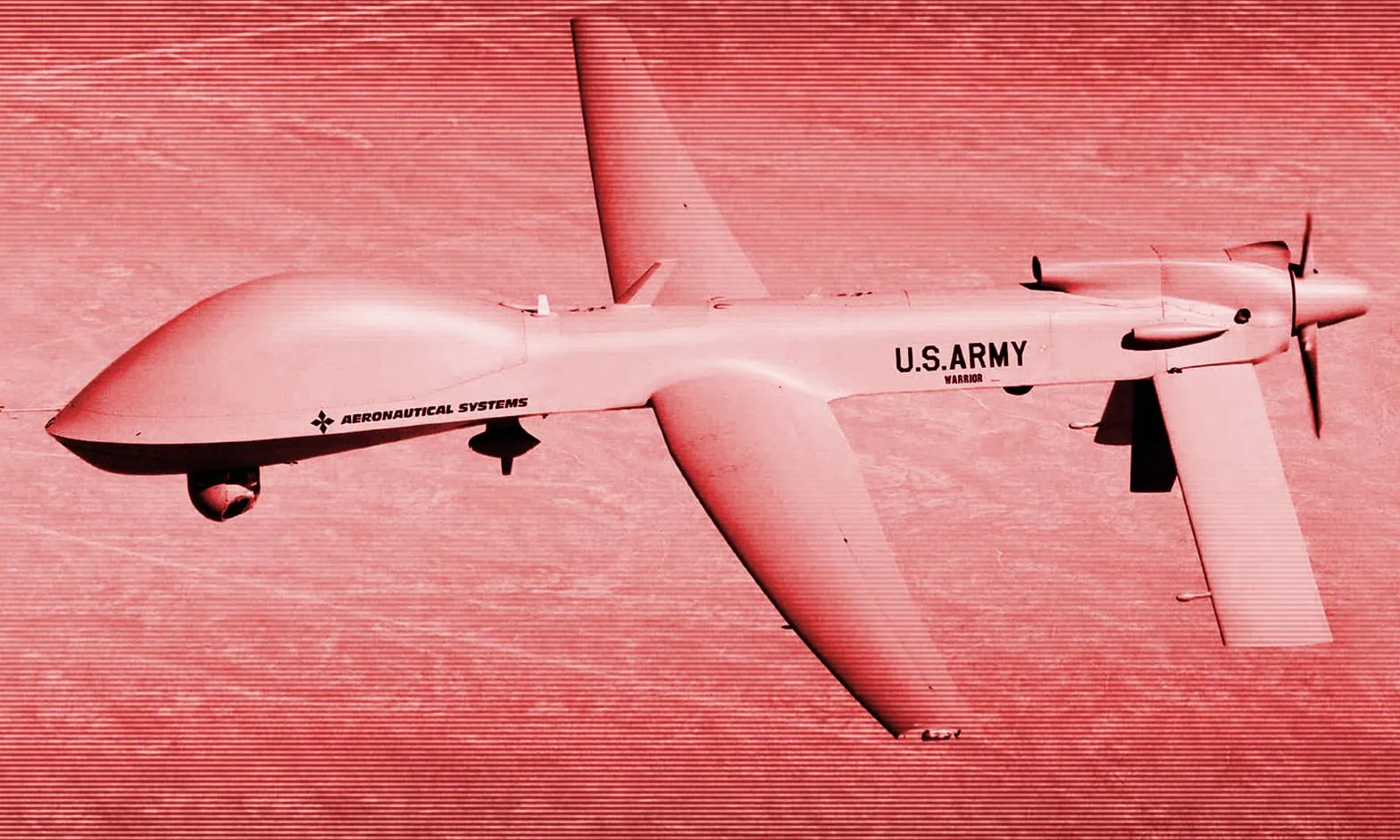
(U.S. Army’s MQ-1C Warrior UAV Photo Courtesy of U.S. Army – Public Domain)
In December 2024, the Chinese government ordered one million kamikaze drones for the People’s liberation Army (Dylan Malyasov, “China places massive order for kamikaze drones”, The Defence Blog, 22 December 2024).
This partnership is the latest in a series of contracts signed between Anduril and the armed services, such as a 100 million USD contract with the Space Force to expand its edge data services integration capabilities (Patrick Tucker, “Can OpenAI power military drones defense? New partnership with Anduril offers clues”, DefenseOne, December 4, 2024).
In order to develop the production capabilities required by its contracts, Anduril is building Arsenal-1 in Columbus, Ohio. This industrial complex is designed to “hyperscale” the production of drones and weapons system (Stavroula Pabst, “The AI weapon army goes to Ohio”, Responsible Statecraft, February 20, 2025).
Drones, be they aerial, terrestrial, marine or submarines, are becoming a prominent segment of contemporary arsenals, integrating AI. Their autonomy is growing at a very fast pace. They are used by national militaries, such as those of the U.S., the Chinese or the Russian armies. They are used as well by militias, such as the Houthi or the Hezbollah. They have become a prominent feature of the Ukraine war, or of the Lebanon war (See Jean-Michel Valantin in The Red Team Analysis, “AI at War (1) – Ukraine”, 8 March 2024 and “AI at War (2), Preparing for the U.S-China War ?“, 17 September 2024).
Meanwhile, rapid progress are made in the field of humanoid/android robots, especially in China and in the U.S. Like drones and other technologies, androids are rapidly being militarized. (Dan Grazier, “What if the robot army is defeated?”, Responsible Statecraft, 10 March 2025).
However, this new dimension of the arms race raises the question of whether these weapons systems are “only” of tactical importance, or whether their importance in warfare is becoming such that their use is of strategic importance?
In other terms, in the age of the militarization of AI, is “drone power” a pivotal new technology ? Is it necessary to acquire general dominance on a theatre of operation? And how are these capabilities going to be projected on theatres of operations ? And for which conflict?
The Age of the Great Swarm
Replicator
On 30 August 2023, Kathleen Hicks, Deputy Secretary of Defense, gave a speech to a military and media crowd about the need for the U.S. to mass produce drones in order to outsize the Chinese People’s Liberation Army (Deputy Secretary Kathleen Hicks Keynote Adress: “The Urgency to innovate”, US Department of Defense, 28 August, 2023).
To achieve this objective, the assistant-secretary announced the “Replicator” initiative. This military-industrial initiative will mobilize the U.S. production capabilities to produce a “mass” of military drones. The objective, for this “mass”, is to be superior to the whole of the Chinese military mass of troops and machines.
It is important to note that the assistant-secretary was talking on the Island of Guam, which is a major U.S. Navy base in the Pacific. So, the geography of the declaration of assistant-secretary of defense takes place in very important U.S Navy base. This base would be, or will be, on the front line of naval operations against, for example, China.
Since then, « Replicator » has become the framework for the Pentagon-led race for drones (“Pentagon ramps up development for Replicator program”, Gov CIO, 01/29/2025). This military and industrial policy has to follow two intertwined tracks. The first one is the development of the industrial capabilities at the proper scale.
The other track is particularly driven by the Defense Innovation Unit (DIU). Its goal is to implement « the initiative’s Autonomous Collaborative Teaming, or ACT, effort. The goal of the ACT is the production of the “automated coordination of swarms of hundreds or thousands of uncrewed assets across multiple domains” (Patrick Tucker, “DIU orders software to drive massive drone swarms”, Defense One, November 20, 2024).
From Replicator to Anduril
In this context, the rapid development of Anduril takes a strategic meaning. Indeed, Anduril multiplies partnerships with the U.S. military. The attractiveness of Anduril for the U.S military is notably motivated by the company’s software platform “Lattice” (Patrick Tucker, “DIU orders software to drive massive drone swarms”, Defense One, 20 November, 2024). “Lattice” works by absorbing data from different resources. Then, an integrative layer treats the data through machine learning process, prioritizes and distributes it to tasks different systems. Among those, drones or swarms of drones are of major military interest (Jon Harper, “Anduril wins $100M deal with CDAO to scale “edge data mesh” capabilities”, DefenseScoop, 3 December 2024).
Meanwhile, Anduril, among other tech companies, has developed a strong partnership with OpenAI. This partnership aims at reinforcing the cybersecurity and the cyber-capabilities of the drones.
According to Anduril as well as to OpenAI, this partnership will be particularly focused on the development of counter unmanned vehicles (drones) and cybersecurity capabilities, in order to protect military personnel (Stavroula Pabst, ibid and James O’Donnell, “We saw a demo of the AI system powering Anduril’s vision for war”, MIT Technology Review, December 10, 2024).).
Towards the AI military-industrial complex
In the same dynamic, in December 2024, Anduril and Palantir, the commercial and defense data analytics company, launched a consortium.
Meanwhile, in order to reinforce their access to Pentagon’s call for tenders, those companies aim to achieve a better integration of AI to national security as defense contractors (Michael Klare, “A new military-industrial complex arises”, TomDispatch, 9 February, 2025).
For this, they aim to access the vast amounts of data that the U.S defense and security apparatus produces. Thus, they would be able to train their AIs through Anduril’s Lattice and Palantir’s Menace software. This access and training would allow these companies to produce the next level defense AI (“Anduril and Palantir to accelerate AI capabilities for National Security”, Anduril, 12/6/2024).
Meanwhile, Anduril and Palantir integrate other AI companies to their consortium. They are in talks with companies such as, for example, Space X, Archer aviation, Scale AI, Saronic, among others. The consortium appears as being both a vehicle and a pressure group. It dedicates itself to a better penetration of the world of defence contractors by the tech & AI sector. Its purpose is to reinforce their capabilities to answer the Pentagon’s call for tenders (Klare, ibid).
The meaning of geography
It is worth noting that Anduril’s Lattice has been tested during an exercise of the U.S Pacific Fleet. Then, it was used to connect a dozen uncrewed systems as well astheir data feeds.
De facto, these exercises have allowed to test the degree of autonomy of drone swarms. They are coherent with the guidelines of the DIU to implement the Replicator policy.
As it happens, situations when and where US drones and military personnels would need to be protected from attacking UAVs seem largely akin to warfare situations. That is why the geography of the Anduril’s tests with the Pacific Fleet and the Central Command is particularly significant because it is deployed in the region where tensions rise between the U.S and China.
In the latter case, the area of responsibility of the CentCom is immense. It covers the region extending from Middle East and the Persian Gulf to Central Asia. So, the CentCom is in charge of the U.S strategic and military stance towards Iran. In the former case, the Pacific Fleet covers the Asia-Pacific area and the Indian Ocean. One must observes that these “areas of responsibility” are also vast geopolitical region where the US and China spheres of influence are also intermingling.
Arsenal 1, what is it good for ?
In this context, the fact that “Arsenal-1”, the new industrial complex of Anduril will be dedicated to “hyperscaling” appears as being a response to the needs generated by the “Replicator” policy. However, the strategic objective is not to create a mass of drones, but a smart mass of smart swarm (Stavroula Pabst, “The AI weapon army goes to Ohio”, Responsible Statecraft, February 20, 2025).
This new field of weapons systems and strategy opens industrial perspectives that seem interesting enough to motivate the opening of talks between Anduril and the Founders Fund, the capital venture company presided by Peter Thiel, co-founder of Palantir. His fund considers an investment to hike Anduril’s valuation at 28 billion USD (Krystal Hu, Anna Hu and Kenrick Hai, “Founders Fund in talks to back defense firm Anduril at $28 billion valuation”, Reuters, February 8, 2025).
In other terms, the Anduril case and its partnerships with AI and tech companies such as Open AI and Palantir are quite revealing of the rapidly evolving new warfare age that the militarization of AI is generating.
The other driver of this technological and strategic trend is a strategic context of rising geopolitical tensions. This new reality begs the question of the kind of adversary the “new swarm military” is designed to fight.
One of the manifestations of this dynamic is the Chinese production and sales of drones, especially of the CASC “Rainbow” and Wing Loong series. They are bought and used all over the Middle East and the Persian Gulf, for example in Iraq, Yemen, the United Arab Emirates, Saudi Arabia, Egypt, Nigeria, and elsewhere such as in Serbia (Dale Aruf, “China’s tech outreach in the Middle East and North Africa”, The Diplomat, November 17, 2022 and Kris Osborn, « China Adds AI to its Wing Loong Fleet of Attack Drones », Warrior Maven – Center for Military Modernization, 13 Décembre 2023).
So, when those drones are used in combat situation, their performances inform the Chinese political and military authorities about their tactical and strategic usefulness. (Jean-Michel Valantin, “China, Serbia, AI and the Pincer movement on Europe”, The Red Team Analysis Society, April 2, 2023).
The civil-military fusion is not for the faint of heart
As it happens, a main driver of this constant Chinese military technological evolution is the policy of “civil-military fusion”. This process is managed through a very close military-civil relationship established between the People’s Liberation Army (PLA) and civil research-development laboratories and industrial companies (Elsa B. Kania in “The PLA’s trajectory from informatized to “intelligentized” warfare”, The Bridge, June 8, 2017).
In this regard, one has to analyze the strategic dimension of the presentation byby UBTech, a major Chinese robot company. The company’s breakthrough took place in the production of humanoid robots functioning autonomously, and as interactive units of a common swarm. This robotic swarm functions through its own internet-of-humanoids and a common software platform. This android swarm supports the development of electric cars in Shenzhen. UBTech is already exporting its model (Jijo Malayil, “Watch: UBTech achieves first multi-humanoid robot coordination feat”, Interesting Engineering, March 3, 2025).
During the same period, in February 2025, the Chinese Unitree company presented its new product, an android able to learn how to replicate tasks, such as dancing or practicing kung-fu (Jijo Malayil, “China’s humanoid robot turns into kung-fu master after dazzling dance debut”, Interesting Engineering, 27 February, 2025).
So, one may hypothesise that these new AI technologies are de facto going to be integrated by the civil-military fusion loop. Consequently, one may also hypothesize that android swarms are going to be militarized. Those new technologies will certainly support the production of a new class of terrestrial combat robots.
The Great Robotic Wall
The People’s Liberation Army is currently developing its own AI architecture, which should integrate all its different armed services. This architecture is called the “ Multi-domain precision warfare (“MDPW”). (Kris Osborne, “China’s new multi domain precision warfare” operational concept”, RealClear Defense, 26 October, 2023).
Hence, it is possible to foresee the emergence and development of an “AI drones and robot ecology” through the connection of drones and other robotic forces within the MDPW architecture. Thus, the (near) future battlefield will see the implementation of drones and android swarms, coordinated through a common AI platform.
Go West, young robot!
In the U.S., the development of autonomous robots is boosted by major investments by AI giants. For example, in March 2025, Nvidia has presented its android “Isaac GROOT N1”. This new humanoid robot is equipped of a double cognitive system, based on a visual language system, which allows the robot to understand its environment. The first system is dedicated to quick decisions. The second one is dedicated to analytical thinking (Kyle Wiggers, “Nvidia debut GROOTS N1, a foundational model for humanoid robotics”, TechCrunch, 18 March 2025).
The key strength of this model is that the system is able to extrapolate general laws from its experience and the environment. Thus, it is able to apply this thinking to other situations. Thus, this robot is able to self-teach to adapt to its tasks. Other major actors of the robotic industry, such as U.S Agility Robotics, Boston Dynamics (that has been bought by the Korean Hyundai Motor Group), Israeli Mentee Robotics and the German NEURA Robotics have started using this system (Ashutosh Sing, “Nvidia launches GROOT N1, an open source foundational AI model for humanoid robotics”, TechPortal, March 19, 2025).
As some of these companies, for example Boston Dynamics, are already working with the U.S military, and especially the U.S Army, one may infer that these robotic advances will be quickly militarized and weaponized. Even if a large number of these companies are not American ones, there are numerous partnerships between the Pentagon, US and non U.S companies developing weapons systems for the U.S military. It is the case, for example of the US-Israeli cooperation necessary to develop the “Iron dome” AI-powered ground to air multi-layered missile defense system (Iron Dome, Wikipedia).
This rapid evolution of the Chinese and U.S. AI combat power begs the question of its projection. This question is especially important for China. Indeed, if the PRC develops its military, and especially its marine capabilities, it does not have the 170 years of experience in force projection accumulated by the U.S military.
The hybridation of sea power and drone power
In November 2024, a new Chinese carrier was detected in the Chinese harbour of Guangzhou. Some of its singular features led analysts to think that this ship may as well be a plane carrier as a drone carrier. In other words, the integration of the different forms of AI (military) power is now streamlined in the forceful industrial modernization of the Chinese military (Alex Luck, “Chinese experimental aviation platform and combat USV emerge in detailed imagery”, Naval News, 07/11/2024)
Drones on the Sea
It is also significant to note that drones are now becoming a part of the Chinese sea power. They add new capabilities in terms of autonomous firepower and intelligence, surveillance and reconnaissance. This happens while the Chinese maritime strategy extends the Chinese influence from the littoral to Taiwan and the South China sea as well as to the Pacific, the Indian ocean and international waters (Commander Aaron Merchant, U.S Navy, “China’s global maritime ambition 10,000 miles beyond Taiwan”, U.S Naval Institute, December 2024).
This technological development is particularly important in regard of the state of the U.S. Navy. Indeed, the Chinese fleet is literally in the making. Thus, its new ships, submarines, command and control systems are being “intelligentized” while they are designed and produced (Jean-Michel Valantin, “Militarizing Artificial Intelligence – China (2)”, The Red Team Analysis Society, May 22, 2018 and Christopher Mc Fadden, « China uses cheap AI chip to control hypersonic weapons, boosting range », Interesting Engineering, 17 April, 2024).
When I’m old, will you still care for me?
On the other side of the Pacific Ocean, the U.S Navy is comparatively old. The U.S Navy and the U.S Air Force are major technological attractors and integrators. However, their massive combat platforms and fleets have all been designed and built during the 20th century or before the new “AI age” (David Edgerton, The Shock of the Old, Technology and global history since 1900, Oxford University Press, 2011 and Jean-Michel Valantin, “The U.S Navy vs the climate and ocean change insecurity”, The Red Team Analysis Society, June 11, 2018). Thus, AI appears as a new layer of technology, that is quite complex to integrate. It also has to imbue and cross strong institutional cultures and boundaries.
This technological competition combines with the lessons learned from the maritime dimension. of the Ukraine war. During the first two years of the war, four Russian ships were sunk in the Black Sea, either by drone swarms or by smart missiles manned by Ukrainian crews (Jean-Michel Valantin, “AI at War (1) – Ukraine”, The Red Team Analysis, 8 March 2024).
In other terms, drones have demonstrated their efficiency as a new dimension of sea power. Reciprocally, one can observe that, facing the Ukrainian drone threat, the Russian forces have strongly reinforced and modernized their electronic warfare capabilities.
Thus, the rise of geopolitical tensions is becoming a strong driver of the militarization of AI, while preparing new forms of war. Those emerge while the “human mass” is “mixed” and hybridized with the “robotic mass” and other forms of AI power.
This means that, if and when a direct conflict erupts between the two intelligentized great powers militaries, the conflict will oppose human soldiers versus robotic power, as well as robotic and AI forces.
Knowing that AI power is a “force multiplier”, we now have to anticipate the level of violence and attrition that such a conflict would entail. We also have to anticipate what would be its strategic and political consequences.
Identifying and using weak signals is an important part of the processes of strategic foresight and early warning. It is at the heart of the activity known as scanning or horizon scanning.
Weak signals can point towards the possible apparition of a new theme for a topic of concern. They can indicate the emergence of novel issues for a specific theme. They can also suggest that a new specific question for an issue is materialising. They will indicate if a possibility is strengthening or weakening (for more see Hélène Lavoix, “Horizon Scanning and Monitoring for Early Warning: Definition and Practice“, The Red Team Analysis Society, 2019)
The earlier you identify those weak signals relevant to you, the more time you have to get prepared for the future. Weak signals not only give you time, but also start outlining what to do because they bring to the fore a theme, issue or question and begin fleshing it out, giving it meaning.
For example, we may wonder if some of the changes brought about by President Trump, who has been shocking and shaking the world since his election in November 2024, are weak signals and what those mean.
Since artificial intelligence (AI) models flourish and are meant to be increasingly efficient, potentially giving us, human beings, new capabilities, can we use them to scan the horizon and identify weak signals? Among AI competing offers, which one should we choose? How can we best use AI models to identify and understand those key weak signals? For example, can they help us with some of the weak signals, if any, stemming from the 2025 Trump administration?
To address these questions, we will explore a variety of AI models, as explained in this article. We present the design of the experiment in the first part. We then detail the results we obtained for each of the AI model tested. We comment and evaluate them according to the needs of weak signal analysis. When possible we rank the three models. Considering results, we had to add a human input to improve analysis. Again we present the new results and evaluate them. Finally, using the experiment and its results and the return of experience created by the AI models on their own analyses and omissions, we put together a series of recommendations to use AI models at best for the second step of weak signal identification and analysis: i.e. the meaning of one or many weak signals and the potential impact of those signals. We end by highlighting a couple of potential consequences for the future.
At the same time, in addition to classical impacts, we highlight the major consequences of President Trump’s statements concerning the Canada, Gaza, Greenland and Panama, in particular, the erosion of the current norms of the international society and, consequently, the increased likelihood of their upheaval in the months and years to come.
Designing the experiment
Selecting the question
First we need to find out what to ask the various AI models. To do so we need to understand how we identify weak signals.
In a nutshell, identifying meaningfully and usefully weak signals can be done by answering the following questions:
Which events (signals) took place – or are taking place – in the world and relate to my primary concern (taken in the broadest sense of the word). The temporal framework can start with looking at the past month then year and broadening it when necessary according to the identified signals.
What is the meaning of this event (or series of events) relative to the issue(s) to which it is linked? Is it related to an existing and known trend? In which way does it comfort it or, on the contrary, undermine it? Is it something new and, potentially, unexpected? In which way is it new compared with events related to my concern? Which dynamic, if any, could result from this new event?
Can I find other events that would comfort or undermine the potential new dynamic created by the new signal?
If the dynamics potentially highlighted by the signal were to truly take shape in the world, what would be the strength of the weak signal, according to the perception of various actors?
For this first experiment we skip the first question and shall address it in another article. Indeed, we need first to understand how and why an AI model gives meaning to an event to be able to guide the AI’s selection of weak signals. Thus we start here with the second question.
“If you start looking for something, even in the loosest way, to do that you need to have an idea, even minimal, of what you are looking for. What happens is that, unconsciously, you rely on a cognitive model. This cognitive model is implicit. Thus, to scan the horizon you already use a model, even if it is a very imperfect one.”
Considering experience and knowledge, the implicit model we use when monitoring what is happening in the world is obviously not the one used by the various AI models. Those are indeed not created for our scanning purpose, even though they include billions of parameters and teraquads of data. We thus need to find how to gear models towards our specific aim.
Selecting the signals
As we started with question 2, we had to select signals ourselves.
The signals we selected needed to be key in terms of geopolitics and international relations, yet not that obvious in terms of analysis, interpretation and impact. They thus needed to be weak for the dynamic at hand, at least in terms of perception by other actors.
Then, the signals needed to be interesting in terms of reading and use, or the whole point of the experiment would be lost.
As a result, as highlighted in the introduction, we chose some statements made by the U.S. president Donald Trump at the start of its second mandate.
Selecting the AI models
We decided to carry out the experiment on three models through typical written exchanges. The models used are all in their most recent free version at the time of writing : namely Grok (model Grok 3, released February 19, 2025, belonging to xAI), ChatGpt (model o3-mini, released 31 January 2025, OpenAI), DeepSeek (DeepSeek-R1, released 20 January 2025, the Chinese AI model that shook Wall Street).
Readers should note that one of the difficulties met when using AI models is that results are not always reproducible. This tends to deny a scientific quality to experiments. However, there is no other way round in our field, as its current niche aspect, despite the key importance of geopolitics, strategic foresight and early warning, makes it unlikely our field will be any time soon part of official AI models benchmarking.
Hence, caution should always be exercised when using AI models for our work.
For this test we focused on the mode or approache “thinking” or “reflexion” for all three models, rather than on the mode “deep search”. Considering the length and details of each answer, we only reproduce here the conclusions. The complete conversations are available in pdf (for members, download accessible on the right-hand side). We particularly recommend reading not only the answers in detail, but also the reasoning of each AI behind the answer.
The colours given below to each answer try to match the colour used by the AI model. Note that Grok 3 determined itself its colour and shared the corresponding code.
Grok 3: You can select either Deep Search or Think – However the Think mode also searches through the web.
ChatGPT: you can select both Search and Reason – we selected only Reason.
DeepSeek: You can select DeepThink-R1 and Search – the Search mode has been unavailable at the time of writing. The model is updated until 2023.
Download the complete conversations:
The complete conversations are for members only. Log in if you are a member.
The meaning of weak signals
The human decision: the weak signals given to the AI
The American President Donald Trump has stated many times he wished to make Canada the 51st state of the U.S., take over Greenland, manage Gaza and claim back the canal of Panama. Considering those are weak signals for the future, can you elaborate on these weak signals and what they could mean for the future?
We remained voluntarily vague in our question to see how the various AI models would handle the question.
Having already selected signals makes it, of course, easier for the AI to be a useful tool in terms of scan for weak signals.
The AIs find alone an answer
Grok 3 – “Think” mode
Conclusion
Trump’s statements regarding Canada, Greenland, Gaza, and the Panama Canal are weak signals of a potentially more assertive and unilateral U.S. foreign policy. They suggest a future where the U.S. prioritizes national interests—economic, strategic, and security-related—over multilateral cooperation. However, the feasibility of these ideas is low due to legal, diplomatic, and sovereignty barriers. The future implications include heightened global tensions, strained alliances, and a reevaluation of U.S. strategic priorities. While these signals indicate intent, their realization will depend on complex negotiations, political will, and international reactions, making the outcomes uncertain but consequential for global stability.
DeepSeek-R1 – “DeepThink” mode
Synthesis: Broader Trends
These weak signals collectively suggest a foreign policy paradigm that could prioritize:
Economic and Territorial Expansionism: Securing resources and strategic chokepoints (Arctic, canals) through coercion or deal-making.
Unilateral Intervention: Bypassing international consensus to manage conflicts or territories.
Transactional Nationalism: Treating alliances and sovereignty as negotiable, risking diplomatic blowback.
Great-Power Competition: Countering rivals like China and Russia by controlling critical infrastructure and regions.
Potential Scenarios
Arctic Resource Wars: U.S.-Russia-China competition over shipping lanes and minerals.
Erosion of Sovereignty Norms: Smaller states pressured into “partnerships” that compromise autonomy.
Coalitional Pushback: Allies banding together to resist U.S. unilateralism (e.g., EU-Canada trade pacts).
While these ideas may not materialize as stated, they reflect ideologies that could resurface in U.S. politics, particularly among leaders advocating “America First” strategies. Their feasibility depends on domestic political support, international resistance, and legal constraints, but the signals underscore a drift toward assertive, zero-sum geopolitics.
Chat-GPT o3-mini – “Reason” mode
In Summary
These comments [by Trump] should be seen as provocative rhetorical devices rather than concrete plans. They signal a shift toward a more assertive, nationalist stance in political discourse and hint at a desire to recapture past glories. However, the practical and legal realities of international relations make actual policy changes in these areas extremely unlikely. Instead, these weak signals serve as a barometer for the current political climate—a mix of nostalgia, assertiveness, and a challenge to the status quo—which may shape the tone of future political debates without necessarily leading to drastic shifts in international borders or control.
Comments and evaluation
Each of the AI model brings relevant yet rather classical interpretations of President Trump’s statements. We rank below each model, and explain why, highlighting strength and weaknesses for this stage of weak signal analysis.
The least adequate model for weak signal analysis is ChatGpt 03-mini. First, its assessment of what are weak signals in its answer is shaky if not plainly wrong:
“In political analysis, such comments are often termed “weak signals” because they hint at broader attitudes without committing to actionable plans” (see full text in pdf).
ChatGPT 03-mini – Reason mode – see full text in pdf.
This lack of understanding is disappointing because, during the reflection phase, 03-mini was closer to a proper comprehension of weak signals. Nonetheless, it seems 03-mini ignores what are weak signals and deduces a bizarre meaning out of the usage of the words by the user. As a result, ChatGPT’s 03-mini model should be disqualified from the start. We keep it nonetheless for the sake of the experiment.
Then 03-mini’s major flaw is its assertion of the rhetorical quality of the American President’s statements, when it gives no evidence and has no historical depth to make such assessment. As a result, the AI’s assertion reads as a subjective judgement lacking the objective detachment that is absolutely needed in weak signals analysis.
On the positive side, ChatGPT highlighted a “Potential for Shifting Norms” in the part of its analysis on broader implications for the future. Unfortunately, it could not relate that sub-title to the content of its explanation, making it inconsistent. We do not know if the inconsistency is related to a willingness to summarise too much or to real inconsistency. When we exchanged with the model to try to explain the inconsistency, the model showed not only an inability to understand but also a stubbornness into insisting it was right, a trait that is not uncommon in AI model.
Rank 2 – DeepSeek DeepThink-R1 – Good despite a handicap
DeepSeek DeepThink-R1 is handicapped by the date of closure for the knowledge of its model (2023) and its inability to use together DeepThink and Search modes. However, the model recollection of past events is precise, even though references are not provided. The absence of references would increase the workload of the weak signal analyst as s/he will have first to find the origin of the AI model information, before to check thoroughly every fact.
DeepSeek-R1 explanation of what are weak signals is correct:
“‘weak signals’ – early, often ambiguous indicators of potential shifts in geopolitical strategy. While these ideas may seem implausible or hyperbolic, they hint at underlying themes that could shape future policy directions.”
DeepSeek-R1 – see pdf
We can particularly highlight two interesting elements in the analysis of the DeepSeek-R1 model. First, DeepSeek rightly stresses the resources of Canada as a possible motivation for the American President’s statement and interest. Then, it also highlights that the American President assertions could lead to the “Erosion of Sovereignty Norms” as a future scenario. Unfortunately, in that case, DeepSeek restricts the impact to “smaller states”.
Rank 1 – Grok 3: Very Interesting
As far as Grok 3 is concerned, first, the model understands correctly what are weak signals:
“First, I need to understand what “weak signals” are. In this context, they likely refer to early indicators or hints of potential future events or trends that are not yet fully formed or obvious.”
Grok 3 – see pdf.
Then, during the thinking phase, Grok 3 uses references with hyperlinks, which fleshes out its thinking and gives evidence. This aspect will ease the task of the weak signal analyst in checking the facts provided by Grok 3. This phase, however, cannot be fully delegated to the IA considering latest reports on the way IA models can be misled (e.g. Ina Fried, “Exclusive: Russian disinformation floods AI chatbots, study finds“, Axios, 6 March 2025). Note however, that disinformation is not something new and that intelligence services and researchers have been fighting it for decades if not century. Analysts should just use usual way to fight misinformation and disinformation.
During the thinking phase, Grok 3 also provides the user, for each signal, with a detailed analysis including future implications framed in the right language (notably likelihood), with a comparative table and with a synthesis. As a result this phase is highly useful in terms of weak signal analysis.
By contrast with ChatGPT o3-mini, Grok 3 highlights that Trump’s statements are “often seen as rhetorical flourishes”. It thus stresses perceptions but does not confuse them with facts. This reveals a far better analytical capacity of facts and events.
Grok 3 also sees a potential for shifting global norms resulting from Trump’s statements, even though it is not highlighted as a subtitle.
On the negative side, we can highlight that, for example, the wealth in resources of Canada that could be of interest to the U.S. is completely ignored.
As a conclusion, for this stage of weak signals analysis we choose Grok 3, possibly in combination with DeepSeek-R1.
However, being a human trained and experienced in international relations, I knew that the three AI models missed something fundamental, even if they all more or less mentioned it: the impact of President Trump’s statements on norms and the corresponding consequences on the international society of states.
Supplementary questions to the AI models were thus necessary.
Adding the human touch: what about international norms?
Now consider again these signals in the framework of the English school of international relations theory.
Being a British educated political scientist, President Trump’s statements immediately triggered for me an alarm bell relative to the norms of the international society, according to the very powerful yet not enough used framework of the English school of international relations theory (e.g. Stephen McGlinchey, Rosie Walters and Christian Scheinpflug, “The Basics of the English School“, in International Relations Theory – an E-IR Foundations beginner’s textbook; Barry Buzan, “The English School: an underexploited resource in IR“, Review of International Studies (2001), 27, 471–488).
.
The AIs consider the new perspective
Grok 3 – “Think” mode
Broader Implications for International Society
Trump’s statements collectively challenge the norms that define the international society:
Erosion of Norms: By questioning sovereignty, territorial integrity, humanitarian principles, and treaty obligations, these proposals could weaken the shared rules that maintain global order. This might push the world closer to an anarchic international system, where power trumps cooperation.
Redefinition of Norms: Alternatively, Trump’s rhetoric could be an attempt to reshape international society’s norms to favor U.S. interests. This “revolutionary” stance might advocate for a new order where powerful states have greater flexibility to act unilaterally, altering the balance of global governance.
The outcome depends on the responses of other states and international actors:
Reinforcement through Opposition: Strong resistance from Canada, Denmark, Panama, and the broader international community—as seen in their public reactions—could reinforce existing norms. This would demonstrate the resilience of the international society’s commitment to sovereignty, territorial integrity, and treaty obligations.
Shift through Accommodation: If states negotiate or compromise on these issues, it might indicate a willingness to adapt norms, allowing for more flexible interpretations of sovereignty or international agreements.
Conclusion
From the English School perspective, Trump’s statements about Canada, Greenland, Gaza, and the Panama Canal represent a significant challenge to the norms of international society—particularly sovereignty, non-intervention, territorial integrity, and the sanctity of treaties. These “weak signals” suggest a potential move toward a more power-driven, unilateral U.S. foreign policy, which could either erode the shared rules of global order or prompt their redefinition. The trajectory hinges on how other states and international actors respond: robust opposition could uphold the current framework, while accommodation might signal an evolving international society.
DeepSeek-R1 – “DeepThink” mode
Synthesis: International Society Under Strain
These signals collectively stress three key English School concerns:
Sovereignty and Hierarchy: The U.S. testing boundaries of sovereign equality risks fragmenting international society into spheres of influence.
Institutional Decay: Unilateral revisionism (on treaties, territory, intervention) weakens institutions like diplomacy, international law, and multilateralism.
Pluralist-Solidarist Tensions: Trump’s transactional approach rejects solidarist projects (e.g., climate cooperation, human rights) in favor of a pluralist, power-centric order—yet without respecting pluralism’s safeguards for weaker states.
Scenarios in English School Terms
Fragmented International Society: Regional blocs (EU, ASEAN) consolidate to counter U.S. unilateralism, creating competing normative orders.
Resurgent Hierarchical Order: A return to 19th-century “great power management,” where norms are imposed by a concert of powers (U.S., China, Russia).
Reformed Solidarism: A backlash fostering renewed commitment to multilateralism, akin to post-Trump rejoining of the Paris Agreement or Iran deal.
Conclusion
From the English School perspective, these signals reflect a crisis of legitimacy in the U.S. role as a custodian of international society. While the U.S. has historically acted as a “primary institution” shaping norms (e.g., post-WWII liberal order), transactional nationalism undermines its moral authority. The future hinges on whether other states:
Pursue ad hoc solidarism (e.g., climate coalitions bypassing the U.S.), or
Accept a fragmented order where power trumps rules.
In essence, Trump’s rhetoric exposes the fragility of international society’s norms when a hegemon opts for coercion over consensus—a challenge foreseen by English School theorists like Hedley Bull in The Anarchical Society (1977).
Chat-GPT o3-mini – “Reason” mode
Broader Implications for the International Society
Normative Disruption: These signals, though largely rhetorical, indicate a potential for shifting the balance in international society. If dominant powers adopt such a stance, it might lead to an erosion of the consensual norms that have underpinned global order since World War II.
Domestic vs. International Legitimacy: While these remarks may resonate with domestic constituencies seeking strong, assertive leadership, they run counter to the expectations of legitimacy within international society. The English School would caution that even symbolic moves can have real-world effects by altering perceptions of what behaviors are acceptable in international relations.
Reconfiguring Pluralism and Solidarism: If such rhetoric gains traction, it could tilt the balance towards a more pluralistic—or even confrontational—approach where unilateral power is emphasized over cooperative norms. This reordering could challenge the very fabric of international society, leading to greater instability and contestation over what constitutes legitimate state behavior.
Conclusion
From the English School perspective, these weak signals are more than mere political theater—they are indicators of a potential reimagining of international society. By challenging long-held norms regarding sovereignty, intervention, and historical agreements, such rhetoric reflects a broader contest over the values and rules that govern global order. While unlikely to result in immediate territorial changes, the underlying sentiment could, over time, contribute to a shift in how legitimacy and power are conceptualized on the international stage.
Comments and evaluation
Each model correctly identifies the challenge the selected weak signals create to the current norms of the international society. Each provides interesting analyses and grasps the stakes. Yet, each analysis could be perfected, in various ways. As a result, it is impossible to rank them and the three could be used together to obtain a better final analysis. Note that detailed theoretical discussions on each point made by each AI model could be fascinating and constructive, such approach is, however, beyond the scope of this article.
Grok 3: Interesting analysis but insufficient historical perspective
Grok 3 offers a good short synthesis of the English School of International Relations Theory, highlighting its essence. It presents the fundamentals of the English School clearly to the reader. Most importantly, it applies the English School’s approach correctly to the American President’s statements. Proper references to the English School of International Relations Theory would have been a plus.
However, there is also, unfortunately, a lack of historical perspective, while it is uncertain that Grok 3 understands that norms evolve in time. For example, Grok 3 should have written “Trump’s statements collectively challenge the [current] norms that define the [contemporary] international society” (my emphasis added). Grok 3 counterbalances the perception of its inability to handle the dynamics of norms when it suggests that the U.S. statements could also lead to the redefinition of new norms. However, these new norms may not be – or not only – in favour of the U.S., when the model only focuses on novel norms that will be favourable to the U.S..
There is here an oversimplification at work in the understanding of the way norms evolve.
ChatGPT o3-mini: Correct conclusion but unsatisfying content
ChatGPT o3-mini starts with a correct definition of the core principle of the English School of International Relations Theory. It then uses a key debate in the School, namely “pluralism versus solidarism” (e.g. William Bain, “The Pluralist–Solidarist Debate in the English School’, Oxford Research Encyclopedia of International Studies, 11 Jan. 2018). O3-mini sees pluralism as “respecting sovereignty and diversity” and solidarism as “shared values and common interests”. This approach to the debate is an extreme shortcut. A more interesting vision is offered by Stephen McGlinchey, et al. with pluralism as “international societies with a relatively low degree of shared norms, rules and institutions” and solidarism as “types of international society with a relatively high degree of shared norms, rules and institutions”.
Considering the often complex character of debates within or between schools of thought, users should be very careful in handling what the AI models summarize and highlight. They should ask for references. Without adequate references, it becomes difficult for the user to know why the AI model has chosen a specific approach or element.
Then, and more worrying, at time, 03-mini appears to fail to understand the dynamic evolution of norms, and is unable to locate them in a historical context that is key for the English School.
The conclusion offered by the AI model is nonetheless correct.
DeepSeek-R1: Interesting but to take with caution considering some overstatements
DeepSeek-R1 focuses its entire reasoning on the tension between “pluralism (state sovereignty) and solidarism (collective action for human rights, etc.)” within the English School (see above).
When DeepSeek-R1 applies this approach to Trump’s statements, its thinking is interesting and provides a relatively thorough analysis according to its initial focus. It attempts to locate norms historically, which is necessary and very valuable, and a plus compared with the other models. It also offers different possible future scenarios, which is of value.
DeepSeek-R1 model, however, goes too far in its conclusion, when it stresses, for example, “the U.S. role as a custodian of international society”. This is a very questionable statement, considering, for example, the typical American refusal to enter treaties that the U.S. perceives as restricting its sovereignty (e.g. Anya Wahal, “On International Treaties, the United States Refuses to Play Ball“, 7 January 2022, Council on Foreign Relations). For example, the U.S. has neither signed nor ratified the Mine Ban Treaty, the UN Convention on the Law of the Sea (UNCLOS), and withdrew from the International Criminal Court (Ibid.).
While DeepSeek attempts to specify historically its statements in its analyses, it has difficulties being consistent with that approach. For example, the previous assertion on the U.S. does not consider the “youth” of the United States compared with many countries in the world. There is also a similar challenge when DeepSeek-R1 states “the U.S. has historically acted as a “primary institution” shaping norms (e.g. post-WWII liberal order).” This role should be limited to the 20th century and, so far, the first decades of the 21st century. The future is still to be written, while for millenia the U.S. did not exist.
Even though the analysis of each of the models tested could be improved and refined, all AIs correctly stressed the normative importance of President Trump’s statements. If the normative impact is so important – as we indeed knew as human beings – then we must understand why the AI models did not immediately include it. We have to make sure such omissions are not the rule or we risk missing key elements and indeed signals.
Using AI for weak signals – Improving results and broader consequences
Understanding AIs omissions
Questioning the AI models on their analysis
Now compare your two conclusions for the analysis of the weak signals. Which one is more powerful if any? Why did you not consider the normative aspect initially?
The AIs offer explanation and synthesis
Grok 3 – “Think” mode
Why the Normative Aspect Wasn’t Initially Considered
Initially, I focused on the practical and immediate implications of Trump’s statements – such as their effects on trade, diplomacy, or geopolitics – because these are the most visible and urgent issues in current political discussions. The normative aspect, tied to abstract concepts like international society and global norms, requires a theoretical framework to fully grasp its significance. In a fast-paced policy context, the immediate “what” (e.g., trade tensions with Canada) often overshadows the deeper “why” or “how” (e.g., challenges to sovereignty norms).
That said, the English School’s normative perspective is critical for understanding the structural risks posed by Trump’s rhetoric. It shows that these weak signals go beyond specific regions or policies—they could reshape the global order itself. Overlooking this initially was a matter of prioritizing practicality over theory, but the normative lens ultimately proves more illuminating.
Conclusion
While both analyses offer value, the English School conclusion is more powerful due to its theoretical depth, normative focus, and predictive strength. It reveals that Trump’s statements, even if not fully acted upon, could erode the foundations of global cooperation—a far-reaching insight that outstrips the general analysis’s focus on immediate outcomes.
DeepSeek-R1 – “DeepThink” mode
Why Normative Aspects Were Not Initially Considered
The initial analysis omitted normative considerations because:
Assumed Framework: The first response followed a mainstream geopolitical approach (realist/liberal), which often treats norms as tools of statecraft rather than foundational.
User Request: The original question focused on “what these signals could mean for the future,” emphasizing material outcomes (e.g., annexation, resource control). Normative implications were secondary until explicitly reframed via the English School.
Practical vs. Theoretical: The first reply aimed for accessibility to a broad audience, while the English School requires engaging with IR theory’s normative debates.
Final Synthesis
The English School conclusion is more powerful for diagnosing systemic risks to international society, while the geopolitical analysis better predicts immediate tactical outcomes. Together, they reveal:
Material Power: The U.S. might achieve short-term gains (e.g., Arctic influence, trade deals).
Normative Costs: These gains could corrode the legitimacy of U.S. leadership and destabilize the institutions that underpin global cooperation.
In essence, the English School warns that transactional victories today could spawn chaotic, fragmented governance tomorrow—a trade-off often overlooked in purely geopolitical assessments.
Chat-GPT o3-mini – “Reason” mode
Why the Normative Aspect Was Initially Omitted
Context of the Question:
The original inquiry was open-ended and did not specify a particular theoretical framework, leading to a more conventional analysis centered on political messaging and practical policy implications.
Theoretical Lens:
Without a prompt to examine the issue through the lens of international society and norms, the initial analysis naturally focused on observable signals and their immediate implications rather than on the deeper, normative impact.
…
In summary, both approaches are insightful, but the English School analysis offers a more powerful explanation by linking seemingly isolated rhetorical gestures to broader, transformative trends in international society.
AI models seek to please as many users as possible and to be useful to the greater number. As a result, they focus on what they perceive as immediately “useful and practical” in a “fast-paced policy context (Grok 3), accessible “to a broad audience” (DeepSeek); they focus on “political messaging and practical policy implications” thus on “immediate implications” (O3-mini).
However, as the models point out, in so doing they miss “the deeper ‘why’ or ‘how'” and thus global “structural risks” (Grok 3). They will also miss what is relevant to specialists (DeepSeek), which can become a serious problem when working with weak signals.
They also assume that the user wants to stick to mainstream analysis and paradigm (DeepSeek), and that if something is not expressly requested by the user, then it means s/he is not interested in it (DeepSeek, o3-mini).
Accessorily, DeepSeek was of bad faith when answering the question on its omission. This is a bias that must be kept in mind when working with AI models.
Incidentally, the choices of the AI models and the reasons for their omissions tell us also a lot on the general level of mediocrity and short-sightedness that is currently prevalent. For the following recommendations, we shall, however, imagine that weak signals analysts and decision-makers wish to get the best possible weak signals analysis for the best possible policies, beyond and above all other considerations.
Our interactions with AI models should consider the characteristics of models they themselves highlighted and be specific in the questions asked to overcome omissions and too much generalities.
Recommendations to use AI models for weak signals analysis
Be as precise as possible when you question an AI model on the meaning of weak signals.
Tell the model which type of user you are, why you are making this weak signal analysis.
Ask the AI model to answer on at least two levels: practical and immediate implications besides deeper and longer terms impacts. Ask the model to explain why it chooses each type of analysis and ask if other theories and approaches could also be useful and powerful.
Note that including knowledge and issue experts may be necessary here.
According to the model used, don’t hesitate to feed the AI model “memory”.
Ask the model to also think in historical terms.
Ask the AI model to give specific references with hyperlinks.
Don’t hesitate to question the AI model when you are unsure of the answer.
If confidentiality is a problem, and if you are afraid to unwillingly share key information, then use a proxy (for example using anonymised accounts, working through experts which handle very different requests when they use AIs, etc.), and, ideally, use your own AI model (if you have the capacities to do so).
Remember that AI models are tools to help human users. Ultimately you are the one asking, reading, understanding and deciding.
Consequences for the future
DeepSeek as a most able AI model for weak signals analysis
The trend according to which countries and organisations forbid access to DeepSeek because of security and privacy concern could also backfire by depriving users of a more capable tool (e.g. “Which countries have banned DeepSeek and why?“, Al Jazeera, 6 February 2025).
Imagine two actors, one using 03-mini for weak signals analysis and the other DeepSeek-R1. The first actor would use a flawed analysis and thus design and carry out suboptimal policies. The second one, on the contrary, would use a far better analysis leading to better decisions then actions. As a result, the first actor would be at a serious disadvantage compared with the second. Potentially, immediate security concerns would conflict with longer terms security concerns.
We see here new complex challenges emerging out of the use of AI models, when those have varying efficiency and when related security concerns multiply.
Blocking a model is probably not the best solution. Finding a way to use the model of a competitor without becoming its prey is a smarter approach.
The need for the human touch
In terms of using these AI models for weak signal analysis, the supplementary questions that must be asked to make sure the AI model is used at best depend upon the knowledge and understanding of the user.
Three major consequences are possible here.
First, only people with the right expertise will be able to use AI models fully for weak signal analysis.
Second, we may move towards a two-tier world, where those who have the right expertise, or can afford it, will be able to use properly AI models, while others will depend blindly upon these models, without being able to go beyond what is told to them.
As a result, in the second case, decisions can be taken that are inadequate.
Third, and that is the worst possible case, if speed, low cost, and mass perceptions are favoured, only AI models’ analysis will be taken into account.
With time, this will lead to the disappearance of expertise and to less than efficient and finally wrong or even dangerous decisions and actions.
Actors that will avoid falling into this trap will, strategically, have an increasingly stronger strategic edge over others.
In February 2025, the Ecole Supérieure des Forces de Sécurité Intérieure (ESFSI) of the Home Ministry of Tunisia organised the second session of its fifth intensive training on early warning systems & indicators.
That session built upon the October session, using what had been achieved then. In an intensive 35-hour programme intertwining lectures, tutorials and practice, Dr Hélène Lavoix trained senior officers in early warning and indicators on issues of interest.
The week was transformed into a high-level, high-quality workshop, thanks to the in-depth and rich discussions with the trainees, making sure the knowledge and skills transmitted were usable in the context of their work. The hospitality of the executive management of the ESFSI further enriched the experience.
Nota: The activity is supported by the European programme “CT-JUST” via Expertise France: “This multilateral and trans-regional programme aims to support regional stability by strengthening cross-border cooperation and the criminal justice system in the fight against terrorism and organised crime.” (News, “The EU-Just-CT project starts its activities in Morocco”, EU Neighbours South, June 2024).
Is China launching a strategic offensive against the dominance of the U.S. artificial intelligence (AI) and tech sector? And if this is the case, what is the meaning of this Chinese offensive?
The question of a Chinese offensive on the U.S. tech and AI sector has been increasingly relevant over the last months (e.g. Foresight frontline: Gepolitics and Security Unpacked, “Tiangong and China’s rising influence”, podcast by the Red Team Analysis Society, 6 December 2024).
A recent episode of this offensive took place in January 2025. On 21st January, just one day after his inauguration ceremony, President Trump announced the launch of “Stargate”, a massive AI infrastructure project. However, on 20 January, DeepSeek, a “small” Chinese start up had launched their new reasoning model “DeepSeek R1”, which sent Wall Street reeling on 27 January (Deepseek.com, “DeepSeek-R1 Release“, 20 Jan 25).
Listen to “Tiangong and China’s rising influence”, an experiment in using NotebookLM for weak signals’ analysis, Foresight Frontlines.
Bloomberg TV: “DeepSeek is a Gamechanger”
This article recalls first the sequence of events for Deepseek and Stargate and highlights elements of theChinese offensive.
Then it explains how the “DeepSeek event” may be interpreted as a Chinese multilevel strategic offensive upon the U.S. AI sector. It wonders whether this sequence is an isolated moment or, on the contrary, part of the normative dimension of the growing tensions between the United States and China. Indeed, the open source dimension of many of the Chinese AI models, including DeepSeek’s and Alibaba’s, creates the possibility of dissemination of Chinese norms versus American ones (Hélène Lavoix, “The War between China and the U.S. – The Normative Dimension, The Red Team Analysis Society, July 4, 2022).
A tale of two AI powers
Timeline of the “DeepSeek sequence”
On 20 January 2025, the Chinese DeepSeek-R1 model was uploaded (Deepseek.com, “DeepSeek-R1 Release“, 20 Jan 25DeepSeek-AI et al., “DeepSeek-R1: Incentivizing Reasoning Capability in LLMs via Reinforcement Learning”, 22 January 2025, arXiv:2501.12948v1; Sarah Mercer, Samuel Spillard, Daniel P. Martin, “Brief analysis of DeepSeek R1 and its implications for Generative AI”, 7 Feb, 2025, arXiv:2502.02523v3). Through DeepSeek website and app, one can freely access and use the classical chatbot DeepSeek, the reasoning version DeepSeek R1, as well as the version of DeepSeek that searches the world-wide-web.
This happened exactly when the inauguration ceremony of the second mandate of President Donald Trump took place.
On 27 January 2025, the Chinese app Deepseek became the most downloaded app on Apple App Store, in the U.S., and remained so until 4 February (ranking 27 Jan 25; ranking 4 Feb 25).
The same day, the paper accompanying “DeepSeek R1” regarding its development and related costs triggered a financial shock in Wall Street (Sinead Carew, Amanda Cooper and Ankhur Banerjee, “DeepSeek sparks AI stocks selloff ; Nvidia posts market cap loss”, Reuters, January 28).
This “DeepSeek sequence” is disruptive of the “Stargate” political announcement by President Trump. The central concept of that mammoth AI infrastructure project is the construction of a network of data-centres across the continental U.S. (Clare Duffy, Ibid.).
This massive Stargate joint venture brings together OpenAI, Oracle and investment funds such as Soft Bank and MGX, besides the American BlackRock, as well as other major US technology and AI players, such as Microsoft (Josh Boak and Zeke Miller, “Trump highlights partnership investing 500 billion in AI”, AP, 22January). It is expected to attract investment worth $500 billion over four to five years. 100 billion euros will be invested as early as 2025 (João da Silva, Natalie Sherman & Imran Rahman-Jones, “Tech giants are putting 500 billion USD into ‘Stargate’ to build up AI in US“, BBC, 22 January 2025).
The Stargate project involves building a network of dozens of data centres across the continental U.S.. The purpose of these centres will be to train AI models produced by OpenAI.
Information about the details of the U.S. Stargate project is still a bit fuzzy. Nevertheless, this continental scale AI infrastructure may also provide important computing as well as cloud resources.
Furthermore, according to OpenAI, this gigantic endeavour will also aim at creating artificial general intelligence (AGI).
“Artificial General Intelligence (AGI) is a research area within AI, … that seeks to build machines that can successfully perform any task that a human might do”.
AGI is part of the Knowledge Representation and Reasoning subfield of AI, and seeks an AI having an intellectual level analogous to the human brain level. AGIs may become able to solve very complex problems (according to JASON – p.5).
Stargate and Militarization
Knowing that there is also a massive dynamic of militarization / weaponization of AI going on, one can hypothesize that the Stargate project may also have a military / national security dimension (Jean-Michel Valantin, “AI at War (2) – Preparing for the US-China War ?”, The Red Team Analysis Society, 17 September, 2024).
It must be seen that this AI militarization dynamic is now encompassing most of the actors of the US tech&AI industry. If, for example, in 2019, Google had decided to withdraw its involvement in the Pentagon’s led project Maven, the Ukraine war has deeply transformed the relationship between the AI sector and the defense sector (Jean-Michel Valantin, “AI at War (I) – Ukraine“, The Red Team Analysis society, April 8, 2024). Indeed, Google has now changed its principles and decided to accept using AI in weapons and surveillance (e.g. Zena Assaad, “Google has dropped its promise not to use AI for weapons. It’s part of a troubling trend“, The Conversation, 10 Feb 25). Nowadays, the militarization of AI is a major trend of the AI and defense industries (Paul Scharre, Four Battlefields, Power in the Age of Artificial Intelligence, WW Norton and Co, 2024).
As it happens, since 2024, OpenAI, as well as Microsoft, is in talks with the Pentagon (Billy Mitchell, “OpenAI GPT 4o gets green light for top secret use in in Microsoft’s Azure Cloud”, Defensescoop, 16 January, 2025) . In December 2024, Open AI and Anduril, a major defense contractor, announced a common partnership. Anduril specializes in military advanced-systems, especially autonomous weapons-systems, such as drones and counter unmanned vehicles. Among others, Anduril is deeply committed to support the Ukrainian military (Patrick Tucker, “Can OpenAI power military drones defenses? New partnership with Anduril offers clues”, Defense One, December 4, 2024).
Its partnership with OpenAI “aims to improve the nation’s defense systems that protect U.S. and allied military personnel from attacks by unmanned drones and other aerial device »(“Anduril partners with OpenAI in order to advance U.S A.I leadership and protect US and allies forces”, Anduril, 14/4/2024). OpenAI may bring its expertise in using AI to handle huge volumes of data to improve the use of drones. The latter may be used to secure the U.S. or to improve battlefield response (Patrick Tucker, ibid).
Thus, because of the defence’s involvement of its major actors, one can see that the Stargate Project possesses an inherent national security and military dimension.
A multiple AI Chinese Offensive? Money Talks
If the evolutions of the U.S. AI sector are deeply impressive, one must remember that they are also heavily dependent on recurrent and massive financial investments. According to Intelligent CIO, “The US invests the most in AI, with $328,548 million spent in the last five years – $67,911 million in 2023 alone, a 65.94% increase from that of 2019″. For example, those massive flows of investment have allowed OpenAI to train its Chat GPT model for 2.5 billion dollars (Bill Tanner, “USA Leading in AI investment”, Intelligent CIO, 8 August, 2024).
Highlighting Chinese AI competition to the U.S.
As we have seen, on 20 January, as President Trump was sworn in office while the Chinese DeepSeek start-up launched their new reasoning model “DeepSeek R1”. On 21 January, President Trump officially announced the launch of the US Stargate Project. On 27 January , DeepSeek-R1 became the most downloaded product on the Apple app store (Ibid.).
Thus, DeepSeek became a direct competitor of the U.S. OpenAI ChatGPT, as well as of other models, such as Claude AI, Perplexity AI or Google Gemini, among others.
As it happens, it seems that DeepSeek has needed 6.5 million dollars in order to train its model To add insult to injury, DeepSeek uses older-generation Nvidia chips, and less energy than Chat GPT. Meanwhile, the architecture of semiconductors is designed in an innovative way, and allows impressive efficiency gains. As a result, the Chinese technology allows performance that are on a par with ChatGPT according to Chatbot Arena LLM Leaderboard, while being 30 times cheaper than the GPT-4 OpenAI model (Isabella Wilkinson, “Trump, Stargate, DeepSeek : a more unpredictable era for AI ?”, Chatham House, 7 February, 2025).
On the U.S. side, OpenAI needed billions of dollars to create ChatGPT. Since 2022 and the release of its chatbot, OpenAI has attracted numerous investors, Microsoft chiefly among them. For example, on 6 October 2024, after a new fundraising round of $6.6 billion, OpenAI’s market value reached $157 billion. OpenAI also makes extensive use of Nvidia’s new-generation semiconductors, which are expensive and energy hungry (Krystal Hu, “OpenAI closes $6.6 billion funding haul, with investments from Microsoft and Nvidia”, Reuters, 2 October, 2024).
The impact of the discrepancy between DeepSeek’s and OpenAI’s development’s ways and costs hit Wall Street on 27 January 25. On this terrible Monday, the amplitude of the sell-off hammered AI sector stocks. The AI sector lost collectively one trillion dollars. Foremost among these is Nvidia, the American semiconductor giant, which lost $593 billion in one day. (Michael J. Davern and Matt Pinnuck, “DeepSeek shatters beliefs about the cost of AI, leaving US tech giants reeling”, The Conversation, 28 January, 2025).
From DeepSeek to Alibaba
On 28 and 29 January, the rally in U.S. technology stocks helped limit the damage. Then, on 29 January, the Chinese Alibaba launched the latest model for its own chatbot, hyped to be better than DeepSeek’s (Prasanth Aby Thomas, “Alibaba debuts Qwen 2.5 Max AI model that “outperforms” DeepSeek”, ComputerWorld, 30 January 2025).
Thus, those Chinese AI models exert a fantastic pressure on the U.S. AI stocks, as well as on the U.S. technological and AI political strategies.
Meanwhile, Deepseek and Alibaba Qwen being open source models they can also compete with other such models, such as the U.S. Llama from Meta or the French Mistral.
This whole “DeepSeek sequence” is extremely interesting, because it may very well be analysed in geopolitical and strategic terms.
Strategic strikes
Target
We do not have access to the history of the decision-making process presiding over the DeepSeek-R1 release. However, one can surmise that the date of the inauguration of President Trump was widely known in China. For example, President-elect Trump had invited the Chinese President Xi Jinping to the ceremony (Stephen Collinson, “Xi RSVP is a snub to Trump, but inauguration invite is still a big deal”, CNN, 13 December, 2024).
The Stargate Project was also widely known. Indeed, The project itself has been conceived during almost two years. Concerning its official announcement by President Trump, it is worth noting that it was the result of several weeks of discussions between Sam Altman, its partners, Donald Trump and its team. Thus, the announcement and its date were everything but secret (Cecilia Kang and Cade Metz, “How Sam Altman Sidestepped Elon Musk to Win Over Donald Trump», The New-York Times, February 8, 2025).
First strike
We can therefore hypothesize that the release of DeepSeek-R1 was deliberately timed to coincide with the week of Donald Trump’s inauguration and his self-positioning as AI president (Jean-Michel Valantin, “Trump Geopolitics (1) – Trump as the AI power President”, The Red Team Analysis Society, January 20, 2025).
Now, as we saw previously, the U.S. AI sector is based on a resource intensive model. By contrast, the DeepSeek way to develop its model cast doubts on the rationale of the giant investments involved in the U.S. approach. Indeed, Chinese companies reach the very same kind of results and quality as OpenAI, while using more efficient and less resource-intensive models.
Consequently, this situation questions the very economic model and technological approach of the U.S. AI industry.
Second strike
Then, on 29 January, Alibaba, the Chinese online retail company that outperforms Amazon, launches Qwen 2.5, its own chat bot, said to better DeepSeek-R1. Thus, implicitly, the latest Qwen model is positioned as another model equal or superior to Chat GPT and other U.S. LLMs.
In other terms, the Chinese tech & AI companies are literally “surrounding” OpenAI, which is at the centre of the Stargate Project. Meanwhile, they also threaten the other U.S. AI models.
Normative warfare
From a normative warfare point of view, this “Chinese cheaper better models’ proliferation” may appear as a “Chinese “blitzkrieg”. Indeed, as Helene Lavoix demonstrates, the competition and escalation between the U.S. and China also and foremost takes place at the normative level (Hélène Lavoix, “The War between China and the U.S- The Normative Dimension”, The Red Team Analysis Society, July 4, 2022).
The fact that after the DeepSeek normative offensive, Alibaba launched a “second strike” allowed these Chinese actors to challenge the U.S. dominance in AI and related norms. At the same time, they are establishing themselves in the normative battlefield for a long time to come.
Weaponizing the store
As a result, in the confrontation between China and the U.S, because of its normative nature, this Chinese offensive appears as being strongly subversive.
Indeed, the Apple app store is a majore engine of the success of DeepSeek through the global downloads that the online store allows. As it happens, the Appstore run by Apple is the most dominant online store for apps at the global level. The Appstore plays an important role in the capitalization of Apple as the most valuable U.S. company in the world, with a market cap around 3.400 billion USD (Anser Haider, “Apple grows gaming market shares as App store dominates mobile space”, S&P Global, 24 June 2022 and “market capitalization of Apple”, Companiesmarketcap, 10 February 2025.
Meanwhile, it is also the Apple app store that becomes a major medium of the Chinese technological and normative success of DeepSeek at the global level. The impact of the Chinese model on the U.S. AI market deploys itself through those U.S. platforms.
Hence, the Chinese DeepSeek uses the U.S. technological dominance against the U.S. AI stock values on the one hand, and on the other to propagate Chinese norms in terms of AI and also possibly in terms of content. Thus, one can understand the DeepSeek / Alibaba’s Qwen twin strikes as a remarkable subversive offensive.
Subversion of the US national security?
The subversive dimension of the “DeepSeek-Alibaba technological, financial and normative strike” also affects the U.S. national security.
As the power of an organization or of a state is at the intersection of its real capabilities and of the perception of those capacities the Chinese AI strike weakens the perception of the potential of power of the U.S. AI sector. Then, by casting doubt on both the efficiency and the dominance of the U.S. AI technology, it extends this disruptive perception to the partnership between firms of the AI sector and U.S. defense contractors, for example OpenAI and Anduril. As a result it is the very U.S. national security apparatus that appears as weakened. As a result, the U.S. national security has grown less secure.
As another example, the “Chinese AI strike” also has a subversive effect on the Stargate Project as well as on the different U.S. political, technological and financial leaders, be they civil or military, that promote this project.
Still at the normative level, the DeepSeek and Alibaba offensive “surrounds” U.S. AI norms with Chinese AI norms. This move works both as an encirclement and as a progressive conversion of the users of U.S. AI tools into users of Chinese AI tools.
This conversion appears as a new version of the Chinese strategic use of space, projected in the “normative dimension”. Indeed, in the Chinese strategic thinking, some spaces are “useful” to the deployment of the Chinese strategy and to China’s influence. It is also why each “useful space” is related, and “useful”, to other “useful spaces”. For example, the different countries involved in the deployment of the Chinese strategy are “useful spaces” for China.
Dimensional strategy
This philosophy of space and time flows is the basic material of the Chinese strategic tradition. As Scott Boorman, Arthur Waldron and David Lai, among others, establish quite clearly, this tradition is at the basis of wéiqí (圍棋) more widely known under its Japanese name as Go“, a strategy board game.
This very ancient game, born in China possibly around c. 1000-400 BC, emphasizes the importance to master space, including that space that appears to belong to the adversary (Petter Shotwell, “The Game of Go: Speculations on its Origins and Symbolism in Ancient China“, American Go Association, 2008; Arthur Waldron, “China’s Military Classics”, Joint Forces Quarterly, Spring 1994). The strategy is to “convert” that space into one’s own. To do so, one has to “surround and conquer” the pieces, i.e. the space of the adversary.
The strategy of useful spaces
In order to win the game, the main goal is to attack the strategy of the adversary and not “only” its space. This strategic philosophy suffuses some of the most important Chinese strategic works, such as Sun Zi’s The Art of War.
It drove some of the major strategic developments during the twentieth century. For example, Mao’s “revolutionary warfare” against Japan and the nationalist military used this strategy (Scott Boorman, ibid). As we have seen, it also drives the mammoth “Belt & Road initiative” (Jean-Michel Valantin, “China and the Belt and Road Initiative” section, The Red Team Analysis Society).
Hence, in this strategic context and tradition, the question arises of the “usefulness” of the Apple appstore. This “usefulness” appears in the context of the worldwide deployment of Chinese influence through the global success of DeepSeek et its likes (David Lai, ibid).
The U.S. AI King is not dead, but it hurts. The U.S. / China AI “Game of Thrones” has started. Is a Chinese winter now coming for the U.S. AI sector ?
GDPR, Privacy and Cookies
The Red Team Analysis Society uses cookies to ensure that we give you the best experience on our website. This includes cookies from third party social media websites if you visit a page which contains embedded content from social media. Such third party cookies may track your use of the Red Team Analysis Society website.
If you click on "Accept", you accept our policy, we'll assume that you are happy to receive all cookies on the Red Team Analysis Society website and this will close this notice. Accept AllGDPR and Cookie Policy
Privacy & Cookies Policy
Privacy Overview
This website uses cookies to improve your experience while you navigate through the website. Out of these, the cookies that are categorized as necessary are stored on your browser as they are essential for the working of basic functionalities of the website. We also use third-party cookies that help us analyze and understand how you use this website. These cookies will be stored in your browser only with your consent. You also have the option to opt-out of these cookies. But opting out of some of these cookies may affect your browsing experience.
Necessary cookies are absolutely essential for the website to function properly. This category only includes cookies that ensures basic functionalities and security features of the website. These cookies do not store any personal information.
Functional cookies help to perform certain functionalities like sharing the content of the website on social media platforms, collect feedbacks, and other third-party features.
Performance cookies are used to understand and analyze the key performance indexes of the website which helps in delivering a better user experience for the visitors.
Analytical cookies are used to understand how visitors interact with the website. These cookies help provide information on metrics the number of visitors, bounce rate, traffic source, etc.
Advertisement cookies are used to provide visitors with relevant ads and marketing campaigns. These cookies track visitors across websites and collect information to provide customized ads.